Crypto security audit marketing is the practice of publishing security evidence that persuades users, and it works through five levers: audit findings announced with their severities, key management in plain language, a stated upgrade policy, a dated change log since the review, and published post-mortems. The badge alone is the weakest trust signal, because the attacks that matter in 2026 are not contract bugs. Three of the four largest incidents this year involved no flawed Solidity at all. The contracts executed exactly as written, after attackers obtained privileged access they should never have had: compromised admin keys, a captured multisig signer, manipulated pre-signed transactions.
The scale is worth stating plainly. DefiLlama counts more than $1 billion stolen across 140+ exploits so far in 2026, and logged 99 separate incidents in Q2 alone, the highest quarterly count in its database. TRM Labs recorded 207 hacks totalling $972 million in the first half. The first six months of 2026 produced more incidents than any previous half-year while total losses fell: attacks got more frequent and less profitable rather than less common. Privileged access abuse has been the leading cause by incident count since May.
What is security audit marketing in crypto?
It is how a project communicates its security posture to users, partners and investors. The weak version displays an audit badge. The working version publishes the material a badge replaces: who holds the keys, how many signers a multisig requires, what changed since the review, and what happens when something goes wrong.
The badge convinces few people because the audience that matters has watched audited protocols get drained. It answers one narrow question, whether a firm reviewed the code at a point in time. Sophisticated users know it covers the least likely failure mode, and the table below shows the gap.
| What the badge implies | What actually caused 2026 losses |
|---|---|
| Contract logic was reviewed | Three of the four largest incidents had no contract flaw |
| The protocol is safe now | The review covered a snapshot; upgrades since then were not audited |
| Funds cannot be taken | Admin key and multisig compromise is the leading incident category |
| A firm accepts responsibility | Audit reports disclaim liability in their own terms |
Crypto security audit marketing: the key tactics
Each tactic publishes uncomfortable content, which is exactly why it works: anyone can buy an audit, while very few teams will document how their own keys are handled.
1. Announce the audit as a finding, not a trophy
An announcement that says a firm reviewed the code, found a specific number of issues at given severities, and that these were fixed and re-reviewed, reads as a working process. An announcement that says only that the protocol is audited reads as marketing, because it is. Publishing that an audit surfaced two high-severity findings and how they were resolved builds more confidence than a logo.
- Best for: any launch or upgrade that went through an external review
- Metric to watch: whether the announcement states counts, severities and fixes
2. Publish key management in plain language
Who can move funds, how many signatures are required, and where the keys live, described without anything that helps an attacker. Signing thresholds and the separation between key holders can be stated plainly; the identities of signers and the location of hardware do not need to be. A sentence stating that any treasury transfer requires signatures from separate people on separate devices says more than a wallet diagram.
- Best for: wallets, custody products and treasuries
- Watch out: where a process is weak, say what is being changed and by when
3. State the upgrade policy and timelock
Whether contracts are upgradeable, who can trigger an upgrade, and what delay sits between the decision and the change. This answers the question a careful reader asks after the audit: whether the reviewed code is still the code running.
4. Keep a dated change log since the review
A review with a date and a list of subsequent changes is worth more than a badge with neither. The review covered a snapshot, and upgrades since then were not audited. A list of changes with dates is the single item that separates documentation from a marketing claim, and it costs a line per deployment.
- Budget: one line per deployment, written by the engineer who shipped it
- Metric to watch: the gap between the last deploy and the last page update
5. Publish the audit scope, including exclusions
Stating the limits is the single strongest credibility signal available. Say what the most recent review covered and what it deliberately did not, next to the report itself.
6. Open a private channel for security reports
Publish a monitored address for security reports, say who reads it, and state how quickly a reporter can expect a first reply. State the scope in the same place: which contracts and addresses are in, what is out, whether testnet activity is acceptable and what conduct disqualifies a report. Without a written scope, eligibility gets argued in public while a live issue goes unfixed. More on this in how to design a bug bounty researchers use.
7. Publish post-mortems of real incidents
A published post-mortem of a real problem persuades more than any claim of safety. It needs a timeline with times, a plain description of what allowed the incident, the scope of what was affected, and the changes made so the same path closes. Readers who care are calculating the losses anyway, and a stated figure beats a description that avoids it.
Where it belongs in the funnel
Earlier than most teams place it. For wallets, custody products and anything holding user funds, security posture is not a trust section near the footer, it is the acquisition argument. The projects that publish audits, key handling and post-mortems as ordinary documentation convert better than those treating crypto security audit marketing as a badge to display. Because this material persuades the exact readers who become customers, we treat it as PR rather than compliance: how we publish trust signals.
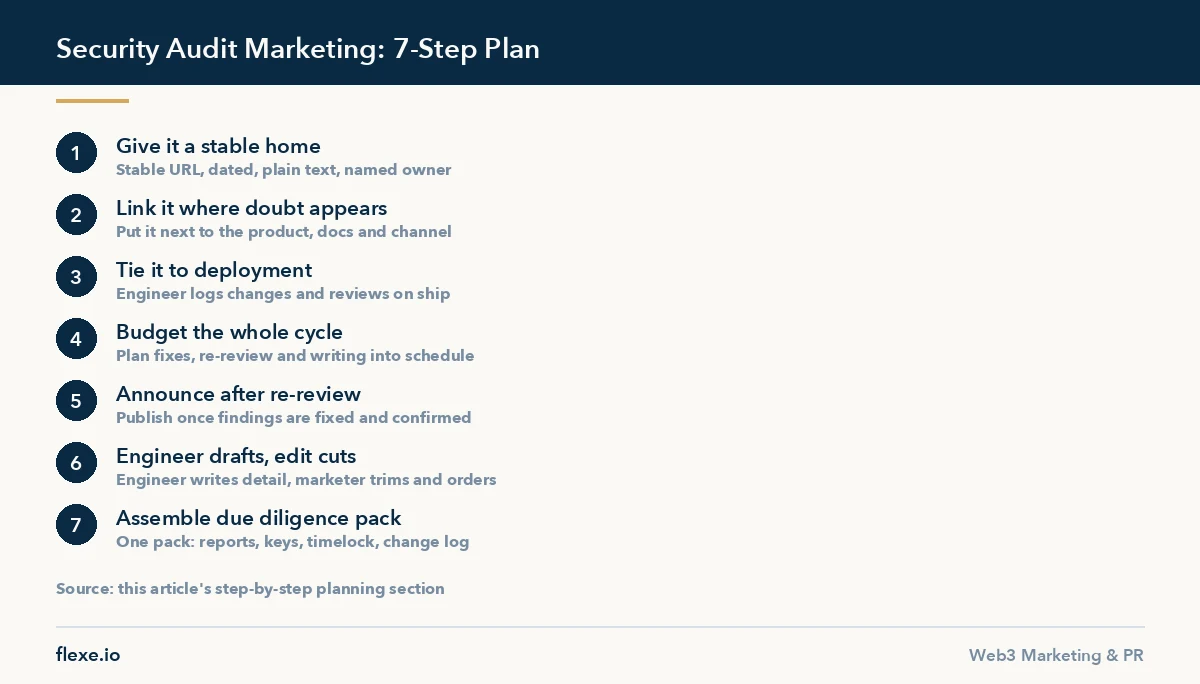
How to plan it step by step
1. Give security material a stable home
Treat it as documentation rather than as a page in the marketing site: a stable URL, a visible last-updated date, plain text that can be read without downloading anything, and an owner whose job includes keeping it current. A PDF attached to a blog post from last year is the format that guarantees nobody checks it.
2. Link it where doubt appears
The page belongs next to the action on the product site, in the documentation, in the pinned material of the community channel and in the partner pack, because the reader who wants it is usually mid-decision and will not go looking through a site menu.
3. Attach updates to the deployment checklist
The page rots the moment a contract ships. The engineer who ships a change also records what changed, which addresses it affects, whether the review covered it and the date. Add a review trigger as well as an owner: any deployment, any change in who holds keys, any new review and any incident forces a read-through. Without a trigger the page is updated when someone remembers, which in practice means when a partner asks for it during due diligence, long after the answer stopped being accurate.
4. Budget the whole cycle, not only the review
Fixing the findings, paying for a re-review, writing the announcement and producing the documentation all take time from the people who are also shipping the product. Plan the announcement into the engineering schedule rather than requesting it the week the report lands, which is exactly when the team is busiest fixing what it found.
5. Announce after the re-review
Publishing that a review is under way tells the market nothing it can act on and commits you to a follow-up you may not want to write. Publishing after the findings are fixed and re-reviewed lets one announcement carry the whole story: what was examined, what surfaced, what changed and what the re-review confirmed.
6. Let the engineer draft and the marketer edit
The first draft belongs to whoever fixed the issue, because the detail that makes the announcement credible is the detail a marketer cannot invent. The marketer then cuts the length, removes internal shorthand, fixes the order of the argument and adds context. The engineer reads it once more before it goes out: accurate first, readable second.
7. Assemble one due diligence pack
Exchanges, custodians and serious investors ask for the same material in a different order. One pack holds the review reports with their dates and scope, the key management summary, the upgrade and timelock policy, the change log and any incident write-ups. Most of it can be public. Hold back only anything naming individuals, describing where hardware lives, or letting a reader reconstruct an internal process.
8. Turn one review into ongoing material
The finding and its fix become a technical write-up, the decision to publish scope becomes a post about how the team works, and the change log becomes an update with each deployment. That fills the quiet period: projects that publish changes as they happen build a record a reader can scroll, instead of announcing loudly and going quiet for months.
When an incident happens to you
The first message matters more than its polish. Say what is known, what has been paused, what users should do right now, and when the next update will come, then publish that update on time even if nothing has changed. Silence during the first hours is filled by other people, and their version is worse. See also crisis response in crypto PR.
- User instructions: if approvals should be revoked, say which ones and link to the interface you recommend.
- Impersonators: warn that support staff will never send a link asking for a signature, and assign someone to report fake accounts.
- Post-mortem: publish the uncomfortable number, since a figure the team states itself is the only version quoted accurately.
- Open decisions: do not promise compensation or attribute the attack early; say when an open question will be resolved.
- Automated marketing: keep a list of the newsletter, scheduled posts, co-marketing and giveaways so one decision stops all of it.
Turning campaigns back on is a deliberate step taken when the write-up is published. A project that publishes what happened, what it cost and what changed has produced the most persuasive document in its security file. Teams that go quiet carry the incident indefinitely, because the only public version belongs to someone else.
Mistakes to avoid
- Displaying a badge with no date, scope or list of later changes.
- Claiming that funds cannot be lost, that the protocol is now safe, or that a category of attack is impossible. These are quoted back after any future incident.
- Publishing security material as a PDF from last year instead of a maintained page.
- Keeping the due diligence pack private, which signals that the answers are uncomfortable.
- Leaving security reports to land in a general support queue.
How to measure results
Measure whether the material stays current and whether it answers questions before they are asked. Describing what was done leaves you with nothing to retract later, so each check below looks at accuracy first.
- Gap between the last contract deployment and the last update of the security page.
- Share of partner due diligence requests answered from the existing pack without new writing.
- Whether each audit announcement states findings, severities and fixes.
- Time from an incident to the first public message, and whether each promised update went out on time.
In crypto security audit marketing, a page that is dated, scoped and current does more work than any badge, because the reader deciding whether to put funds at risk today checks it at that moment, not at the time of the announcement.
Frequently Asked Questions
Does a security audit prevent hacks?
Not on its own. An audit addresses contract logic, which was not the cause of most large 2026 incidents. Three of the four biggest involved no flawed code, and privileged access abuse, such as compromised keys, multisig signer compromise and pre-signed transaction manipulation, has been the leading incident category by count since May.
How much was stolen in crypto in 2026?
DefiLlama counts over $1 billion across 140+ exploits year to date, with 99 incidents in Q2 alone, the highest quarterly count in its database. TRM Labs recorded 207 hacks totalling $972 million in the first half. Incidents grew more frequent while total losses fell, so attacks became more common and less profitable.
What should a project publish besides an audit?
Key management and signing thresholds, the upgrade policy and timelocks, what changed since the audit, the audit scope including exclusions, and post-mortems of any incidents. Keep it on a stable page with a visible last-updated date and an owner, and link it next to the product action rather than only from the footer.
How should an audit result be announced?
With the findings. Stating how many issues were found, at what severity, and how they were resolved and re-reviewed reads as a working process. Announcing only that the protocol is audited reads as marketing. Publish after the fixes are re-reviewed, so one announcement carries the whole story from review to confirmation.
Where should security information appear on a crypto site?
Next to the action, not near the footer. Link the security page from the product site, the documentation, the pinned community material and the partner pack, because the reader who wants it is usually mid-decision. For wallets and custody products, security posture is the acquisition argument, so it belongs early in the funnel.