A crypto bug bounty program is a standing offer to pay outside researchers for reporting vulnerabilities privately, and it works through five levers: a reward scaled to funds at risk, a scope that includes key handling, one intake route with a stated response time, a published severity rubric and safe-harbour language. It is the cheapest security programme a project can run and the one most often designed so that nobody serious participates. The failure is almost always the same: rewards too low to compete with the exploit itself, scope so narrow that the real attack surface is excluded, and a response process slow enough that a researcher gives up before anyone reads the report.
The economics are unforgiving. DefiLlama counts more than $1 billion stolen across 140+ exploits in 2026 alone, with 99 incidents in Q2. A researcher deciding whether to report or to sell compares your bounty against a share of that. A four-figure maximum payout on a protocol holding eight figures is not a programme, it is a notice that reporting is the worse option.
What is a bug bounty program in crypto?
It is a published set of terms: reward tiers by severity, a list of assets in scope, rules for what testing is permitted, one private channel for reports and a stated path to payment. A researcher who finds a flaw reports it through that channel instead of exploiting it or selling it, and the project fixes the bug before anyone else finds it.
The design has to match where losses come from. Privileged access abuse, meaning compromised keys, multisig signer compromise and pre-signed transaction manipulation, has been the leading incident category by count since May 2026. A programme that covers only contract logic excludes the category that causes the most incidents, however generous its rewards look.
Crypto bug bounty program: the key tactics
1. Scale the reward to funds at risk
The critical tier has to be plausibly competitive with exploiting the bug, which means it is set by what the contracts hold, not by what is left in a marketing budget.
- Best for: any protocol, wallet or custody product holding user funds
- Budget: scaled to funds at risk, with the annual pool agreed before publication
- Metric to watch: the number of valid reports arriving per review period
- Watch out: a four-figure maximum on a protocol holding eight figures
2. Put key handling and operational access in scope
If admin compromise is out of scope, the programme covers the wrong thing. Include signer processes, key storage, deployment access and the infrastructure around the contracts, since that is where the leading 2026 incident category sits. Where something is excluded, state the reason, because an unexplained exclusion reads as an attempt to hide the weak part.
- Best for: protocols with admin keys, multisigs or upgradeable contracts
- Metric to watch: which scope items produce findings over the year
3. Offer one way in and a stated response time
A stated response time and a named contact are the minimum. Twenty-four hours to acknowledge is a low bar and most programmes miss it.
- Best for: every programme, from launch day
- Metric to watch: time to first human reply against the promised window
4. Publish the severity rubric before the first report
Deciding severity after receiving the report is how disputes start. A published rubric tells a researcher what a finding is worth before they start. When severity is decided solely by the team, the payout reads as whatever they feel like afterwards.
5. Write safe-harbour language and payment terms up front
Researchers need to know that good-faith testing will not produce a legal letter. Put the compliance requirements in the same terms: the settlement asset, sanctions screening, identity checks above a stated threshold and any tax paperwork. Sprung on a researcher after the fix, those legitimate checks read as an excuse not to pay.
- Best for: programmes that expect reports from anonymous researchers
- Metric to watch: time from validation to payment
6. Turn resolved reports into a public disclosure record
This is where the programme becomes marketing, not only security. It produces the one thing a security page cannot fake: a public record of how the project behaves when someone finds a problem. A resolved report, disclosed with the timeline and the payout, is evidence. A badge is a claim. The audience that reads either of those is the audience worth acquiring, particularly for wallet marketing, custody and anything holding user funds.
It also compounds. Every disclosed and fixed finding adds to a history that a new user can check, which is why projects with a visible disclosure record convert better than those with a clean-looking page and nothing behind it. We handle that publication side as communications work: how we publish security and incident material. The same logic applies to audits, covered in what to publish beyond an audit badge.
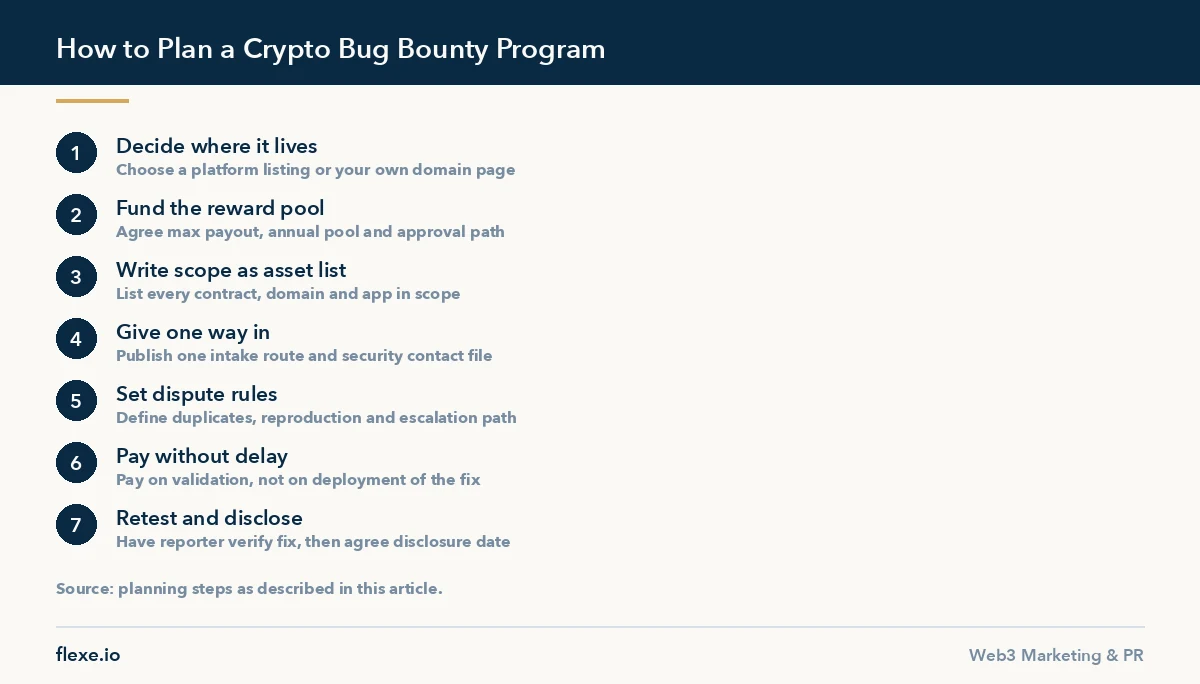
How to plan it step by step
Most of the work happens before a single researcher looks at your code. A programme published without funds behind it, without a scope anyone can act on, and without a person whose job is to answer, fails quietly: reports stop arriving and nobody on the team notices, because the absence of reports looks exactly like the absence of bugs.
1. Decide where the programme lives
A listing on an established platform brings its own audience of researchers and handles intake and identity checks for a fee. A page on your own domain costs nothing and reaches only the people already looking at you.
2. Fund the reward pool first
Agree the maximum payout, the total annual pool and the approval path before publication. The finance question that stalls a payout is always the same one: who signs, and within how long. Answer it in advance, because a researcher waiting three weeks for a treasury signature tells other researchers about the wait.
Decide what happens when the pool is exhausted mid-year. Quietly refusing valid findings once the budget runs out damages the record permanently. Either top the pool up on a stated cadence or publish the cap plainly so nobody spends a week on research against a reward that no longer exists.
3. Write scope as an asset list
List every contract address, repository, domain, application and piece of infrastructure in scope, with the network and version for each. Anything absent will be argued about later. Write the out-of-scope items just as explicitly.
Say what testing is permitted. Mainnet testing, denial of service attempts, social engineering of staff and phishing of other users need explicit rules rather than silence, and most programmes want a testnet deployment or a forked environment used instead.
4. Give researchers one way in
Publish a single intake route, a security contact file on the domain, and a key for encrypted submissions. Reports sent through a support form or community chat get lost invisibly. One address, one inbox, monitored by named people with a rota covering weekends, removes the most common reason a serious finding never reaches an engineer.
Acknowledge receipt automatically and follow it with a human reply inside the window you promised. Route submissions into a private tracker with restricted access rather than a shared engineering board, since unfixed findings are attack material and the researcher’s contact details belong in the same restricted space.
5. Name who reads the report first
Name a rotating triage owner with the authority to pull an engineer in. That person confirms the report is in scope, attempts reproduction, and assigns a provisional severity within the stated window. That first pass cannot wait.
Keep triage separate from the team that wrote the code where you can. Authors tend to classify their own bugs downward, not dishonestly but because they know the mitigations already in place and assume an attacker would too.
6. Set rules for reproduction, duplicates and disputes
Require a proof of concept and state what it has to contain: the steps, the environment and the observable result. Reproduce it yourself before discussing the reward, and record the attempt either way. A finding you cannot reproduce is not automatically invalid; closing it silently is how a researcher ends up posting the bug publicly instead.
Duplicates need a rule written before the first one arrives. Timestamp of first valid submission is the usual answer. Publish the escalation path for disputes: a second reviewer, then an independent one, with the decision and reasoning sent in writing.
7. Pay without a month of email
Pay on a defined trigger, usually validation rather than deployment of the fix, because a patch held for a coordinated release should not hold the reward with it. If the payment has to wait, say why and give a date. Have a position ready for the researcher who will not provide identity documents: a stated threshold below which minimal checks apply, with fuller verification above it, is the compromise most programmes settle on.
8. Retest the fix and agree disclosure
Have the reporter verify the fix wherever the terms allow it. They will find an incomplete patch faster than your own review. Agree the disclosure date at the same time, along with what each side may publish and whether they are credited by name or handle. Write the entry while the detail is fresh, then hold it until the agreed date.
When reports arrive badly
The edge cases are what the programme is actually tested on, so decide each response before it is needed.
- Reported in public: reply publicly and briefly, ask for details in the private channel, and start the internal response at once rather than arguing about the disclosure method.
- Already exploitable in public: the matter becomes an incident, with the pause or key rotation that implies. Decide that threshold in advance, so the person on triage at two in the morning is not inventing it. See how to handle a crypto crisis.
- Deadlines, demands or threats to sell: keep the tone level, keep everything in writing, bring in whoever handles legal, and pay the published amount if the finding is valid. Never negotiate a private figure to buy silence.
- Funds moved during testing: a researcher who drained funds to prove the bug and returned them has broken the terms and delivered value at once. Publish a position on return deadlines and rewards before it happens.
Mistakes to avoid
Five design choices explain most of the programmes researchers ignore. Each looks reasonable from inside the team and reads very differently from outside.
| Design choice | How it reads to a researcher |
|---|---|
| Maximum reward far below funds at risk | Reporting costs more than it pays |
| Admin keys and multisig excluded from scope | The actual 2026 attack surface is off limits |
| No stated response time | The report may sit unread for weeks |
| Severity decided solely by the team | The payout is whatever they feel like afterwards |
| Legal threats in the terms | Participation carries personal risk |
The second row matters most given what actually happened this year: privileged access abuse has led incident counts since May, so a contract-only scope misses the main risk. Beyond the table, these are the process mistakes that cost findings in a crypto bug bounty program:
- Publishing the page without a platform or other distribution, then reading the silence as a lack of bugs.
- Refusing valid findings once the pool runs out instead of stating the cap.
- Letting the authors of the code set the severity of their own bugs.
- Holding the payment until a coordinated release ships the fix.
- Deferring the disclosure write-up until after the release, when it almost never gets written.
How to measure results
Review the whole programme on a fixed cadence: how many reports arrived, how long each stage took against the promised windows, what was paid, and which scope items produced findings. That review is also the argument for next year’s pool.
The public side is measured by the disclosure record. After each resolved report, publish the finding at a level of detail that no longer helps an attacker, the severity, the time from report to fix, and the amount paid. Teams frequently withhold the payout figure, which removes the part researchers use to decide whether to look at you next time. Withholding the timeline is worse, because a slow response is exactly what the record is supposed to prove did not happen.
- Time to acknowledge and time to first human reply, against the promise.
- Time from report to fix, and from validation to payment.
- Share of resolved findings with a published disclosure entry.
- Scope items that produced findings, used to adjust scope next cycle.
A short, factual entry published on schedule does more for the next researcher’s decision than a long one that never ships, and each one adds to the history that makes a crypto bug bounty program worth reporting to.
Bounties and grants draw on the same builder audience, so our guide to crypto grant programs is worth reading alongside this one.
Frequently Asked Questions
How much should a crypto bug bounty pay?
The critical tier should be plausibly competitive with exploiting the bug, which means scaling it to the funds at risk rather than to a marketing budget. A four-figure maximum on a protocol holding eight figures tells researchers that reporting is the worse option, and the serious ones take their findings elsewhere or never look at your code at all.
What should be in scope of a bug bounty?
Key handling and operational access, not only contract logic. Privileged access abuse, such as compromised keys, multisig signer compromise and pre-signed transaction manipulation, has been the leading incident category by count since May 2026. Write scope as an asset list with every contract address, repository, domain and piece of infrastructure, and explain every exclusion.
Does a bug bounty help crypto marketing?
Yes, through the disclosure record rather than the programme itself. A published finding with its severity, timeline and payout is evidence of how the team behaves when someone finds a problem, which a security badge cannot provide. The record compounds, because every fixed and disclosed finding adds history a new user can check.
What should be disclosed after a bug is fixed?
The finding at a level of detail that no longer helps an attacker, the severity, the time from report to fix, and the amount paid. Withholding the payout removes what researchers use to decide whether to look at you next time, and withholding the timeline defeats the purpose, since a fast response is what the record exists to show.
How fast should a project respond to a bug report?
Acknowledge automatically at once and send a human reply within a stated window. Twenty-four hours to acknowledge is a low bar and most programmes miss it. Name a rotating triage owner who confirms scope, attempts reproduction and assigns a provisional severity inside that window, and shorten the promise if the rota cannot cover it.