Crypto wallet marketing is the hardest job in crypto, because a wallet is free, it holds the user’s money, and the people most likely to install one are the least willing to be tracked. The usual acquisition playbook collapses: there is no purchase to optimise, no email captured at signup, and a privacy-minded audience that blocks the measurement you would normally rely on.
What works in crypto wallet marketing instead is placement inside a flow the user is already in, and trust signals that survive scrutiny. Distribution beats persuasion here more clearly than in any other crypto category.
Why does normal acquisition fail in crypto wallet marketing?
| Standard tactic | Why it underperforms for wallets |
|---|---|
| Paid acquisition to an install | The install is free, so cost per install is easy and cost per funded wallet is what matters |
| Retargeting | The audience blocks it more than any other segment, and the platforms restrict crypto retargeting anyway |
| Email nurture | There is no email; the user arrives and remains as an address |
| Feature comparison content | Users choose on trust and habit, not on feature tables |
| Influencer endorsement | Works, but a wallet endorsement carries reputational risk the influencer prices accordingly |
What actually drives wallet installs?
Being the default in someone else’s flow. A wallet integrated into a chain’s onboarding, a marketplace checkout or a game’s first-run experience captures users at the moment they need a wallet and have no opinion about which one. That single placement outperforms most campaigns, and it is a business development motion rather than a marketing one.
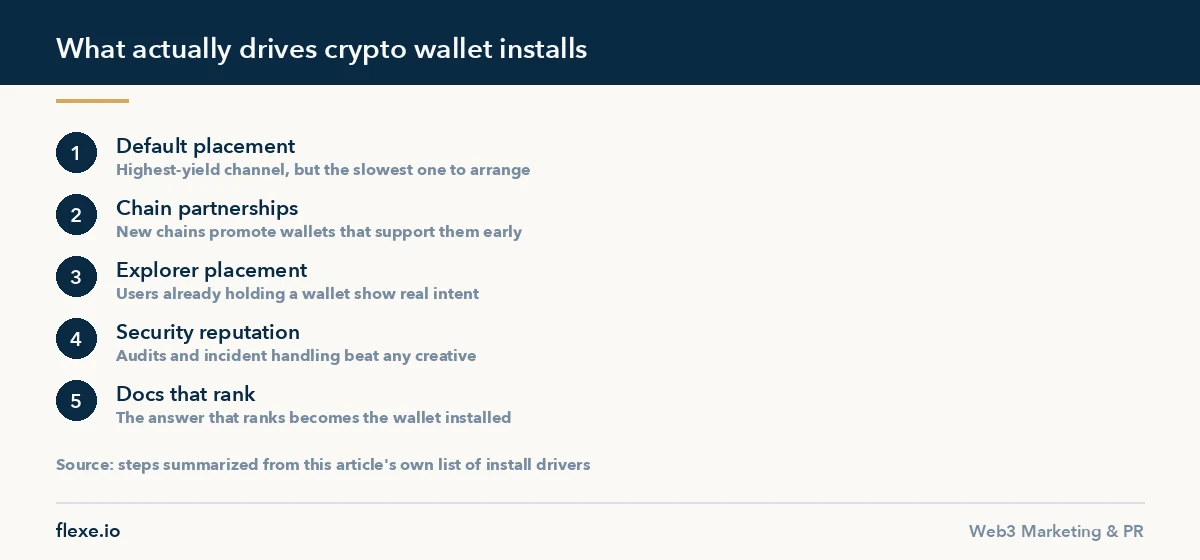
- Integrations and default placement. The highest-yield channel and the slowest to arrange.
- Chain and ecosystem partnerships. New chains need wallets and will promote the ones that support them early.
- Block explorer placement. The visitor already holds a wallet and is inspecting a transaction, which is the closest thing to buying intent this category offers.
- Security reputation. Audits, disclosure history and how a past incident was handled do more for conversion than any creative.
- Documentation that ranks. Wallet questions are searched constantly, and the answer that ranks becomes the wallet that gets installed.
What should crypto wallet marketing measure?
Not installs. The meaningful sequence is install, first connection, first transaction, and funded balance retained at day 30. The gap between install and funded is where the entire economics of a wallet sit, and a campaign optimised to installs will reliably buy the cheapest users at the top of that funnel and none of the ones below it.
Attribution across this path is genuinely partial. The user arrives as a browser session and becomes an address, and no tool joins those two identities cleanly, so plan for a campaign-specific landing path before launch rather than trying to reconstruct the journey afterwards.
How should a wallet handle trust?
By publishing the uncomfortable material rather than the reassuring material. Audit reports, the disclosure timeline for past vulnerabilities, and a plain description of what the team can and cannot access are read carefully by exactly the audience worth acquiring. A marketing page claiming the wallet is secure persuades nobody; a published post-mortem of an incident handled well persuades a great many.
The same logic covers impersonation, which is the largest ongoing threat to a wallet brand. A stated, repeated rule that support never messages first, combined with fast takedowns, protects the brand more than any campaign builds it.
If the gap between install and funded is the problem: how we grow wallet installs.
Getting into someone else’s onboarding
Default placement is won in conversations, not campaigns, and the conversation is easier than most teams expect because the other side has a problem you solve. A new chain needs a wallet its users can install on day one, a marketplace needs checkout that does not lose buyers, a game needs a first run that works for people who have never held an address. Arrive with that framing rather than with an audience pitch.
Who to approach and when
Chains before mainnet, applications before their public launch, and infrastructure providers whose documentation already names competitors. Timing decides the answer: integration is a development decision, and once it is made and shipped, replacing it is work nobody wants. Being early and slightly unfinished usually beats being polished and late by a quarter.
Approach the people who build, not the people who market. Developer relations, the engineer who owns onboarding, and the technical founder decide which wallet gets wired in, and they evaluate documentation and support responsiveness rather than brand. A working example they can run in an afternoon does more than any deck, and it is the artefact worth investing in before outreach starts.
Bring a named engineer to the first technical conversation and keep them attached to the account afterwards. Integration questions are answered in hours or the partner moves on, and a support channel where the wallet team replies the same day is frequently the whole reason one wallet is chosen over another with identical features.
What a placement deal contains
Write down what appears where, how the user reaches it, which party handles support for the joint flow, and what happens if either side changes the interface. Placement that quietly disappears in a redesign is the usual failure, so include notice of interface changes and a named contact on each side. Where money changes hands, tie it to something observable rather than to promotion in the abstract.
Decide how joint users are counted before launch and make sure both parties can see the same figures. Partners renew on evidence, and the argument at renewal is almost always about whose number is correct rather than about whether the integration helped. One shared definition of an active joint user, agreed in writing early, removes that argument entirely.
Shipping the integration without breaking trust
Test the flow yourself as a new user with an empty device, in the markets you intend to promote it in, on the hardware your audience actually uses. Integrations ship with broken deep links, an install step that loops, and recovery copy written for people who already understand keys. Every one of those turns a hard-won placement into a stream of users who fail at the first step and blame the wallet.
Write the recovery and permission wording jointly with the partner, since the user cannot tell whose interface they are in. A prompt asking for signing permission phrased casually inside a partner flow teaches exactly the habit that drainers rely on. The wording that protects your users protects their users too, which makes it an easy thing to insist on.
A crypto wallet marketing measurement stack
Build the measurement before the campaign rather than after it, because the parts of this funnel that cannot be reconstructed later are the parts that matter. Decide what counts as a real user, which events record that, and where those events are stored, then accept that the picture will be incomplete and read it honestly rather than filling gaps with assumptions.
Events that are worth instrumenting
Instrument the install, the first successful connection, the first signed transaction, the first incoming funds, and the state of the balance thirty days later. Those events describe an actual user. Everything above them describes interest. Record them with the acquisition source attached at the moment they happen, because attaching a source retrospectively is the step that fails.
Add the failure events as well: the abandoned onboarding, the failed recovery, the connection that timed out, the transaction rejected at signing. Those tell you where the funnel leaks and they arrive long before the retention figures do. A wallet that fixes one of the common failure points usually gains more than a campaign of equivalent cost would have bought.
Agree what you will not collect and publish that alongside what you do collect. A wallet audience reads the privacy page before the feature list, and a measurement setup you would rather not describe in public is one you should not be running. The restriction is also useful internally, because it settles the recurring argument about adding one more tracker to answer one more question.
Reading address data honestly
On-chain activity is visible, which tempts teams into reading more from it than it supports. One person routinely holds several addresses, one address can be shared, and a burst of new addresses during an incentive period is not a burst of new users. Keep a stated rule for what you will and will not infer, and apply it to your own reporting first.
Resist the urge to profile users from their on-chain history for targeting. Beyond the privacy question, the audience you are trying to reach is unusually alert to it, and a wallet discovered doing that loses the trust its entire proposition depends on. What is fair game is aggregate behaviour in your own product, with the retention consequences it exposes.
Reporting to people who fund it
Report the funded and retained number and show the install figure beside it as context rather than as the headline. Anyone funding growth will optimise whatever is presented first, and presenting installs guarantees pressure to buy more of the cheapest ones. The comparison that makes the case is cost per retained funded user across sources, tracked over enough weeks to be real.
Include the integrations in the same report even though their numbers arrive slowly and unevenly. A placement negotiated this quarter may deliver nothing measurable for months and then carry the year, and leaving it out of the reporting is how the slowest and highest yielding channel gets cut in favour of activity that shows up faster.
Support, impersonation and brand defence
For a wallet the support channel is the product surface where trust is won or lost, and it is also the surface attackers copy. Treating impersonation as an ongoing operational task rather than as an occasional nuisance is the difference between a brand people trust with funds and one they have learned to approach cautiously.
Give the community a way to verify official channels that does not depend on a search result, such as a signed list on your own domain linked from inside the application. Then repeat where that list lives, often enough that users check it by habit. Most successful impersonation works because nobody could remember which account was real, not because the fake was convincing.
Takedowns as a standing process
Monitor for fake applications in the stores, lookalike domains, sponsored search results against your own name, and copied community channels. Keep the registrar, store and platform reporting routes documented with the evidence each one requires, so a takedown is a form to fill rather than a research project. Speed matters more than thoroughness here, since most of the damage happens in the first day.
Record every case with the date and the outcome. The pattern shows you which channel the impersonators favour and where your own users are being intercepted, and the file is what you hand to a platform when asking for faster handling. It also answers the question a partner will eventually ask about how you deal with this.
Decide in advance how much support can do and make sure every member of the team knows it precisely. Support staff who can be talked into looking at a seed phrase, or who reply to a direct message they did not start, are the gap attackers work on hardest. The rule that the team never writes first has to hold inside the team before it means anything to users.
Answering security questions in public
Answer in the open, in full, including the parts that are inconvenient. What the team can access, what happens if the company disappears, how recovery works and what a compromised device means for the user are the questions that decide installs, and a vague answer is read as a bad one. Publish the answers where they can be linked and refer people to them rather than retyping them.
Keep the same wording everywhere, because inconsistency between the documentation, a support reply and a community answer reads as evasion even when every version is true. Review the page whenever the product changes, since a security claim that used to be accurate is worse than one that was never made.
What to do after an incident
Publish the account before anyone else summarises it, explain what users need to check on their own side, and state plainly whether anything is required of them. Then keep the page updated as the picture fills in. The wallets that came through incidents with their user base intact are the ones that treated the write-up as the main deliverable rather than as an afterthought.
Expect a period afterwards where every prompt and permission request is read suspiciously, and use it. Shipping the clearer signing screen and the better recovery flow in the weeks after an incident is when users actually notice the change, and it converts the event into the thing the next security question gets answered with.
Frequently Asked Questions
Why is marketing a crypto wallet harder than other products?
The product is free, so there is no purchase to optimise; there is no email address because users arrive as wallets; and the audience blocks tracking more than any other segment. Growth comes from distribution and trust rather than persuasion.
What is the best channel for wallet growth?
Integration into someone else’s flow, where the user needs a wallet and has no preference yet. Chain onboarding, marketplace checkout and game first-run placements outperform most direct campaigns.
What should a wallet measure instead of installs?
First connection, first transaction, and funded balance retained at day 30. The gap between install and funded is where a wallet’s economics live, and install-optimised campaigns buy only the top of that funnel.
How does a wallet build trust?
By publishing audits, disclosure timelines and honest post-mortems, and by stating plainly what the team can and cannot access. Published incident handling persuades the target audience far more than security claims do.