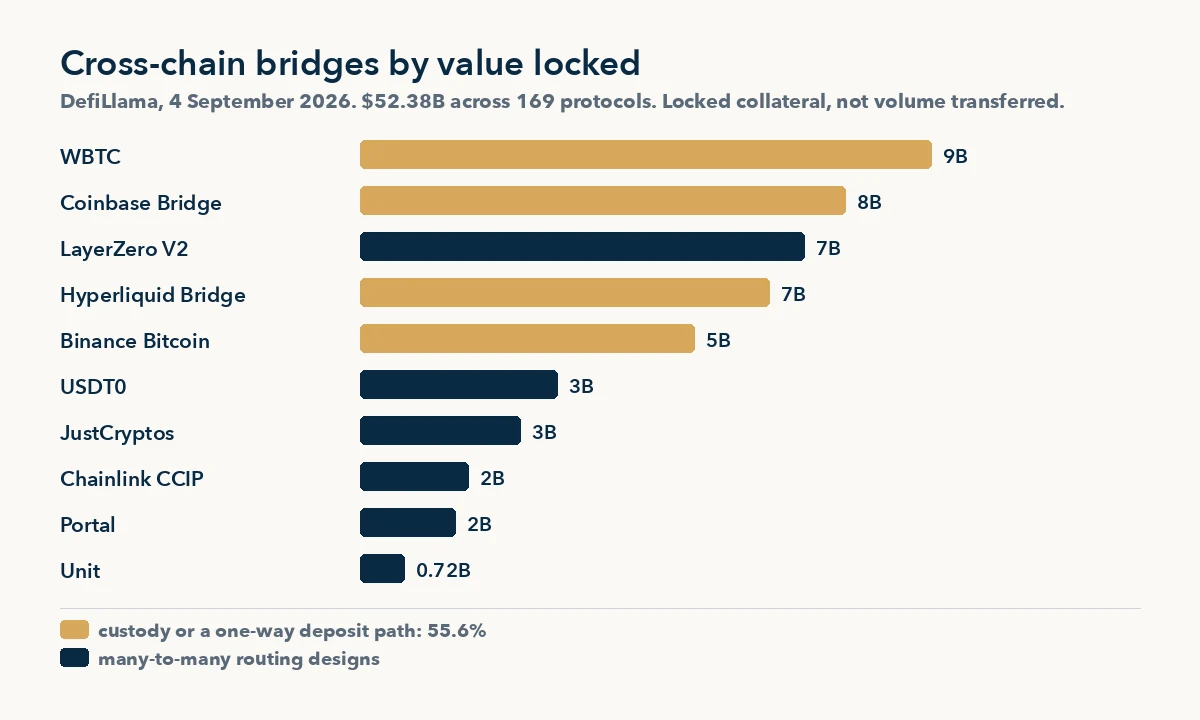
The best cross-chain bridge in 2026 by locked value is WBTC ($9.24 billion of custodied bitcoin), followed by Coinbase Bridge ($7.85 billion), LayerZero V2 ($7.18 billion across 91 chains), Hyperliquid Bridge ($6.62 billion) and Binance Bitcoin ($5.41 billion). The figures come from DefiLlama’s bridge category on 4 September 2026, which covers 169 protocols and $52.38 billion, and they measure value locked rather than value moved. Chainlink CCIP, the name most published rankings put first, is eighth at $1.75 billion.
What are cross-chain bridges
A cross-chain bridge lets an asset that exists on one blockchain be used on another. In most designs, assets sit on one side and back claims issued on the other, so the locked collateral is exactly what is at stake if the bridge fails.
The word covers very different products. Some are custodians that hold bitcoin and issue a token against it, some are deposit paths into a single destination, and some are messaging networks that connect dozens of chains. The ten largest hold $46.10 billion, 88% of the category, and half of them are not bridges in the usual sense.
The best cross-chain bridge ranking for 2026, by locked value
Each entry gives locked value, share of the $52.38 billion category and the number of chains the tracker lists. Locked value is collateral held, not volume transferred, so it tells you how much sits behind a design rather than how much traffic it carries.
1. WBTC (custodied bitcoin, 1 chain)
WBTC is the largest entry and appears on none of the published 2026 rankings. It is a custodian: someone holds bitcoin and issues a token against it, and nothing routes anywhere.
- Locked value: $9.24B
- Share: 17.6%
- Best for: bringing bitcoin into markets that accept WBTC
- Watch out: you are trusting a custodian, not a protocol
2. Coinbase Bridge (exchange deposits, 5 chains)
Coinbase Bridge is an exchange-operated deposit path rather than a network connecting many chains. It holds the second-largest pool of collateral in the category.
- Locked value: $7.85B
- Share: 15.0%
- Best for: users moving funds between Coinbase and the chains it supports
- Watch out: an exchange sits in the trust path
3. LayerZero V2 (messaging layer, 91 chains)
LayerZero V2 is third by size and first by reach by a wide margin. It is the one entry where breadth and capital coincide, and the largest of the genuinely many-to-many designs.
- Locked value: $7.18B
- Share: 13.7%
- Chains: 91
- Best for: moving assets between many chains through one messaging layer
- Watch out: the security model depends on how each application configures it
4. Hyperliquid Bridge (deposits into one L1, 2 chains)
Hyperliquid Bridge is a deposit path into a single destination. It exists to fund one chain rather than to connect many, and it holds the fourth-largest share of collateral.
- Locked value: $6.62B
- Share: 12.6%
- Best for: funding a Hyperliquid account
- Watch out: a one-way door, not a general route
5. Binance Bitcoin (custodied bitcoin, 1 chain)
Binance Bitcoin is the second custodian of bitcoin in the top five. Like WBTC, it is a claim on bitcoin held by someone else, and it is not interchangeable with other wrappers.
- Locked value: $5.41B
- Share: 10.3%
- Best for: venues and markets that accept this wrapper
- Watch out: exchange custody sits behind every token
6. USDT0 (stablecoin transfer layer, 1 chain)
USDT0 is a transfer layer for a stablecoin rather than a general bridge. Its size reflects how much of cross-chain activity is simply moving dollars to where they can be used.
- Locked value: $3.20B
- Share: 6.1%
- Best for: moving USDT between supported chains
- Watch out: check that the version you receive is the one your venue accepts
7. JustCryptos (wrapped assets on Tron, 1 chain)
JustCryptos issues wrapped assets on Tron. It is another single-chain entry, which fits the wider pattern: six of the ten largest sit on one or two chains.
- Locked value: $2.59B
- Share: 4.9%
- Best for: users who need wrapped assets inside Tron
- Watch out: depth for the wrapped token outside Tron may be thin
8. Chainlink CCIP (oracle-verified messaging, 21 chains)
Chainlink CCIP is the security-first option in every published ranking and holds about a fifth of what the largest custodian does.
- Locked value: $1.75B
- Share: 3.3%
- Chains: 21
- Best for: teams that weight verification over cost
- Watch out: not every route is equally used or maintained
9. Portal (Wormhole-based wrapped assets, 24 chains)
Portal issues Wormhole-based wrapped assets across 24 chains, which makes it the second-widest design in the top ten after LayerZero V2.
- Locked value: $1.54B
- Share: 2.9%
- Chains: 24
- Best for: moving tokens to chains the larger designs do not reach
- Watch out: the wrapped token you receive may have little depth on arrival
10. Unit (deposits, 5 chains)
Unit closes the top ten as a deposit design across five chains. Just below the table, Function FBTC adds to the bitcoin total that dominates the category.
- Locked value: $0.72B
- Share: 1.4%
- Chains: 5
- Watch out: a small pool, so test the route at your size
| Bridge | Locked value | Share | Chains | What it locks |
|---|---|---|---|---|
| WBTC | $9.24B | 17.6% | 1 | Custodied bitcoin |
| Coinbase Bridge | $7.85B | 15.0% | 5 | Exchange-operated deposits |
| LayerZero V2 | $7.18B | 13.7% | 91 | Messaging layer collateral |
| Hyperliquid Bridge | $6.62B | 12.6% | 2 | Deposits into one L1 |
| Binance Bitcoin | $5.41B | 10.3% | 1 | Custodied bitcoin |
| USDT0 | $3.20B | 6.1% | 1 | Stablecoin transfer layer |
| JustCryptos | $2.59B | 4.9% | 1 | Wrapped assets on Tron |
| Chainlink CCIP | $1.75B | 3.3% | 21 | Messaging with oracle verification |
| Portal | $1.54B | 2.9% | 24 | Wormhole-based wrapped assets |
| Unit | $0.72B | 1.4% | 5 | Deposits |
If you run a project here, not just research one: Bridge volume follows the assets that are worth bridging. Getting your token listed and tracked on both sides of the route does more for flow than promoting the bridge itself. exchange listing support.
Best cross-chain bridge by use case
Locked value ranks one architecture, so the practical question is what you are moving. Here is how the bridges above map to common use cases.
- Highest security for large transfers: Chainlink CCIP, the security-first option in every published ranking, with oracle verification across 21 chains. No public figure measures assurance, so send a small test first and cap each transfer.
- Fast, cheap transfers between L2s: our source has no speed or fee data, so we do not name a winner. Compare quotes for your route on the day.
- Stablecoins and native assets: USDT0 for moving USDT between supported chains. For bitcoin, WBTC or Binance Bitcoin, both custodians and not interchangeable.
- Solana and non-EVM chains: the tracker data we used does not name Solana routes, so we do not rank them. The widest reach here is LayerZero V2 at 91 chains and Portal at 24; JustCryptos serves Tron.
- Many chains through one layer: LayerZero V2, the only design where breadth and capital coincide.
- Intent-based swaps: Across and Stargate. A solver fills your order from inventory on the destination and rebalances later, so they move volume while locking little.
- Aggregators: when the question is the best route today rather than the biggest bridge, routing matters more than locked value. See our ranking of DEX aggregators by routed volume.
How cross-chain bridges work
Every bridge answers one question: who guarantees that the asset on the destination is backed by something on the origin? The designs in this table fall into a small number of patterns.
- Lock and mint: an asset is locked or custodied on one side and a token is issued against it on the other. WBTC and Binance Bitcoin are the pure form.
- Deposit paths: funds go into one destination rather than a network. Coinbase Bridge, Hyperliquid Bridge and Unit work this way.
- Liquidity networks and intents: a solver fills your order from inventory on the destination and rebalances later. Across and Stargate hold little at any moment by design, which is why locked value misses them.
- Messaging: a message layer carries instructions between chains and applications mint or release assets on arrival. LayerZero V2, Chainlink CCIP and Portal are messaging designs.
Read the security model in one sentence before you use a route: who could take the funds, and who has to stay honest. A custodian, a multisig of validators, an oracle network and a set of independent relayers are different answers, and honest documentation states which it is.
Custodial vs many-to-many bridges: which should you choose
WBTC, Binance Bitcoin, Coinbase Bridge and Hyperliquid Bridge together hold $29.12 billion, 55.6% of the category. The genuinely many-to-many designs, LayerZero V2 at 91 chains, Portal at 24 and CCIP at 21, hold $10.46 billion, or 20.0%. So four fifths of what the word bridge covers in this table is custody or a one-way door.
Choose by the transfer, not the brand. Getting bitcoin into a smart contract ecosystem means accepting a custodian. Funding one destination is a deposit path. Moving an arbitrary asset between arbitrary chains is the many-to-many case. Before looking at any ranking, write down four things, which eliminate most options on their own:
- the origin chain
- the destination chain
- the asset
- the amount
Price the return trip too, since a route that works one way can be slow or absent going back. If the question is how to get an asset across today, routing matters more than locked value, and we ranked those venues in our comparison of cross-chain DEX venues. Depth on the far side is covered in the list of the top 30 decentralized exchanges and the ranking of stablecoins by supply.
Bridge hacks and safety checks
The largest historical losses in crypto happened at exactly this layer, and locked value measures how much would be exposed rather than how well it is defended. A large bridge is a large target. These are the checks we run before moving anything across chains.
Verify the address and the interface
Get the contract address and the interface URL from the project’s own documentation rather than from a search result or a chat message, then confirm the address on an explorer before approving anything.
Check what you receive on arrival
The asset that lands is often not the asset you sent. Wrapped versions of the same token differ by issuer, and a wrapper with no depth on the destination leaves you holding something you cannot sell without bridging back. Bitcoin is the clearest case, since several separate wrappers appear in this table and they are not interchangeable.
Send a small test first
Run a small amount through the exact route and wait for it to arrive and be usable, not merely confirmed. Then send the real amount through the same path. Keep the transaction hash on both sides, the time each step took and the fee paid, because any support conversation will ask for them.
When a transfer stalls
Messages get sent but not delivered, relayers need a manual claim, routes get paused, or an amount sits outside a limit nobody displayed. Most of these end with funds arriving late rather than gone. Never repeat a transfer that has not failed: check the destination chain, then the bridge explorer, then the status channel, and keep some gas on the destination.
Limit what sits in transit
Set a cap on how much you move in a single transfer and hold to it regardless of the fee saving from batching. Re-check routes you already use, since a pause, a change of operator, a new wrapper or a migration to a new version is a warning, and an old deployment can stay reachable through a bookmark.
Market trends in 2026
- Bitcoin is the dominant bridged asset. WBTC, Binance Bitcoin and Function FBTC hold $15.33 billion between them.
- Custody outweighs routing. Four custodial or one-way designs hold 55.6% of the category, against 20.0% for many-to-many networks.
- Chain count and capital move in opposite directions. Six of the ten largest sit on one or two chains, and LayerZero V2 is the only exception at scale.
- Rankings and collateral disagree. Across and Stargate appear in 2026 rankings but hold little by design, while WBTC appears in none.
For teams, the practical work is making the asset usable at the destination: get the wrapped version recognised by trackers and venues on that chain, and publish the contract address where users can verify it.
How this ranking was built
Order comes from collateral currently held, as reported by DefiLlama in its bridge category on 4 September 2026, covering 169 protocols and $52.38 billion. For a bridge, that number is what is at stake: the assets sitting on one side backing claims issued on the other.
It is not throughput, so intent-based designs score low by construction and two of the five bridges named in 2026 rankings do not appear at all. A best cross-chain bridge list built on locked value is a ranking of one architecture rather than of the whole category, and it says nothing about security.
Frequently Asked Questions
What is the best cross-chain bridge in 2026?
By locked value, WBTC, with $9.24 billion of custodied bitcoin on 4 September 2026, or 17.6% of the category. Coinbase Bridge follows at $7.85 billion and LayerZero V2 at $7.18 billion. For moving arbitrary assets between many chains, the relevant designs are LayerZero V2, Portal and Chainlink CCIP.
Why is Chainlink CCIP only eighth?
Because locked value measures adoption of a design, not its assurance. CCIP holds $1.75 billion across 21 chains, about a fifth of the largest custodian. Published rankings name it first for security, which is a different property and one no public figure in this table captures.
Why are Across and Stargate not on the list?
Because their design does not hold much collateral. Intent-based bridges fill an order from inventory and rebalance afterwards, so they move large volume while locking little at any moment. Ranking them against custodial designs on locked value would compare two different things, so we left them out rather than misplacing them.
Are cross-chain bridges safe?
Not by default. The largest historical losses in crypto happened at the bridge layer, and locked value measures how much would be exposed rather than how well it is defended. Check who holds the keys, take the contract address from official documentation, and send a small test before the full amount.
How much of the bridge market is actually custody?
More than half. WBTC, Binance Bitcoin, Coinbase Bridge and Hyperliquid Bridge together hold $29.12 billion, 55.6% of the category, and none of them routes between many chains. The many-to-many designs, LayerZero V2, Portal and CCIP, hold $10.46 billion between them, or 20.0%.
Related reading
For the routers that move assets across these bridges, see our ranking of DEX aggregators by routed volume.