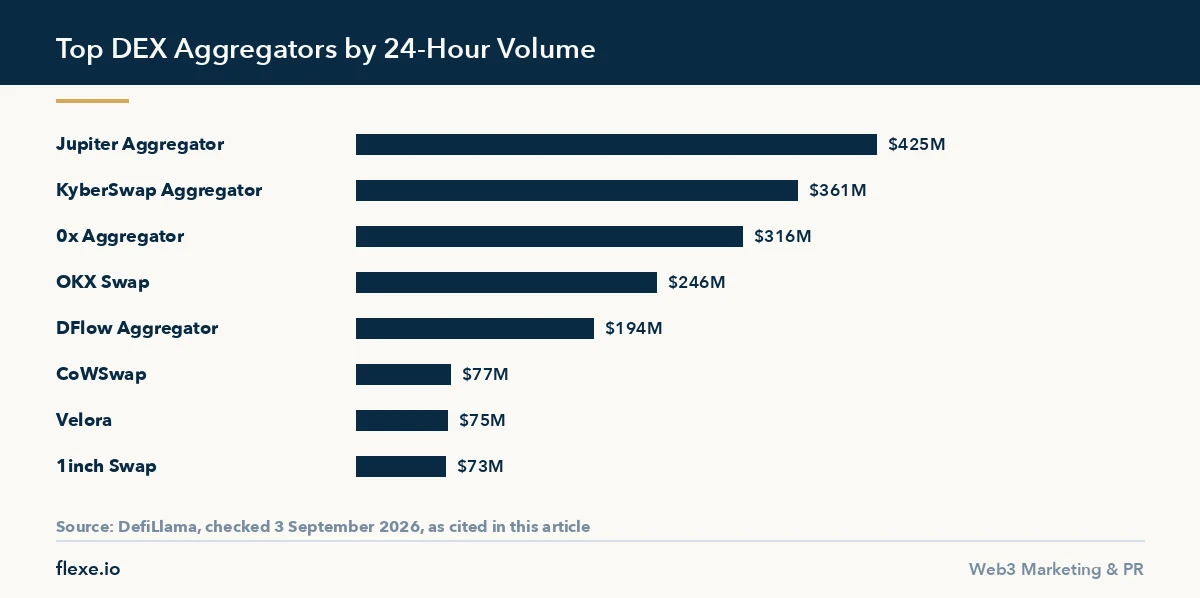
DEX aggregators route roughly $2.29 billion a day across 168 tracked protocols, and nine of them, the best DEX aggregators by volume, handle most of that flow. An aggregator holds no liquidity of its own: it splits a single order across the venues that already have it and returns one quote. That is why this ranking looks nothing like a ranking of exchanges, and why the chain count matters more than headline volume if you trade across networks. Figures from DefiLlama, checked 3 September 2026.
| Aggregator | 24h volume | 30d volume | Chains | What sets it apart |
|---|---|---|---|---|
| Jupiter Aggregator | $425M | $14,098M | 1 | Solana only |
| KyberSwap Aggregator | $361M | $6,695M | 24 | Widest chain coverage |
| 0x Aggregator | $316M | $6,500M | 33 | API-first, powers other front ends |
| OKX Swap | $246M | $7,018M | 35 | Wallet-embedded router |
| DFlow Aggregator | $194M | $6,870M | 1 | Solana only, order-flow model |
| CoWSwap | $77M | $3,059M | 8 | Batch auctions, MEV protection |
| Velora | $75M | $1,356M | 9 | Formerly ParaSwap |
| 1inch Swap | $73M | $2,932M | 14 | Fusion mode, resolver auctions |
| Binance Wallet | $47M | $3,023M | 12 | Wallet-embedded router |
How this best DEX aggregators ranking was built
Every figure comes from DefiLlama’s aggregator category on 3 September 2026, ranked by 24-hour routed volume. Thirty-day volume sits beside it because a single day can be distorted by one large mint or one liquidation cascade, and the two columns disagreeing is itself information. Chain counts are the networks each router supports at that date, not the networks it advertises on a roadmap. Routers that exist only inside a single wallet are included, because their volume is real even though it is not chosen deliberately.
If you run a project here, not just research one: Aggregator routing follows liquidity, so a new pool is invisible until there is depth to route into. That is a market-making problem before it is a marketing one, and we run both sides. crypto market making.
What the table says that the order does not
Three readings matter more than the ranking itself.
- The leader is a single-chain product. Jupiter routes more than anyone else and supports one network. Its lead is a statement about Solana activity rather than about routing quality, and it tells you nothing about performance on a chain it does not serve.
- Three of the nine are wallet-embedded. OKX Swap, Binance Wallet and, in practice, much of DFlow’s flow arrive from inside an application. That volume was never a choice between aggregators, so it says little about which router a trader would pick on the open market.
- Chain coverage and volume move in opposite directions. The two widest routers by network count, 0x with 33 and OKX Swap with 35, sit below a single-chain router on daily volume. Breadth is bought at the cost of depth on any one network.
- Daily and monthly volume disagree sharply in one case. DFlow shows $194M in a day against $6,870M in a month, a ratio far above the rest of the group, which points to concentrated order flow rather than steady retail routing.
Which of the best DEX aggregators fits which trader
- Trading on Solana only. Jupiter, on depth. A router serving 30 chains has no advantage on a network where it holds a fraction of the flow.
- Trading across many networks. KyberSwap at 24 chains or 0x at 33. Count the chains you actually use rather than the total, because an unused network adds nothing.
- Moving size and worried about being front-run. CoWSwap. Batch auctions settle orders together rather than one by one, which removes the ordering that extraction depends on.
- Building a swap into a product. 0x. It is API-first and already powers other front ends, so the integration path is the product rather than an afterthought.
- Wanting a resolver market rather than a fixed route. 1inch in Fusion mode, where resolvers compete to fill the order instead of the router picking a path outright.
What this ranking leaves out
Routed volume measures flow, not execution quality. It does not show the price a specific trade received against the best available route, and no public dataset does that consistently across nine routers. It also excludes gas: a router that finds a better price on a chain with higher fees can still leave a smaller order worse off. Finally, the 168 tracked protocols beneath the top nine include specialised routers that beat all of them inside a narrow pair. If you trade one pair repeatedly, test it directly rather than trusting the aggregate.
How to test the best DEX aggregators yourself
Published volume cannot tell you what a specific trade will receive, so test the routers against each other on the pair and the size you actually trade. Open the same order in each interface within a few minutes of one another, record the quoted output, then record what lands in the wallet after the transaction confirms. The second number is the only one worth keeping, because the first is a promise and the second is a result.
Size the test to your real order rather than to a token amount that is convenient. Routing advantages appear and disappear with size: a split across venues that wins on a large order can lose on a small one once the extra gas is counted, which is the same reason the ranking above warns against reading volume as execution quality. Repeat the test at a quiet hour and at a busy one, because depth and fees both move.
Reading a quote before you sign it
Expand the route breakdown before approving anything. Count the hops, because each hop adds a venue whose depth you have not checked and a fee you may not have noticed. Confirm the token address on the receive side matches the one the chain’s main liquidity uses, since a correct-looking ticker backed by a thin wrapper is the expensive mistake here. Check the minimum received figure rather than the headline quote.
Read the approval the wallet is asking for, not only the swap. Many interfaces request an unlimited allowance by default so the next trade needs one signature instead of two, which is convenient until the contract holding that allowance has a bad day. Set the allowance to the amount of the trade when the interface permits it, and use the wallet’s simulation preview to see the expected balance changes before signing.
Settings that change the fill
Slippage tolerance is the setting that costs people money silently. A default set wide enough to make every trade succeed is also wide enough to let a poor fill through on a volatile pair. Tighten it until trades occasionally fail, then loosen it by one step. A failed transaction costs gas; a filled transaction at an acceptable slippage costs the difference between the price you assumed and the price you got.
The transaction deadline matters on congested chains. A long deadline lets a transaction sit in the pool while the market moves away from the quote that produced it, and it executes anyway when it finally lands. Where the interface offers batch settlement or a resolver auction instead of a direct route, understand that you are trading immediacy for protection, and that a quiet market can make the wait longer than the saving.
Building a repeatable test log
Keep a simple log with one row per trade: date, pair, size, router, quoted output, received output, gas paid on both the approval and the swap, and whether the transaction reverted. Twenty rows is enough to see a pattern that no ranking can give you, because it is measured on your pairs at your sizes. Without the log every comparison becomes an argument about which screenshot was taken first.
Review the log on a schedule rather than after a bad trade. Routers change fee models, add networks and lose liquidity partners, and a router that was consistently better last quarter can quietly stop being so. The habit worth building is re-testing the two routers you actually use on the pair you trade most, rather than re-reading a table of aggregate volume and assuming it describes your order.
Watch for the difference between a router performing badly and a market being thin. When several routers quote poorly on the same pair at the same moment, the problem is depth rather than routing, and waiting is usually cheaper than paying the spread twice in order to switch. Note the hour in the log, because a pair that is reliably thin at the same time of day is a scheduling problem you can solve for nothing.
What goes wrong on a routed swap
The common failures are dull and avoidable. A trade reverts because the price moved past the slippage tolerance, because the approval never confirmed, or because gas was priced for a calmer block than the one it landed in. Each of those costs gas without moving the position, and each has a different fix, so read the failure rather than resubmitting immediately with every setting loosened at once.
When a swap reverts or lands short
Open the transaction in a block explorer and read the revert reason before doing anything else. A minimum-output failure means the quote aged out and the trade should be re-quoted rather than forced through with wider tolerance. A failure on the approval step means nothing was traded at all. Resubmitting blindly while the first attempt is still pending is how one failed trade becomes two.
Landing short is different from failing, and it is worse, because nothing alerts you. If the received amount sits far below the quote, check whether the route passed through a pool with little depth and whether the receive token is the version the chain’s liquidity actually uses. Fix the route for next time; unwinding a bad fill usually costs more than the fill did.
Approvals and the tokens left behind
Audit allowances periodically and revoke the ones you no longer need, particularly unlimited approvals granted to routers you tested once and abandoned. An allowance survives long after the trade it was granted for, and it is only as safe as the contract holding it. The review takes a few minutes per chain and removes a class of loss that no amount of careful quoting protects against.
Sweep the leftovers as well. Testing routers produces dust balances, half-wrapped positions and native gas stranded on chains you no longer use, and each of those is a small distraction the next time you trade under pressure. Consolidate them while the market is quiet rather than discovering them mid-trade, and note which chain holds the gas you would need to move in a hurry.
Choosing a router for a live product
If a swap is being built into a product rather than used by hand, the questions change. Quote latency, uptime during volatile hours, error messages that a support agent can act on, and whether failures are reported clearly enough for you to reproduce them matter more than a few basis points on a quote. Test the integration during a busy period, because that is when your users will meet it.
Instrument the swap before launching it. Log the quote, the settings used and the settled result for every trade so support requests can be answered from data instead of from memory, and so a degradation in fills is visible before users report it. Keep a second router wired in behind a flag, because the cost of switching during an outage is far higher than the cost of building the switch beforehand.
Decide in advance what the product does when no acceptable quote comes back. Showing a stale price, retrying silently, or failing with a generic error each teach the user something different, and the least damaging option is usually an explicit message naming the reason and suggesting a smaller size. Write that behaviour into the specification rather than leaving it to whatever the integration happens to do by default.
Frequently Asked Questions
Is an aggregator always cheaper than trading on one DEX?
No. Splitting an order across venues adds gas for each leg, so on a small trade the saving on price can be smaller than the extra cost of executing it. Aggregators earn their keep on larger orders and on pairs where liquidity is genuinely fragmented.
Does higher routed volume mean better prices?
Not by itself. Volume shows how much flow a router receives, and three of the top nine receive it from inside a wallet rather than from traders comparing quotes. Depth on the chain and pair you trade decides the price you get.
What is a cross-chain aggregator?
One that quotes and settles across more than one network in a single flow, usually by combining a swap with a bridge. Chain count in the table above is the practical measure: 0x covers 33 networks and OKX Swap 35, while two of the largest routers by volume serve one network each.
How often do these figures change?
Daily volume moves constantly and the order of the top nine can change within a week. The thirty-day column is the more stable of the two. This table was checked on 3 September 2026 and should be re-checked against DefiLlama before it is used in a decision.
Do aggregators protect against MEV?
Some do by design. CoWSwap settles orders in batches so there is no ordering to exploit, and 1inch Fusion hands filling to competing resolvers. The rest reduce exposure only as far as the underlying venues and the transaction path allow.
Related reading
The full picture on venues sits in our list of the top 30 decentralized exchanges, which covers spot volume, chains and categories. Routers that carry a trade from one chain to another are ranked separately in the eight largest cross-chain DEX venues. For how these protocols acquire users, see DeFi marketing by protocol type and how exchanges build traffic. If you are choosing which network to target first, audience size by chain explorer has the numbers.
Before trading through any router, check how to choose a reliable DEX, and compare centralized venues in the top rated crypto exchanges ranked by trust score. For yield and settlement assets, see the best liquid staking protocols and the biggest stablecoins by circulating supply. Projects listing a token should read what a crypto market maker does and costs and how to verify a token contract on every chain.