Finding new crypto audiences in 2026 means working eight venues that already hold them: Telegram (over 1 billion active users), Discord (90 million daily actives), X, YouTube (2.65 billion monthly ad reach), TikTok (2.21 billion), Reddit, Bluesky (over 43 million accounts) and the chain explorers, where Solscan alone draws 3.9 million visits a month. Every platform figure below was read from that platform’s own page or official report on 20 September 2026; the explorer figures are Similarweb estimates for July 2026; the campaign figures are our own records.
Each venue holds a different kind of person and needs a different first message. Below: the sizing method, the cheap pilot, the scale signals, and the mistakes that burn a budget.
Key takeaways
- Chain explorers are the most reliable audience proxy available, because everyone who transacts eventually visits one and the traffic is hard to inflate.
- Audience size differs by an order of magnitude between chains. Solscan and Polygonscan are not the same opportunity.
- Young networks are cheaper to reach and harder to measure. Budget for the measurement, not just the placement.
- Test with one channel and one message. A network that does not respond to a small test will not respond to a larger one.
- The audience you can buy is not the audience you want. Segment by behaviour, not by chain logo or platform logo.
- Across our last 150 campaigns the median net return was 2.8x inside 90 days, with a disclosed failure rate of 12 percent.
Finding new crypto audiences in 2026: where they actually are
The eight venues below are ordered by how fast a project can get a first reading out of them. Sizes are each platform’s own published numbers, read on 20 September 2026. Where a platform publishes nothing, that is said plainly.
1. Telegram: the default crypto venue
Telegram states on its own FAQ that it is one of the top five most downloaded apps with over 1 billion active users. Crypto sits near the top of it: the Binance announcement channel showed 3,442,505 subscribers on its public page on 20 September 2026.
- Best for: token launches, announcement reach, trading communities and support. A channel costs nothing to open; paid posts are priced per post.
- Watch out: subscriber counts are the easiest number in crypto to manufacture. Read view counts per post instead.
2. Discord: where builders and holders stay
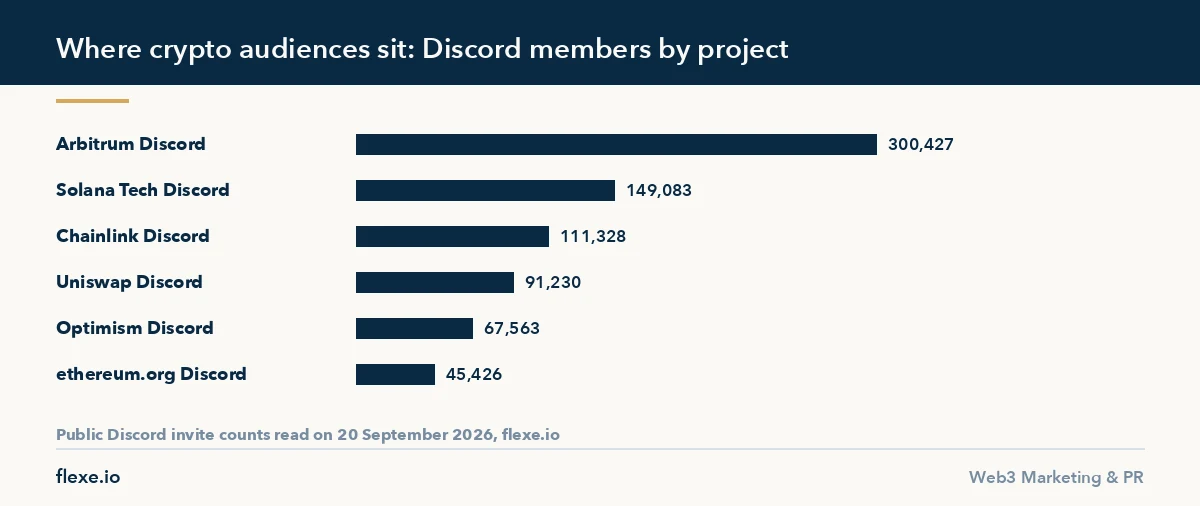
Discord reports 90M+ daily active users as of Q4 2025 on its company page. Crypto servers there are mid-sized and durable rather than huge. Reading Discord’s public invite counts on 20 September 2026 gave Arbitrum 300,427 members, Solana Tech 149,083, Chainlink Official 111,328, Uniswap 91,230, Optimism 67,563 and ethereum.org 45,426.
- Best for: developer relations, testnet cohorts and governance. Free to open, expensive to staff; community management with us starts at $2,000 a month.
- Watch out: members are not readers. On those same servers the live presence counts sat between roughly 2,000 and 8,000.
3. X: still the price discovery feed
X publishes no current audience figure, so size it through the accounts that matter rather than the platform total. Our own base holds 11,859 crypto key opinion leaders on X, all with 5,000 followers or more, and an active roster of 85 verified accounts reaching 8.7 million followers at 1.74 percent engagement.
- Best for: launch timing, narrative and reaching traders inside the hour. A focused single-channel campaign with us starts at $4,000.
- Watch out: engagement on paid crypto posts decays within a day. See the channel-by-channel view in our guide to crypto influencer channels.
4. YouTube and TikTok: the explanation layer
DataReportal’s April 2026 figures put YouTube advertising reach at 2.65 billion and TikTok at 2.21 billion. Neither is a crypto audience, but both are where a person goes after hearing a token name. Our base holds 11,695 crypto and finance YouTubers, all with 5,000 followers or more.
- Best for: product explanation, tutorials and non-English markets. Higher per placement than Telegram, with a much longer tail.
- Watch out: production time. A video placement rarely goes live inside a launch week.
5. Reddit: search traffic that outlives the post
Reddit blocks automated reads of subreddit member counts, so we took no number from it on 20 September 2026 and will not quote one. Its value is different anyway: crypto threads keep pulling search traffic for months, which makes Reddit the one venue where a single post keeps working after the campaign ends.
- Best for: durable search visibility and objection handling. The cost is time; paid promotion is tolerated poorly by crypto subreddits.
- Watch out: moderation. A promotional post removed at hour two teaches nothing.
6. Bluesky, Farcaster and Lens: small and high signal
Bluesky’s own Series B post of 19 March 2026 says the network has grown from 13 million to over 43 million global users since October 2024. Farcaster and Lens publish no official account totals we could read on 20 September 2026, so every figure circulating for them is a third-party estimate.
- Best for: reaching developers, founders and crypto-native early users. Cost of entry is the lowest here, because paid inventory barely exists.
- Watch out: the ceiling. These networks validate a message but rarely fill a funnel on their own.
7. Twitch and regional platforms
Live streaming and regional messengers hold audiences that English-language crypto marketing misses: Telegram dominates in the CIS, Turkey and much of MENA, while Korea, Japan and Indonesia run on their own messengers. None publish a crypto-specific audience figure, so size them with a paid test rather than a spreadsheet.
- Best for: exchange listings aimed at one country and localised community growth. Low media cost, real translation and moderation cost.
- Watch out: compliance. Promotion rules for tokens differ sharply by country.
8. Chain explorers: the audience nobody counts
Explorers are the only venue here where every visitor has already transacted, which makes them the cleanest first test on a young chain. Placement inventory by chain and publication is listed on our Web3 ads page.
How to size a crypto audience before you spend
Finding new crypto audiences starts with one number that is hard to fake, and on a chain that number is explorer traffic. Every active user reaches the explorer eventually, so it is a usable proxy for how many people transact and how often. The spread between chains is wide enough to change a plan entirely. As of July 2026, monthly visits ran roughly as follows.
| Explorer | Chain | Monthly visits | What it implies |
|---|---|---|---|
| Solscan | Solana | 3.9M | Large retail base, high activity |
| Etherscan | Ethereum | 3.4M | Deepest capital, most competition |
| BscScan | BNB Chain | 2.3M | High volume, price-sensitive audience |
| BaseScan | Base | 918K | Growing, less saturated |
| Polygonscan | Polygon | 759K | Application-led rather than trading-led |
Read these as relative, not absolute. A campaign that works on Base at 918,000 monthly explorer visits does not need a fifth of Solana’s budget; it needs a different message, because the population is at a different stage.
Then cut the platform number twice. First by topic: only a fraction of any general platform cares about crypto. Second by reachability: only a fraction of that sits inside channels, servers or creator audiences you can buy. What survives both cuts is the number worth planning against, and on a young network it is usually in the tens of thousands.
Segment by what people do, not by which chain they hold. A trader on Solana has more in common with a trader on BNB Chain than with an NFT collector on Solana, and a campaign built on the chain logo addresses both as if they were the same person.
The segments that behave distinctly in paid crypto acquisition are tokens and trading, blockchain infrastructure, NFTs, crypto media readers, crypto tools and wallets, and mobile applications. Each responds to a different promise: traders to liquidity and fees, infrastructure users to reliability and documentation, collectors to scarcity and provenance.
How to test a new network cheaply
Run one channel with one message for a defined window, and decide in advance what result would justify a second round. Testing several channels at once on a small budget produces inconclusive results rather than one clear answer.
A focused single-channel campaign with us starts at $4,000 and community management at $2,000 a month, which is the practical floor for a test that reads as a number rather than noise. A pilot needs at least one full weekly cycle, because crypto activity swings sharply by day, and two to four weeks is where a result stops moving.
Explorer placement is usually the cleanest first test on a new chain, because the audience is unambiguous. If a message does not work there, it will not work in the chain’s media either.
Set the measurement before the spend. Track cost per qualified visit, wallet connects, channel joins, and reply rate on the paid posts. On young networks attribution is thinner, and campaigns that were never instrumented produce arguments rather than conclusions.
Be honest about the base rate. Across our last 150 campaigns the median net return was 2.8x within 90 days, in a range of 1.4x to 7.0x, with a disclosed failure rate of 12 percent. Finding new crypto audiences is a search process with a real miss rate, and a pilot budget should be sized as money you can lose without changing the plan.
Signals that a network is worth scaling
A pilot answers one question: does this venue produce people who behave like the ones you already keep?
- Cost per qualified action falls as spend rises. If it rises at once, the reachable pocket was smaller than the platform number suggested.
- Conversation continues after the placement ends. Unpaid replies and reposts are the only cheap growth on any network.
- Day 30 retention matches your existing channels. Cheap traffic that leaves costs more than dear traffic that stays.
- A second creator or channel reproduces the first result. One good placement is luck; two is a channel.
- The venue produces product questions, not price questions. Product questions come from users; price questions come from traders passing through.
Two readings say stop: flat conversion across a doubled budget, and engagement concentrated in a handful of accounts you can name by hand.
Networks compared by audience type and cost of entry
| Network | Audience type | Published size, read 20 September 2026 | Cost of entry | Best first test |
|---|---|---|---|---|
| Telegram | Traders and launch followers | Over 1 billion active users | Low, priced per post | One paid post in a mid-size channel |
| Discord | Builders and governance voters | 90M+ daily active users | Low media, high staffing | A hosted AMA in one partner server |
| X | Traders, founders, media | No current official figure | From $4,000 per campaign | Five roster accounts, one message |
| YouTube | Researchers, later buyers | 2.65 billion ad reach | High per placement, long tail | One review with a named creator |
| TikTok | New retail, non-English | 2.21 billion ad reach | Medium, high volume needed | A short-form batch in one language |
| Researchers, sceptics | Not published openly | Time rather than money | An answer thread in one subreddit | |
| Bluesky | Developers, early users | Over 43 million users | Lowest, little paid inventory | Founder posting for four weeks |
| Chain explorers | People mid-transaction | 759K to 3.9M monthly visits | Medium, fixed placements | A banner on the chain’s own explorer |
Common mistakes when picking a new network
- Treating a chain or a platform as an audience. That produces messaging which speaks to nobody in particular.
- Using follower counts to size an opportunity. Follower counts are the easiest number in crypto to manufacture; view counts, presence counts and explorer traffic are not.
- Applying an established chain’s playbook to a young one. The media layer it depends on does not yet exist, so the sequence stalls at step two.
- Buying reach on a network the project has no product reason to be on. That produces traffic which bounces.
- Running the pilot without instrumentation. An uninstrumented test on a thin-attribution network buys an expensive opinion.
Nothing here is financial advice. Explorer traffic figures are third-party Similarweb estimates for July 2026 and change month to month. Platform figures are each platform’s own published numbers, read on 20 September 2026.
Related reading: crypto influencer marketing for roster selection, crypto community management for server staffing costs, and DeFi marketing strategy for how paid acquisition sits alongside community and PR. For turning a new audience into followers who stay, see how to build a crypto brand on social media.
Testing a new network? Send the brief on Telegram at https://t.me/flexe_io_agency and we will reply with a channel mix and a measurement plan within 24 hours.
Frequently Asked Questions
Where are new crypto audiences in 2026?
They sit in eight venues: Telegram, Discord, X, YouTube, TikTok, Reddit, Bluesky and the chain explorers. Telegram states over 1 billion active users and Discord reports 90 million daily actives, but the reachable pocket inside each is far smaller. Size the pocket you can actually buy, not the platform total, before any budget is committed.
Are emerging networks cheaper to advertise on?
Usually yes, because fewer advertisers compete for the same inventory. The trade is that measurement is thinner and the ceiling is lower, so the same spend reaches a larger share of a smaller population. Budget for the measurement work as well as the placement, or the saving disappears into an unreadable result.
How do you know if a network audience is real?
Compare the published total against something harder to fake. On a chain, compare explorer traffic with on-chain active addresses; on a channel or server, compare subscriber counts with per-post views or live presence counts. A venue reporting large membership with little visible activity is describing automation rather than people.
How much does a test on a new network cost?
A focused single-channel campaign with us starts at $4,000, and community management starts at $2,000 a month. Below that the result is usually too small to read. Across our last 150 campaigns the median net return was 2.8x within 90 days, with a disclosed failure rate of 12 percent, so treat pilot money as money you can lose.
How long should a test on a new network run?
Long enough to cover a full weekly cycle at minimum, since crypto activity varies sharply by day. Anything shorter measures the day rather than the network. Two to four weeks is the range where cost per qualified action stops moving, which is the point at which the reading can be trusted enough to scale or stop.
Should a project launch on the chain with the biggest audience?
Only if the product belongs there. Audience size is the last consideration after technical fit and cost, because a large audience on the wrong chain converts worse than a small audience on the right one. Solscan at 3.9 million monthly visits is not an argument for Solana if the product needs something Solana does not offer.