The best cross-chain DEX aggregators in 2026, ranked by thirty-day routed volume, are LI.FI ($1.40B across 63 networks), SOCKET Protocol ($1.35B), Silentswap ($1.21B), Jumper ($1.04B) and THORChain ($1.03B, the largest that settles natively without an outside bridge). Chainflip, Rango, Bitget Wallet X and 0x each routed more than $300 million as well. Every figure on this page was read from the DefiLlama API on 20 September 2026.
What a cross-chain DEX is, and how one works
A cross-chain venue takes an asset on one blockchain and returns a different asset on another blockchain in a single user action. A multi-chain venue is the same contract deployed separately on several networks, where every trade still settles inside one of them. Uniswap V3 sits in the second group: it is live on 44 networks and moved $36.78B in thirty days, yet no single trade crosses a chain boundary, which is also true of the forks built on its code. That distinction removes most of the names that published lists carry.
Underneath, four settlement mechanisms do the actual work, and the one your route picked decides what you are trusting.
| Mechanism | What actually moves | What you trust | Typical venue |
|---|---|---|---|
| Lock and mint | Asset locked on chain A, a wrapped claim minted on chain B | The custodian or validator set holding the locked asset | Classic token bridges inside a router path |
| Liquidity network | Nothing crosses: pre-funded pools pay out on the far side | Pool solvency and the relayer set | Stargate V2, Across |
| Native vault settlement | Real assets in protocol vaults, native asset delivered | The venue’s own validator set and vault economics | THORChain, Chainflip |
| Intent based | You sign a desired outcome, a solver fronts the capital | The solver network and the settlement contract | Solver routes inside aggregators |
Only native vault settlement removes the extra bridge from the path; everything else adds one more party between your signature and your funds.
Cross-chain DEX aggregators compared, ranked by thirty-day volume
The cut-off is $300 million of routed volume over thirty days. Seven names come from DefiLlama’s bridge aggregator category, which on 20 September 2026 held $147.93M in 24-hour volume and $6.42B over thirty days across 28 protocols. THORChain and Chainflip sit in the DEX category instead, because they settle on a chain of their own. We did not compare quotes, fill rates or slippage. Volume shows how much flow a venue attracts, not how well it prices your trade. For venues that settle inside one chain, see our list of the top 30 decentralized exchanges.
1. LI.FI (routing API, 63 networks)
The largest routing stack in the category. This row is volume reaching the API from other applications, because its own interface is counted separately as Jumper.
- 30-day volume: $1.40B
- 24-hour volume: $25.06M
- Best for: teams embedding swaps in a wallet or app
- Watch out: the bridge inside your route is chosen for you
2. SOCKET Protocol (routing layer, 31 networks)
Almost all of this flow arrives from inside other products rather than from a front end of its own, and it grew 15.22% week over week while the category fell.
- 30-day volume: $1.35B
- 24-hour volume: $18.39M
- Best for: embedded routing with a wide EVM reach
- Watch out: DefiLlama lists no audit for it
3. Silentswap (privacy router, 1 network listed)
Third by volume and the strangest row in the table: attributed to a single chain, with no audit listed, and up 1,243.16% over the month while falling 51.82% week over week.
- 30-day volume: $1.21B
- 24-hour volume: $30.46M
- Best for: nothing we would put client funds through
- Watch out: reported volume, no audit, one chain, violent swings
4. Jumper (consumer front end, 65 networks)
LI.FI’s own interface, and the widest network list of any venue here. It quotes one all-in price and hides the bridge, which is the flow with the fewest ways to strand funds.
- 30-day volume: $1.04B
- 24-hour volume: $17.81M
- Best for: a person making one swap by hand
- Watch out: down 32.81% month over month
5. THORChain (native settlement, own chain)
The largest venue that holds real assets and delivers the native token on the far side, with no wrapper and no third-party bridge in the path. It settles Bitcoin against EVM assets directly.
- 30-day volume: $1.03B
- TVL: $58.58M in protocol vaults, three audits listed
- Best for: native BTC in and out of EVM assets
- Watch out: 13 connected networks, so the asset list is short
6. Chainflip (native settlement, just-in-time AMM)
The same idea on a smaller asset list: its own chain, native deposits, and market makers quoting into each swap rather than a static pool.
- 30-day volume: $444.97M
- TVL: $11.59M, two audits listed
- Best for: native swaps on a short list of major assets
- Watch out: few networks, so long-tail tokens are out of reach
7. Rango (bridge and DEX aggregator, 45 networks)
Splits one order across several bridges and pools, which finds fills that a single venue reports as unavailable. It is the practical answer for assets nobody else routes.
- 30-day volume: $432.76M
- 24-hour volume: $11.28M
- Best for: long-tail and game tokens across many chains
- Watch out: a split route inherits every bridge it touches
8. Bitget Wallet X (router inside a wallet, 36 networks)
Volume that arrives from inside a wallet, so this flow was never a choice between venues. It grew 10.88% week over week.
- 30-day volume: $427.89M
- 24-hour volume: $17.31M
- Best for: people already holding that wallet
- Watch out: you are not comparing quotes, you are taking one
One more venue clears the cut-off: 0x’s bridge aggregator at $379.77M over thirty days across 22 networks, up 1,259.44% in a month and 45.70% week over week, the fastest mover in the set. Below the line, OpenSea sits at $125.33M, Rubic at $115.26M across 84 networks, Bungee at $34.48M and DZap at $6.03M across 77, which shows how weakly network count tracks volume.
| Venue | 30d volume | 24h volume | Networks | How it settles |
|---|---|---|---|---|
| LI.FI | $1.40B | $25.06M | 63 | Routing API over third-party bridges |
| SOCKET Protocol | $1.35B | $18.39M | 31 | Routing layer embedded in other apps |
| Silentswap | $1.21B | $30.46M | 1 listed | Privacy router, no audit listed |
| Jumper | $1.04B | $17.81M | 65 | Consumer front end running on LI.FI routing |
| THORChain | $1.03B | $27.39M | 13 | Own chain, native assets in protocol vaults |
| Chainflip | $444.97M | $8.60M | Own chain | Just-in-time AMM, native deposits |
| Rango | $432.76M | $11.28M | 45 | Aggregates bridges and DEXs into one route |
| Bitget Wallet X | $427.89M | $17.31M | 36 | Router built into a wallet |
| 0x Bridge Aggregator | $379.77M | $24.31M | 22 | Routing API, fastest growth in the set |
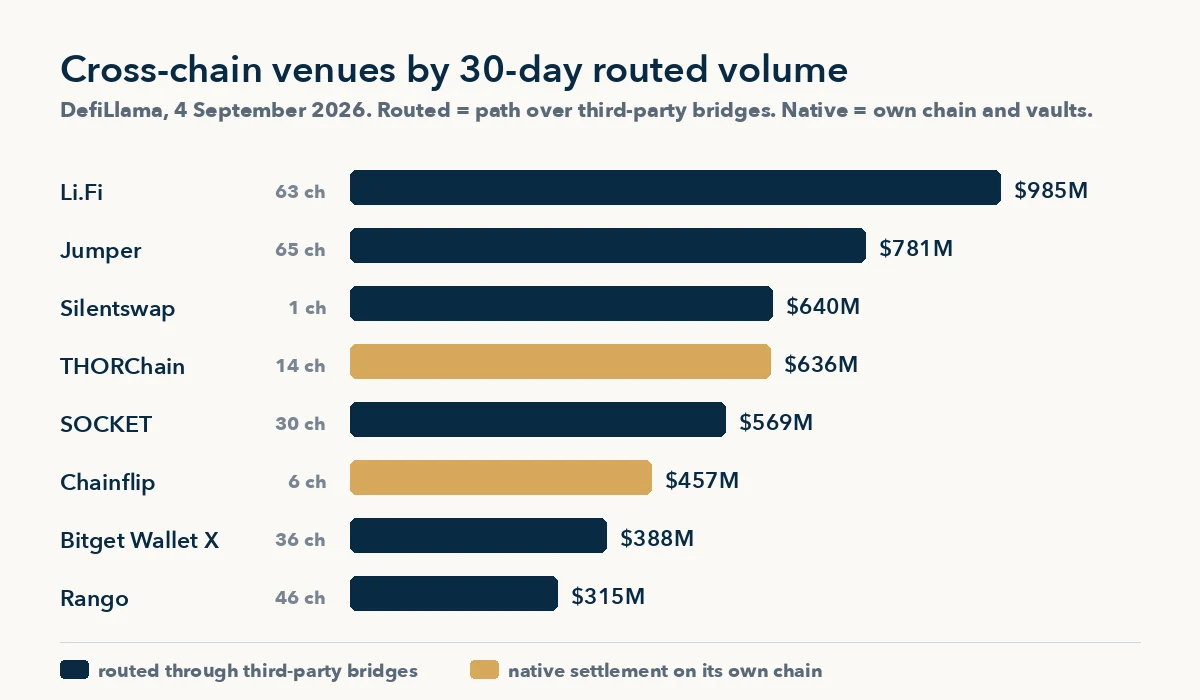
Two readings of this table matter more than the order. LI.FI and Jumper are one stack, not two competitors, and together they hold 37.98% of the category. The top five names hold 84.74% of the $6.42B, so this is a concentrated market that reads as a crowded one. And the category as a whole moved 2.10% of what single-chain DEXs settled over the same thirty days, $6.42B against $304.96B.
Two of the cross-chain DEX aggregators above, THORChain and Chainflip, settle natively and hold their own liquidity, so they carry no outside bridge risk. The rest route through third-party pools, which is why the venue you pick decides who holds your funds mid-swap.
Cross-chain liquidity: who provides it, and which solutions hold capital
Ranking venues by volume hides the fact that most of them own no liquidity at all. DefiLlama reports no TVL for LI.FI, Jumper, SOCKET, Rango, Bitget Wallet X or Silentswap, because a router holds nothing: it reads pools other people funded and picks a path through them. The capital sits one layer down.
- Routers and aggregators: no pooled capital, no TVL reported, revenue from routing fees. They are distribution, not depth.
- Liquidity networks: pre-funded pools on both chains. Stargate V2 holds $140.35M of TVL, Across $20.30M and Symbiosis $8.08M, checked 20 September 2026.
- Native vault venues: THORChain at $58.58M, Chainflip at $11.59M and Maya Protocol at $6.48M hold real assets and carry their own validator risk.
- Market makers and solvers: they quote into intent based routes and hold inventory on both sides, which is why a thin destination pool still fills at a sane price.
- Your own pools: for a token team, the only liquidity solution that changes anything is depth on the destination chain, because routers cannot route to a pool that does not exist.
If you run a project here, not just research one: Cross-chain flow goes to whoever has depth on both sides of the route. If your pools are thin on the destination chain, the aggregators will not send you flow no matter how the venue is marketed. crypto market making.
Bridging altcoins in one transaction: what to check first
A single-transaction bridge and swap is standard on every router in the table above, and the failures are almost never the routing itself. They are the token you ended up holding and the gas you did not have. Six checks before you sign.
- Canonical contract: wrapped and bridged versions of the same asset live side by side on most chains. Confirm the destination address against the issuer, not against a search box.
- Reach before brand: Jumper lists 65 networks, LI.FI 63, Rango 45 and Rubic 84, yet Rubic moved $115.26M against LI.FI’s $1.40B. A long network list is not depth.
- Gas on arrival: you need the destination chain’s native token to move the asset afterwards. Routes that drop a small gas amount with the swap save a second rescue transaction.
- One transaction, not two: any flow that asks you to bridge first and swap afterwards is where funds get stranded on the wrong network.
- Game and long-tail tokens: these usually exist on one chain with a shallow pool. An aggregator that splits the order across several sources, such as Rango, prices them better than a single venue, and single-chain aggregators handle the last leg once you are on the right network.
- Test size first: send a small amount, confirm it lands as the right contract, then send the rest. It costs one extra fee and removes the only irreversible mistake in the flow.
Fees and slippage on a cross-chain swap
Four costs stack up in one quote, and only the combined figure is worth comparing: gas on the source chain, the bridge or protocol fee, gas on the destination chain, and price impact in the pool that pays you out. A venue that advertises the lowest protocol fee can still deliver the smallest amount, because the route it picked crossed an expensive chain or a thin pool.
Risks and the bridge exploits on record
DefiLlama’s hack dataset, read on 20 September 2026, records 92 incidents flagged as bridge hacks for $3.68B in total losses, of which 42 incidents and $743.13M fall in 2026 alone. The techniques cluster: 14 bridge logic flaws, 11 forged proofs, 7 unbacked cross-chain mints, 7 compromised validator key sets and 5 cases of cross-chain message spoofing. Across every incident where a key was compromised rather than code broken, the total is $978.71M from 14 events, which says the operational side fails about as often as the contracts do.
The most recent large one is verifiable at the source. Blockstream’s own status page records that roughly 4,000 BTC, about $320 million, was withdrawn from the Liquid Federation wallet through a peg-out authorization key in September 2026, with peg operations still suspended during the recovery as of 10 September 2026. It was not a DEX failure, it was a cross-chain peg failure, which is exactly the layer a router hides from you. Two practical rules follow: prefer native settlement when the asset pair allows it, and read which bridge your route selected before signing, using our guide to the bridges those routes run on to see who runs it.
Frequently Asked Questions
What is a cross-chain DEX and how is it different from a single-chain venue?
A single-chain decentralized exchange settles a trade inside one blockchain, so both tokens must already live on that network. A cross-chain venue accepts an asset on one chain and delivers an asset on another, using a bridge, a pre-funded liquidity network or protocol vaults to coordinate settlement. You inherit the security assumptions of whichever mechanism sits underneath the route you were quoted.
Which cross-chain DEX has the largest volume?
LI.FI, with $1.40B routed over the thirty days to 20 September 2026 and $25.06M in the last day. Its own consumer front end Jumper is counted separately at $1.04B, so the shared routing stack behind both moved $2.44B, which is 37.98% of the whole bridge aggregator category. Among venues that settle natively, THORChain leads at $1.03B.
What are the best cross-chain liquidity solutions?
It depends on which side of the trade you are on. Traders get depth from pre-funded liquidity networks such as Stargate V2, which holds $140.35M of TVL, and from native vault venues like THORChain at $58.58M. Projects get depth by funding pools on every chain they want reachable, because routers only find liquidity that already exists.
Can you bridge an altcoin and swap it in one transaction?
Yes, on any router that quotes a single all-in price. Rango reaches 45 networks and LI.FI 63, and both build one transaction that bridges and swaps in sequence. Check the destination contract is the canonical one, keep a gas balance on the receiving chain, and avoid flows that ask you to bridge first and swap afterwards.
What does a cross-chain swap cost?
Gas on the source chain, the bridge or protocol fee, gas on the destination chain, and price impact in the destination pool. No venue is cheapest on every pair. The only number worth comparing is the all-in amount the quote says will land in your wallet, because the fee attached to the route changes with the pair and the hour.
How do you list a token on a cross-chain router?
Routers do not list tokens. They read pools that already exist, so the work is funding liquidity on each chain you want reachable and getting the canonical contract into the token lists routers read. Native venues differ: THORChain and Chainflip both admit assets by governance, and their asset lists are short.