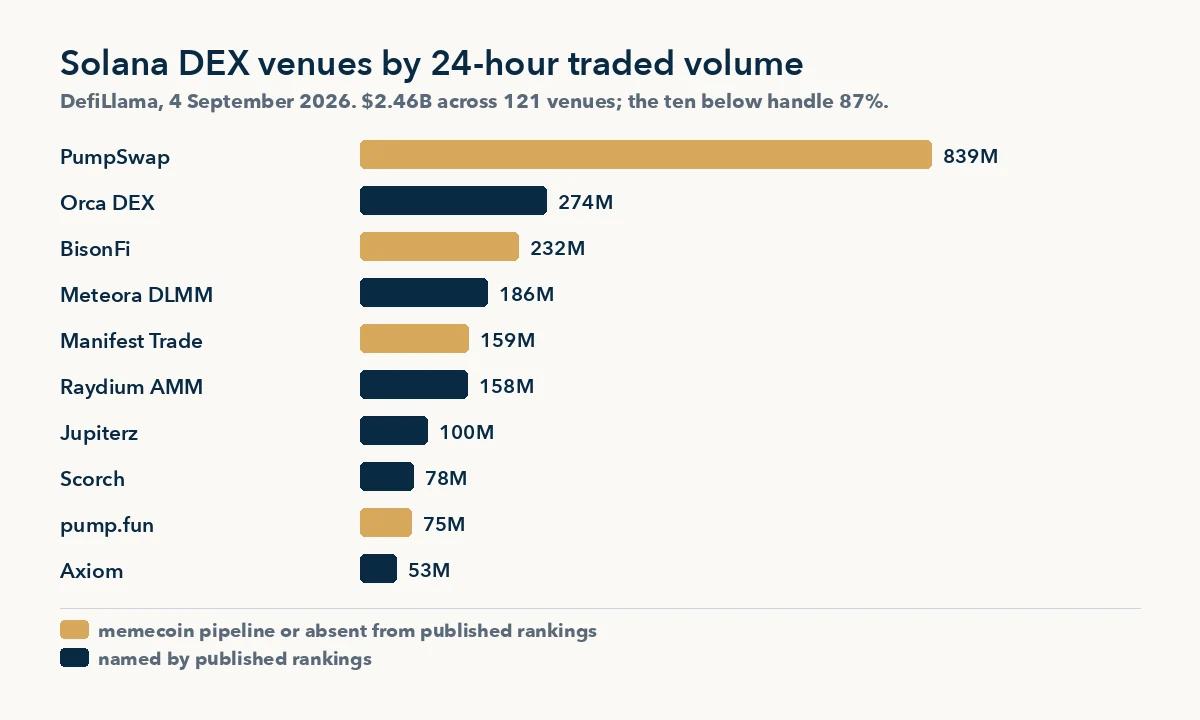
The best Solana DEX by traded volume in 2026 is PumpSwap ($838.7M in 24 hours, 34.1% of network volume), followed by Orca ($274.0M, concentrated liquidity), BisonFi ($232.5M), Meteora DLMM ($186.5M) and Manifest Trade ($158.7M, order book), with Raydium sixth at $158.1M. Figures are from DefiLlama’s Solana DEX category for the 24 hours to 4 September 2026, when 121 venues traded $2.46 billion and the ten largest handled $2.15 billion, or 87% of it.
What are Solana DEXs
A Solana DEX is a venue where tokens on the Solana network trade directly from a wallet, without a custodial exchange in between. The venues differ in how they hold liquidity: classic AMMs, concentrated liquidity pools, dynamic liquidity market makers, on-chain order books and bonding-curve launch venues where new tokens start trading.
Aggregators such as Jupiter sit one layer above. They hold no liquidity of their own and route each order into whichever venues quote best, which is why this ranking lists the venues and treats the router as a separate category. Published rankings still open with Jupiter, Raydium and Orca in that order; by traded volume the order is PumpSwap, Orca, BisonFi.
The best Solana DEX in 2026, ranked by traded volume
Order is set by 24-hour volume, with the thirty-day figure beside it because one launch can distort a single day. The two disagreeing is itself information.
1. PumpSwap (memecoin AMM)
PumpSwap is where tokens trade after graduating from the pump.fun bonding curve. It alone moves more than a third of Solana DEX volume, and its thirty-day total shows the lead is stable rather than a one-day spike.
- 24h volume: $838.7M
- Share: 34.1%
- 30d volume: $20.03B
- Best for: Memecoins after launch
- Watch out: Flow is dominated by one asset class
2. Orca (concentrated liquidity AMM)
Orca is usually described as the beginner-friendly option, and it is second by volume. Simplicity turns out to be a volume strategy. Its concentrated liquidity pools reward providers who manage their range, and punish those who set it and forget it.
- 24h volume: $274.0M
- Share: 11.1%
- 30d volume: $6.46B
- Best for: Established pairs with active liquidity management
- Watch out: A narrow range goes out of position after the first move
3. BisonFi (AMM)
BisonFi is third on the day and second on the month, meaning the day we measured was below its own average. It is also missing from the published rankings we compared against, despite being one of the three largest venues on the network.
- 24h volume: $232.5M
- Share: 9.5%
- 30d volume: $7.63B
- Why it stands out: Second largest over thirty days
- Watch out: Less coverage, so do your own depth checks
4. Meteora DLMM (dynamic liquidity)
Meteora’s dynamic liquidity market maker places liquidity in price bins and adjusts fees with volatility. It sits fourth, with a thirty-day total in line with its daily rank.
- 24h volume: $186.5M
- Share: 7.6%
- 30d volume: $4.42B
- Best for: Pairs where fee income should rise with volatility
- Watch out: Bin placement decides whether your liquidity is used at all
5. Manifest Trade (order book)
Manifest is an on-chain order book, the part of the Solana story that summaries still describe as coming rather than already here. Together with BisonFi it moves $391.2 million a day, and both are absent from the lists we checked.
- 24h volume: $158.7M
- Share: 6.5%
- 30d volume: $3.45B
- Best for: Traders who want limit orders instead of a curve
- Watch out: Book depth varies by pair and by hour
6. Raydium AMM (AMM)
Raydium is the long-running default and still the venue most coverage treats as the Solana standard. By traded volume it is sixth, behind an order book and two AMMs that most of those lists never name. The published order was set when Raydium and Orca were the only two answers.
- 24h volume: $158.1M
- Share: 6.4%
- 30d volume: $3.98B
- Best for: Pairs that already have deep Raydium pools
- Watch out: Its reputation runs ahead of its current share
7. Jupiterz (Jupiter-family venue)
Jupiterz is a venue from the Jupiter family, distinct from the Jupiter router that aggregates the rest of this table. Its thirty-day total is the lowest of the ten relative to its daily figure.
- 24h volume: $99.6M
- Share: 4.1%
- 30d volume: $1.33B
- Watch out: Do not confuse its volume with Jupiter’s routed volume
8. Scorch (AMM)
Scorch is an AMM that ranks eighth on the day but posts a thirty-day total above Jupiterz, another case where the two columns order venues differently.
- 24h volume: $77.9M
- Share: 3.2%
- 30d volume: $2.70B
- Watch out: Check depth in your pair before trusting the total
9. pump.fun (bonding-curve launch venue)
pump.fun is where tokens start on a bonding curve before they graduate to PumpSwap. With PumpSwap it forms a pipeline that handles $913.9 million a day, 37.2% of Solana DEX volume.
- 24h volume: $75.2M
- Share: 3.1%
- 30d volume: $2.60B
- Best for: The first hours of a memecoin launch
10. Axiom (trading front end)
Axiom is a trading front end rather than a pool venue, and it is tracked in the same category. Its thirty-day volume is high relative to its daily figure, so the day measured was a quiet one for it.
- 24h volume: $53.1M
- Share: 2.2%
- 30d volume: $2.34B
- Watch out: A front end reports flow it passes to other venues
| Venue | 24h volume | Share | 30d volume | What it is |
|---|---|---|---|---|
| PumpSwap | $838.7M | 34.1% | $20.03B | Memecoin AMM, bonding-curve graduates |
| Orca DEX | $274.0M | 11.1% | $6.46B | Concentrated liquidity AMM |
| BisonFi | $232.5M | 9.5% | $7.63B | AMM |
| Meteora DLMM | $186.5M | 7.6% | $4.42B | Dynamic liquidity market maker |
| Manifest Trade | $158.7M | 6.5% | $3.45B | Order book |
| Raydium AMM | $158.1M | 6.4% | $3.98B | AMM, the long-running default |
| Jupiterz | $99.6M | 4.1% | $1.33B | Jupiter-family venue |
| Scorch | $77.9M | 3.2% | $2.70B | AMM |
| pump.fun | $75.2M | 3.1% | $2.60B | Bonding-curve launch venue |
| Axiom | $53.1M | 2.2% | $2.34B | Trading front end |
How to choose a Solana DEX for your pair
Volume picks the venue for the market, not for your pair. Start from the pair you actually trade and read the pools that hold it on each candidate venue, because a network leader can have a thin book in your asset while a smaller venue holds the deepest pool for it. Write down the expected pattern of flow first: an asset that trades continuously in both directions is a different problem from one that sees a burst at launch.
- Depth: request quotes at several sizes, from trivial up to your largest order, and record the price at each step. The shape of that curve is the number the tables do not carry.
- Time of day: repeat the quotes at the opposite end of the day, since liquidity here is provided by systems that turn themselves off.
- Test fills: send a small order and compare the fill with the quote, then run the same test on your second choice the same day.
- Pool setup: decide the fee tier and initial range before depositing, because neither is recoverable without redeploying.
- Tracking: read each tracker’s requirements before creating the pool, since some are easier to satisfy at creation than to retrofit.
Keep those test fills. They become the baseline that tells you later whether execution has degraded, and they cost almost nothing to collect. Projects that skip this step usually discover the problem during a launch, when the gap between the expected price and the realised one becomes public and gets read as a failure of the token rather than of venue selection.
If you run a project here, not just research one: A Solana DEX lives or dies on being tracked. We handle CoinGecko and CoinMarketCap listings, including the pool and volume data they require before they will index you. CoinGecko fast-track listing.
Aggregator or direct DEX on Solana: which to use
Jupiter routes an order across PumpSwap, Orca, Raydium and the rest, splitting it where pools are fragmented. For most traders that finds a better price than any single venue, and it is the reason Jupiter leads its own category in our comparison of DEX aggregators by routed volume. Going direct to Raydium or Orca makes sense when you already know the deepest pool for your pair sits there, or when you are providing the liquidity yourself.
For a project, the choice also changes the data. Flow sent through a router is reported wherever the router reports it rather than where you expected, so a venue table may show less of your volume than you traded. Neither route is wrong, but pick deliberately and test both with real fills, because the difference between the quote and the fill is the cost the tables never show: routing, fees, priority payments during congestion and transaction reordering around yours.
Risks and safety checks
Volume is not depth. A venue can move a lot of money in small trades and still fail a large order, and nothing in the table measures slippage at a given size, fees or how much of the flow is wash trading. We did not test a single trade, so treat the ranking as a shortlist, not a verdict.
If a market maker provides your liquidity, the contract decides what you get: quoted spread, size on each side, the share of hours quotes must be live, and the venues covered. Separate the inventory loan from the service fee, ask for daily reporting, and state that volume between the maker’s own accounts does not count. Keep a file of every fill with venue, size, quoted price and realised price, and have a second venue already tested so a move under pressure does not leave two half-funded pools.
If execution degrades without the pool changing, the cause is usually elsewhere: congestion, a routing change upstream, or a competing pair pulling flow. Compare the quote curve you recorded at the start with a fresh one before concluding anything about the venue. Rebuilding it takes minutes and settles the question.
Market trends in 2026
Memecoin infrastructure is the market, not a corner of it. PumpSwap and pump.fun handle 37.2% of volume, more than the next four venues combined, and neither existed in its current shape three years ago. Order books have arrived: Manifest is fifth. Raydium, the old default, is sixth at 6.4%.
Daily and monthly volume tell different stories. PumpSwap’s thirty-day total of $20.03 billion confirms a stable lead, while BisonFi is third on the day at $232.5 million and second on the month at $7.63 billion. Anyone using a single day to pick a venue for liquidity will get the order wrong roughly a third of the time on this list, so prefer the thirty-day column for anything that takes longer than a week to execute.
Published rankings lag this shift because they re-check names rather than numbers, which is why BisonFi and Manifest are missing from them. Composition changes faster on Solana than on most networks because launch mechanics keep changing, and this table will misdescribe December. For the wider market see our list of the top 30 decentralized exchanges and, for trading across networks, the comparison of cross-chain DEX venues.
How this best Solana DEX ranking was built
Order is set by volume traded in the 24 hours to 4 September 2026, from DefiLlama’s Solana DEX category, which covered 121 venues and $2.46 billion that day. Thirty-day volume sits beside it because a single day can be distorted by one launch.
Jupiter is deliberately absent. It routes orders into the venues in this table rather than holding liquidity of its own, so listing it alongside them double-counts the same trades. That is a category distinction, not a judgement.
Frequently Asked Questions
Which is the best Solana DEX in 2026?
By traded volume the best Solana DEX is PumpSwap, with $838.7 million in the 24 hours to 4 September 2026, which is 34.1% of all Solana DEX volume. Orca is second at $274.0 million and BisonFi third at $232.5 million. The ten largest handle 87% of a $2.46 billion daily market across 121 venues.
Why is Jupiter not in this ranking?
Because it aggregates rather than holds liquidity. Jupiter routes orders into the venues listed here, so counting it alongside them would count the same trades twice. It leads a separate category, and we rank it there against the other routers by volume actually routed.
Is Raydium still the main Solana DEX?
No. Raydium AMM is sixth by traded volume at $158.1 million a day, or 6.4%. Published summaries still place it near the top, which reflects an order set when it and Orca were the only real options. Its thirty-day figure of $3.98 billion confirms the position rather than contradicting it.
How much of Solana DEX volume is memecoin trading?
PumpSwap and pump.fun together handle $913.9 million a day, 37.2% of the network’s DEX volume. One is the bonding-curve launch venue, the other is where tokens trade after graduating. That pipeline moves more than the next four venues on the list combined.
Should I compare Solana DEXs on daily or monthly volume?
Monthly, for anything that takes more than a week. The two columns disagree on this list: BisonFi is third on the day and second over thirty days, so a single day gets the order wrong for roughly a third of these venues. One large launch can move a daily figure by a lot.
Related reading
For how Solana projects find their first holders, see our notes on audience size by chain explorer.