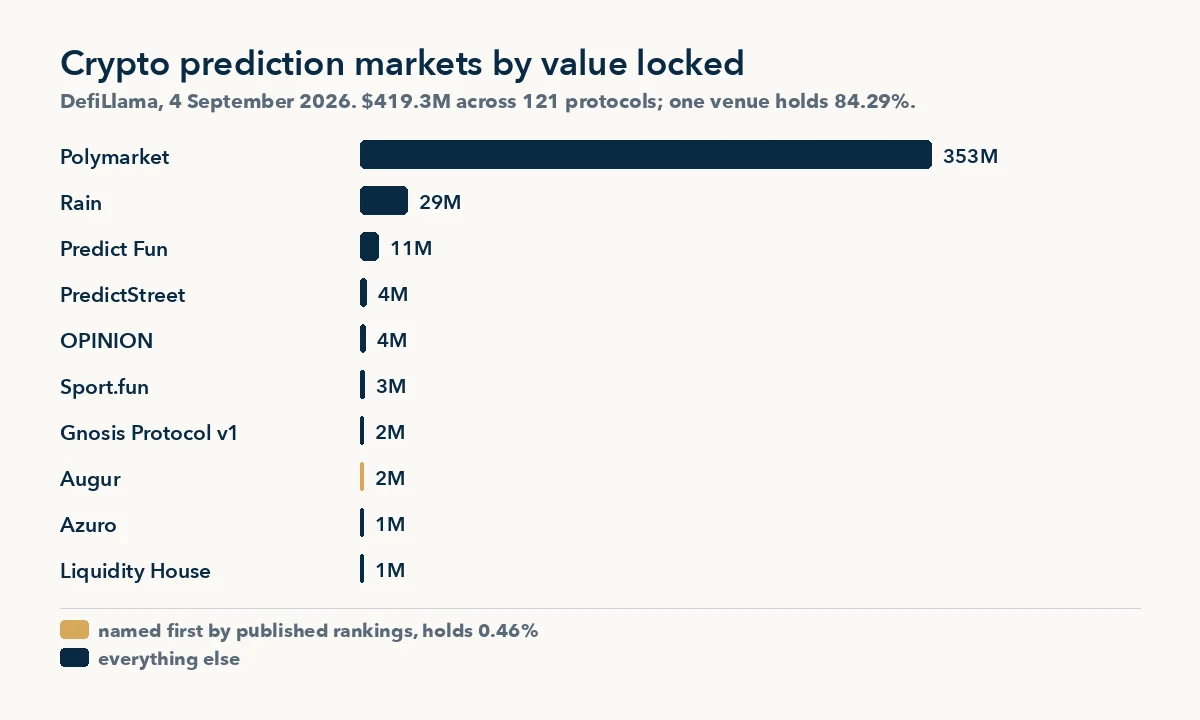
The best crypto prediction markets in 2026 by value locked are Polymarket ($353.44 million, 84.29% of the category), Rain ($29.46 million), Predict Fun ($11.25 million), PredictStreet ($4.09 million) and OPINION ($3.55 million). The figures come from DefiLlama’s prediction market category, which held $419.3 million across 121 protocols when we read it on 4 September 2026.
One platform holds most of the money, the next largest is $29.46 million, and the name that published rankings usually put first, Augur, holds $1.93 million, or 0.46%. The ranking below follows the capital, not the history of the category.
What are crypto prediction markets
A crypto prediction market is an on-chain venue where people buy and sell positions on the outcome of a real event: an election, a match, a price level, a policy decision. Each position pays out if the outcome happens and expires worthless if it does not, so the market price reads as a live estimate of the probability.
Every position needs a counterparty, and the whole product depends on who decides the outcome. That makes these venues different from a swap on an automated market maker: liquidity and resolution rules matter more than features, and the category has grown from near nothing on the back of two election cycles.
The best crypto prediction markets in 2026, ranked by value locked
1. Polymarket (Polygon)
Polymarket is the category. It holds 183 times more than Augur, so for most users the question is not which market to pick but whether a specific question has a real book behind it.
- Value locked: $353.44 million, 84.29% of the category
- Best for: general event markets with the deepest liquidity available
- Why it stands out: no other DeFi category we measured is this concentrated in one venue
- Watch out: depth on the headline markets does not mean depth on every question
2. Rain (Arbitrum)
Rain is the clear second, far ahead of third place. It runs general event markets on Arbitrum, a single chain, like most of this list.
- Value locked: $29.46 million, 7.03% of the category
- Best for: general event markets on Arbitrum
- Why it stands out: the only real challenger by size
- Watch out: still a fraction of the leader, so check the book on each market
3. Predict Fun (multi-chain)
Predict Fun is third and one of only two multi-chain venues in the top ten. Below it, every entry sits under $5 million.
- Value locked: $11.25 million, 2.68% of the category
- Best for: general event markets across more than one network
- Why it stands out: the last venue with more than $5 million locked
- Watch out: spreading across chains also spreads liquidity thin
4. PredictStreet (ADI)
PredictStreet runs general event markets on ADI. At this size a single large position can move its place in the ranking.
- Value locked: $4.09 million, 0.97% of the category
- Best for: general event markets on ADI
- Why it stands out: fourth place on a chain no other top venue uses
- Watch out: thin books, so test your order size first
5. OPINION (BNB Chain)
OPINION is the largest prediction market on BNB Chain and the fifth largest overall.
- Value locked: $3.55 million, 0.85% of the category
- Best for: general event markets on BNB Chain
- Why it stands out: the BNB Chain entry in a scattered field
- Watch out: small enough that one deposit changes the picture
6. Sport.fun (Base)
Sport.fun is the one sport-specific venue in the top ten and sits ahead of Augur, which says more about current demand than any list of pioneers.
- Value locked: $2.76 million, 0.66% of the category
- Best for: sport markets on Base
- Why it stands out: a niche venue that outranks the category’s founder
- Watch out: sport outcomes get delayed and postponed, so read the settlement rules
7. Gnosis Protocol v1 (Ethereum)
Gnosis Protocol v1 still holds capital on Ethereum mainnet, where settlement costs more than on the chains the newer venues chose.
- Value locked: $2.44 million, 0.58% of the category
- Best for: general event markets on Ethereum
- Why it stands out: an older design still in the top ten
- Watch out: mainnet gas makes small positions expensive
8. Augur (Ethereum)
Augur was genuinely first and is genuinely still running. It is also eighth by size, which is why a list that opens with it is describing the history of the category rather than its current state.
- Value locked: $1.93 million, 0.46% of the category
- Best for: users who want the original Ethereum design
- Why it stands out: the pioneer, still named first by most published rankings
- Watch out: Polymarket holds 183 times more
9. Azuro (multi-chain)
Azuro is infrastructure rather than a front end: it supplies sport betting liquidity that other apps build on, across several chains.
- Value locked: $1.43 million, 0.34% of the category
- Best for: teams building sport betting products
- Why it stands out: the only infrastructure layer in the top ten
- Watch out: the user experience depends on whichever app sits on top
10. Liquidity House (Etherlink)
Liquidity House closes the top ten on Etherlink. Together the ten hold 98.1% of all value locked in the category.
- Value locked: $1.18 million, 0.28% of the category
- Best for: general event markets on Etherlink
- Why it stands out: the Etherlink entry in the ranking
- Watch out: at this size, rank against its neighbours is close to meaningless
| Platform | Value locked | Share | Chain | Focus |
|---|---|---|---|---|
| Polymarket International | $353.44M | 84.29% | Polygon | General events |
| Rain | $29.46M | 7.03% | Arbitrum | General events |
| Predict Fun | $11.25M | 2.68% | Multi-chain | General events |
| PredictStreet | $4.09M | 0.97% | ADI | General events |
| OPINION | $3.55M | 0.85% | BNB Chain | General events |
| Sport.fun | $2.76M | 0.66% | Base | Sport |
| Gnosis Protocol v1 | $2.44M | 0.58% | Ethereum | General events |
| Augur | $1.93M | 0.46% | Ethereum | General events |
| Azuro | $1.43M | 0.34% | Multi-chain | Sport betting infrastructure |
| Liquidity House | $1.18M | 0.28% | Etherlink | General events |
If you run a project here, not just research one: Prediction markets grow on the back of a single loud event, not on steady content. We run the social side of those moments, from the accounts that will carry it to the creative. crypto social media management.
How crypto prediction markets work
A prediction market is a contract about who decides the outcome. You deposit a settlement asset, buy a position on one side of a question, and either sell it back before the event or hold it until the market resolves. Resolution is handled by a committee, an oracle or a named data source, depending on the venue.
Before you fund anything, find the resolution document and read how a market settles, who can dispute it, how long the window stays open and what happens if the event is ambiguous or postponed. Venues differ sharply on all of that, and the difference only becomes visible on the one market where the wording gets tested.
Then run a small position through the whole path: deposit, place, cancel, close, withdraw. Time each step. The withdrawal is the part most people leave out of a test, and it tells you most. A venue that accepts capital in seconds and returns it in days has answered a question the table cannot. Keep a dated copy of the rules and the fee schedule as they read on the day you entered, because terms pages get edited.
Fees and costs
The cost of a position is the spread you cross, the venue fee, the settlement asset you have to hold and the gas on whichever chain the venue settles on. The chains in this ranking are scattered across Polygon, Arbitrum, BNB Chain, Base, Ethereum and Etherlink, so a low fee on an expensive chain is not cheap.
Price the exit as well as the entry. Many positions are closed by selling back into a thinner book rather than by holding to settlement, so the round trip can cost several times the headline fee. If you cannot get an exit quote before entering, treat the position as one you will hold until resolution and size it on that basis.
Check depth on the market you actually intend to trade rather than the headline one. Below third place every venue sits under $5 million, so the book on a specific question can be thin enough that your own order sets the price. Place a small order, watch what it does to the quote, and size from that rather than from the venue total.
Risks and safety checks
Resolution quality is the real product risk, and no public figure measures it. A prediction market is only worth using if the outcome is settled correctly and promptly. Regulatory exposure also differs sharply between these venues and does not show up in any table of locked value.
- Delayed settlement. The common failure is delay rather than fraud: the event happens, the market does not settle, and capital sits in a resolved position while a dispute runs. Never count funds in open positions as available.
- Awkward cases. An event is delayed past the settlement date, a result is overturned after payout, the named data source stops publishing, or a question admits two honest readings. Search the venue for markets that already hit one of these and read the resolution thread.
- Terms drift. A fee or withdrawal rule can change between your test and your real position. Compare against your dated copy.
- Evidence. If a venue stops resolving, collect transaction hashes, the market page as it read on the day, the resolution source and screenshots of the terms. Support runs through chat channels, so nobody else keeps that record for you.
A venue with no public record of a contested settlement has not been tested rather than proven. Treat that as missing information, not as a clean record.
Market trends in 2026
One venue, a long tail. At 84.29% in one place, no other DeFi category we measured this week comes close. Stablecoins are 58.9% concentrated in Tether and liquid staking 46.4% in Lido. Prediction markets are a single venue with a long tail attached, and seven of the ten largest are small enough that one large position would move them.
Coverage far ahead of capital. The whole category is $419.3 million. That is smaller than the ninth largest RWA product and roughly a hundredth of the lending market, yet it gets more attention than categories many times its size.
Chains follow settlement, not fashion. Eight of the ten run on a single chain, and those chains are scattered. Only Predict Fun and Azuro are multi-chain, and both are small. These products need cheap settlement of many small positions rather than deep composability, so there is no shared home network the way Solana anchors memecoin trading. That also leaves prediction markets with almost no cross-chain liquidity story, unlike the venues in our ranking of cross-chain DEX venues.
For builders, liquidity beats features. A market with no counterparty is not a market, and liquidity concentrates faster in this format than in an automated market maker. Decide before launch which single question you can bring both sides to, and seed that one: twenty thin markets convert worse than one with a real book. Attention arrives around one loud event and leaves when it resolves, so plan spending against the event calendar and keep a reserve for the week after settlement.
How this ranking was built
Order is set by value currently locked in each protocol, from DefiLlama’s prediction market category on 4 September 2026. The category held 121 protocols and $419.3 million. The chain column is where each venue actually settles, and the focus column separates general event markets from sport-specific infrastructure.
Locked value is the capital sitting in open positions and liquidity, the closest public proxy for whether a market has anyone in it. It is not activity: a venue can hold capital in long-dated positions and see little trading. Traded volume is not published consistently across these protocols, so we did not mix the two. Locked value, traded volume, open interest and registered accounts are separate numbers, and a venue can lead on one while sitting near the bottom on another.
Re-read the source before acting on any of this. A category this size moves on a single large deposit, so treat the 4 September reading as a starting point. If you track venues over time, log locked value and the category total once a week from the same source, and watch share rather than dollars. For adjacent markets measured the same way, see our rankings of crypto lending platforms by value supplied and liquid staking protocols by value staked.
Frequently Asked Questions
What are the best crypto prediction markets in 2026?
By value locked, Polymarket leads with $353.44 million, 84.29% of the category, followed by Rain at $29.46 million and Predict Fun at $11.25 million. PredictStreet and OPINION complete the top five. The category totalled $419.3 million across 121 protocols on 4 September 2026, and the top ten held 98.1% of it.
Is Augur still a big prediction market?
Not by size. Augur holds $1.93 million, which is 0.46% of the category and eighth place, behind a sport-specific venue on Base. Published rankings still open with it because it was first, not because it is large. Polymarket holds 183 times more capital.
How big is the crypto prediction market sector?
The sector held $419.3 million across 121 protocols on 4 September 2026. That is smaller than the ninth largest RWA product and roughly one hundredth of DeFi lending. Prediction markets get coverage far out of proportion to the capital actually in them.
Why is Polymarket so dominant?
Because a prediction market needs a counterparty for every position, so liquidity attracts liquidity harder here than in an automated market maker. Polymarket holds 84.29%, and everything below third place is under $5 million, small enough that a single large position moves the ranking.
Which blockchain do crypto prediction markets use?
No single one. Eight of the ten largest run on one chain each, spread across Polygon, Arbitrum, BNB Chain, Base, Ethereum and Etherlink. These products need cheap settlement of many small positions rather than deep composability, so they follow fees rather than clustering on one network.
Related reading
For the settlement assets these venues price positions in, see our ranking of the biggest stablecoins by circulating supply.