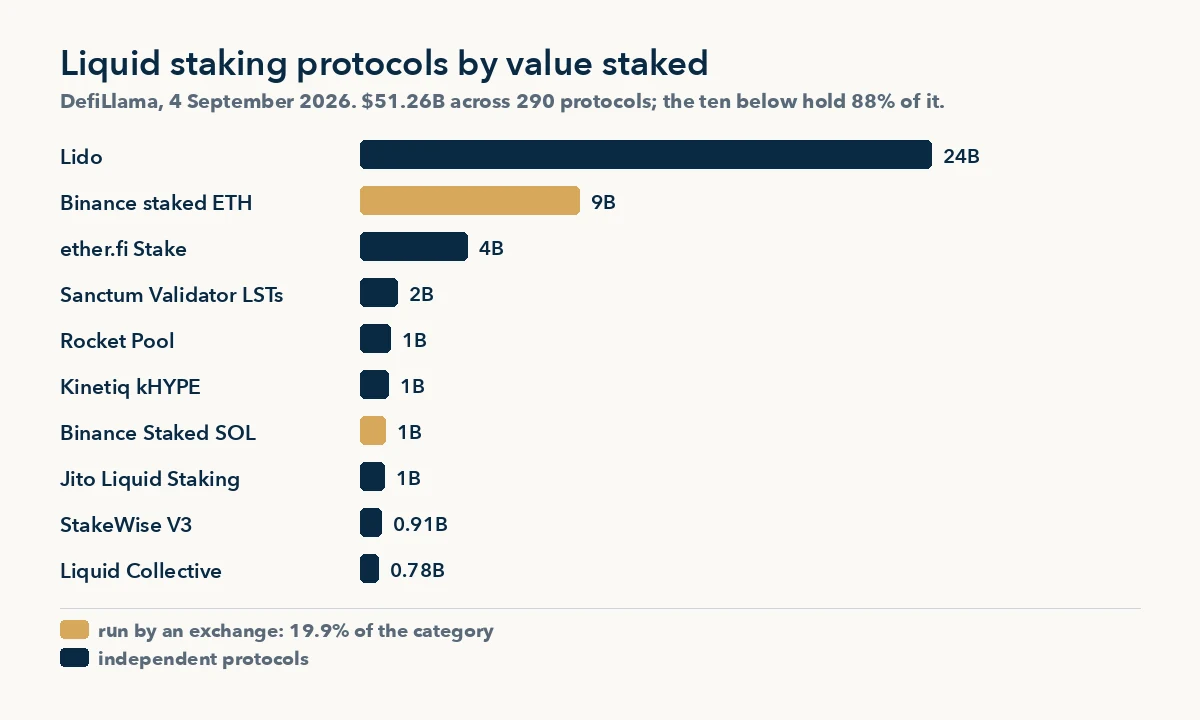
The best liquid staking protocols in 2026, ranked by value staked, are Lido ($23.76 billion, 46.4% of the category), Binance staked ETH ($9.12 billion, missing from most published lists), ether.fi Stake ($4.49 billion across 5 chains), Sanctum Validator LSTs ($1.55 billion, the largest on Solana) and Rocket Pool ($1.28 billion, the permissionless option). The figures are the value staked through each protocol in DefiLlama’s liquid staking category, read on 4 September 2026, when 290 protocols held $51.26 billion and the ten largest held $45.14 billion, or 88%.
What are liquid staking protocols
A liquid staking protocol stakes an asset with validators on the network it secures and gives the depositor a receipt token in return. The stake keeps earning rewards, and the receipt can be traded, lent or moved to another chain while it does. That is the liquid part: the same capital works in two places at once.
The category is large and unusually concentrated. DefiLlama counts 290 protocols, yet one of them holds nearly half of the value and two of the ten largest are run by an exchange.
The best liquid staking protocols in 2026, ranked by staked value
Each entry gives staked value, share of the category and chain count on 4 September 2026. The order is value and nothing else.
1. Lido (Ethereum)
Lido is the default answer and the numbers explain why. It holds $23.76 billion, which makes it larger than the next four protocols combined, and it is live on 5 chains. For a category built on the argument that staking should not concentrate, one protocol with 46.4% of it is the argument against itself.
- Staked value: $23.76B, 46.4% of the category
- Chains: 5
- Best for: holders who want the protocol where most capital already sits
- Watch out: one protocol this size is a concentration risk for the network it secures
2. Binance staked ETH (Ethereum, exchange-run)
The second largest protocol is the one most published rankings leave out. Those lists converge on Lido, Rocket Pool, Frax, Coinbase and ether.fi, and none of them includes this product, which holds $9.12 billion on 2 chains.
- Staked value: $9.12B, 17.8% of the category
- Chains: 2
- Best for: Binance users who want a staking receipt without leaving the exchange
- Watch out: the exchange runs the validators, so this is exchange staking with a token attached
3. ether.fi Stake (Ethereum, restaking)
ether.fi is the largest restaking-based product in the table and, like Lido, it is live on 5 chains. Several published lists describe it as holding $7 to $9 billion. DefiLlama reports $4.49 billion, and that is the figure used here.
- Staked value: $4.49B, 8.8% of the category
- Chains: 5
- Best for: holders who want restaking exposure on top of Ethereum staking
- Watch out: restaking adds a second set of obligations on the same stake
4. Sanctum Validator LSTs (Solana)
Sanctum is the largest Solana entry. With Binance Staked SOL and Jito it forms a Solana market of $3.63 billion: small next to Ethereum, and large enough that a Solana project planning liquidity has three credible venues rather than one.
- Staked value: $1.55B, 3.0% of the category
- Chains: 1
- Best for: SOL holders who want the largest on-chain Solana option
- Watch out: all of its liquidity depends on Solana venues
5. Rocket Pool (Ethereum, permissionless)
Rocket Pool lets anyone run a validator with a partial bond, the design most often cited as the answer to concentration. The market has allocated it accordingly. It appears on every published list and is seven times smaller than Binance staked ETH, which appears on none.
- Staked value: $1.28B, 2.5% of the category
- Chains: 1
- Best for: holders who put validator decentralisation ahead of size
- Watch out: a much smaller receipt-token market than the leaders
6. Kinetiq kHYPE (Hyperliquid)
Kinetiq is the only protocol in the ten that stakes Hyperliquid. On one network it holds more than StakeWise and Liquid Collective hold across three chains between them, which is the clearest evidence that chain count does not predict size.
- Staked value: $1.17B, 2.3% of the category
- Chains: 1
- Best for: Hyperliquid holders who want rewards and a tradable receipt
- Watch out: the whole position depends on one network
7. Binance Staked SOL (Solana, exchange-run)
The second exchange-run product in the ten. With Binance staked ETH it brings exchange-run liquid staking to $10.17 billion, or 19.9% of the category. Just under a fifth of liquid staking is exchange staking wearing a token.
- Staked value: $1.05B, 2.1% of the category
- Chains: 1
- Best for: Binance users holding SOL
- Watch out: the exchange runs the validators and controls the product
8. Jito Liquid Staking (Solana)
Jito sits just behind Binance Staked SOL and completes the three Solana venues that together hold $3.63 billion. It is the on-chain alternative to the exchange product on the same network.
- Staked value: $1.03B, 2.0% of the category
- Chains: 1
- Best for: SOL holders who prefer a protocol to an exchange product
- Watch out: check pool depth for the receipt token before sizing a position
9. StakeWise V3 (Ethereum)
StakeWise V3 is one of the two protocols that Kinetiq outweighs from a single network, which says more about the market than about StakeWise. It is live on 2 chains.
- Staked value: $0.91B, 1.8% of the category
- Chains: 2
- Best for: ETH holders looking beyond the largest protocols
- Watch out: depth on the second chain is a separate market with its own risk
10. Liquid Collective (Ethereum, institutional)
Liquid Collective closes the ten. It is the one product in the table built for institutions rather than individual holders.
- Staked value: $0.78B, 1.5% of the category
- Chains: 1
- Best for: institutions that need a product designed around them
- Watch out: a smaller secondary market than the Ethereum leaders
The same ten side by side, with the asset underneath each receipt token:
| Protocol | Staked value | Share | Chains | Underlying |
|---|---|---|---|---|
| Lido | $23.76B | 46.4% | 5 | Ethereum |
| Binance staked ETH | $9.12B | 17.8% | 2 | Ethereum, exchange-run |
| ether.fi Stake | $4.49B | 8.8% | 5 | Ethereum, restaking |
| Sanctum Validator LSTs | $1.55B | 3.0% | 1 | Solana |
| Rocket Pool | $1.28B | 2.5% | 1 | Ethereum, permissionless |
| Kinetiq kHYPE | $1.17B | 2.3% | 1 | Hyperliquid |
| Binance Staked SOL | $1.05B | 2.1% | 1 | Solana, exchange-run |
| Jito Liquid Staking | $1.03B | 2.0% | 1 | Solana |
| StakeWise V3 | $0.91B | 1.8% | 2 | Ethereum |
| Liquid Collective | $0.78B | 1.5% | 1 | Ethereum, institutional |
If you run a project here, not just research one: A liquid staking token is only liquid if the secondary market is deep enough to hold the peg. We provide that depth and the exchange relationships that go with it. crypto market making.
How liquid staking works: stake, receive a liquid token
Every protocol in the table follows the same path.
- Stake. You deposit the asset and the protocol delegates it to validators on the network it secures. On an exchange-run product the exchange runs them; on Rocket Pool anyone can run one with a partial bond.
- Receive a liquid token. The protocol issues a receipt token that represents your claim on the stake and its rewards.
- Earn rewards. Some protocols mint more tokens to you. Others keep the token count fixed and move the rate at which it converts to the underlying asset.
- Exit. Redeem directly through the protocol, often through a queue, or sell the receipt token on the open market, which is the route almost everybody uses.
What travels between chains is the receipt token, not the stake. The stake stays with validators on the network it secures, and the wrapped claim moves. The venues that must hold it are wherever the token trades. We looked at where those venues are in our list of the top 30 decentralized exchanges.
Liquid staking vs restaking: which should you choose
Liquid staking puts an asset to work securing one network and gives you a tradable claim on it. Restaking takes an asset that is already staked and stakes it again to secure a second network, which adds rewards and adds a second set of conditions under which the stake can be penalised.
In this table the line is already blurred. ether.fi Stake, third at $4.49 billion, is a restaking product counted in the liquid staking category. Totals differ between trackers because restaking products are sometimes counted twice, so any market size needs a source and a date.
Choose plain liquid staking when you want the simplest claim on one network and the widest choice of receipt-token markets. Choose restaking when you accept extra conditions on the same stake in exchange for extra rewards, and read who absorbs a penalty on each layer. Restaking is not a way out of concentration either: our restaking directory of 42 protocols shows one protocol holding 57 percent of that market.
Risks and safety checks: slashing, depeg and exits
The table settles where capital sits, not whether a protocol suits you. Run these checks before depositing.
Slashing: who absorbs a penalty
The question underneath everything is who absorbs a penalty when an operator misbehaves. Find out whether losses are spread across all holders, covered by a bond the operator posted, absorbed by an insurance pool or left with the operator entirely, and how large any cover is next to the stake. A protocol that does not describe this clearly has still decided it; you simply do not know the answer.
Depeg: when the receipt token drifts from par
A receipt trading below its redemption value is ordinary in small amounts and informative in large ones. Check first whether the gap exists on every venue or on one. A single thin pool produces a discount that means nothing. A discount visible everywhere and widening means holders are paying to exit early, which is a statement about the queue or about confidence in it. Decide in advance what you will do at each depth: redeem directly, sell into the discount, wait for the queue or split between them.
Exits: read the withdrawal path first
Start at the exit. Find out whether the protocol lets you redeem directly, how long the queue takes when it is empty, what it took at the worst point on record and whether redemption can be paused. Then check the market exit: which venues list the receipt token, how deep the largest pool is against your position and what a sale of that size would cost in slippage. Write both numbers down before depositing.
Governance, fees and a test deposit
- Read what a vote can change, how quickly, and whether any withdrawal parameter can move without a timelock you can watch.
- Note exit costs the headline yield hides: a redemption fee, a spread against the published rate, a minimum size or a delay above a threshold.
- Stake a small amount first and take it through deposit, a reward period and a partial redemption by both routes.
- Set a maximum share of your staked position for any one protocol, and check the receipt rate and queue length weekly.
Market trends in 2026
- Concentration. Lido holds 46.4% and the ten largest hold 88% of a $51.26 billion category.
- Exchanges. Two Binance products hold $10.17 billion, or 19.9% of liquid staking.
- Solana as a second market. Sanctum, Binance Staked SOL and Jito hold $3.63 billion between them.
- Restaking moves money. Restaking pulled several billion around between quarters, so a September table will misdescribe December.
- Published rankings lag the data. The usual lists omit the second largest protocol and put ether.fi at $7 to $9 billion against the $4.49 billion DefiLlama reports.
How this best liquid staking protocols ranking was built
One number sets the order: value currently staked through each protocol, as reported by DefiLlama in its liquid staking category on 4 September 2026. That category held 290 protocols and $51.26 billion. Chain counts are the networks each protocol is live on at that date. The underlying column names the asset being staked and, where it matters, who runs the validators.
Not scored: yield, fee structure, withdrawal queues or validator decentralisation. Those decide whether a protocol suits you and none of them is comparable from a single public figure. The reproducible part is the method, not the numbers. If you are bringing a staking product to market rather than choosing one, see our notes on DeFi marketing by protocol type and the ranking of RWA tokenization platforms by assets.
Frequently Asked Questions
What are the best liquid staking protocols in 2026?
By value staked, the leaders are Lido, Binance staked ETH, ether.fi Stake, Sanctum Validator LSTs and Rocket Pool. Lido holds $23.76 billion, 46.4% of the category, and Binance staked ETH holds $9.12 billion. The ten largest hold $45.14 billion of a $51.26 billion market spread over 290 protocols, read from DefiLlama on 4 September 2026.
How big is the liquid staking market?
$51.26 billion across 290 protocols in DefiLlama’s liquid staking category on 4 September 2026. Concentration is extreme: the top ten hold 88% and the single largest holds nearly half. Totals differ between trackers because restaking products are sometimes counted twice, so any figure needs a source and a date.
Is Rocket Pool bigger than Binance staked ETH?
No, and the gap is seven times. Rocket Pool holds $1.28 billion, or 2.5% of the category. Binance staked ETH holds $9.12 billion, or 17.8%. Published rankings frequently list Rocket Pool and omit the Binance product entirely, which inverts the actual order of the market.
What is the difference between liquid staking and restaking?
Liquid staking stakes an asset once and gives you a tradable receipt token; restaking stakes an already staked asset again to secure a second network. Restaking adds rewards and extra conditions on the same stake. It is also more concentrated: in our directory of 42 restaking protocols, one holds 57 percent of the market.
Can a liquid staking token lose its peg?
Yes, a receipt token can trade below its redemption value. A small discount on one thin pool is ordinary and means little. A discount visible on every venue and widening means holders are paying to exit early, which signals a long withdrawal queue or falling confidence in it. Decide in advance whether you would redeem, sell or wait.
Related reading
For where staking receipt tokens trade once issued, see our ranking of DEX aggregators by routed volume and the comparison of cross-chain DEX venues.
Assets already staked can be staked again to secure a second network. The restaking directory of 42 protocols by value locked shows how concentrated that market is: one protocol holds 57 percent of it.