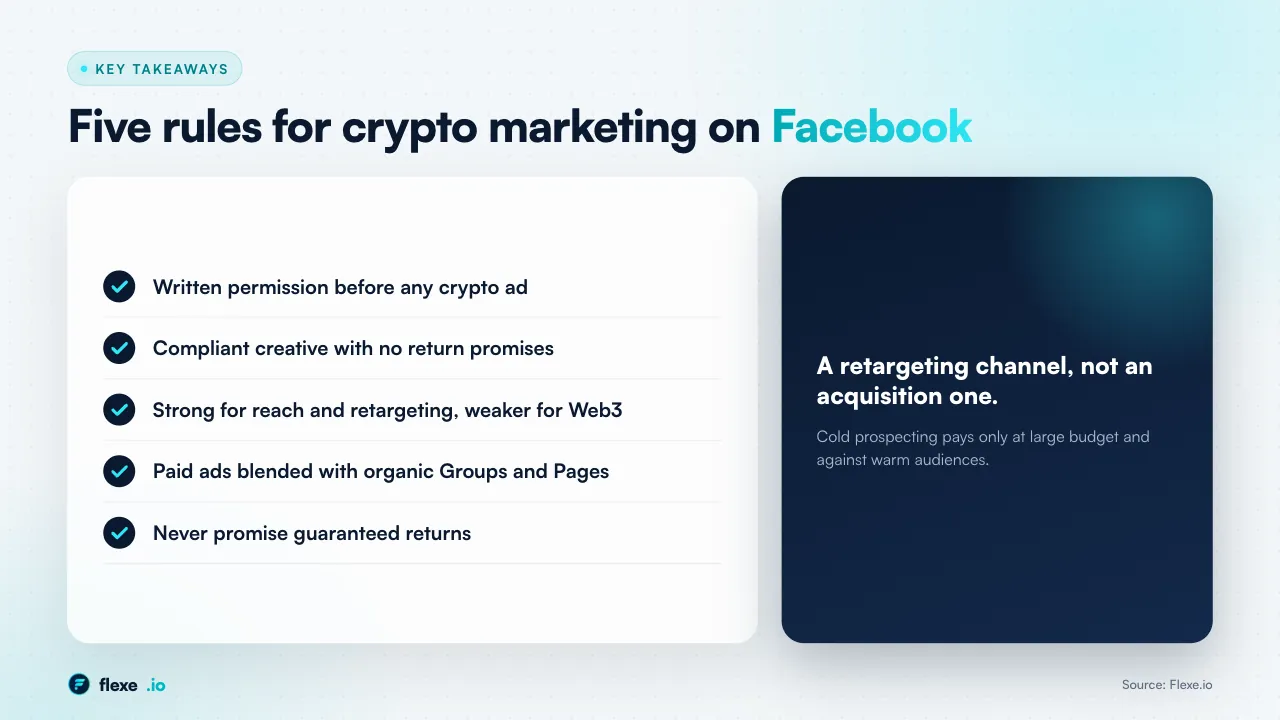
Crypto Facebook advertising is a retargeting channel, not an acquisition one. As checked on 11 November 2026, policy restrictions and advertiser verification make cold prospecting on Facebook and Instagram expensive enough that it is worth running only at large budget and only against audiences that already touched the project. The channels that acquire cold are elsewhere: vetted influencer posts and task-based community campaigns with verified participants, which start from 5,000 per campaign and run up to 10,000 a month (terms checked on 11 November 2026). Documented 2026 runs listed in November 2026 include Fourmeme, from 35,000 to 47,000 members.
Crypto marketing on Facebook is the practice of reaching and converting audiences for crypto and Web3 products across Facebook and its ad network, within its strict advertising rules. Facebook remains a huge audience, but crypto ads are restricted and require written permission, so success in 2026 depends on compliant campaigns, strong creative, and blending paid reach with organic community. This guide covers the ad policy, what works, and the mistakes to avoid. Cryptocurrency advertising on Facebook needs Meta’s written permission, so many teams work with crypto influencers on Facebook pages and groups instead.
Key Takeaways
- Facebook restricts crypto ads and requires prior written permission to run them.
- Compliant, non-hype creative that avoids return promises is what gets approved and performs.
- Facebook is strong for top-of-funnel reach and retargeting, weaker for pure Web3-native audiences.
- Blend paid ads with organic Groups and Pages to build durable community.
- Never promise guaranteed returns; it breaks policy and erodes trust.
Can You Advertise Crypto on Facebook in 2026?
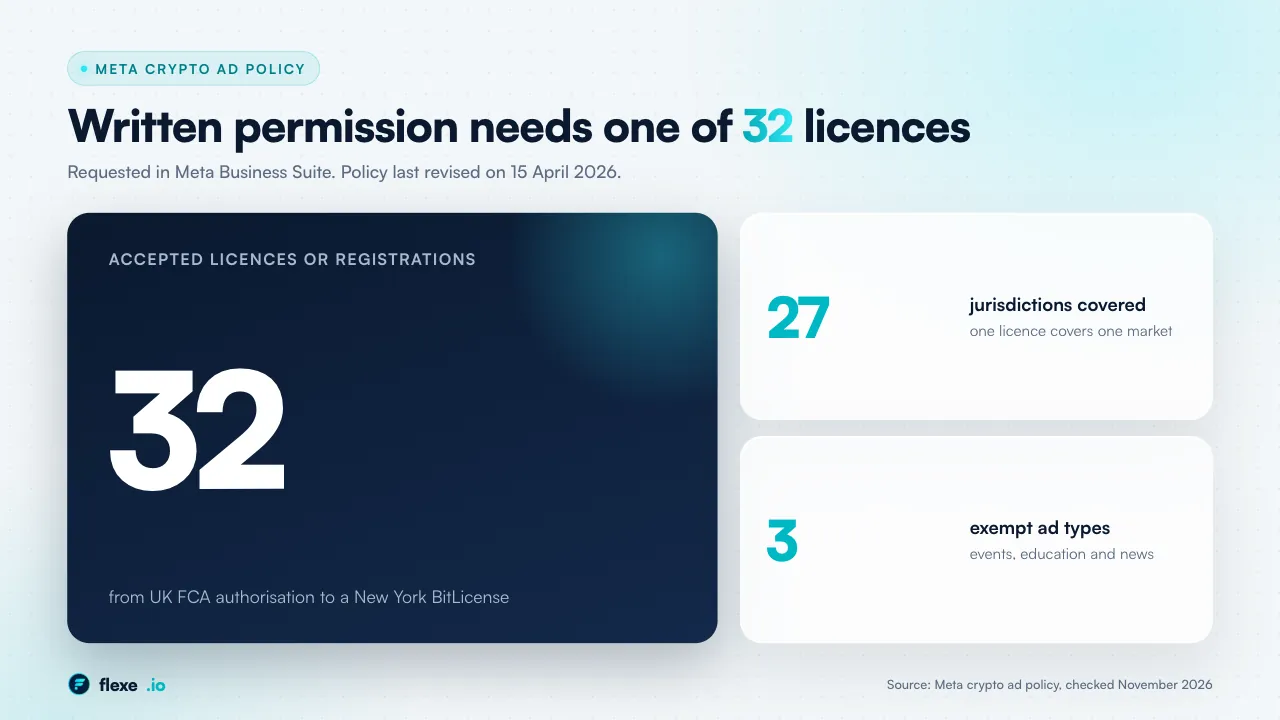
Yes, but with limits. Facebook (Meta) restricts ads for cryptocurrency products and services, and advertisers need written permission, now requested in the Authorizations and Verifications tab of Meta Business Suite. Meta’s crypto ad policy, last revised on 15 April 2026 and checked in November 2026, grants it only to holders of one of 32 licences or registrations across 27 jurisdictions, from UK FCA authorisation to a New York BitLicense. Affiliate and aggregator sites that solicit investment in exchanges need the same permission. The cryptocurrency advertising Facebook accepts without a licence is narrow: events, education and news that do not offer crypto products. Some categories, such as unlicensed offerings and hype-driven token promotions, stay prohibited. The practical takeaway is that eligibility and compliant messaging come before creative and budget.
What Works for Crypto Marketing on Facebook?
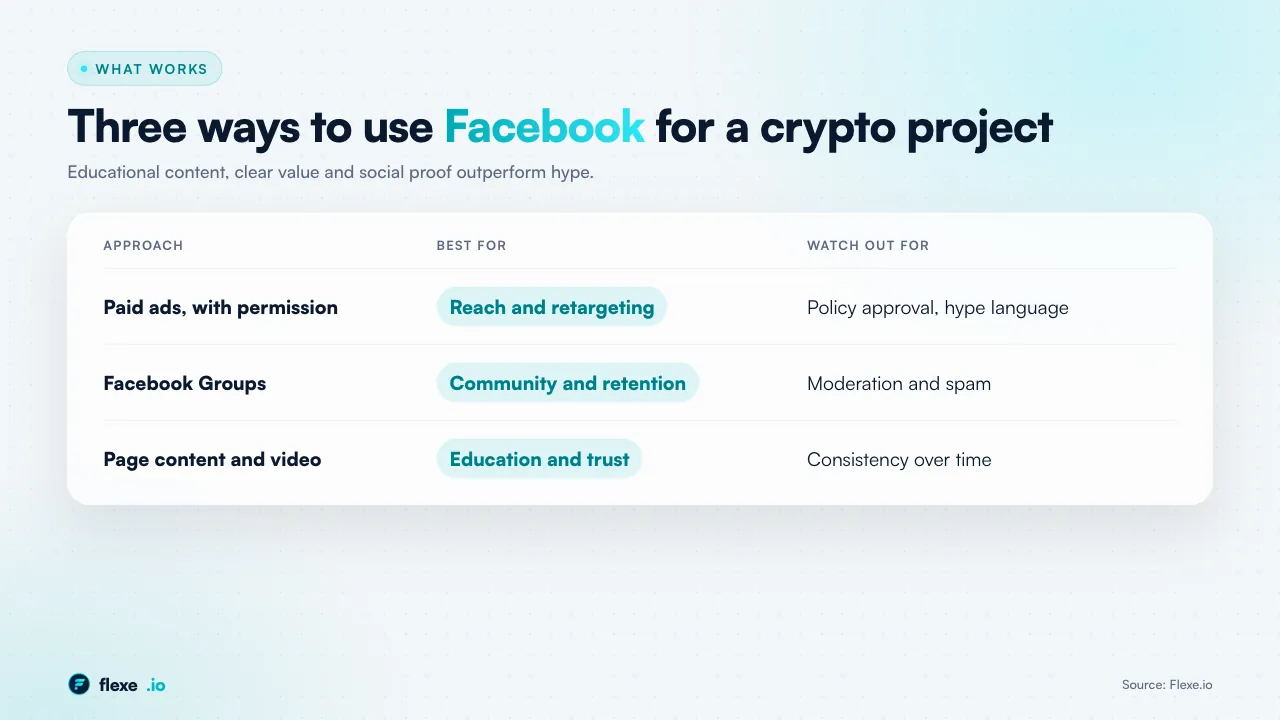
Facebook is best for broad awareness, education, and retargeting warm audiences, rather than reaching hardcore Web3 users who live on X and Telegram. Educational content, clear value propositions, and social proof outperform hype. Combining approved ads with active Groups and a Page turns paid reach into a community that lasts. Running that Page and Group week to week is the core of crypto social media management.
| Approach | Best for | Watch out for |
|---|---|---|
| Paid ads (with permission) | Reach and retargeting | Policy approval, hype language |
| Facebook Groups | Community and retention | Moderation and spam |
| Page content and video | Education and trust | Consistency over time |
How Do You Get Crypto Facebook Ads Approved?
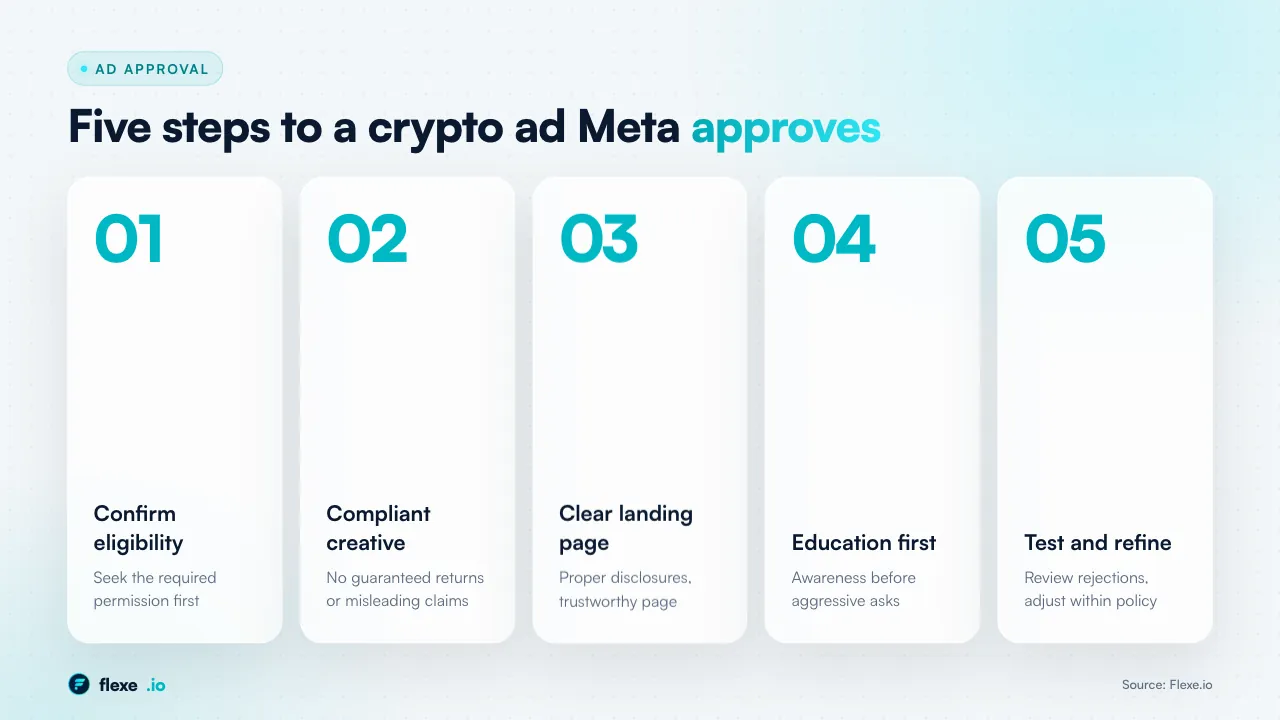
- Confirm your product is eligible and seek the required permission or certification.
- Keep creative compliant: no guaranteed returns, no misleading claims.
- Point to a clear, trustworthy landing page with proper disclosures.
- Start with education and awareness rather than aggressive conversion asks.
- Test, review rejections, and refine messaging within policy.
What Are the Biggest Mistakes?
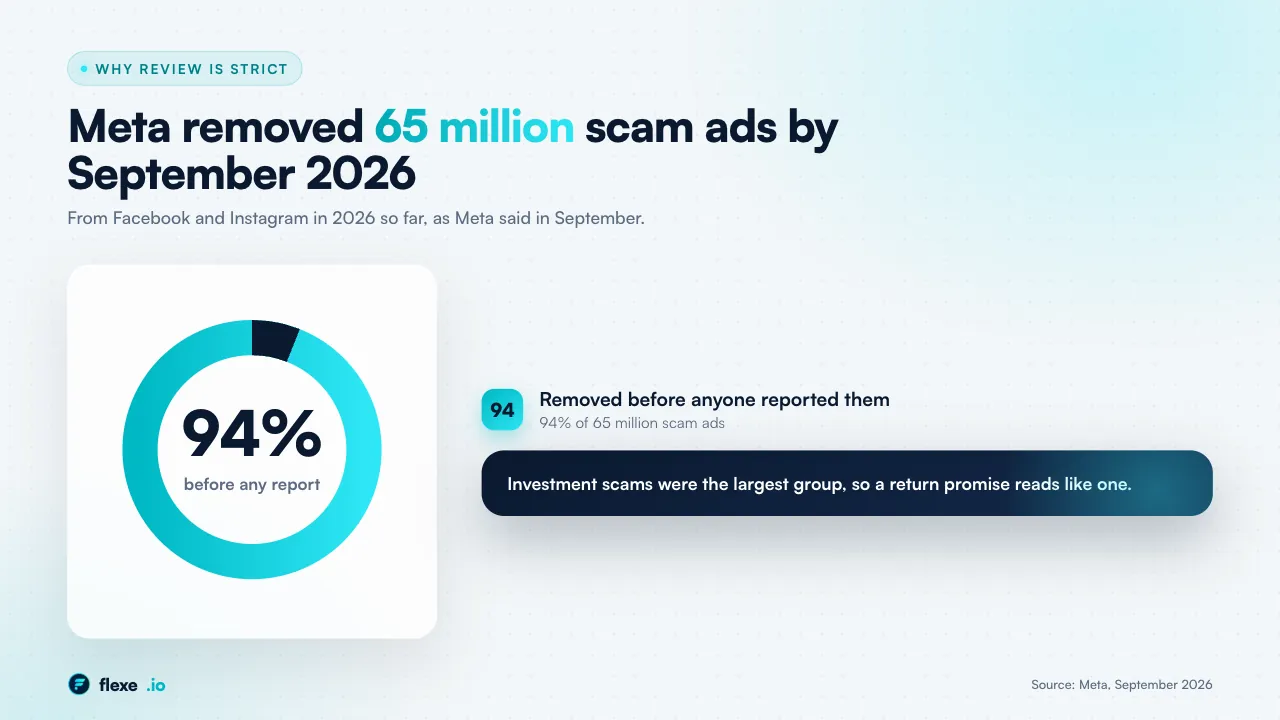
The usual failures are running ads without permission, using hype or return promises that trigger rejections and bans, and treating Facebook like a Web3-native channel. Facebook rewards patient, compliant, education-led marketing, not quick-flip token hype. Meta’s own figures explain the scrutiny: in September 2026 it said it had removed 65 million scam ads from Facebook and Instagram so far that year, 94% of them before anyone reported them, with investment scams the largest group. A legitimate crypto advertiser goes through the same review, so creative that sounds like a return promise gets treated like one.
This guide is educational and is not financial advice. Follow Facebook’s current advertising policies and the rules in your jurisdiction.
Marketing a Crypto Event on Facebook
Events are the one crypto use case Facebook still handles well, because an event page is not a financial promotion. Meta’s policy lists events, education and news about crypto among the ads that need no written permission, as long as they do not offer crypto products. That distinction is what keeps campaigns alive where token ads get rejected.
- Create the event under a Page, never a personal profile. Personal-profile events cannot be promoted and cannot be handed over if the organiser leaves.
- Describe the event, not the asset. A conference, meetup or AMA is promotable. The same page describing token returns is not. Keep price, yield and investment language out entirely.
- Complete verification before you need it. Business verification takes days and is required for most financial-adjacent categories. Meta said on 11 March 2026 that it wants verified advertisers to drive 90% of its ad revenue by the end of 2026, so the check now reaches more accounts. Starting it the week of the event is too late.
- Target by adjacent interest. Direct crypto interest targeting is restricted in many markets, but fintech, developer tooling, gaming and specific conference audiences are not.
- Use the event for retargeting afterwards. Responders are a warm audience you can reach for months, which is usually worth more than the attendance itself.
Do crypto Facebook groups still work?
They work for a specific audience: older, less technical, and largely absent from Telegram and Discord. That audience is underserved and cheap to reach, which is exactly why it is worth a look. Expect heavy scam activity in open groups and moderate accordingly, since a single drainer link in your group ends its usefulness.
If you want this bought rather than built: we run Web3 ad campaigns across crypto-native inventory, and Google Ads for fintech where the category clears verification. We report on post-click behaviour, not impressions.
Cryptocurrency advertising Facebook approves can still break local law
Meta’s written permission covers its own platform, not the law of the country your ad reaches. A licence on Meta’s list gets the ad past review, but the financial promotion rules of each target market apply on top, and they are often stricter than Meta’s checklist. We write the creative for the strictest market in the targeting, then drop countries rather than soften the copy.
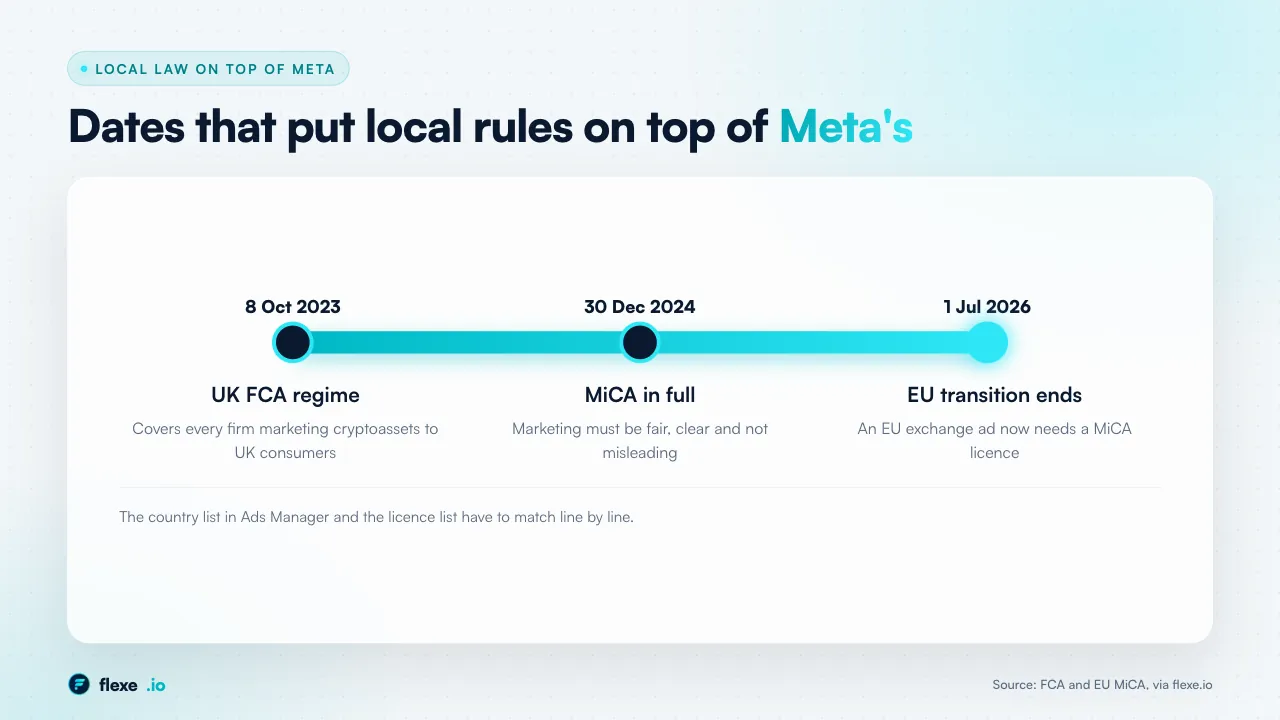
The UK is the clearest case. Since 8 October 2023, every firm marketing cryptoassets to UK consumers, including firms based overseas, falls under the FCA financial promotions regime. The FCA says the rules apply to social media posts, require prominent risk warnings, and cites a 24-hour cooling-off period as an example of the frictions firms must add. Promoting outside the four approved routes is a criminal offence.
In the EU, the Markets in Crypto-Assets Regulation has applied in full since 30 December 2024. Article 7 requires marketing about a public crypto-asset offer to be clearly identifiable as marketing and to be fair, clear and not misleading. Firms already operating could continue under transitional rules only until 1 July 2026, so an EU-targeted exchange ad now needs a MiCA licence behind it.
In practice the country list in Ads Manager and the licence list have to match line by line. A licence that covers one market does not cover the next, so a UK campaign needs its own FCA route even when the EU side is licensed. We keep a one-page matrix per campaign with the country, licence, approved wording, risk warning text and the person who signed it off.
How crypto influencers on Facebook should disclose payment
Crypto influencers on Facebook have to disclose payment inside the post, in words a casual reader will see. The FTC’s Endorsement Guides, updated on 29 June 2023, added a definition of clear and conspicuous disclosure and warn that a platform’s built-in disclosure tool may not be adequate alone. The same update counts social media tags as endorsements, so a tagged exchange in a paid post is an ad.
The most expensive example so far came from a Meta platform. On 3 October 2022 the SEC charged Kim Kardashian over an Instagram post about EMAX tokens, which she was paid $250,000 to publish without disclosing the payment. She settled for $1.26 million and agreed not to promote crypto asset securities for three years.
Brands carry part of that risk, because the 2023 FTC update spells out the potential liability of advertisers and intermediaries, not only endorsers. In our campaigns the creator brief fixes the disclosure wording and its position before any fee is agreed. Our network sits on X and YouTube, so on Facebook we use creators only as a supplement, and our crypto influencer marketing team screens each account first.
A compliant post puts the disclosure in the first line of the caption, before the text Facebook hides behind See more, and repeats it in the spoken intro of a video. Use plain words such as Paid partnership with or #ad, not #sp or a vague thank-you to the brand. For a crypto event, the post should describe the event and link to the event page, never to a token sale.
How long a Facebook retargeting audience lasts
Meta lets a website custom audience keep visitors for between 1 and 180 days, according to its Marketing API documentation checked on 13 November 2026. For an event, the clock starts when someone visits the registration page, not on the event date. Build the audience six weeks before the event and the 180-day window still covers roughly four months afterwards.
Split that window by intent instead of running one large audience. Registrants who did not attend get the recording and the next date within two weeks. Attendees get product education over the following months, under the same permission rules as any other crypto ad. People who only opened the page get one reminder, because a cold visitor is still a cold prospect.
Judge the retargeting on what it returns, not on reach. Across the 150 campaigns in our campaign ROI benchmark, the median net ROI was 2.8x within 90 days, the range ran from 1.4x to 7.0x, and 12% lost money. A Facebook retargeting line that shows no post-click activity within 90 days should be cut before it joins that 12%.
Retargeting does not rescue a weak event. If registrations came mostly from giveaway hunters, the audience is large and worthless, and a 180-day window only stretches the waste. Check the registration list for duplicate emails, disposable domains and empty company fields before any budget goes against it.
Related Services
If you would rather have this handled than run it in-house, these are the specific services involved.
- Facebook Crypto
- Advertise Crypto on Facebook
- Cryptocurrency Facebook Ads
- Facebook Crypto Ads
- Facebook Ads Cryptocurrency
If the plan is still being written, choosing the right crypto marketing agency decides most of what follows.
How to choose a crypto Facebook marketing approach in 2026
Choose by audience temperature and by whether your product can get ad permission. Facebook works for broad awareness, education and retargeting people who already know you, not for reaching heavy Web3 users who live on X and Telegram, so the mix of paid ads, Groups and Page content should follow these checks.
- Eligibility: your product type can get Meta’s permission or certification for crypto ads.
- Local law: the ad is legal in every country where it runs, even after Meta approves it.
- Audience: you have warm visitors or holders to retarget, not only cold reach.
- Team time: someone can moderate a Group every day against spam.
- Creators: crypto influencers on Facebook disclose payment on every paid post.
- Landing page: it carries proper disclosures and makes no guaranteed return claims.
Frequently Asked Questions
Can you advertise crypto on Facebook?
Yes, if you hold one of the 32 licences or registrations Meta accepts and get written permission through Meta Business Suite. Exchanges, lending platforms, trading wallets and affiliate sites that solicit investment all need it. Events, education and news without a crypto product do not, which is why event promotion is the use case that reliably clears review.
Why do crypto Facebook ads get rejected?
Financial promotion language, unverified business status, and landing pages naming a different legal entity than the verification. Rejections give generic reasons, so fix all three before appealing. Check the licence too: permission is tied to a specific regulator registration, and an ad aimed at a country your licence does not cover is rejected even when the creative is clean.
How do you promote a crypto event on Facebook?
Create the event under a Page rather than a personal profile, describe the event rather than the asset, complete business verification before you need it, and target adjacent interests such as fintech or developer tooling where direct crypto targeting is restricted. Keep price, yield and investment language out of the event page entirely.
What is the best use of Facebook for a crypto project?
Retargeting event responders. They form a warm audience you can reach for months, which is usually worth more than the attendance itself. Cold prospecting with crypto Facebook ads rarely pays back, so spend the budget on people who already registered, attended or watched, and use crypto-native channels to find new users.
Can crypto influencers on Facebook promote an exchange?
Organic posts can mention one, but a promoted post is an ad. Meta’s crypto policy, checked on 11 November 2026, requires written permission for ads that solicit investment in exchanges or trading platforms, including affiliate and aggregator sites. Paid posts should carry Meta’s paid partnership label and a clear disclosure, and should never promise returns.
Is Facebook good for crypto marketing?
It is strong for reach, education, and retargeting, but should be paired with X, Telegram, and community channels for Web3-native audiences. The audience on Facebook skews older and less technical, which suits explainer content and events better than token launches, and it rarely brings the early adopters a new protocol needs.
Do I need permission to run crypto ads?
Generally yes; Facebook restricts crypto ads and requires prior written permission for eligible advertisers. Meta grants it only against a recognised licence or registration, such as FCA authorisation in the UK or a BitLicense in New York. Ads about crypto events, education or news that do not offer a crypto product are exempt.
Run Compliant Crypto Campaigns With Flexe.io
Flexe.io has run 800+ crypto and Web3 marketing campaigns since 2018, including compliant paid social. For a Facebook and multi-channel plan that gets approved and performs, message us on Telegram at https://t.me/flexe_io_agency.