The restaking category holds 11.55 billion dollars across 42 live protocols, and one of them holds 57 percent of it. Checked on 8 September 2026 against DefiLlama. Below is the full ranking of the largest restaking protocols by total value locked, with the chain count and the seven day change for each.
One of the largest restaking protocols is more than half the category
EigenCloud alone holds 6.56 billion dollars. Add Babylon Protocol at 3.26 billion and Kelp at 1.11 billion and the top three reach 95 percent of everything staked in restaking. The top five reach 98 percent.
That leaves 39 protocols sharing the remaining 5 percent. Twenty nine of the 42 hold less than 10 million dollars each, and together those 29 come to 37 million, which is 0.3 percent of the category. The long tail here is not a market, it is a list of deployments.
If you run a project here, not just research one: Restaking TVL concentrates because integrations concentrate. Exchange listings and the market-making that comes with them are what open the integrations, and we handle both. exchange listing support.
Growth is broad, the money is not
Thirty protocols grew over the last seven days and ten shrank, so by count the category looks healthy. By value it barely moved: the three that matter changed by less than six percent each, and everything below them is too small for its percentage swings to shift the total. A weekly gain of forty percent on two million dollars is noise.
What DefiLlama does not show for half of them
Twenty one of the 42 protocols carry no audit record in DefiLlama, and that includes Babylon Protocol at 3.26 billion dollars, the second largest in the category. Absence of a record is not proof of an unaudited contract, a team can publish a report without it reaching the aggregator, but it does mean the check has to be done by hand rather than read off a table. We are printing that because it is the least convenient fact in this dataset.
Eleven of the 42 run on more than one chain. Renzo is the widest at thirteen chains, followed by OpenGDP Shared Security at seven and Mellow Restaking at five. The three largest protocols each run on a single chain, which is the reverse of what the multichain pitch would predict.
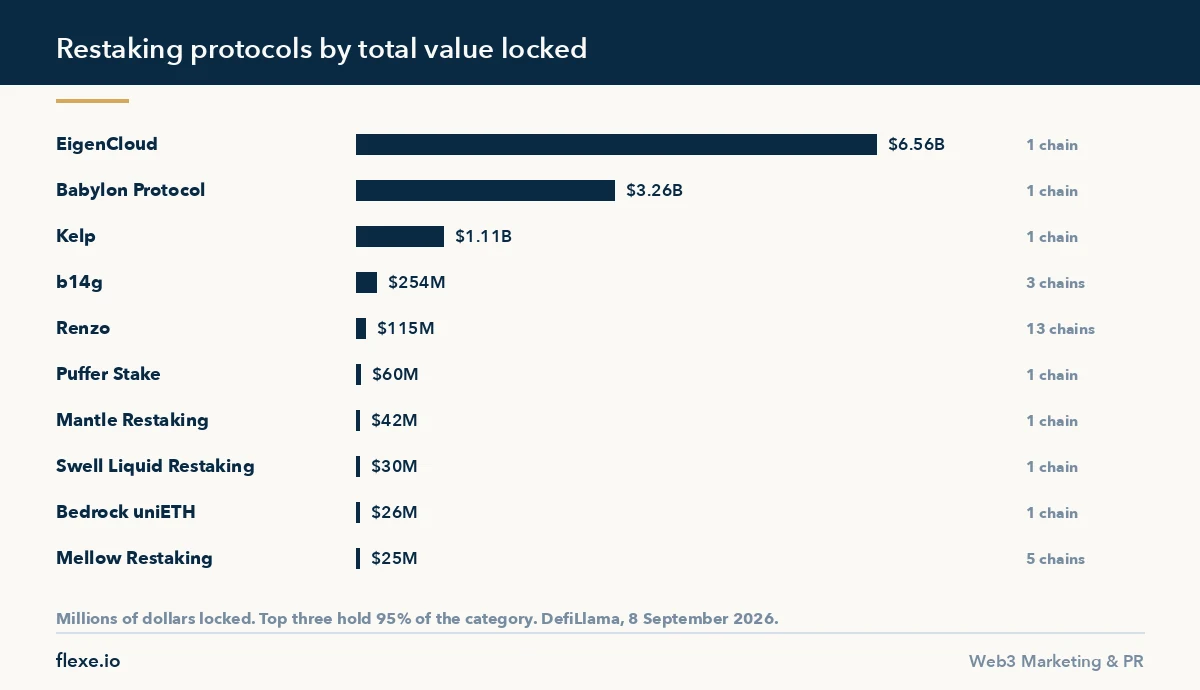
All 42 restaking protocols by total value locked
Ranked by value locked on 8 September 2026, with chain count and the seven day change. Both liquid restaking and native restaking are included, because the split matters to a builder and not to someone comparing where the money sits.
| # | Protocol | TVL | Chains | 7d change |
|---|---|---|---|---|
| 1 | EigenCloud | $6.56B | 1 | +0.7% |
| 2 | Babylon Protocol | $3.26B | 1 | +5.4% |
| 3 | Kelp | $1.11B | 1 | -0.4% |
| 4 | b14g | $254.3M | 3 | -0.5% |
| 5 | Renzo | $114.5M | 13 | +0.3% |
| 6 | Puffer Stake | $60.1M | 1 | +0.5% |
| 7 | Mantle Restaking | $41.7M | 1 | +0.1% |
| 8 | Swell Liquid Restaking | $30.0M | 1 | -0.2% |
| 9 | Bedrock uniETH | $25.7M | 1 | +0.5% |
| 10 | Mellow Restaking | $25.5M | 5 | -0.3% |
| 11 | Jito Restaking | $17.7M | 1 | +1.0% |
| 12 | Kyros | $12.4M | 1 | +2.2% |
| 13 | Solayer Restaking | $11.1M | 1 | -0.9% |
| 14 | OpenGDP Shared Security | $8.2M | 7 | +0.3% |
| 15 | InceptionLRT (Isolated Restaking) | $6.9M | 1 | +0.7% |
| 16 | Fragmetric | $5.3M | 1 | +0.2% |
| 17 | Eigenpie | $4.5M | 2 | +1.2% |
| 18 | ClayStack ETH | $2.5M | 1 | no data |
| 19 | Parasail | $1.5M | 4 | +22.5% |
| 20 | Kernel | $1.4M | 1 | +6.7% |
| 21 | King Protocol | $1.4M | 1 | +7.6% |
| 22 | Neemo Finance | $1.1M | 2 | +16.5% |
| 23 | Allstake | $928K | 3 | +22.4% |
| 24 | Suzaku | $748K | 1 | +10.1% |
| 25 | Adrastea LRT | $587K | 1 | -0.4% |
| 26 | Zeus btcSOL | $577K | 1 | -1.1% |
| 27 | Euclid Finance | $297K | 1 | +0.8% |
| 28 | EA Finance | $249K | 1 | -15.6% |
| 29 | Milkyway Restaking | $245K | 1 | no data |
| 30 | Pell Network | $228K | 20 | -0.9% |
| 31 | Meta Pool mpSOL | $106K | 1 | -11.6% |
| 32 | Affine Restaking | $62K | 2 | +1.0% |
| 33 | Restake Finance | $58K | 1 | +2.3% |
| 34 | Kernel Protocol | $52K | 1 | +1.1% |
| 35 | Prime Staked ETH | $50K | 1 | +1.1% |
| 36 | GenesisLRT (Native Restaking) | $47K | 1 | +1.0% |
| 37 | Aqua Patina | $19K | 1 | +1.9% |
| 38 | Dunes | $4K | 1 | +1.9% |
| 39 | Aspida | $3K | 1 | +1.1% |
| 40 | Zero-G Finance | $3K | 4 | +1.0% |
| 41 | Binlayer | $0K | 1 | +8.0% |
| 42 | iBTC Finance | $0K | 1 | +0.9% |
How the largest restaking protocols were checked
Source is the DefiLlama protocols endpoint, filtered to the Restaking and Liquid Restaking categories with non zero value locked, read on 8 September 2026. Audit records are the ones DefiLlama itself carries, taken from the same response.
Total value locked is what the protocol reports as deposited, not what it earns and not what it has paid out. It moves with the price of the underlying asset, so a fall in the table can mean an asset repriced rather than users leaving. Read the seven day column with that in mind.
This is part of ongoing research based on 150+ crypto marketing campaigns. Our company Flexe.io has worked since 2018 with over 800 clients. Related directories: liquid staking protocols by value locked, yield farming platforms and crypto lending platforms. For a protocol launch we run market making and exchange listing.
How to check a restaking protocol yourself
The table above says where the money sits. It does not say whether a protocol is safe to deposit into, and no value column ever will. The check that matters starts with what the protocol actually secures: which services borrow its security and what happens to a deposit when one of those services misbehaves. Read that chain of obligations in the documentation before reading any yield figure, because the yield is payment for exactly that risk.
Check the integrations, not the pitch
A restaking protocol’s real size is the set of services that rely on it, since that is where the yield comes from and where the risk enters. Look for services that are live with their own users rather than testnet deployments announced in a blog post. Where the list is short, the yield quoted today is mostly token incentives, and incentive driven yield ends on a schedule that is usually public. Find that schedule.
Incentives also explain most of the deposit movements you will see in a weekly series. Money arrives when a programme opens and leaves when it closes, which looks like adoption on the way in and a crisis on the way out while being neither. Before drawing a conclusion from a jump, check whether a points programme, a partner campaign or an emissions change started that week.
Verify the audit record by hand
Where an aggregator carries no audit record, go to the protocol’s own documentation and its public repository. A published report should name the commit or the contract addresses it covered, and those addresses should match what is deployed now. A report written against an earlier version of a contract set is common, and it is not the same thing as a current audit. If the deployed addresses appear nowhere, that absence is your finding.
Then read the report instead of counting it. The part that carries information is the issue list and the resolution status beside each item, since an audit with open high severity findings tells you more than a missing one. Note who commissioned it and when. The whole exercise is short once you have done it twice, and it replaces a column that was never populated for half of these protocols.
Read the exit path before depositing
Restaked capital is rarely liquid on demand. Exit normally runs through an unbonding period on the underlying network plus whatever queue the protocol adds on top of it, and a liquid restaking token solves that only while a secondary market for the token exists. Check both routes, the contract level exit and the market level one, and write down how long each takes in calm conditions and what the protocol says happens when everyone leaves at once.
The losses people describe afterwards are usually timing losses rather than contract failures. Capital was committed for a period nobody had written down, a price moved, and an exit that looked instant turned out to be a queue. Price the exit as part of the position and size the deposit so that a slow withdrawal is survivable. If the documentation is vague about queue length, assume the slowest case you can find in the code.
Slashing is the term that matters
Every restaking design answers one question: what behaviour loses principal, and who decides that it happened. Some protocols reserve that power for provable faults on the base network. Others pass discretion to the services borrowing the security, which means the deposit is exposed to code and governance written by teams the depositor never looked at. Find that boundary in the documents, and if you cannot find it, assume the wider exposure applies.
Operator concentration sits next to it. Security delegated to a handful of operators behaves like a single counterparty whatever the marketing says, and the delegation list is usually public. Check how much of the stake sits with the largest operators and whether they run infrastructure that could fail together. Correlated operator failure is the scenario that turns a contained technical incident into a loss spread across every depositor in the protocol.
Tracking the largest restaking protocols over time
One reading is a photograph. Decisions need a series, so record the same fields on the same weekday: value locked, chain count, the seven day change and the date you read them. Keep the series in a file you own rather than a bookmarked dashboard, because a dashboard shows today and hides the history you actually need. Two months of your own readings say more about a protocol than any single snapshot can.
Separate repricing from flow while you record it. A fall in value locked can mean depositors left or it can mean the underlying asset fell in price, and those two call for opposite responses. Where the protocol publishes deposits in native units, record that column as well. When the native figure and the dollar figure move apart, you are looking at real flow, and that is the reading worth acting on.
Set a review trigger, not a habit
A series is only useful if something happens when it moves. Decide in advance what changes force a review: a withdrawal queue lengthening, a governance proposal touching slashing parameters, an operator set shrinking, or your own position growing past the share of the protocol you are willing to be. Write the triggers down before you deposit, because afterwards every reason to stay will look convincing.
When one fires, the response should already be written too. Usually it is one of two things: reduce the position to the size you would be comfortable holding through a slow exit, or leave entirely and re-enter later. Deciding that in advance is what stops a queue from turning into a loss, because the queue is longest exactly when everyone else has reached the same conclusion.
Mistakes that repeat in this category
Four appear constantly. Ranking the whole list by percentage change, which puts the smallest deployments on top every week and describes no money at all. Treating a multichain deployment as a bigger protocol when the deposits sit almost entirely on one network. Reading a liquid restaking token’s market price as the value of the position behind it. And assuming a flat category total means individual positions are steady, when concentration lets the tail churn completely underneath a total that never moves.
When the numbers stop agreeing
Sooner or later the aggregator, the protocol dashboard and a block explorer will disagree about the same protocol. Work outward from the contract: read the balance the deposit contracts hold, then compare each source against it and check what each one counts. The gap usually comes from a wrapped asset counted twice or from a partner deployment folded into the parent. Once you know which, you know which source to keep using.
If the gap survives that and nobody explains it, the silence is the answer. Ask in public, because the response time and the tone of the reply are both data. A team that publishes a reconciliation the next day is a different risk from a team that deletes the question. None of this depends on trusting one dashboard, which is the whole reason for doing it by hand.
Frequently asked questions
What is restaking in crypto?
Restaking lets assets already staked on one network secure a second protocol at the same time, so the same capital earns twice and carries risk twice. On 8 September 2026 the category held 11.55 billion dollars across 42 live protocols, according to DefiLlama, split between native restaking and liquid restaking tokens.
Which restaking protocol is the largest?
EigenCloud, at 6.56 billion dollars locked, which is 57 percent of the whole category. Babylon Protocol is second at 3.26 billion and Kelp third at 1.11 billion. Those three together hold 95 percent of everything staked in restaking, and the top five hold 98 percent.
How many restaking protocols actually matter?
By value, three. Twenty nine of the 42 hold under 10 million dollars each, and all 29 together come to 37 million, which is 0.3 percent of the category. Percentage gains in that tail look dramatic but move almost no money, so a weekly chart of them tells you very little.
Is the restaking category growing?
By count it is: thirty protocols grew over the last seven days and ten shrank. By value it is flat, because the three protocols that hold 95 percent of the money each moved less than six percent. Growth among small protocols does not shift a total that is this concentrated.
Are restaking protocols audited?
Twenty one of the 42 carry no audit record in DefiLlama, including Babylon Protocol at 3.26 billion dollars. A missing record is not proof that contracts were never audited, since a team can publish a report that never reaches the aggregator, but it does mean verification has to be done by hand.