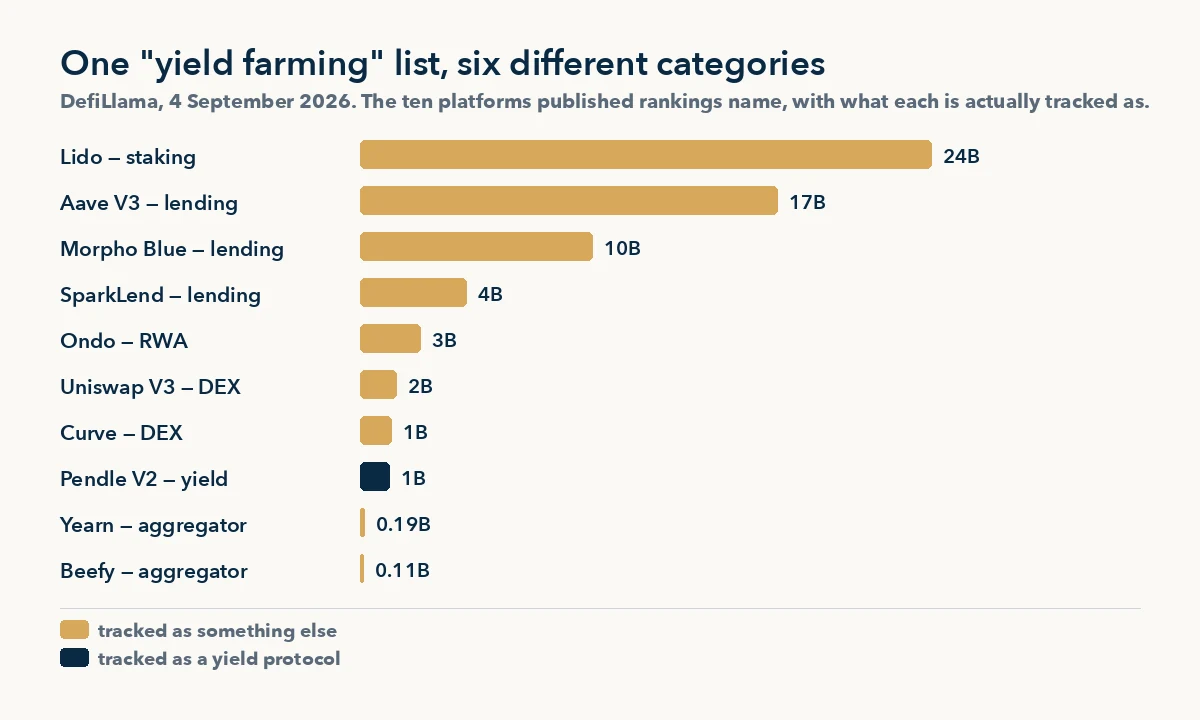
The best yield farming platforms in 2026 by value locked are Lido ($23.76B, liquid staking, about 2.3% APY), Aave V3 ($17.35B, lending, 0 to 3.2% APY), Morpho Blue ($9.66B, lending, 2.5 to 6.0% APY), SparkLend ($4.44B, lending, 0.9 to 3.4% APY) and Ondo Yield Assets ($2.53B, Treasury bills, about 3.6% APY), while Pendle V2 ($1.22B, 5.2 to 11.7% APY) is the only one of the ten usually named that is actually tracked as a yield protocol. Value locked is from DefiLlama on 4 September 2026 and typical APY from DefiLlama yields data on 18 September 2026.
What are yield farming platforms
Yield farming platforms are DeFi protocols that pay a return on deposited crypto. The term started with liquidity providers chasing incentive tokens from pool to pool, and it has since stretched to cover almost anywhere capital earns something: lending markets, staking, exchanges, tokenised Treasury bills and vaults that route between them.
That stretch is why published lists mix six categories under one label. Of the ten names September 2026 rankings give, three are lending markets, one is liquid staking, two are decentralised exchanges, one holds Treasury bills, two are aggregators and one, Pendle, is a yield protocol. They range from $23.76 billion to $0.11 billion, a spread of 216 times.
The best yield farming platforms in 2026, ranked by value locked
The order below is by value locked, the only axis all ten share. Each entry names its category, because the category decides what you earn and what can go wrong. The “Typical APY” line is the middle half of APY across the platform’s pools with at least $5 million TVL, from DefiLlama yields data read on 18 September 2026.
1. Lido (liquid staking)
Lido is the largest entry on every published list and it is not a farm. Depositors earn validator rewards and keep a liquid token in exchange. At $23.76 billion it is bigger than the other nine combined.
- Value locked: $23.76B
- Typical APY: About 2.3%, from its single pool above $5 million: stETH on Ethereum at 2.25%
- Rank in category: 1 of 290 liquid staking protocols
- What you earn: Staking rewards
- Watch out: Validator set and withdrawal behaviour matter more than the headline rate
2. Aave V3 (lending)
Aave V3 is the largest lending market DefiLlama tracks. Supplying assets earns interest paid by borrowers, so the rate follows utilisation. Its risks are liquidation and oracle failure, not impermanent loss.
- Value locked: $17.35B
- Typical APY: 0 to 3.2% across 99 pools; stablecoin example: USDe on Ethereum at 0.71% on $517M
- Rank in category: 1 of 637 lending protocols
- Best for: Earning borrower interest on assets you already hold
- Watch out: Utilisation and liquidation parameters on anything borrowed against the position
3. Morpho Blue (lending)
Morpho Blue is second in lending. It pays the same kind of return as Aave, interest from borrowers, so it should be compared against Aave and SparkLend on rate and liquidation parameters rather than against a DEX or a vault.
- Value locked: $9.66B
- Typical APY: 2.5 to 6.0% across 201 pools; stablecoin example: steakUSDG on Robinhood Chain at 7.12% on $471M
- Rank in category: 2 of 637
- What you earn: Borrower interest
- Watch out: Market parameters differ, so read them per market before supplying
4. SparkLend (lending)
SparkLend is third in lending. The Spark name also appears in the yield category, where Spark Savings holds $1.21 billion and sits almost level with Pendle, a reminder that one brand can span two categories with two different risk profiles.
- Value locked: $4.44B
- Typical APY: 0.9 to 3.4% across 11 pools; stablecoin example: USDS on Ethereum at 4.16% on $561M
- Rank in category: 3 of 637
- What you earn: Borrower interest
- Watch out: Check which Spark product a ranking actually means
5. Ondo Yield Assets (RWA)
Ondo holds Treasury bills, so the yield is Treasury bill yield passed through on chain. It appears here as a real-world asset product and would be called a stablecoin issuer by a different tracker, a boundary we took apart in our ranking of the biggest stablecoins by supply.
- Value locked: $2.53B
- Typical APY: About 3.6%; example: USDY on Ethereum at 3.58% on $1,202M
- Rank in category: 4 of 156 RWA protocols
- What you earn: Treasury bill yield
- Watch out: The category label depends on the tracker
6. Uniswap V3 (DEX)
Uniswap V3 is second among 2,087 exchanges by locked value, not by yield. Providing liquidity there is a market-making position: you earn trading fees and carry impermanent loss, so the return depends on how prices move while you are in it.
- Value locked: $1.52B
- Typical APY: 0.8 to 26.3% across 51 pools; stablecoin example: AUSD-USDC on Ethereum at 0.59%
- Rank in category: 2 of 2,087 DEXs
- What you earn: Trading fees, minus impermanent loss
- Watch out: Fee income has to cover the price gap before the position is ahead
7. Curve DEX (DEX)
Curve is third among exchanges. Liquidity providers earn trading fees plus incentives, which is the closest thing on the list to farming in its original sense.
- Value locked: $1.31B
- Typical APY: 0.8 to 5.5% across 47 pools
- Rank in category: 3 of 2,087
- What you earn: Trading fees and incentives
- Watch out: Incentives on a schedule can end, leaving fees alone
8. Pendle V2 (yield)
Pendle is first in the category these lists claim to be about. It lets users trade yield itself, locking in a fixed return or taking the variable one. Restricted to actual yield protocols, the list would be short, with Pendle at the top and Spark Savings almost level.
- Value locked: $1.22B
- Typical APY: 5.2 to 11.7% across 26 pools; stablecoin example: USDai on Arbitrum at 9.8%
- Rank in category: 1 of 672 yield protocols
- What you earn: Traded yield, fixed or variable
- Why it stands out: The only one of the ten tracked as a yield protocol, in a $4.80B category
9. Yearn Finance (yield aggregator)
Yearn holds no strategy of its own. Its vaults route deposits into the other protocols on this list, and they change route without asking.
- Value locked: $0.19B
- Typical APY: 3.0 to 6.7% across 15 pools; stablecoin example: USDC on Ethereum at 3.67%
- Rank in category: 3 of 230 yield aggregators
- What you earn: Whatever the vault routes into
- Watch out: The risk you hold is the vault plus every protocol it touches
10. Beefy (yield aggregator)
Beefy is fourth among aggregators, in a category that totals $1.38 billion. Like Yearn it compounds returns from underlying protocols.
- Value locked: $0.11B
- Typical APY: 2.7 to 7.5% across its 2 pools above $5 million
- Rank in category: 4 of 230
- What you earn: Whatever the vault routes into
- Watch out: A small vault can pay more for months, which is exactly what it is built to chase
| Platform | Tracked as | Value locked | Rank in its own category | What you actually earn |
|---|---|---|---|---|
| Lido | Liquid staking | $23.76B | 1 of 290 | Staking rewards |
| Aave V3 | Lending | $17.35B | 1 of 637 | Borrower interest |
| Morpho Blue | Lending | $9.66B | 2 of 637 | Borrower interest |
| SparkLend | Lending | $4.44B | 3 of 637 | Borrower interest |
| Ondo Yield Assets | RWA | $2.53B | 4 of 156 | Treasury bill yield |
| Uniswap V3 | DEX | $1.52B | 2 of 2,087 | Trading fees, minus impermanent loss |
| Curve DEX | DEX | $1.31B | 3 of 2,087 | Trading fees and incentives |
| Pendle V2 | Yield | $1.22B | 1 of 672 | Traded yield, fixed or variable |
| Yearn Finance | Yield aggregator | $0.19B | 3 of 230 | Whatever the vault routes into |
| Beefy | Yield aggregator | $0.11B | 4 of 230 | Whatever the vault routes into |
If you run a project here, not just research one: Yield hunters search before they deposit, and the search results are dominated by aggregators rather than protocols. We work on making the protocol itself the page that ranks. crypto SEO.
How yield farming works: where the returns come from
Every return on the list comes from one of a handful of mechanisms, and naming the mechanism tells you more than any advertised rate:
- Borrower interest in lending markets such as Aave V3, Morpho Blue and SparkLend.
- Validator rewards in liquid staking such as Lido.
- Trading fees and incentives in exchange pools such as Uniswap V3 and Curve.
- Treasury bill yield in real-world asset products such as Ondo.
- Traded or routed yield in Pendle and in the Yearn and Beefy vaults.
Token emissions sit on top of several of these, and the same rankings that recommend these platforms elsewhere call emissions unsustainable. If the yield now comes mostly from emissions on a schedule about to end, the position has quietly become a bet on that token. Compare inside a category, not across them: within lending the question is rate and liquidation parameters, covered in our comparison of crypto lending platforms by value supplied, and within staking it is validator set and withdrawal behaviour, covered in the ranking of liquid staking protocols.
Lending markets vs liquidity pools: which should you choose
Supplying to a lending market is closer to a deposit. You earn interest from borrowers, the position does not lose value when prices move apart, and the risks are liquidation of anything borrowed against it and oracle failure. It suits capital that should stay in the same asset.
Providing liquidity on an exchange is a market-making position. You earn fees on every trade through the pool, and impermanent loss means the outcome depends on price movement during the time you are in. The venues are ranked by volume in our list of the top 30 decentralized exchanges.
Vaults add a layer on top of either. Tax treatment also tends to differ between interest, staking rewards and liquidity fees in most jurisdictions, so take local advice rather than inferring the rule from how a platform describes itself.
Risks and safety checks: impermanent loss and smart contract risk
Impermanent loss applies to exchange pools; smart contract risk applies to everything. The checks that matter are mechanical rather than editorial:
- Contract address: take it from the protocol’s own documentation and confirm it against a second source, because search results and adverts routinely point at clones.
- Verification: an unverified contract holding deposits is not a risk to price, it is a risk to decline.
- Admin powers: look for an admin key, a timelock on parameter changes and upgrades through a proxy. A timelock gives depositors time to leave.
- Audit scope: compare the audited commit against deployed contracts and note findings acknowledged but not fixed. Economic design, oracles and dependencies usually sit outside scope.
- Exit test: deposit an amount you can lose, withdraw all of it, and repeat at a busier hour to surface delays, unbonding periods and exit fees.
Record the gas cost of that round trip, because on small positions it can consume the return. After depositing, watch what changes the mechanism: utilisation in lending, price moves in a pool, the current route in a vault.
Concentration hides behind different names. A lending position, a vault and a pool can all depend on the same stablecoin, oracle or bridge, and two venues that settle against the same asset fail together. Keep a record of every deposit and withdrawal with date, hash and mechanism, because compensation claims open months later and ask for exactly that detail.
Market trends in 2026
Capital sits in lending and staking, not in yield protocols. The whole yield category holds $4.80 billion across 672 protocols, about a tenth of DeFi lending and a fifth of the largest single staking protocol. Aggregators are small in capital relative to their name recognition, with Yearn and Beefy at a combined fraction of their $1.38 billion category.
Treasury bill products now sit on yield lists beside DeFi protocols, and category boundaries keep moving between trackers. Advertised rates increasingly lean on emissions.
How this ranking was built
We took the ten names that September 2026 rankings give for yield farming and looked each one up in DefiLlama on 4 September 2026, recording the category it is tracked in, its value locked and its position inside that category. Nothing was reordered to make a point.
APY comes from DefiLlama yields, read on 18 September 2026: for each platform we kept pools with at least $5 million TVL and report the middle half of their APY, so one outlier pool cannot set the figure. Rates change hourly and many include token emissions, so read them as a snapshot, not a quote.
Frequently Asked Questions
What are the best yield farming platforms in 2026?
By value locked, the largest names are Lido ($23.76B), Aave V3 ($17.35B), Morpho Blue ($9.66B), SparkLend ($4.44B) and Ondo Yield Assets ($2.53B). Only Pendle V2 is tracked as a yield protocol, where it leads with $1.22 billion of a $4.80 billion category. The rest are lending markets, exchanges, a staking protocol, a Treasury fund and two aggregators.
Why do yield farming lists include Lido and Aave?
Because they answer “where can I earn something” rather than “which of these is a yield farm”. Lido is liquid staking and pays validator rewards; Aave is lending and pays borrower interest. Both are the largest in their own categories, and neither is farming in the sense the term originally meant.
What is impermanent loss in yield farming?
Impermanent loss is the gap between holding two tokens in a liquidity pool and simply holding them in a wallet, created when their prices move apart. Trading fees have to cover that gap before the position is ahead, which is why a Uniswap or Curve position is a market-making bet rather than a deposit that earns a fixed rate.
How much capital is actually in yield protocols?
$4.80 billion across 672 protocols in DefiLlama’s yield category on 4 September 2026, with Pendle at $1.22 billion and Spark Savings almost level at $1.21 billion. That is about a tenth of DeFi lending and a fifth of what sits in the largest single staking protocol.
Are Yearn and Beefy still major platforms?
By name recognition yes, by capital no. Yearn holds $0.19 billion and Beefy $0.11 billion, third and fourth in a yield aggregator category totalling $1.38 billion. Both are roughly two hundred times smaller than the largest entry on the same published list.
Related reading
For where yield-bearing tokens are routed and swapped, see our ranking of DEX aggregators by routed volume.
Restaking is the adjacent category where the same capital secures two networks at once. All 42 restaking protocols are ranked by value locked in a separate directory.