RWA and stablecoin marketing for a tokenised real-world asset product is institutional B2B work wearing crypto vocabulary, and treating it as crypto marketing is the most common and most expensive error in the category. The buyer is an allocator or a treasury team, the sales cycle is measured in quarters, and none of the channels that move a token launch have any effect on them. For the shape of the market you are selling into, we ranked the ten largest RWA tokenization platforms by assets actually tokenised: ten of them hold 76% of a $27,59 billion category, and seven of the fourteen largest appear on none of the published lists.
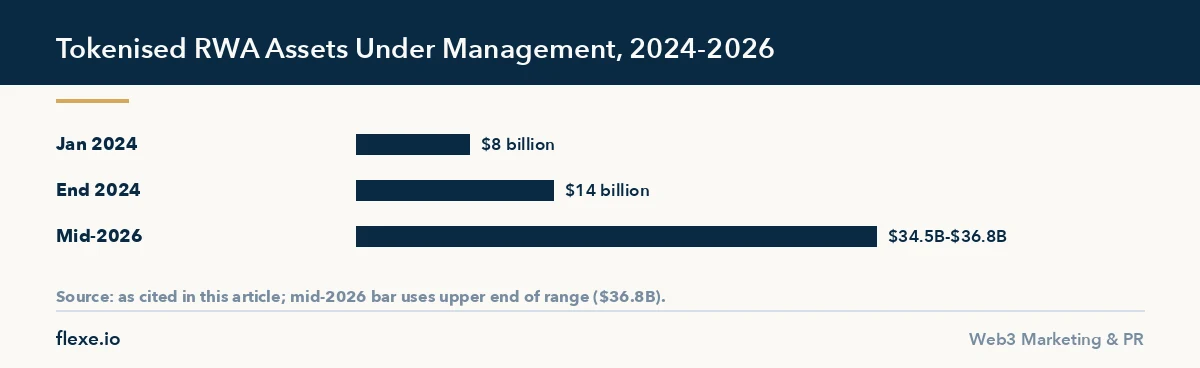
The market behind RWA and stablecoin marketing is real and growing quickly. Tokenised RWA assets under management reached somewhere between $34.5 billion and $36.8 billion by mid-2026 depending on the source, up more than 100% year on year from roughly $14 billion at the end of 2024 and about $8 billion in January 2024. More than 106 asset managers now participate, including BlackRock and Franklin Templeton. Estimates disagree at the margin, which is itself worth noting when someone quotes a single precise figure.
Who is actually the audience for RWA and stablecoin marketing?
| Segment | What they need to see | Where they are |
|---|---|---|
| Asset managers and allocators | Custody arrangements, legal wrapper, audit trail, redemption mechanics | Industry press, conferences, direct relationships |
| Corporate treasury teams | Settlement reliability, counterparty risk, accounting treatment | Finance media, peer references |
| Crypto-native funds | Yield, liquidity, on-chain composability | Crypto channels, but this is the smallest segment |
| Retail holders | Simplicity and a clear risk statement | Rarely the buyer, and regulated products often cannot market to them anyway |
The distribution of budget usually inverts that table. Projects spend on the crypto-native channels because that is where the agencies and the familiar tactics are, while the segments holding the money read something else entirely.
Why do stablecoins matter to this?
Because they are the settlement layer the rest of it runs on. Every subscription, redemption, collateral movement and secondary trade in a tokenised product settles in a stable asset, which is why the two categories grew together. As of 2026, USDT and USDC alone account for roughly $200 billion in circulation, with the total stablecoin float somewhere between $230 billion and $298 billion depending on what is counted, across more than 278 million holders.
For a stablecoin issuer the marketing problem is different again: the product is a commodity by design, so the differentiators are reserve transparency, attestation cadence, redemption reliability under stress and the breadth of places it is accepted. None of those are campaign material. They are operational facts that marketing can only publish, not create.
What actually works in RWA and stablecoin marketing?
- Publish the boring documents. Attestations, audit reports, legal structure and redemption terms are read closely by the only audience that matters.
- Lead with the wrapper, not the yield. An allocator evaluates what happens if something fails before evaluating the return.
- Name your custodian and your auditor. An unnamed counterparty reads as an unresolved one.
- Treat conference presence as sales, not brand. This is a relationship market and the pipeline is built in person.
- Assume every claim will be checked. The audience has compliance staff, which is not true of a token launch.
What does not work?
Everything that works for a token. Influencer campaigns, quest platforms, trending pushes and community growth programmes reach an audience that will not buy this product and, in regulated cases, an audience the issuer is not permitted to solicit. Growth targets expressed as community size or social reach are the wrong instrument entirely, and hitting them can coincide with no commercial progress at all.
Private credit has quietly become the largest non-stablecoin RWA segment, ahead of treasuries. That detail matters for positioning: the growth is coming from institutional credit products, not from retail-facing yield.
If the audience is an allocator rather than a token holder: how we scope institutional work.
How does compliance shape the work?
In a regulated product, marketing is a publishing function with an approval step in front of it. Every figure, every description of the structure and every claim about what the product does passes through somebody accountable before it goes out, and material that cannot be substantiated does not go out at all. Teams arriving from token marketing find this the hardest adjustment to make.
Build the approval into the calendar rather than treating it as a delay. A weekly review slot, a standing set of approved phrasings for the things you describe constantly, and a named reviewer together mean routine material moves in days. Material that skips the step and then has to be withdrawn costs far more than the review would have.
Jurisdiction decides what may be shown to whom, and that affects the site as much as the campaigns. Where a product cannot be offered in a market, the page, the form and the follow-up all have to respect it, and the fix is structural rather than a line of small print underneath everything else.
Keeping a record of every claim
Keep an archive of what was published, when, and which version of the underlying document supported it. Attestations and audit reports are dated, the figures in them move, and a page quoting a figure from two cycles ago is a compliance problem rather than an editing oversight.
The same applies to conference decks and to whatever the sales team carries. A slide that lives on somebody’s laptop for a year is the most common way an outdated figure reaches an allocator, and it is the one nobody checks precisely because it was approved once.
Review the standing pages on a schedule tied to the reporting cycle, so the site updates when the attestation does. An allocator who finds the current report in one place and a stale number on the product page has learned something about the operation, and what they learned is not about marketing.
What does the content operation look like?
Mostly documentation. The structure of the vehicle, who holds the assets, how redemption works and what happens in a failure, written so that a professional reader can evaluate it without a call. The pages that do the work in this category read like offering material rather than like a blog, and they are the pages a serious buyer spends real time on.
Around that sits a smaller layer of explanation: how the product compares with the traditional instrument it replaces, what the settlement flow looks like in practice, and what a treasury team has to change operationally in order to use it. That last question decides more deals than yield does, and almost nobody publishes an answer to it.
Publishing cadence follows the operational calendar rather than a content plan. Attestations, holdings reports and any change of counterparty are the events worth writing around, and a reader who learns that these appear reliably has learned the thing the marketing was there to communicate.
The data room and what it holds
Serious conversations move to a data room quickly, so it should exist before the first one does. Legal structure, custody arrangements in summary, audit and attestation history, the redemption policy, the operational runbook for a stressed period, and the team with their actual backgrounds. Access is granted by a person, and each request is recorded.
Access requests are also the most honest demand signal this category produces. Who asked, from what kind of institution, and what they opened first says more about positioning than any traffic report, and it is the input that should reshape the public pages between quarters.
Keep the public and private versions consistent. A number in the data room that contradicts the site ends a process quietly, because the reader concludes that nobody is checking, and nobody calls afterwards to tell you which document lost the mandate.
Who does this work internally
The people who produce this material sit closer to product and legal than to a campaign team: somebody who can read the structure documents, somebody who writes for professional readers, and a person who owns the relationships. An arrangement that supplies only the last of those leaves the documentation to nobody, which is where most programmes stall.
Whoever writes has to sit near the operations team, because the material is a description of how things actually work. A writer briefed once and then left alone produces plausible text that the first informed reader finds wrong, and a single wrong sentence in a structure description costs the credibility of the whole document.
Questions an allocator will ask
What happens to the asset if the issuer fails, who is the legal owner of record, how quickly a position can be exited and at what cost, what the accounting treatment is, and which regulator holds a view. Material answering these directly gets forwarded internally, which is how a document reaches the people you never meet.
Write the answers down even where they are unflattering, because the alternative is that the reader assumes the worst and stops reading. A stated limitation with the reasoning behind it survives diligence; an omission discovered during diligence ends the process, and nobody will call to tell you that was the reason.
Keep a running record of which questions arrive and how often, and let it set the publishing order. The category is young enough that most buyers ask the same short set, and a team that has answered them in public before the call gets to spend the call on something else.
Stablecoin issuers have a narrower story
For an issuer, the material that moves a treasury team is operational: where reserves sit, who attests and how often, what happened during the last stressed period, and how redemption behaves at size. Publishing the attestation on time, every time, communicates more than any campaign describing the same facts in adjectives.
Distribution is the other half. Which venues, custodians and payment routes accept it, and how quickly a new one is added, is the practical question behind every evaluation, and answering it well is a partnerships programme with a marketing surface rather than a marketing programme.
When something goes wrong, and in this category something eventually does, the response is the marketing. A dated statement, the same figures as always, a clear description of what happened and what changed afterwards. Issuers that go quiet during a stressed week spend the following year answering for the silence rather than for the event.
Conferences and what to do around them
Treat the event as a sales calendar rather than a presence. Meetings booked in advance, a defined set of institutions to reach, material that answers the questions this audience asks, and a follow-up written while the conversation is still recent. The badge on its own produces nothing worth reporting.
The follow-up is where most of the value is lost. A short message referencing what was actually discussed, with the specific document attached and a proposed next step, keeps a conversation that a generic summary would have ended. Send it within days, and record it wherever the pipeline lives.
Speaking slots are worth whatever the audience is, and that varies enormously between events here. A panel in front of allocators is different work from a stage in front of a retail crypto audience, and the second is where budgets go out of habit rather than out of analysis.
How to measure RWA and stablecoin marketing
Measure the pipeline rather than the audience. Qualified conversations started, data room access granted, diligence processes entered, mandates won, and how long each stage takes. These are small numbers that move slowly, which is why teams under pressure substitute community and reach figures that move weekly and mean nothing in this market.
Attribution has to survive a cycle measured in quarters. Record how each relationship began, somewhere that is not an individual inbox, and keep the record updated as it progresses, because the event that started a conversation will have been forgotten by the time it closes. Without that discipline the budget conversation happens with no evidence in it.
Report the leading indicators separately from the outcomes, so the work stays legible between closings. Documents published, attestations delivered on schedule, conversations opened with new institutions, and the share of diligence questions already answered by existing material are all things the team controls, and the last of those is the clearest sign the content is doing its job.
Attribution over a quarterly cycle
Agree at the start which activities are being tested and for how long, because a channel judged after a single quarter here is judged before anything could have closed. Set a review point far enough out to be meaningful, and write down in advance what result would justify continuing with it.
Keep the counter-evidence as well. Conversations that ended, and the reason each one ended, are the most useful record this function produces, and they usually point at a document that was missing or a question nobody had answered rather than at a channel that underperformed.
Frequently Asked Questions
How big is the tokenised RWA market in 2026?
Between roughly $34.5 billion and $36.8 billion in assets under management by mid-2026, depending on the source, up more than 100% year on year from about $14 billion at the end of 2024.
Is RWA marketing the same as crypto marketing?
No. The buyer is an allocator or treasury team with a sales cycle measured in quarters, and the crypto-native channels that move a token launch have almost no effect on them.
How large is the stablecoin market?
USDT and USDC together account for roughly $200 billion in circulation as of 2026, with total stablecoin float estimated between $230 billion and $298 billion across more than 278 million holders, depending on what is counted.
What is the largest RWA category?
Private credit has overtaken treasuries as the largest non-stablecoin RWA segment, which means the growth is coming from institutional credit products rather than retail-facing yield.
If you would rather have this run for you, see our PR placement inventory.