Crypto grant programs open in September 2026 include Starknet Seed Grants (up to $25K in STRK), Stellar Community Fund Build Awards (up to $150K in XLM), Filecoin Open Grants (up to $50,000), Solana Foundation milestone grants (a decision in about three weeks) and the Ethereum Foundation ESP (most reviews in 3 to 6 weeks). Below are nine programs checked on their own official pages on 18 September 2026, the ones that closed or paused this year, and what separates a grant that funds builders from one that funds applications.
The failure pattern is identical to airdrops and quest campaigns: an open application form attached to a reward attracts people optimising for the reward. Arbitrum found roughly 149,000 sybil addresses capturing an estimated 21.8% of its token distribution, and a grant programme with a low-friction application is the same mechanism with a review step bolted on. The airdrop side of that problem is covered separately.
Crypto grant programs open in 2026
Amounts are quoted as each official page states them, and none of these pages states an acceptance rate.
1. Ecosystem Support Program (ESP) (Ethereum Foundation)
- Funds: free, open-source, non-commercial work that improves Ethereum: infrastructure, tooling, research, education and the builder ecosystem.
- Amount: not stated. The page says funding is determined by the scope and complexity of the proposal unless a Wishlist or RFP item specifies it. Grants are paid on-chain in ETH by default.
- How to apply: apply against a published Wishlist item or RFP. Most applications are reviewed within 3 to 6 weeks.
- Source: esp.ethereum.foundation/applicants
2. Arbitrum Audit Program and ArbiFuel (Arbitrum Foundation)
- Funds: third-party smart contract audits for early-stage projects (Audit Program) and gas fees for early-stage teams (ArbiFuel).
- Amount: the Audit Program has $10M in ARB over 12 months as a total budget; per-project amounts are not stated. ArbiFuel: not stated.
- How to apply: rolling forms, both marked “Applications open”. The same page lists the Alchemy-Arbitrum Grant Program ($10M, up to $500K in Alchemy infrastructure credits) as open.
- Source: arbitrum.foundation/grants
3. Solana Foundation Grants (Solana Foundation)
- Funds: milestone-based grants for public goods, convertible grants for public goods with a commercial side, and RFPs for Foundation priorities.
- Amount: not stated per grant. The page cites $100M+ in total ecosystem funding and 500+ projects funded; Superteam Microgrants of $10k serve early-stage builders in emerging markets.
- How to apply: rolling application with a budget and milestones. Initial review takes about a week and a decision about three weeks, followed by a legal agreement.
- Source: solana.org/grants-funding
4. Uniswap Foundation Grants and Unichain Grants (Uniswap Foundation)
- Funds: protocols, tooling, research, security, governance and community work across the Uniswap ecosystem, including v4 hooks and audits.
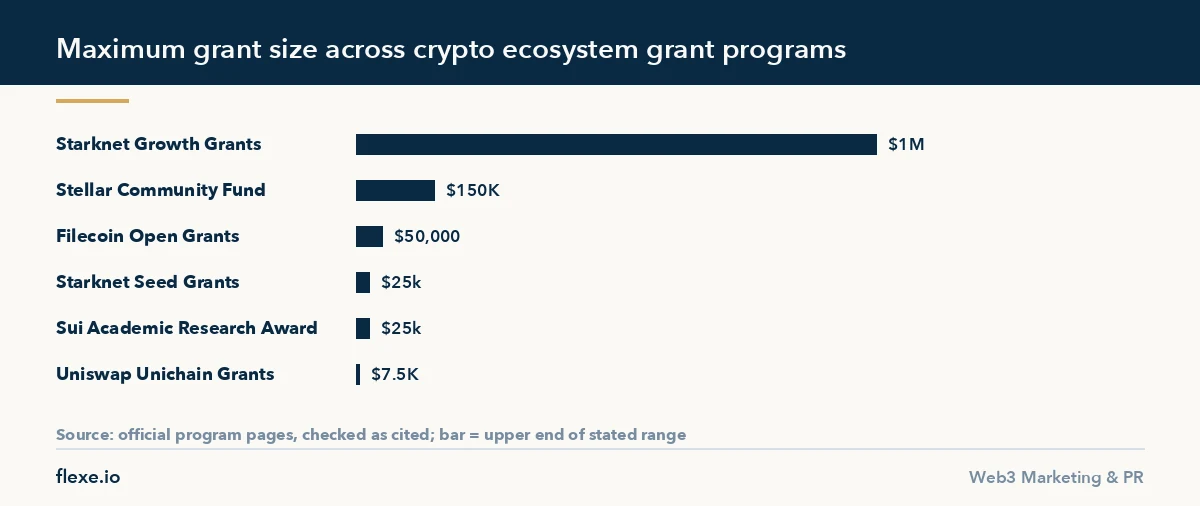
- Amount: Uniswap Foundation grants: not stated. Unichain Grants: up to $7.5K for Unichain DeFi projects with $250K+ TVL and for infrastructure projects.
- How to apply: application form on the Build page; audit subsidies for v4 hooks use a separate form. The page does not say whether intake is rolling or in rounds.
- Source: www.uniswapfoundation.org/build
5. Starknet Seed Grants and Growth Grants (Starknet Foundation)
- Funds: Seed Grants give non-dilutive go-to-market funding to early teams with an MVP or proof of concept; Growth Grants back later-stage teams with a production product.
- Amount: Seed: up to $25K in STRK. Growth: $25K to $1M STRK.
- How to apply: application links for each track are live on the grants page, which states no deadline or timeline.
- Source: www.starknet.io/grants
6. Academic Research Awards and RFPs (Sui Foundation)
- Funds: research that advances the science or security of blockchain technology, plus specific problems the Foundation posts as RFPs.
- Amount: Academic Research Award: $25k. RFPs: not stated.
- How to apply: Research Awards through the linked application; RFPs through the request-for-proposals page. The page itself says its focus is long-term support rather than grants.
- Source: www.sui.io/grants-hub
7. NEAR ecosystem funding (NEAR Foundation)
- Funds: developer tooling (DevHub Grants), metrics-based rewards for dev activity and adoption (Protocol Rewards), public goods rounds (Potlock) and DeFi and education (Meta Pool Grants).
- Amount: not stated.
- How to apply: through each program’s own portal; the Foundation page routes applicants to these ecosystem-run programs.
- Source: www.near.org/funding
8. Stellar Community Fund Build Awards (Stellar Development Foundation)
- Funds: taking validated projects on Stellar and Soroban from concept to mainnet, through Open, Integration and RFP tracks.
- Amount: up to $150K in XLM, paid in three milestone tranches: MVP, Testnet and Mainnet.
- How to apply: rounds run on a 6-week cycle: interest form, then an invitation to submit. Round SCF #46 is in its submission phase with a deadline of 8 November 2026.
- Source: communityfund.stellar.org/awards
9. Filecoin Open Grants (Filecoin Foundation)
- Funds: novel ideas that advance the Filecoin ecosystem: tooling, integrations and research.
- Amount: up to $50,000.
- How to apply: rolling: open a GitHub issue with the “Apply for an Open Grant” template. The RFP track currently shows no open RFPs.
- Source: github.com/filecoin-project/devgrants
Programs that closed or paused in 2026
Several well-known names take no applications now, and not every official page says so.
- Aave Grants DAO. Its own site still shows rolling applications, but in the official Aave governance forum on 15 July 2026 TokenLogic replied that the program has been sunset and takes no new applications.
- Optimism. Season 9 Grants Council applications closed on 20 May 2026 and the final report came out on 11 July 2026. Optimism’s own blog says Retro Funding will not run for at least the next 12 months.
- Gitcoin Grants. The latest round was GG24 in October 2025, and no new round is open or dated.
- Base. The official docs list the Ecosystem Fund and Base Batches, which are investments, not grants.
What grant programmes are actually for
A grant programme is a fund a chain or protocol uses to pay outside teams to build on it. It is a distribution channel: money goes out, and the chain expects ecosystem activity to come back. The money buys that activity only if selection filters for teams that would have built anyway.
| Stated goal | What it usually produces | What produces it instead |
|---|---|---|
| Ecosystem growth | A list of funded projects, most inactive within a year | Funding teams already shipping on the chain |
| Developer acquisition | Applications from developers who apply everywhere | Documentation, support and tooling that make building easy |
| Marketing and visibility | A press release per grant | Funded projects that succeed and say so unprompted |
| Filling product gaps | Whatever applicants wanted to build | A published list of what the ecosystem needs, with grants attached |
That last row is the highest-yield change most programmes never make. Publishing the gaps you want filled turns a passive fund into a request for proposals, and the applications arrive pre-filtered.
How to run a grant programme: the key tactics
1. Publish the gaps you want filled
Write down what the ecosystem needs and attach grants to it. Applicants then answer a stated question instead of pitching whatever they wanted to build.
- Best for: Filling product gaps and developer acquisition
- Metric to watch: Share of applications that answer a published gap
2. Require something already built
A prototype, however rough, separates teams from documents. Funding a roadmap instead of a prototype is the most common structural mistake.
- Best for: Every round, from the first one
- Metric to watch: Proposals rejected for no working prototype
3. Fund in tranches against milestones
A single upfront payment removes every incentive that follows it, and the completion rate reflects that. Each payment becomes a check on delivery rather than an act of faith.
- Best for: Any grant larger than a small first test
- Budget: Smallest first tranche that lets the team start, with a final tranche payable after the work is live
- Metric to watch: Milestones delivered on the stated date
- Watch out: Milestones written as continued development cannot be checked at all
4. Prefer teams already deploying on your chain
Migration promises are the least reliable input in the process. Funding teams already shipping on the chain is what actually produces ecosystem growth.
- Best for: Ecosystem growth
- Metric to watch: Contract calls from funded teams in the last thirty days
5. Cap the cohort and publish rejection criteria
A programme that funds everything worthy funds nothing well, because support capacity is the real constraint. Clear rejection reasons reduce application volume and raise quality at the same time.
- Best for: Programmes drowning in applications
- Budget: Set by support capacity, not by the size of the fund
6. Support funded teams beyond the money
Write down what the programme provides beyond money: a technical contact who answers within a working day, a review of the integration before it goes live, introductions to teams building nearby, and a slot in whatever the ecosystem publishes. The same logic applies to hackathons run for builders.
- Best for: Turning funded teams into public advocates
How to plan it step by step
1. Open a fixed intake window
Publish the dates a round opens and closes, how many grants it can support and the day decisions go out, then hold to them. A permanent form produces a queue nobody owns.
2. Give every application a named owner
That person chases missing information and carries the proposal to a decision. Publish a target in working days for the first reply, because a slow reply tells a builder what support will look like later.
3. Score each application alone on a written sheet
Score whether something already runs, whether the team has shipped before, whether the work fills a published gap and what the amount buys. Reviewers with a stake in an applicant declare it and do not score. Where reviewers disagree, the milestone plan breaks the tie.
4. Reject quickly with a reason code
Out of scope, no working prototype, milestones not checkable, and amount not matched to the work cover most cases. A late rejection with no reason costs goodwill the programme has to buy back elsewhere.
5. Verify before the first tranche
Read the commit history rather than the README, run the prototype, and check that the deployed contract and addresses belong to the team. Ask which other grants are live, because teams applying everywhere with one deck risk getting the same milestones paid twice.
Contracts, milestones and payment terms
The agreement names the scope, the milestones, what counts as acceptance for each, the amount and currency of every tranche, each deadline, and what happens when one passes. It also states who owns the output and its licence. Milestones must be checkable by someone who was not in the meeting: a deployed contract address, a tagged release, an audit report delivered, an integration live on mainnet.
Decide the payment currency before the offer. Native tokens push price risk onto the team and create sell pressure; stablecoins avoid both. Size the first tranche as the smallest amount that lets the team start, and handle the invoice, the named recipient and sanctions screening before it moves.
When a milestone slips or a grant is cancelled
Slippage is normal; silence is the problem. A missed date requires written notice with a revised date, and a second miss on the same milestone triggers an explicit pause. Cancellation follows a procedure written in advance: notice, a period to respond, return of unspent funds and a written close. Handled that way a cancelled grant costs one tranche.
Mistakes to avoid
- Funding a roadmap instead of a prototype. The document gets funded and the product never arrives.
- Paying everything upfront because the amount felt small. Every incentive after the payment disappears with it.
- Funding more teams than the programme can support. The support that produces advocacy never happens.
- Changing the criteria mid-round. Applicants learn that the published rules are decorative.
- Treating the announcement as the deliverable. A press release per grant describes nothing that has happened yet.
A grant programme works as B2B marketing only through funded teams talking about the experience unprompted after real support. If the programme needs operational support rather than more applications: how we support builder programmes.
How to measure results
Not grants awarded, the number that says least. The honest measures are how many funded projects are still active at six and twelve months, how many reached users without further funding. The same day-30 logic we apply to community campaigns applies at a longer scale here: activity after the last tranche is the entire signal.
Keep a register of funded teams: the grant, the tranches paid, the contract addresses, the repository, the contact and the date of the last response. A monthly check-in of four questions is enough:
- What shipped?
- What slipped?
- What is blocked?
- What can the programme do about it?
Define activity once and measure it the same way every quarter: contract calls in the last thirty days, commits in the last ninety, a working front end, someone answering support questions. Publish the outcomes, including the failures, because builders comparing crypto grant programs across ecosystems notice when only successes are reported.
Frequently Asked Questions
Which crypto grant programs are open in 2026?
As of 18 September 2026, open programs include the Ethereum Foundation ESP, the Arbitrum Audit Program, Solana Foundation Grants, Uniswap Foundation and Unichain Grants, Starknet Seed and Growth Grants, Sui Academic Research Awards, NEAR ecosystem funding, Stellar Community Fund Build Awards and Filecoin Open Grants. Each was checked on its official page. Aave Grants DAO, Optimism and Gitcoin Grants have no open round.
How much do crypto grants pay?
It depends on the program, and several publish no amount. Starknet Seed Grants go up to $25K in STRK and Growth Grants from $25K to $1M STRK. Stellar Build Awards go up to $150K in XLM, Filecoin Open Grants up to $50,000, and Unichain Grants up to $7.5K. The Ethereum Foundation sets ESP amounts by scope.
How long does a grant decision take?
Only a few programs publish it. Ethereum Foundation ESP reviews most applications within 3 to 6 weeks. Solana Foundation does an initial review in about a week and decides in about three weeks. Stellar Community Fund runs rounds on a 6-week cycle, with SCF #46 taking submissions until 8 November 2026.
What makes a crypto grant programme fail?
An open application form attached to a reward is the usual cause, because it attracts teams optimising for the grant rather than for the product. Arbitrum found roughly 149,000 sybil addresses capturing an estimated 21.8% of its token distribution, and a low-friction grant form is that mechanism with a review step added.
How should crypto grants be paid out?
Pay in tranches against milestones that someone outside the meeting can check, such as a deployed contract or a tagged release. A single upfront payment removes every incentive that follows it. Keep the first tranche small and hold a final tranche until the work is live, then track whether the team is still active at six and twelve months.