To submit a crypto press release that gets read, you build it on one checkable fact, choose outlets by trust rather than volume, agree terms in writing, send it Tuesday to Thursday morning with an exclusive first, and track every placement afterwards. Crypto press release distribution is the practice of publishing and syndicating project news across crypto media and wires to build awareness and credibility, and in 2026 it works best as part of earned PR, not as a standalone tactic. This guide covers where to submit, what to check first, and the limits of a paid placement.
What you need before you start
A crypto press release is the syndication of a project announcement, such as a launch, listing, or partnership, across crypto news outlets and wire services to reach investors, users, and media. Before anything goes to an outlet, have these ready:
- A newsworthy fact. A number, a named partner, or a filing that a reporter can verify in two minutes.
- A headline written as the fact. The project name and the thing that happened, not a slogan.
- A founder quote that explains a decision. Why it was made, or what changes for users, in a couple of sentences.
- Assets. A logo in a usable format, an image or two that are not screenshots of a slide, spokesperson biographies, and the landing page the release points to.
- A reachable contact. A named person who will answer the same day, with a working handle.
How to submit a crypto press release step by step
Distribution amplifies news but does not replace earned editorial coverage. The steps below keep the submission useful on both counts.
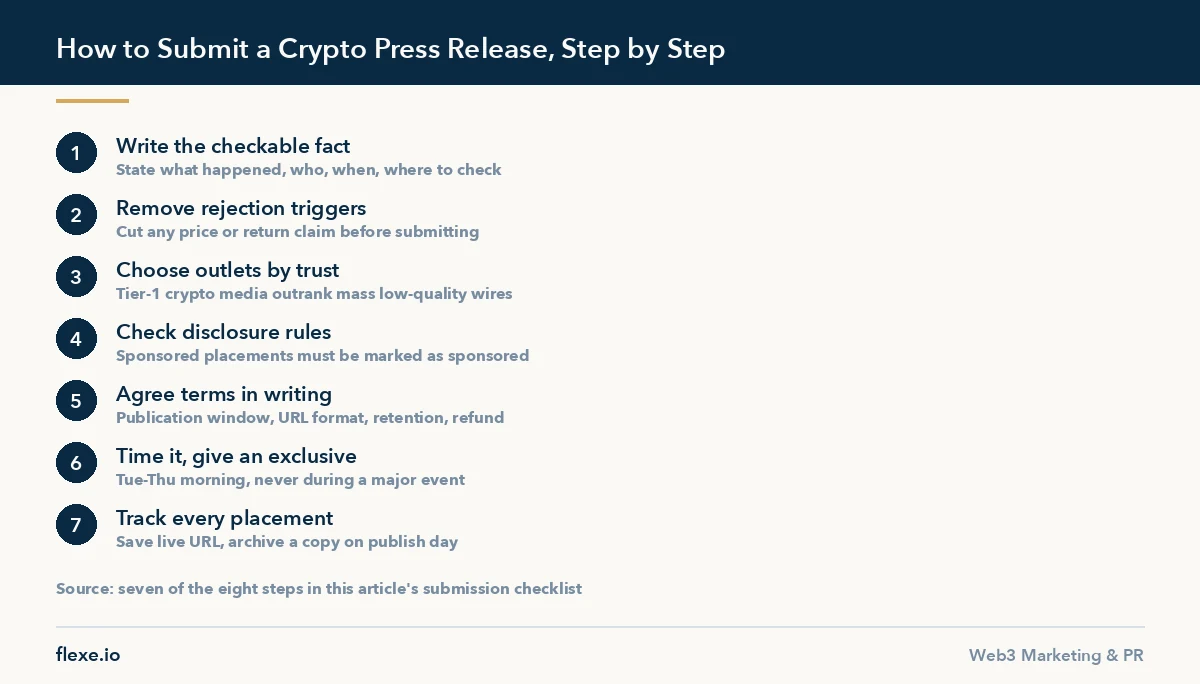
1. Write the release around the checkable fact
A crypto press release is read in the first two lines or not at all, so the opening has to state what happened, who it involves, when, and where it can be checked, with no preamble about the state of the industry. Put the number or the named partner in the first sentence. The quote is where most releases lose the reader: a founder saying the project is excited adds nothing, while a line explaining why the decision was made is the part an outlet keeps when it cuts the release down to a paragraph. Close with the boilerplate, the named contact, and links to the material supporting the claim.
- Check: the headline works as a line in a feed, a search result for the project name, the subject of an email to a reporter, and the sentence somebody repeats back.
- Why: a release with no reachable contact is treated as syndication filler, because the outlets that would have followed up cannot.
2. Remove anything that gets it rejected
Read the release once for anything that reads as a price or return claim, since that is what gets a submission rejected and what makes a published placement a liability later. Remove superlatives you cannot source, undated statistics, any comparison with a named competitor you cannot evidence on request, and any claim about a partner who has not approved being named. Cut anything a reporter cannot verify in two minutes. That single edit does more for pickup rates than any distribution package.
- Check: no price forecast, no return promise, every partner named with approval.
- Time: one careful read, before the assets go anywhere.
3. Choose outlets by trust, not by volume
Tier-1 crypto media carry far more trust than mass low-quality wires. A media kit is a sales document: traffic and readership figures in it are supplied by the outlet and are not audited, so treat them as claims rather than data and ask what recent placements in your category actually produced. Decide what each placement is for before paying. A tier-1 placement buys credibility a mass wire cannot, a wire buys a footprint a single placement cannot, and the mix depends on whether the release supports a fundraise conversation or a brand search result.
- Watch out: buying only the cheap end fills the search results for your name with low-authority copies of one text.
- Ask: whether the placement carries a followed link, before the invoice rather than in the report afterwards.
4. Check the disclosure rules for each destination
Credible outlets mark sponsored placements as sponsored, and asking to have that marking removed is the request that ends the relationship. Disclose sponsored posts and avoid price or return claims. Plan the release on the assumption that the marking will be there, because a release that only works unmarked is the wrong release.
5. Agree terms in writing
Get the publication window, the URL format, the retention period, and the refund position in writing. Some outlets remove sponsored posts after a period, which turns a placement you paid for into a dead link on your own press page. Agree who edits: outlets routinely cut releases to fit, and a cut that removes the checkable fact leaves the adjectives behind. Ask to see the version that will publish, and structure payment so part of the fee follows publication rather than preceding it.
- Check: how long the post stays live, whether the URL survives a site redesign, and who to contact when it does not.
- Timing: ask how long publication takes after acceptance, whether the outlet will hold to an embargo, and who carries a delay caused on their side.
6. Time it and give one outlet a reason to be first
Tuesday to Thursday morning in the target market is the window, never during a major industry event where you compete with everything else. An exclusive an hour ahead converts far better than a simultaneous blast, and costs nothing. Releases tied to a listing or a launch date are the ones that get published a day late, so outlets that cannot commit to a date should receive the release after the event rather than before it.
- Time: Tuesday to Thursday morning, target market time zone.
- Cost: an exclusive costs nothing extra.
7. Track every placement after publication
Collect the live URL for every placement on the day it appears and archive a copy, since the record is what the next fundraise conversation or the next outlet will ask to see. Check a fortnight later that each one is still live and still carries the link, because quiet removals happen and nobody will write to tell you. Keep the press page on your own site as the canonical record, with every placement listed by date, outlet, live link and archived copy.
8. Follow up once, then build relationships
One follow-up, short, to a named person, referencing the fact rather than the release. Reporters answer the messages that offer something specific: an interview with the named partner, or the data behind the number. A second follow-up on the same announcement works against you. Pair distribution with community and KOL amplification, and keep relationships alive between announcements: the outlets that cover a project on its third release are usually the ones that were sent something useful when there was nothing to sell. Build the contact list from reporters already writing about your category rather than from a purchased database.
Where to submit a crypto press release: channels and outlets
Prioritize credible crypto media, relevant niche publications, and reputable wires. A placement in a trusted outlet does more for credibility than dozens of low-quality republish sites that add no trust.
| Channel | Reach | Trust |
|---|---|---|
| Tier-1 crypto media | Targeted | High |
| Niche crypto sites | Focused | Medium |
| Mass wires | Broad | Low |
The outlets below accept paid placements, and each page sets out what that particular publication costs and how long it takes to appear.
- BraveNewCoin Submit Press Release
- CryptoBriefing Submit Press Release
- CoinJournal Submit Press Release
- BitcoinWorld Submit Press Release
- CryptoCompare Submit Press Release
- InsiderMonkey Submit Press Release
- TheStreet Submit Press Release
- HackerNoon Submit Press Release
- Investing.com Submit Press Release
- TheBitTimes Submit Press Release
- TheNewsCrypto Submit Press Release
- U.Today Submit Press Release
- CryptoDaily Submit Press Release
- CryptoSlate Submit Press Release
- MENAFN Submit Press Release
- Finbold Submit Press Release
- ADVFN Submit Press Release
- BusinessInsider Submit Press Release
Only a minority of release outlets carry a followed link, and which ones they are changes. If you want the placement decided on that basis rather than on a media kit, our crypto PR team works from a current list of authority and readership figures per outlet.
Distribution vs pickup: what you are actually buying
Does press release distribution still work in 2026? Yes as amplification, but a paid wire blast alone rarely builds trust. Paid distribution guarantees publication on syndication sites and almost never produces coverage. The two are sold together and are not the same purchase.
- Distribution buys a footprint. Your announcement appears on dozens of low-authority sites. Useful for the record and for search of your brand name, worthless as coverage.
- Pickup requires a fact a journalist can check. A number, a named partner, a filing. Announcements built on adjectives are not rejected, they are simply never read past the first line.
- Timing beats wording. The same release lands differently on a Tuesday morning and a Friday afternoon.
- A newsworthy angle beats volume. A newsworthy angle and clear facts matter more than the number of placements.
Coverage that survives scrutiny takes relationships and a checkable claim. We handle both, and package the supporting material: whitepapers and promo video that give a journalist something to work with.
Common mistakes
- Sending the same release to everyone at once. It removes the one thing an editor wants, which is a reason to be first. The wider distribution can follow on the same day without losing anything.
- Publishing during a major industry event. The release competes with everything else that week, and one sent on a Friday afternoon is read by nobody on either side of the transaction.
- Treating distribution as coverage. A footprint across syndication sites proves publication rather than interest, and a report counting republish sites as media coverage misleads the people inside the project, who then approve the same spend again next quarter.
- Padding the release to look substantial. The shorter document is both more likely to be read to the end and more likely to be quoted when an outlet writes its own version.
- Rewriting everything after a rejection. Rejections usually name a category: unverifiable claims, a forecast about price, a missing entity behind the announcement, or a landing page that does not match the story. Fix the named issue only and resubmit, because a full rewrite discards whatever was already acceptable and sends the submission back to the start of the review queue.
If several outlets reject the same release, the problem is the news rather than the wording. A partnership with no named partner, a listing with no date, a funding round with no investor, or a product with no live link cannot be published by anyone who checks. Hold the release until the missing fact exists rather than buying wider distribution to compensate for its absence.
How long it takes and what it costs
Costs range from low-cost wire syndication to premium sponsored placements in top outlets. Price tracks the authority of the destination, so a few high-trust placements usually beat a large cheap blast. Each outlet on our publications list states its own price and how long it takes to appear.
Time is mostly lost on your side, not the outlet’s. Outlets that ask for assets after acceptance add days to publication, and a launch release that appears after the launch is worth less than the fee paid for it. Settle the timing before the assets go over, and plan for the checks that follow publication: live URLs on the day, a second check a fortnight later.
Measure brand search rather than clicks. Syndicated releases send very little direct traffic and most carry no followed link, so the honest measures are whether searches for the project name rise in the days after publication, whether the placements hold the first page for that name, whether the release reached anyone in the target market, and whether any outlet that was not paid picked the story up. That press page on your own site is also what a reporter checks when deciding whether the project has been covered by anyone who asks questions.
Frequently Asked Questions
Where should I submit a crypto press release?
Submit it to credible tier-1 crypto media first, then to relevant niche crypto publications, and use reputable wires only for the footprint. One placement in a trusted outlet does more for credibility than dozens of low-quality republish sites, and the outlets listed on our PR publications page each show their own price and time to appear.
Does paid press release distribution work?
It works as amplification, not as coverage. Paid distribution guarantees publication on syndication sites and almost never produces editorial pickup. Those are two different purchases sold together: distribution buys a footprint that helps searches for your brand name, while pickup requires a fact a journalist can check, such as a number, a named partner or a filing.
When is the best time to send a crypto press release?
Send it Tuesday to Thursday morning in the target market, and never during a major industry event where you compete with everything else happening that week. Give one outlet an exclusive an hour ahead of the wider release, because a reason to be first converts better than a simultaneous blast and costs nothing extra.
Do crypto press releases help SEO?
Only a little, and mostly indirectly. Most syndicated releases are nofollow, so the value is awareness and brand mentions rather than direct link equity. Only a minority of release outlets carry a followed link and the list changes, so ask about the link before paying and measure brand search rather than clicks afterwards.
Is a press release enough on its own?
No. A press release works as amplification alongside earned coverage, community and KOLs. A paid wire blast alone rarely builds trust, while earned coverage in credible crypto media does far more, so treat distribution as one part of a real PR strategy and keep relationships with reporters alive between announcements.
Work With Flexe.io
Flexe.io has helped 800+ crypto, Web3, and fintech clients since 2018. To get help, message us on Telegram at https://t.me/flexe_io_agency.