Web3 advertising platforms compared by type: ad networks give the broadest reach with the weakest quality control, direct placement on one property such as DappRadar or CoinGecko gives fewer impressions and far better context, and on-chain, wallet-targeted platforms reach users by holdings but with immature measurement. Fourteen crypto ad networks sell this inventory as of September 2026, and they differ on which wallet data they target on, how metrics are verified, and the minimum budget. Whatever the type, campaigns work through five levers: wallet-based targeting, short video, regional focus, native placements and retargeting, all judged on what users do after the click.
Mainstream platforms are not a substitute either. Google, Meta and X restrict crypto categories, and crypto ads there run only with certification, only in permitted markets and rarely for tokens. That restriction is precisely why crypto-native inventory exists and why it commands the prices it does.
What is a Web3 advertising platform?
It is ad inventory sold against a crypto audience, usually with targeting built on wallet data. The table shows the four capabilities that separate it from mainstream ad platforms.
| Capability | What it does | What mainstream ad platforms do instead |
|---|---|---|
| Wallet-based targeting | Selects users by transaction history and token holdings | Infer interest from browsing and declared demographics |
| Niche audience access | Reaches DeFi traders, NFT collectors or GameFi players as separate segments | Group them all under a single finance or gaming interest |
| Verifiable metrics | Delivery and interaction recorded on chain and auditable by the buyer | Report from the platform’s own measurement only |
| Crypto-native placement | Runs on sites whose audience already holds a wallet | Restrict or reject crypto creatives under category policy |
In practice these capabilities mean wallet-based targeting of active blockchain users by transaction history and token holdings, access to niche audiences such as DeFi traders, NFT collectors or GameFi players, metrics that can be verified rather than taken on trust, and higher engagement, because Web3 audiences are more likely to interact with ads written for them.
Web3 advertising platforms compared: three types
| Type | Reach | Quality control | Best use |
|---|---|---|---|
| Ad networks | Broadest, across many sites | Weakest; ask for the publisher list first | Reach |
| Direct placement on one property | Fewer impressions | Far better context | Quality |
| On-chain and wallet-targeted | By holdings or activity, smaller than pitched | Measurement still immature | Small experiments |
| Google, Meta and X | Large, but crypto categories restricted | Certification and permitted markets only | Rarely tokens |
The category covers three different products sold under one name, and picking the wrong type wastes the budget before targeting is even considered:
Ad networks resell inventory across many sites. They offer the broadest reach and the weakest quality control, and they are the type where a publisher list should be requested before any spend.
Direct placement on one property, such as an explorer, a data site or a wallet, gives fewer impressions and far better context, and is priced accordingly.
On-chain and wallet-targeted platforms reach users by holdings or activity rather than by site. They are genuinely novel and worth testing small, because measurement is still immature and audience sizes are smaller than the pitch suggests.
Which one is right depends on a single question: do you need people who already hold a wallet, or people who do not yet know the category exists? Our crypto traffic team buys against that answer rather than against a rate card.
Web3 ad campaigns: the key tactics
1. Wallet-based targeting
Ads are shown to users selected by wallet activity, such as transaction frequency or specific token holdings. It works because it reaches people already active on chain instead of people who once read about crypto. Focus on specific ecosystems such as Ethereum, Solana or Polygon rather than on crypto in general. Flexe.io’s Web3 Ads services reach crypto audiences across blockchain explorers and crypto media.
- Best for: DeFi, wallets and any product that needs an existing on-chain user
- Metric to watch: wallet connections from the campaign, not clicks
- Watch out: audience sizes are smaller than the pitch suggests
- Test size: the smallest unit the platform sells
2. Short video alongside the platform campaign
Short, engaging videos explain what a project does faster than a banner can, and they drive stronger engagement and recall. Highlight tokenomics, staking rewards or product benefits in 60-second clips and share them on TikTok, Instagram Reels and YouTube Shorts alongside the Web3 campaign. Flexe.io’s short video production services can help produce them.
- Best for: products whose mechanism needs a demonstration
- Metric to watch: visits and sign-ups from viewers who saw the clip
- Watch out: a clip that promises something the landing page does not repeat
- Format: 60-second clips
3. Regional audiences
Focus campaigns on high-growth Web3 regions such as Southeast Asia, Latin America and Africa, where regional campaigns reach markets that mainstream crypto advertising leaves thin. Create localised ads written for the cultural context rather than translated copy. Flexe.io’s regional PR services can help build campaigns for specific markets.
- Best for: projects with a product that already works in the target region
- Metric to watch: conversion rate per region, compared side by side
- Watch out: running one global creative in every market
- Pair with: local community channels in the same language
4. Native ads
Native ads blend into the content of the platform that carries them, feel less intrusive and are more likely to engage users. Use sites such as DappRadar or CoinGecko for native placements, and work with Flexe.io’s native ad experts on execution. Native placement on one well-known property is often the quality option discussed above.
- Best for: projects that need context and credibility more than raw reach
- Metric to watch: time on page and actions after the click
- Watch out: placements that sit below the fold
- Where: data sites and explorers such as DappRadar or CoinGecko
5. Retargeting
Show ads to users who previously visited your site or used your product. Retargeting keeps a project in front of people who already showed interest and lifts conversion rates. Use cookie-based tracking to retarget visitors, and give them a reason to return: new features, limited-time offers or staking rewards.
- Best for: projects with steady site traffic to recapture
- Metric to watch: cost per acquisition on returning visitors
- Watch out: crypto audiences block scripts more than most, so audiences shrink
- Message: something new since the first visit
How to plan it step by step
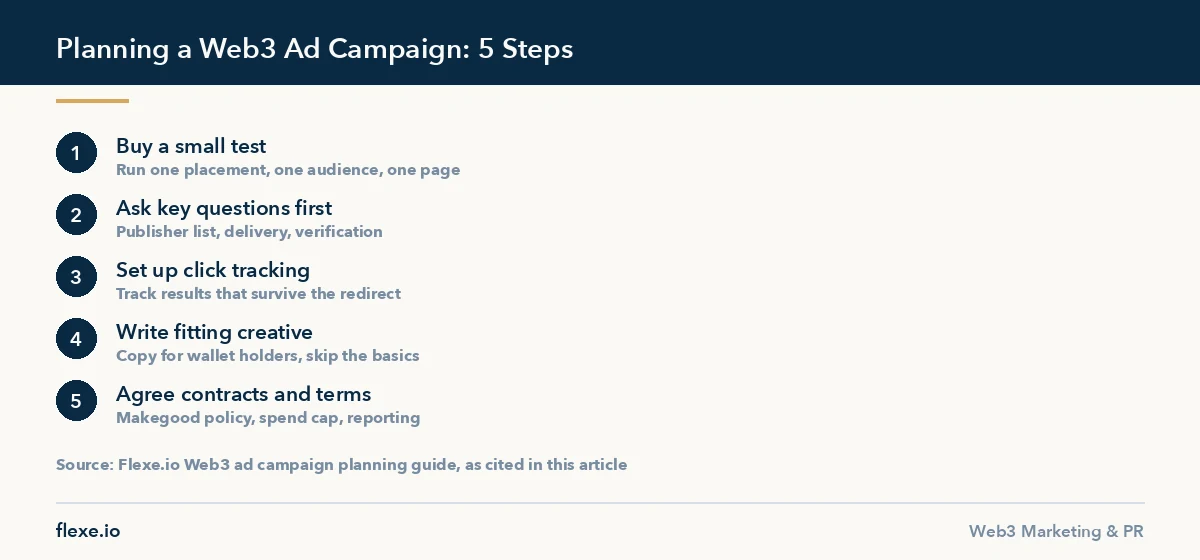
1. Buy a small test and treat it as an audit
Buy the smallest unit the platform sells: one placement, one audience, one landing page, run long enough to collect behaviour instead of clicks. The purpose is to find out whether the traffic behaves like people, which a week of data answers and a rate card never does. Keep the creative constant so the inventory is the only variable, and run the same test with a second vendor over the same period. Two vendors measured side by side against one landing page tell you more than either measured alone across two months.
2. Ask the questions before the first insertion order
Ask for the publisher list, the share of traffic the largest sites contribute, whether placements sit above the fold, and what share of inventory is bought in from other networks, because resold inventory is where a publisher list stops being accurate. Ask how impressions and clicks are counted, who counts them and whether you can verify the count. Where a platform reports on chain, ask what exactly is written there: a request, a rendered impression or a viewed one. The word verifiable describes the record, not the definition behind it. Finally, ask whether the vendor may use your name in its own materials once the campaign ends.
3. Set up tracking that survives the click
Decide what a result is before buying anything. Wallet connections, documentation visits, application sign-ups or joins of your own channel are usable; impressions are not. Put a distinct parameter on every placement, check that it survives the redirect the platform adds, and confirm that a test click arrives correctly labelled before the campaign starts. Record the campaign dates in your analytics, so later readings of the numbers have that context attached.
4. Write creative that fits crypto inventory
Write for people who already hold a wallet and skip the category explanation mainstream copy needs. Name the chain, the mechanism and the action, then send the click to a page that repeats that promise in the first screen. Most wasted spend on this inventory is a mismatch between the ad and the page rather than a targeting failure, and it shows up as a bounce within seconds. Check the page on a phone, since most of this traffic arrives on one, and do not demand a wallet connection before explaining anything.
5. Agree contracts, payment and reporting
Agree the makegood policy before spending: what happens if delivery falls short, if placements run in positions you did not buy, or if a publisher pauses the campaign. Set a spend cap, ask for reporting at a fixed interval and keep creative approvals in writing. Paying in stablecoins is normal on this inventory and removes none of that paperwork. Start on a short order with no minimum commitment and let the second order carry the volume, and keep the raw reports the vendor sends, because they decide any later credit negotiation.
Mistakes to avoid
- Ignoring compliance guidelines. Non-compliance can lead to ad bans or fines, so follow advertising rules for crypto and Web3 promotions in every market you buy.
- Generic messaging. Generic ads fail to connect with blockchain-savvy audiences; state the project’s specific value instead.
- Overlooking mobile. Most users reach Web3 products on mobile devices, so ads and landing pages must work on a phone.
- Choosing a network when you needed one placement. Most projects waste their first budget this way on a site their audience already uses.
- Tuning instead of pausing. Optimisation assumes the inventory works, and no bid or creative change repairs an audience that was never there.
The usual failure is sudden volume with no post-click behaviour. Check the hour-by-hour distribution, the device mix and the share of sessions lasting under a second, then ask the vendor for the publisher breakdown behind the traffic. A vendor who credits the spend and names the source is worth a second test; one who explains the pattern away is not. Expect your own count to sit below the platform’s: a gap of a few percent is ordinary loss, a gap of several times over must be settled before a second order.
How to measure results
Five numbers show whether a Web3 ad campaign is working:
- Impressions: how many users saw the ads, a measure of reach.
- Click-through rate (CTR): how many users interacted with the ads.
- Conversion rate: how many clicks became token purchases, sign-ups or other actions.
- Cost per acquisition (CPA): what it costs to acquire a new user.
- Return on ad spend (ROAS): whether the campaign returns more than it costs.
Review by placement rather than by platform. Most spend on a network concentrates in a handful of sites, and those sites are often buyable directly once you know their names. Keep whatever produced verified actions and re-test the remainder only when you have a new offer rather than merely a new creative.
One example of what these numbers look like when the tactics are combined: a new DeFi platform struggling for visibility launched wallet-based ads aimed at active DeFi traders on Ethereum and Binance Smart Chain, added short explainer videos on its high APY staking, and used retargeting to turn site visitors into users. Website visits increased by 300%, the platform gained 15,000 new users in three months, and ad spend delivered a 5x return.
Flexe.io plans these campaigns end to end, from wallet-based targeting to short video content and regional marketing. Visit Flexe.io or contact us on Telegram at Flexe_io_agency to plan a campaign against wallet-targeted inventory. If you would rather hand paid media to a team, our crypto advertising agency guide explains what to expect.
For teams that want someone to run these platforms for them, we checked the best crypto advertising agencies on pricing and channels.
Frequently Asked Questions
What is a Web3 advertising platform?
It is ad inventory sold against a crypto audience, targeted by on-chain behaviour rather than browsing history. Three products share the name: ad networks reselling inventory across many sites, direct placement on one property such as an explorer or data site, and on-chain platforms that target by wallet holdings or activity. They differ more than the label suggests.
Which type of Web3 ad platform should you choose?
Direct placement for quality, networks for reach and on-chain targeting for experiments. Most projects waste their first budget by choosing a network when they needed one placement on a site their audience already uses. Decide first whether you need people who already hold a wallet or people new to the category.
Does wallet-based targeting work?
It is genuinely novel and worth testing at small scale, but measurement is still immature and audience sizes are smaller than the pitch suggests. Treat early results as directional rather than conclusive, judge them on wallet connections and other actions after the click, and compare at least two vendors over the same period.
How do you audit a Web3 ad platform?
Request the publisher list, run a small test before committing, and judge on behaviour after the click rather than click volume. Ask how impressions are counted and what exactly is written on chain. A platform that will not disclose where its ads run cannot be audited at all and should not get a second order.
What does Web3 advertising cost?
The range is wide, from cents per thousand impressions on open networks to four-figure monthly placements on high-traffic explorers. Price tracks audience quality closely enough that unusually cheap inventory is usually a warning. Minimum budgets differ between networks, so start with the smallest unit sold and let the second order carry the volume.