A KOL campaign or paid ads: both channels buy attention. They differ in what comes attached to it. A paid impression is anonymous and repeatable; a creator post arrives with an endorsement from someone the reader already chose to follow, and that endorsement is the entire reason it costs more per view.
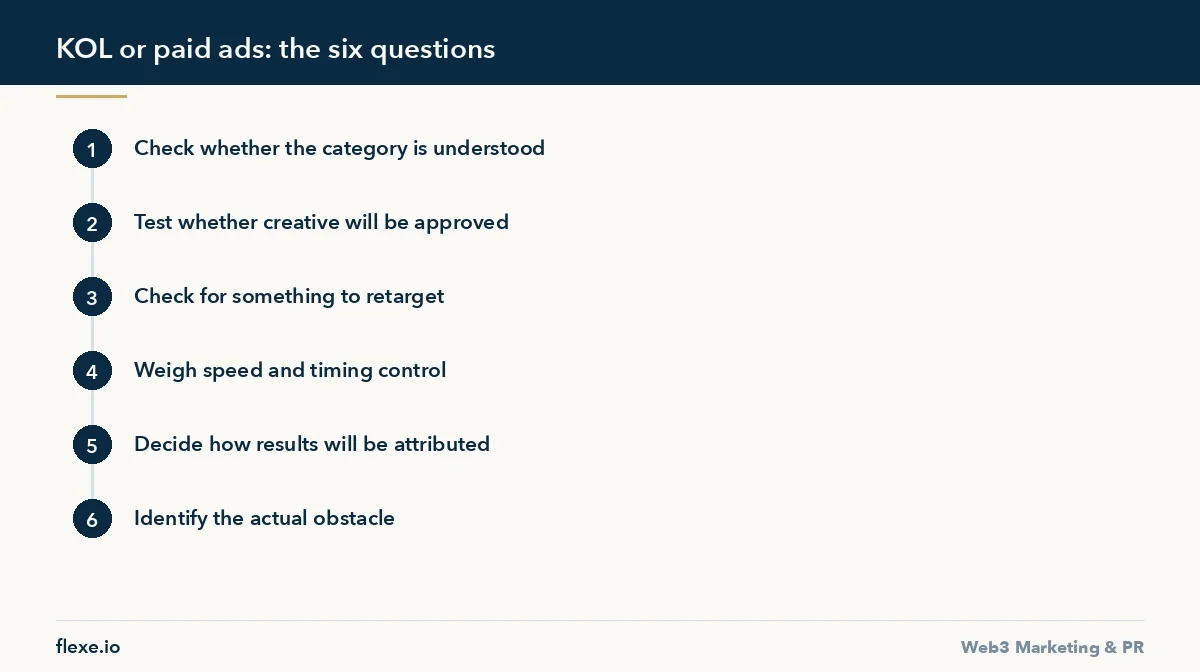
Which one moves a launch depends on six things about your specific situation, none of which is budget size.
KOL campaign or paid ads: the honest comparison
| KOL campaign | Paid ads | |
|---|---|---|
| What you buy | An endorsement plus reach | Reach only |
| Cost per view | Higher | Lower |
| Turning it off | Not possible. The post is published | Instant |
| Scaling up | Book more creators, one negotiation each | Raise the budget |
| Attribution | Partial. Many readers act later | Direct, within platform limits |
| Moderation risk | Low. Creators publish freely | High. Crypto creatives are rejected routinely |
| Failure mode | A post nobody engages with | Spend with no conversions |
| What it leaves behind | A permanent, quotable post | Nothing once the budget stops |
The last two rows drive most real decisions. Ads stop existing the moment you stop paying. A creator post stays up, gets indexed, and is available to be cited later, including by assistants summarising a project.
1. Does anyone know what your product is yet?
Advertising works best on demand that already exists. If a person does not know your category, a banner asking them to connect a wallet is asking for a decision they have no basis to make.
Creators can explain. A post that spends four sentences on why something matters before naming the product does work an advertisement cannot, which is why unknown products usually need the creator first and the ad second.
2. Can your creative get approved?
Mainstream ad networks apply financial promotion rules to crypto unevenly and reject a great deal of it, and the worst outcome is not a refused advertisement but a restricted account. Crypto-native networks and explorers avoid that entirely, at the cost of a narrower audience.
Creators face no such gate. If the product cannot be described in a way a mainstream network will accept, that alone often settles the question. What passes and what does not is covered in how to get crypto ads approved on mainstream networks.
3. Do you have something to retarget?
Paid channels are strongest when they bring back people who already visited. That requires existing traffic, working measurement and an audience pool with enough volume to be worth bidding on.
A project with none of those is asking advertising to do prospecting, which is its most expensive mode. Creators are frequently the cheaper way to generate the first visit that retargeting then depends on.
4. How fast do you need it, and how precisely timed?
Ads start today and can be paused mid-campaign if something goes wrong. A creator campaign takes days to negotiate and brief, publishes on a schedule you only partly control, and cannot be recalled once live.
For a listing hour or a sale window, that difference matters. It is also why a launch that might slip should not have creator posts locked to a date.
5. Can you tell which one worked?
Advertising reports its own results. Creator attribution is partial by nature: people see a post, do nothing, and arrive through search a week later, and some wallets never touch a tracked link at all.
That is an argument for measuring creators consistently rather than for avoiding them. Unique links per creator and a thirty-day check are the minimum, and the method is in how to measure whether a KOL campaign worked.
6. Are you buying attention or credibility?
If the obstacle is that nobody has heard of you, attention is the answer and ads are the efficient form of it. If the obstacle is that people have heard of you and are unsure whether you are real, no amount of impressions helps and a credible person saying so does.
Most crypto launches face the second problem and buy the first, which is why so many campaigns deliver reach and no wallets.
If a KOL campaign wins the comparison, our ranking of the top crypto influencers shows who reaches the largest audiences, and crypto influencer marketing explains how we plan and report those campaigns.
Set up measurement before either channel starts
Both channels are unreadable without a baseline captured before anything publishes. Record the current sessions, wallet connections and community joins for the week before the first post, and keep that snapshot somewhere nobody can edit later. Decide in advance which single event counts as a result, because comparing a channel that reports clicks against one that reports wallets produces an answer that flatters whichever side you measured more generously.
Build the link scheme next. One tracked destination per creator, one per ad set, and a naming convention you can still read three months later. Send every link to the same page so the landing experience is identical across channels, otherwise you are testing two pages as well as two channels. Check each link yourself on a phone before it goes anywhere, because a broken parameter is discovered by the creator’s audience first.
Agree the window as well as the metric. If the paid side is judged on a fortnight and the creator side on a quarter, the comparison is decided before either runs. Whoever signs off the budget should see the definition in writing beforehand, because the argument about what counted always arrives at the point where one channel has to be cut and nobody wants it to be theirs.
Splitting the first budget
Treat the opening round as a purchase of information rather than results. Reserve part of the budget for the retargeting stage the creator posts are supposed to feed, because a campaign that spends everything on the first stage has nothing left to do with the audience it just created. Book fewer creators than the budget allows and keep the remainder for a second round against whoever performed.
The paid side needs a smaller opening figure than most teams set, enough to learn which audience and which creative survive rather than enough to matter. Raising spend on an ad set that has not proved anything simply buys the same result faster. Hold the increase until the tracked event moves, not the click, and give each change a few days to settle before reading it.
An even split between the two is a default, not a decision. Because the stages run in sequence, the money is needed at different times, and a plan that releases it that way survives a slipped date far better than one that committed everything in the first week. Keep the unspent part visible so it does not quietly become somebody else’s line item.
KOL campaign or paid ads: the paperwork
The written terms differ by channel and both are usually thinner than they should be. For a creator, state the deliverable, the publication window, the minimum time the post stays live, whether it is pinned, and the split between payment before and after. Add permission to reuse the content in your own advertising, which is the clause most often left out and the one that later turns a single post into ad creative.
On the paid side, the thing to protect is ownership of the assets. The advertising account, the payment method and the audience data should sit under an entity you control rather than an agency’s, and the tracking should have been firing on your site long before the first campaign runs. Agencies change. An account with history attached to it is much harder to replace than the creative inside it.
What to check in the first week
For creator posts, capture the metrics at a fixed interval rather than whenever you remember, and archive the post itself. Posts get edited and deleted, and a campaign report built from links that no longer resolve is not a report. Read the replies more carefully than the view count, because the tone underneath a post predicts whether the audience took it as a recommendation or as an advertisement.
On the paid side, look at frequency, at how far people get on the page, and at whether the tracked event is rising with spend or flat against it. Flat is the signal to stop rather than to raise the bid. Change one thing at a time so the next reading means something, and resist rewriting the page and the targeting in the same afternoon.
Watch the destination page as closely as either channel. Traffic from a creator post and traffic from an advertisement behave differently on the same page, and a page that converts one and not the other is a finding about the page rather than about the channel that delivered the visit. Check it on a phone during the hour the post lands, when the load is heaviest.
When a post underdelivers
Decide what you will do about a weak post before you book it, because the negotiation afterwards is unpleasant and rarely productive. A creator who takes the work seriously will often offer a repost, a follow-up or a replacement slot, and that offer is usually worth more than a partial refund. Ask for it plainly and once, then move on.
What not to do is spend more with the same account to rescue the first post, or push paid budget behind a creative that the creator’s own audience ignored. Weak performance in front of an engaged audience is information about the message rather than about the placement. Rewrite the offer and the page before buying the next slot, or the second attempt fails in the same way as the first.
When the ad account is restricted
Stop and read the policy the rejection cites before appealing anything. Repeated appeals on the same creative are the fastest route from a refused advertisement to a restricted account, which costs far more time than the campaign was worth. Fix the landing page first, since the page is judged as much as the advertisement, and remove promises about returns, guarantees and anything that reads as financial advice.
Keep a crypto-native fallback ready rather than assembling one under pressure. If the product cannot be described in terms a mainstream network accepts, that limit is permanent for this product and worth planning around rather than testing repeatedly. The creator side continues unaffected while the paid side is stuck, which is part of the reason to run it first.
Keep the paperwork for every rejection: the creative, the page it pointed at, the wording cited and the date. Appeals are answered by people who see none of the history, and a single clear submission that names what changed is treated better than a series of identical requests. If the account is lost, that same file is what a new one is built against.
Mistakes that repeat across launches
The most common is booking creator posts against a date that can still slip. A post cannot be recalled, so a delayed launch leaves a permanent public record pointing at nothing. The second is giving every creator the same link, which makes the campaign unattributable at exactly the moment you need to decide who deserves a second booking.
After that comes judging a creator campaign in forty-eight hours. People read a post, do nothing, and arrive through search later, which is why the thirty-day check exists. Teams that declare a result on day two consistently cut the accounts that were working and renew the ones that produced a fast, shallow spike with nothing behind it.
The quiet one is having nobody own the campaign. Creator bookings sit with one person, paid sits with another, and the numbers meet in a document neither of them wrote. Name a single owner who sees both sides and reports on the same day each week, or the two channels will be compared on figures that were never collected the same way.
Edge cases worth planning for
If there is nothing to show yet, creators can still explain the category, but send them to a page that asks for an email rather than a wallet. If a listing is under embargo, brief the creator on what may be said and get the timing in writing, since an early post is not retractable and the exchange will hear about it before you do.
For audiences in a second language, pay for the post to be written rather than translated, and have someone who speaks it read the draft. Copy that has been run through a translator reads as an advertisement immediately, even from a trusted account, and it costs exactly the endorsement you were paying for. The same applies to any reply the creator is expected to write underneath.
If the product is restricted in some countries, say so in the brief and in the ad targeting rather than sorting it out after the traffic arrives. A creator whose audience cannot use the thing will produce engagement and no accounts, and the replies explaining why will sit under the post permanently.
KOL campaign or paid ads: what we actually recommend
Sequence rather than choose. Creators first, to create the initial visits and the explanation, then paid retargeting against the audience those visits produced, then broader paid prospecting only once you know what a converting visitor looks like.
Run in that order the same budget produces materially more, because each stage supplies the input the next one needs. Run in reverse it produces a wide, cheap, anonymous audience that does not convert.
Creator selection and briefing are in how to vet a crypto KOL and how to brief a crypto KOL. Channel mix and the split of a launch budget across both are on our crypto traffic acquisition page.