Crypto banner ads remain one of the most effective tools for driving traffic, increasing brand visibility, and engaging users in the competitive cryptocurrency space. As the market evolves, so do the strategies, trends, and tools required to execute successful campaigns. In this comprehensive guide, we’ll explore the latest trends, the best platforms for running crypto banner ads, and actionable tips to ensure your campaigns deliver optimal results.
What Are Crypto Banner Ads?
Crypto banner ads are visual advertisements designed to promote cryptocurrency projects, exchanges, or blockchain services. These ads appear on websites, apps, and platforms frequented by the target audience, such as crypto news portals or trading platforms.
Key Benefits of Crypto Banner Ads:
- Wide Reach: Connect with millions of crypto enthusiasts globally.
- Cost-Effective: High ROI when targeted effectively.
- Customizable: Tailored designs to suit specific campaigns and audiences.
The Importance of Crypto Banner Ads in 2026
The cryptocurrency industry is projected to surpass $3 trillion in market cap by 2025. With the increasing number of projects and exchanges, the competition for user attention is fierce. Crypto banner ads play a crucial role in:
- Building Awareness: Introducing your project to new users.
- Driving Conversions: Encouraging users to sign up, trade, or participate in token sales.
- Strengthening Brand Identity: Reinforcing your presence in a crowded market.
Trends in Crypto Banner Ads for 2026
1. Interactive and Dynamic Ads
Static ads are no longer enough. Dynamic banner ads that adapt to user behavior or include interactive elements, such as live token prices or countdowns to events, are gaining traction.
2. Personalized Advertising
With advancements in AI, personalized banner ads tailored to individual user preferences and browsing history are driving higher engagement.
3. Native and Programmatic Advertising
Programmatic advertising platforms are becoming more sophisticated, allowing crypto projects to reach specific user segments with precision.
4. Mobile-First Design
With over 70% of crypto users accessing platforms via mobile devices, banner ads optimized for mobile screens are essential.
5. Focus on Privacy
As regulations tighten, cookie-free tracking and privacy-compliant advertising solutions are becoming standard.
Best Platforms for Crypto Banner Ads
1. Crypto News Websites
Platforms like CoinDesk, CoinTelegraph, and CryptoSlate attract millions of daily visitors interested in blockchain and cryptocurrency topics.
2. Crypto Exchanges
Running banner ads on popular exchanges like Binance, Kraken, or KuCoin allows direct access to active traders and investors.
3. Advertising Networks
Networks such as Coinzilla and Bitmedia specialize in crypto-related ads, offering access to premium crypto websites.
4. DeFi Platforms
DeFi dashboards and tools like Dune Analytics or Zapper.fi provide niche audiences for banner ads targeting DeFi users.
5. Social Media Advertising
Platforms like Twitter and Reddit allow banner-style ad placements, providing another avenue for audience engagement.
Tools for Creating Effective Crypto Banner Ads
- Design Tools: Use tools like Canva, Figma, or Adobe Photoshop for professional designs.
- Ad Analytics: Platforms like Google Analytics and Hotjar help track ad performance.
- Programmatic Ad Platforms: Services like Coinzilla enable automated and targeted ad placements.
Tips for Successful Crypto Banner Ads
1. Craft a Clear Message
Focus on a single, compelling message that resonates with your target audience. Highlight benefits, such as “Earn Up to 15% APY” or “Join the Fastest-Growing Exchange.”
2. Use High-Quality Visuals
Invest in professional design to ensure your ads stand out. Avoid clutter and stick to a clean, visually appealing layout.
3. Target the Right Audience
Leverage data from analytics tools to define your audience by geography, interests, and behavior. Use programmatic advertising to reach users on relevant platforms.
4. Incorporate CTAs (Calls-to-Action)
Include actionable prompts like “Sign Up Now,” “Trade Today,” or “Learn More.” Make it easy for users to understand the next step.
5. Test and Optimize Continuously
Run A/B tests on different designs, messages, and placements to identify what works best. Optimize campaigns based on performance metrics such as CTR (click-through rate) and ROI.
Common Mistakes to Avoid
- Overloading Information: Keep your ads simple and focused.
- Ignoring Mobile Optimization: Ensure your ads look great on all devices.
- Neglecting Analytics: Continuously monitor performance to improve future campaigns.
Real-World Example: Crypto.com’s Banner Ad Success
Crypto.com’s banner ad campaign targeted users across major crypto news websites. By using dynamic ads featuring live updates on token prices and rewards, the campaign achieved:
- CTR of 4.2% (well above industry standards).
- 30% increase in user registrations within 60 days.
Why Work with Specialized Agencies
Promoting crypto projects requires expertise and precision. Agencies like Flexe.io specialize in creating and managing crypto banner ad campaigns.
Benefits of Partnering with Flexe.io:
- Tailored Strategies: Custom solutions based on your project’s goals.
- Data-Driven Insights: Continuous optimization for maximum ROI.
- Comprehensive Services: From design to placement and performance tracking.
What to take from this
Crypto banner ads are a powerful tool for driving traffic, building brand awareness, and achieving your project’s growth goals in 2026. By staying on top of trends, leveraging the right platforms, and optimizing your campaigns, you can ensure success in this competitive market. For expert assistance, consider partnering with Flexe.io, a trusted agency with over experience since 2018 in crypto marketing.
Contact us today via Flexe.io or reach out on Telegram at @flexe_io_agency.
Crypto Banner Ads: What Still Works and What Stopped
Display in crypto has bifurcated. Broad-network buying performs worse every year, while a narrow set of placements holds up because the context does the qualifying.
- Still working: explorers, charting tools, listing aggregators and wallet interfaces. The visitor is mid-task and the ad is contextually relevant to what they are doing.
- Stopped working: broad crypto-network buys across a long tail of unknown publishers. Fraud rates are high and the traffic rarely survives a bounce-rate check.
- Creative reality: animated banners with price claims underperform plain ones stating what the product does. The audience has seen ten thousand of the former.
- Benchmark to hold: display click rates above roughly one percent in this category are a warning about traffic quality, not a success.
Buy placements, not audiences. In a sector where targeting data is unreliable, the site someone chose to visit tells you more than any behavioural segment.
If you want this bought rather than built: we run Web3 ad campaigns across crypto-native inventory, and Google Ads for fintech where the category clears verification. We report on post-click behaviour, not impressions.
Related Services
If you would rather have this handled than run it in-house, these are the specific services involved.
- CryptoDnes.bg Banner Display Ads
- CardanoScan Banner Display Ads
- BscScan Banner Display Ads
- FTMScan Banner Display Ads
Which placement is right depends on one question: do you need people who already hold a wallet, or people who do not yet know the category exists. Our crypto traffic team buys against that answer rather than against a rate card.
How To Brief Crypto Banner Ads Creative
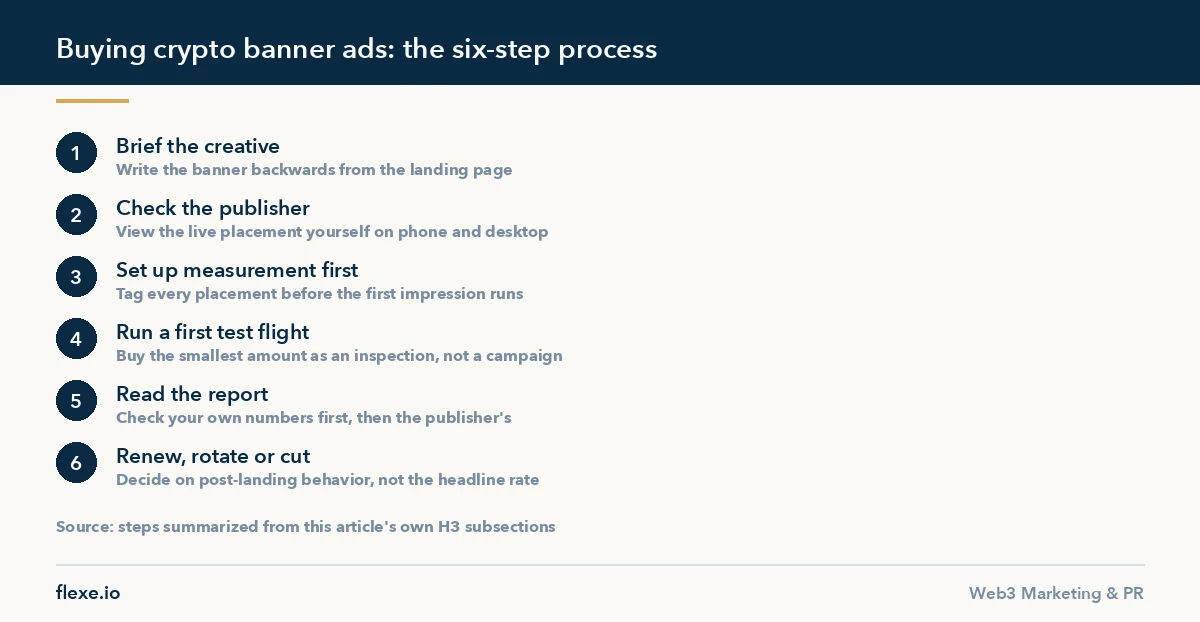
Start the brief with the single action you want and the page that action lands on, then write the banner backwards from that page. If the landing page leads with a different promise than the creative, the click is wasted before anyone reads a word. Give the designer the sizes the publisher actually sells, the file weight limit, and the wording your compliance review has already cleared, so the set does not come back for a second round.
Ask for one plain version alongside anything animated, and a version that still reads at the smallest size sold. Much of the inventory in this category is narrow and sits beside a chart, so type that works in a mockup disappears in place. Keep the product name legible when the banner is scrolled past at speed, and avoid wording that reads as a return promise, because that is the most common reason a creative is rejected after the slot is booked.
Checking A Publisher Before You Buy
Before money moves, ask the publisher what the placement looks like on a live page and where it sits relative to the content. Open the site on a phone and on a desktop and find the slot yourself. Ask which other categories run in the same position, because a slot that rotates gambling creative next to yours changes how the audience reads it. Ask whether the traffic is reported by the publisher or by a network sitting in between.
Request the reporting format in advance and check that it separates the properties you are buying. A single line covering a bundle of unnamed sites is not a report you can act on. Ask what happens if the placement underdelivers, and whether replacement inventory would sit on the same property or somewhere else entirely. Get the answers in the booking email rather than the sales call, so the terms exist in writing when the first invoice is queried.
Setting Up Measurement Before The First Impression
Measurement has to exist before the first impression runs, because retrofitting it costs you the only clean read you will get. Give every placement its own tagged link so the report does not collapse into one channel row. Decide which on-site behaviour counts as a real visit, and record it as an event rather than judging by arrival counts alone. Agree the reporting window with whoever approves the budget, so nobody compares different periods later.
Keep a short written baseline of what the site normally does before the campaign starts. Without it, a rise in arrivals during a busy market week gets credited to the buy, and a flat week gets blamed on the creative. Note anything else running at the same time, since concurrent activity is the usual reason two reports disagree with each other. That one page of notes settles more arguments than any dashboard you can build afterwards.
Running A First Test Flight
Buy the smallest amount the publisher will sell and treat it as an inspection rather than a campaign. One creative, one landing page, one placement and one reporting window, so anything you learn has a single cause. Resist testing several variables at once at this stage: the volume is too small to separate them, and the conclusion you draw will quietly follow whichever variable you already believed in.
Watch post-click behaviour rather than arrival counts while the test runs. Traffic that lands and leaves immediately, at a rate far outside what the rest of the site produces, is the clearest early sign that the inventory is not what was sold. Check the arrival pattern across the day as well, since real audiences have a shape and automated traffic frequently does not. Stop the test early if the pattern is obviously wrong rather than letting it run for completeness.
Reading The Report You Get Back
Read the report against your own numbers first and only then against the publisher’s. Where the two disagree, name the gap in the report rather than picking the version that supports a renewal. Ask how the publisher counts an impression and at what point it counts a click, because differing definitions explain most discrepancies and are far easier to settle before a dispute than during one.
Separate what the placement did from what the creative did. The same banner on two properties tells you about the properties; two banners on one property tell you about the creative. Changing both at once and reporting the combined result is the most common reason a campaign gets renewed on a false conclusion, and it is also the reason the second month so often fails to repeat the first.
Renewing, Rotating Or Cutting A Placement
Decide renewal on whether the traffic did anything after landing, not on the headline rate. A placement that keeps delivering visitors who behave like your existing audience earns another month on the same terms. One that delivers arrivals who leave immediately needs either a different creative or an exit, and the cheapest way to find out which is to rotate the creative once before cancelling anything.
Rotate creative before the audience stops seeing it rather than after the numbers fall, since recovery takes longer than prevention. Keep a record of every creative run on every property with the dates, so you are not rebuilding the same set from scratch in six months. When you do cut a placement, tell the publisher why in plain terms; the ones worth buying from again come back with a better slot rather than a reworded pitch.
Keep one owner for the buy across its whole life. Placements booked by whoever held the budget that month, with nobody holding the history, get renewed automatically and reviewed never. The person who booked it should also be the person who reads the report and signs the renewal.
Banner formats are one part of paid crypto media; the crypto ads guide covers networks, costs and approvals.
Frequently Asked Questions
Do crypto banner ads still work?
On a narrow set of placements, yes. Explorers, charting tools, listing aggregators and wallet interfaces still convert because the visitor is mid-task and the ad is contextually relevant. Broad network buying across unknown publishers performs worse every year.
What creative works for crypto display?
Plain statements of what the product does outperform animated banners with price claims. The audience has seen ten thousand of the latter, and anything resembling a return promise also risks rejection.
What is a good CTR for a crypto banner?
Lower than you would expect. Anything above roughly one percent is a signal to check traffic quality rather than a result to celebrate. Measure post-click behaviour instead: bounce rate and time on page separate real traffic from bots within a few hundred dollars.
Should you buy audiences or placements?
Placements. In a sector where targeting data is unreliable, the site someone chose to visit tells you more about intent than any behavioural segment sold alongside it.
How do you test a crypto ad network safely?
Buy small, ask for the publisher list before spending, and judge on post-click behaviour. Networks unwilling to name their publishers are selling inventory they cannot vouch for.
Are banner ads dead for crypto?
Broad-network banner buying is close to it. Direct placement on properties traders use daily is not, and is priced accordingly because the inventory is finite.