Mainstream ad platforms did not ban crypto; they made it conditional. The conditions are documented, applied unevenly, and enforced by systems that decline first and explain later. Most rejections are avoidable, and almost all of them are caused by the same handful of mistakes.
The worst outcome is not a refused advertisement. It is a restricted advertising account, which costs weeks and sometimes cannot be recovered on the same entity. Everything below is arranged to avoid that.
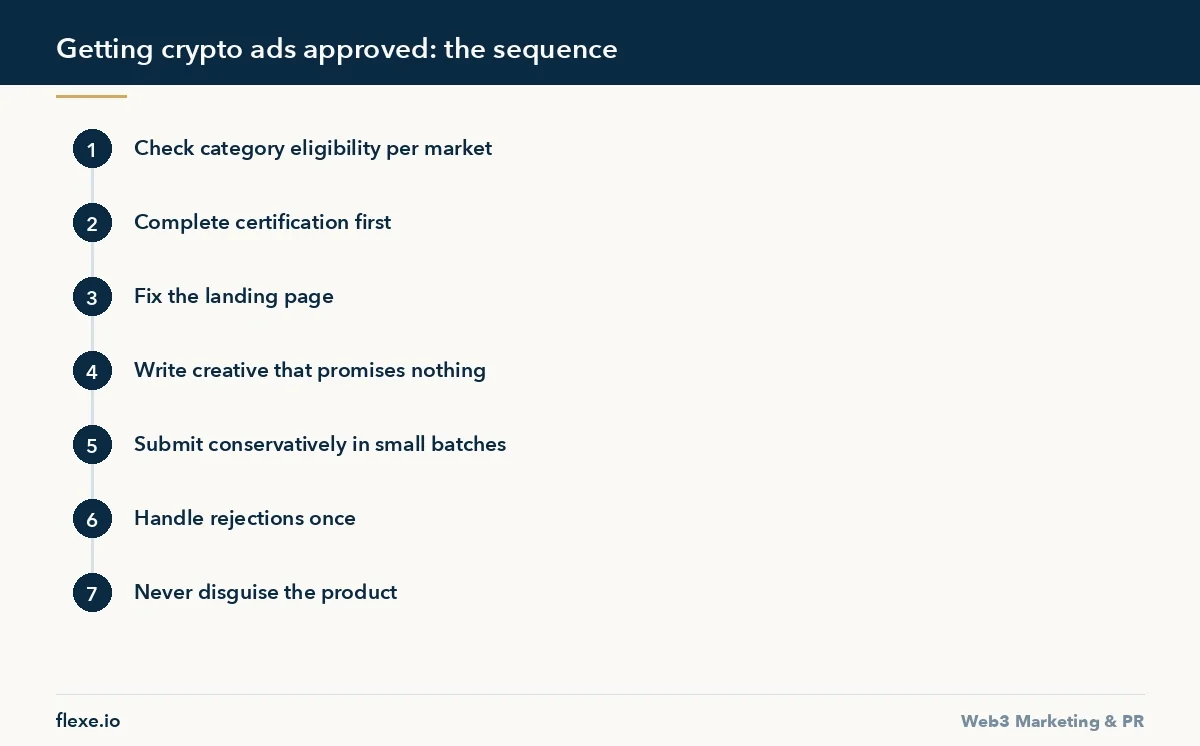
1. Find out whether your product is eligible at all
Platforms distinguish between categories: exchanges and wallets, informational or educational content, software and infrastructure, and token sales. The last is restricted almost everywhere, and no amount of careful wording changes that.
Read the current policy for each platform and for each country you intend to target, because eligibility is set per market. Establish this before creative is produced, since discovering it afterwards has already cost you the production.
2. Complete certification before you build anything
Where a platform runs a certification or verification programme for financial products, apply first. It usually requires a registered legal entity, business documentation, and in some markets a licence or registration number for the specific jurisdiction.
Approval takes time and cannot be rushed at launch. Running uncertified campaigns while an application is pending is a reliable way to attract the account restriction you are trying to avoid.
3. Fix the landing page first
Reviewers check the destination, not only the advertisement, and a compliant banner pointing at a non-compliant page is refused. The page needs a visible legal entity, terms, a privacy policy, working contact details, and risk disclosure where the market requires it.
It also has to match the advertisement. A banner about a product and a page about a token sale is treated as a bait-and-switch, and that is the class of finding that escalates from a rejection to a restriction.
4. Write creative that cannot be read as a promise
The reliable rejections are consistent across platforms: returns of any kind, the words guaranteed or risk-free, urgency built on price, price charts implying performance, and anything framing a token as an investment.
Describe what the product does. Function, speed, cost, coverage and security are all sayable and none of them imply a financial outcome. This constraint improves most crypto creative, because it forces a claim about the product instead of a claim about the price.
5. Submit conservatively and in small batches
Start with the most cautious variant. Once it is approved and running cleanly, submit the next one. Uploading twenty aggressive variants at once, several of which breach policy, is read by the system as a pattern rather than as individual mistakes.
Prepare the variants in advance so this is a sequence rather than a scramble, and keep the approved ones running while new ones are in review.
6. Handle a rejection correctly
Read the stated policy reason, change the thing it names, and resubmit once. Do not resubmit the same creative repeatedly hoping for a different reviewer, and do not open several appeals in parallel. Both look like circumvention.
If two attempts fail, the problem is usually the landing page or the product category rather than the wording, and continuing to edit the banner will not resolve it.
7. Never try to disguise what you are advertising
Cloaking, redirecting reviewers to a different page, spelling around filters and running through an unrelated entity are all detected, and the penalty is not a rejection but permanent loss of the account and often of associated ones.
If a product cannot be advertised compliantly on a platform, that platform is not available to it. The correct response is crypto-native inventory, which accepts creative mainstream platforms will not, and which is covered in how to choose a crypto ad network.
What passes most reliably
Retargeting a defined audience with a product message, on a compliant page, from a certified entity, in a market where the category is eligible. That combination is approved routinely, which is why mainstream platforms are best used to recover visitors rather than to find new ones.
Where mainstream advertising fits alongside creators and crypto-native placement is in how to split a launch budget across channels. Account setup, certification and campaign operation are on our crypto traffic acquisition page.