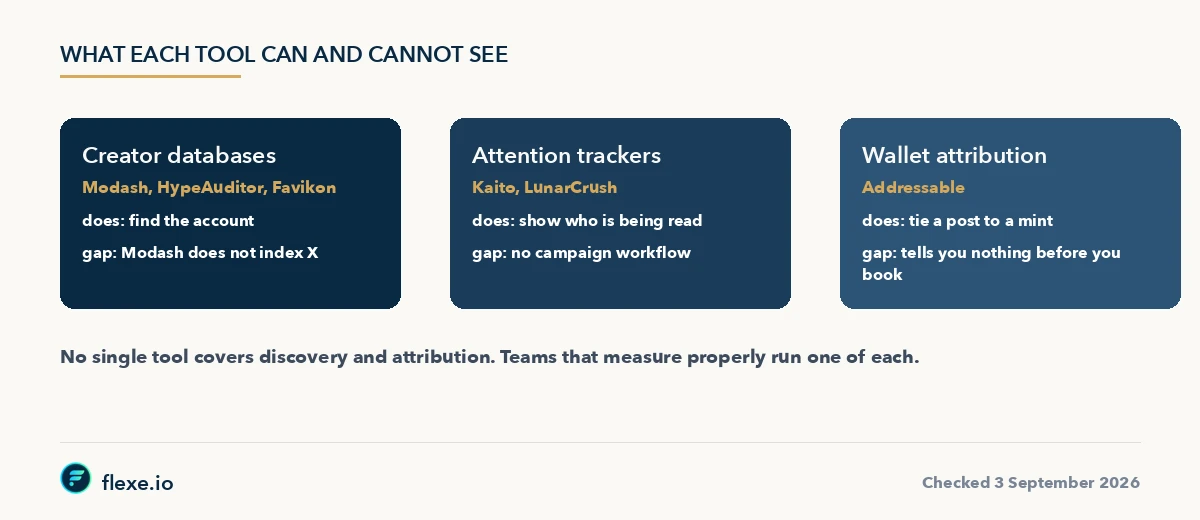
The top NFT influencer marketing tools in 2026 are Modash, HypeAuditor, Favikon, Kaito, LunarCrush and Addressable, and none of the 6 is an NFT influencer platform in the sense the search implies. Three are general creator databases that happen to index crypto accounts, two are crypto attention trackers with no campaign workflow, and one is wallet attribution that connects a post to a mint. Pick by which half of the problem you have: finding the creator, or proving the creator worked.
| Platform | What it actually is | Scale it publishes | Covers X | Weak spot for NFT work |
|---|---|---|---|---|
| Modash | Creator database and campaign manager | 350M+ creators | No | Instagram, TikTok and YouTube only, so it misses the network NFTs live on |
| HypeAuditor | Creator database with fraud detection | 227.2M+ profiles, 15k added daily | Yes | Audience quality scoring is built for consumer brands, not token holders |
| Favikon | Creator database with public leaderboards | 10M+ profiles, 9 networks | Yes | Smallest index of the three; rankings are a discovery aid, not a vetting one |
| Kaito | Attention-economy intelligence, crypto-native | Mindshare Arena leaderboards | Yes | Shows who has attention, not how to book or measure them |
| LunarCrush | Social sentiment and volume | 40+ categories tracked | Yes | Asset-level signal, not creator-level campaign data |
| Addressable | Wallet-level targeting and attribution | 900M+ wallets, 7 chains, 23M+ matched wallet owners | Yes | Answers what happened after the post, not who should make it |
How We Compared Them
Every figure here comes from the vendor’s own site, read on 3 September 2026, and nothing is carried over from an older roundup. We checked four things: whether the tool indexes X, since that is where NFT communities form; the database size the vendor publishes; whether pricing is public; and whether anything in the product connects a creator post to an on-chain event. We are a marketing agency and sell none of these tools, receive nothing for listing them, and have no affiliate arrangement with any of them.
If you run a project here, not just research one: Picking the platform is the easy half. The accounts you actually book on it decide the drop, and platform dashboards will not tell you which of them buys its engagement. We check that first and send the vetted shortlist before anyone is paid. crypto influencer campaigns.
The top NFT influencer marketing tools, one by one
Three general creator databases, two crypto attention trackers and one wallet attribution tool. Each entry below states what the vendor publishes, what it costs where that is public, and the specific thing it will not do for an NFT campaign.
Modash: The Largest Index, Missing the Right Network
Modash publishes the largest index of the six, 350M+ creators with more than 1,000 followers, and it is the only one of the three general platforms with an entry price on the page: plans start at $199 a month, with a 14-day trial that does not ask for a card. Discovery, outreach, tracking and creator payments run from one dashboard.
The problem for NFT work is coverage. Modash indexes Instagram, TikTok and YouTube. It does not index X, which is where NFT projects are discussed, where mints are announced, and where the accounts that move a collection actually post. A 350M database that excludes the relevant network is a smaller database than a 10M one that includes it.
HypeAuditor: Fraud Detection Built for Consumer Brands
HypeAuditor indexes 227.2M+ profiles and adds around 15,000 a day across Instagram, TikTok, YouTube, Twitch and X. Its differentiator is audience analysis: it scores follower authenticity and flags engagement patterns that look bought, which is the check most often skipped before a crypto placement and the one that most often explains a campaign that reached nobody.
Read those scores with the audience in mind. The fraud models are trained on consumer influencer behaviour, and a genuine crypto account looks abnormal by those standards: bursty posting around market events, high reply volume from a small core, follower spikes after a viral thread. Treat a poor score as a prompt to look at the account manually, not as a verdict. Pricing is not published; you have to ask.
Favikon: Public Leaderboards as a Free Starting Point
Favikon indexes 10M+ creator profiles across nine networks, including X, LinkedIn and Twitch, and resolves the same person’s accounts across networks into a single profile. The genuinely useful part costs nothing: Favikon Rankings are free public leaderboards by niche and country, which makes them a reasonable first pass when you have no shortlist at all.
It is the smallest index of the three general platforms, and a leaderboard is a popularity ranking rather than a fit assessment. Use it to assemble a list of names, then vet each one somewhere else. A 7-day trial covers the paid tooling; full pricing is behind a sales conversation.
Kaito: Who Currently Has Attention in Crypto
Kaito describes itself as an intelligence and financial markets platform for the attention economy, and its Mindshare Arena ranks voices and projects by how much of the conversation they hold in a given sector. For picking creators it answers a question the general platforms cannot: not how many followers an account has, but how much of the current conversation about your category runs through it.
It is not a campaign tool. There is no outreach, no brief management, no payment rail, no post tracking. Kaito is also a token project in its own right, with staking, a launchpad and airdrop mechanics attached, so the leaderboards sit inside an ecosystem that has its own incentives. Use it as a signal for who is being read right now, and run the actual campaign elsewhere.
LunarCrush: Asset Signal, Not Creator Signal
LunarCrush tracks real-time sentiment and social volume across more than 40 categories, drawing on X, Reddit, YouTube and TikTok. For an NFT campaign its value is timing and context: whether conversation about your category is rising or falling, and which platforms carry it, before you commit a budget to a mint week.
What it will not give you is a creator shortlist. The unit of analysis is the asset or the topic, not the account, so it belongs in the planning stage rather than the booking stage. Teams that treat a rising sentiment line as a reason to buy placements usually discover that the conversation was about a different collection.
Addressable: The Only One That Reaches the Wallet
Addressable matches social accounts to on-chain identities and publishes the scale it works at: 900M+ wallets across 7 blockchains, 23M+ matched wallet owners, 500+ pre-built audience categories, 7.5M+ smart contracts indexed, and 450+ daily metrics across Web2 and Web3. Practically, it lets you build an audience from wallet behaviour rather than follower counts, and then see which campaign produced which on-chain action.
It is the only tool here that closes the loop from a post to a mint, which is the measurement most NFT campaigns are missing. It is also the wrong tool for discovery: it tells you what happened after the creator posted, not which creator to approach. Pricing is by demo only.
What to Pick for Your Situation
| Situation | Start with | Because |
|---|---|---|
| No shortlist, no budget for tooling | Favikon Rankings, then Kaito | Free leaderboards plus a crypto-native read on current attention |
| Shortlist exists, need vetting | HypeAuditor | Only one of the six that scores audience authenticity on X |
| Campaign spans crypto and consumer creators | Modash plus one X-covering tool | Best Instagram, TikTok and YouTube coverage at a published price |
| Mint happened, results unclear | Addressable | Wallet-level attribution is the only way to tie a post to a mint |
| Deciding when to launch | LunarCrush | Category-level sentiment and volume before the budget is committed |
How to run an NFT influencer campaign with these tools
No single tool covers a whole campaign: use a free ranking or attention tracker for the long list, a creator database for audience quality, direct outreach for pricing and briefs, and wallet or link attribution for results.
Building the long list
Start with leaderboards and attention trackers, since attention moves between collections within weeks, then add creators your holders already follow. Log handle, network, reason and date found; an undated list is a guess within a month.
Vetting the short list
Run a database’s audience checks, then read recent replies yourself: real collectors or stock phrases? Check what happened to collections the creator promoted before. If their floors all fell, the audience ignores the posts.
Budgeting across creator tiers
NFT buyers discount posts from the largest accounts because they know those are paid. A few large accounts plus several mid-sized creators with overlapping audiences usually produce more mints per dollar. Hold part of the budget back and repeat the creators whose first posts moved people.
Briefing creators
Cover what the collection is, mint date and price, where to mint, what to disclose and what not to claim, such as guaranteed value or returns. Collectors spot project-written scripts; a creator’s own words keep the post credible.
Tracking what the posts produced
Give each creator a separate link or allowlist code and, where possible, tie minting wallets to it. Compare creators on mints and on holders who keep the token for a few weeks, not on likes.
Timing posts around the mint
Spread posts: a few creators introduce the collection early, more explain it as the allowlist or mint nears, and a final wave says where to mint. Book early, since the best creators fill their calendars first.
Following up after the mint
Creators sharing updates, reveals or holder events help holders decide to keep the token. Budget a smaller second round and use first-round tracking to pick who returns.
Agreements with creators
Put in writing the deliverable, date, disclosure, price and payment timing, any tokens or allowlist spots, and what happens if the post is removed early. For larger campaigns, add mint-period exclusivity and the right to reuse the post.
Using the tools again after the campaign
Compare each creator’s database audience data with the mints and holders they actually produced. After one or two campaigns this shows which signals to trust for your kind of collection.
Red flags the tools will not catch
These problems look normal in public signals and show up only when someone reads the account closely before paying.
Engagement pods and reply rings
Groups of accounts reply to each other to lift engagement rates every tool reports as healthy. The tell: the same few accounts reply first under every post, within minutes, with generic praise.
Recycled promotion
Some accounts promote a new collection every few days in near identical wording, and their audience discounts every post. Count the promotions in a month of posts before judging engagement.
Undisclosed paid posts
Advertising rules in most major markets require paid promotion to be disclosed, and hidden sponsorship can be removed or reported, with risk to the project too. Write disclosure into the agreement and check past sponsored posts carried it.
Creators who sell what they promote
Some creators take free mints or allowlist spots as part of the fee and sell them soon after posting, in full view of followers. Agree a holding period, or pay cash where that cannot be checked.
Audiences in the wrong markets
An engaged audience may sit where the mint is restricted, the chain is little used or the price is out of reach. Databases show geography for some networks only, so ask for the creator’s own country breakdown.
Followings built on giveaways
Giveaway audiences follow for the next prize and rarely mint anything they must pay for. Steady growth around the account’s own content beats jumps matching giveaway announcements.
What We Left Out and Why
We excluded agencies, because an agency is a service and not a platform, and comparing the two in one table flatters whichever one is being sold. We excluded marketplaces that publish no verifiable scale figures, since a roster claim nobody can check is not a comparison point. And we excluded tools whose crypto coverage exists only in marketing copy, with no product surface that indexes X or reads a chain.
Frequently Asked Questions
Which of the top NFT influencer marketing tools is best?
There is no single tool that does both halves of the job. HypeAuditor is the strongest single choice for finding and vetting NFT creators, because it indexes 227.2M+ profiles including X and scores audience authenticity. Addressable is the strongest for proving the campaign worked, because it matches 23M+ wallet owners to social accounts. Most teams that measure properly run one of each.
Do general influencer platforms cover crypto creators?
Partly, and the gap is specific rather than general. HypeAuditor and Favikon index X, so crypto accounts appear in their databases. Modash does not index X at all, which removes most of the NFT field regardless of its 350M+ total. Coverage of an account is also not the same as understanding it: audience quality models built for consumer influencers misread normal crypto posting behaviour.
How do you measure an NFT influencer campaign?
By on-chain outcomes rather than engagement: wallets that minted, secondary volume in the days after, and holders still holding at 30 days. Impressions and likes are available from every tool here and predict almost nothing about a mint. Wallet-level attribution is the only method that connects a specific post to a specific on-chain action, which is why it sits in a different product category from discovery.
Are these platforms worth it for a small NFT project?
Below roughly ten placements a year, usually not. Favikon Rankings and Kaito’s public leaderboards cost nothing and will get a small project to a workable shortlist, and manual vetting of twenty accounts takes an afternoon. Paid tooling starts to pay for itself when the volume of outreach, or the cost of one bad placement, exceeds the subscription.
Do any of these tools price publicly?
One of the six. Modash publishes plans from $199 a month with a 14-day trial that needs no card. Favikon offers a 7-day trial but keeps full pricing behind a sales conversation. HypeAuditor, Kaito and Addressable quote on request, and Kaito’s model is bound up with its own token rather than a subscription.
Running the Campaign Instead of the Tooling
Tooling narrows a list; it does not negotiate, brief, or hold anyone to a posting schedule. If you would rather hand over the whole channel, our crypto influencer marketing service covers sourcing, negotiation and reporting. For the mechanics of running placements yourself, the crypto KOL guide covers briefing and pricing, and the crypto YouTuber comparison covers long-form video specifically.