Almost every crypto KOL price you can read is an asking price, not a paid price. Exactly one figure in this market has ever been confirmed by a regulator rather than by a seller: the $250,000 Kim Kardashian was paid for a single Instagram post promoting EthereumMax, disclosed in the SEC settlement of October 2022. Everything else is a quote, a media kit, or a vendor blog. That gap is the whole subject of this page.
What are the three prices behind a KOL quote?
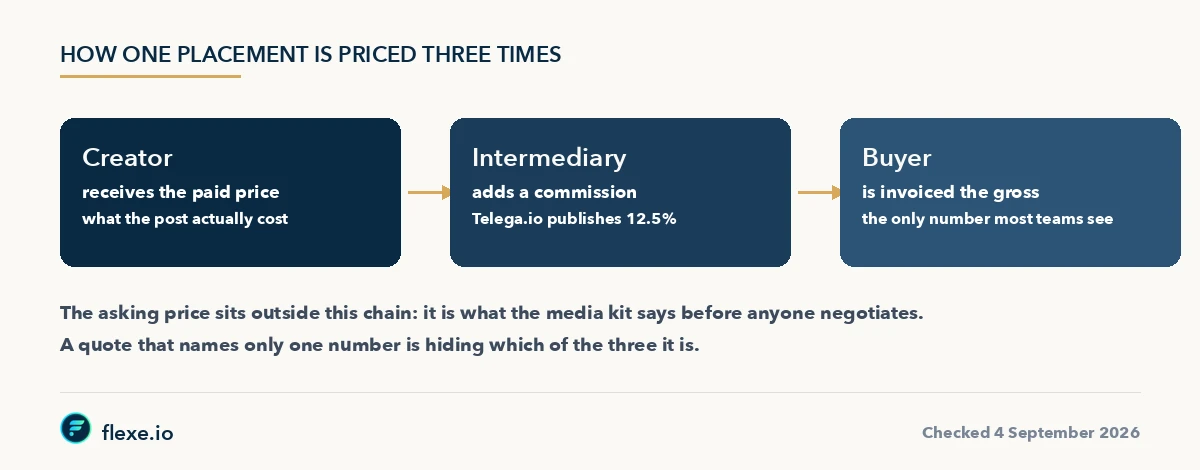
Every placement has three different numbers attached to it, and public price tables almost never say which one they are showing. Separating them is the single most useful habit a buyer can build, because it turns an argument about whether a price is fair into a question about which number you are looking at.
| What it is | Who sees it | Built-in bias | |
|---|---|---|---|
| Asking price | The rate card, the media kit, the number in a DM | Everyone. Nearly every published figure is this one | Set high, with room for negotiation and for a buyer who looks well funded |
| Paid price | What the creator actually receives | Only the two parties | Almost never published. Regulator filings are the rare exception |
| Buyer price | What the budget holder is invoiced | The payer | Paid price plus every intermediary margin in the chain |
One consequence is worth stating plainly. Two people can quote very different “average prices” for the same account and both be telling the truth, because one is describing what a creator received on a direct deal and the other what a campaign cost delivered end to end. Comparing them as if they were one number is how most budget arguments start.
If you run a project here, not just research one: Knowing the going rate only helps if you also know which accounts are worth it. We price a campaign against verified reach rather than follower counts, and you see the account list and the projected numbers before you commit. crypto influencer campaigns.
What commission do intermediaries actually take?
One number in this market is published rather than estimated. Telega.io, the Telegram channel exchange, states in its own FAQ that a channel owner receives “the cost of the advertising post minus a 12.5% service commission.” That is the clearest public reference point for what sits between a buyer and a creator on any platform.
Treat it as a floor rather than a norm. It is the take of a self-serve marketplace that automates the transaction and holds no relationship with the buyer. Anything that adds sourcing, briefing, negotiation, compliance review and reporting costs more, and reasonably so. What you should refuse is a chain you cannot see: a proposal reading “12 KOLs for $80,000” with no handle-level breakdown is a buyer price with an unknown number of margins stacked inside it.
Why do prices differ threefold for the same follower count?
Because followers are the wrong denominator, and every platform has a different right one. On X you are buying impressions, on YouTube views, on Telegram reads, on Twitch average concurrent viewers. The share of an audience that actually sees a post is not a constant, and it is the variable that moves price per real viewer more than the tier does.
The arithmetic is unforgiving. An account with 200,000 followers whose posts reach 30,000 people, priced at $8,000, costs $267 per thousand people reached. The same $8,000 against 200,000 real impressions would be $40. Nothing in the follower count tells you which of those two you are buying, and the account looks identical in both cases.
How many crypto accounts are bots?
There is no single answer, and the reason matters more than any figure: the published percentages use different denominators. The number that applies to a crypto campaign is not the platform-wide one.
| What was measured | Result | Source |
|---|---|---|
| Accounts sharing crypto invite links to Telegram and Discord, classified by Botometer | 36.4% bots | Nizzoli et al., Charting the Landscape of Online Cryptocurrency Manipulation, 2020 |
| The same set, adding accounts already suspended by the platform | 56.3% | Same study: 2,710 classified as bots, a further 1,483 suspended |
| Botnets of ten accounts or more found in that dataset | 69 | Same study |
Planning a crypto campaign against a platform-wide bot estimate systematically overpays, because your campaign does not live among average accounts. It lives among accounts that engage with crypto promotion, which is precisely the population the study above sampled.
We have been on the wrong side of this ourselves, and not with a creator. Our own page on Bitcointalk promotion carried a monthly traffic figure of roughly 703,000 for months, taken from a supplier sheet. When we re-measured it against Similarweb in August 2026 the real number was about 212,000, on a trend falling around 10% a year. We corrected the page and dated the note. A published number is a claim until someone re-runs it, and that applies to reach as much as to price.
Can you trust an influencer trust score?
Only as a first-pass filter. The crypto-native scoring tools work by looking at who follows an account: how many funds, projects and recognised operators are in the follower list. That is a reasonable signal, and it has an obvious weakness: follower lists can be arranged. Services openly advertise raising an account’s score by organising subscriptions from curated sets of accounts. A high score therefore proves one of two things, and no external check separates them: the account earned the attention of serious people, or it paid for their follows.
The second, larger problem applies to every tool in the category, honest ones included. None of them measures the thing you are buying. You are buying the impressions of one specific future post. Tools measure the audience, or they measure past posts. Between the median of past performance and your post sits a recommendation algorithm that is undocumented and changes.
Which checks can you actually run before paying?
Four of the useful checks are free and answerable in about twenty minutes per account. Read the median views of the last twenty posts rather than the average, because one viral post distorts it. Compare engagement on the creator’s previous sponsored posts with their organic ones, which is the most predictive single check available and almost nobody runs it. Open the replies and look for identical phrasing from different handles, the signature of a paid engagement pod. Look the handle up in a web archive: an account with a real audience leaves snapshots going back years.
Three things cannot be checked at all before payment, and no tool changes that. The true reach of the post you are buying is visible only to the account owner, and screenshots are trivially edited. The human share of an audience has no reproducible crypto-specific census, for the reasons in the table above. And what the creator was actually paid stays private everywhere except where a regulator forced the disclosure.
Tool coverage has one gap worth knowing before you buy a subscription. The largest general creator databases are built for consumer marketing: Modash indexes 350M+ creators but covers Instagram, TikTok and YouTube only, which excludes the network most crypto conversation happens on. HypeAuditor indexes 227.2M+ profiles and does cover X. Figures are the vendors’ own, checked 3 September 2026.
Negotiating from the right number
Once you know which of the three prices a quote represents, negotiation stops being a haggle over a single figure. If the number is an asking price from a public table, ask for the price paid on the creator’s last few sponsored posts in the same format. If it comes through an intermediary, ask what the creator receives and what the intermediary keeps. A creator or agent who will not say which number they are quoting is telling you the answer.
Anchor the conversation on what the post is expected to deliver rather than on follower count. Median views on recent posts, the engagement those views produced and the share of the audience in markets you can serve give both sides a reason for the price. A creator whose recent posts reach fewer people than their follower count suggests has less room to hold a headline rate.
Paying in stages
Paying the full fee before anything is published puts all the risk on the buyer. A common structure is a deposit when the placement is booked and the balance once the post is live and has stayed up for an agreed period. For a series of posts, pay per post rather than for the whole package in advance, so that a creator who stops delivering does not keep the money for the posts that never appeared.
Agree what counts as delivered before paying anything. The format, the date, the minimum time the post stays up and whether it may be deleted afterwards all belong in writing, because a post that disappears two days later is a common and avoidable dispute.
When a creator asks for tokens
Payment in tokens can look cheaper because no cash leaves the treasury, but it has a cost that does not appear on the invoice. Tokens given to a creator are often sold soon after the post, and followers who watch the creator’s wallet see it. If tokens are part of the deal, agree a vesting schedule or a holding period, record the wallet address in the agreement and treat the market value on the day of the post as the real price you paid.
Packages, exclusivity and usage rights
Package deals for several posts or several networks lower the price per post and raise the amount at risk. Ask whether the package includes exclusivity, meaning the creator will not promote a direct competitor for a period, and what that period is. Exclusivity has real value in a crowded category and is often given away for nothing when the buyer does not ask. Ask as well whether you may reuse the creator’s post in your own channels or ads, since usage rights are frequently priced separately.
Disclosure written into the agreement
Advertising rules in most major markets require paid promotion to be disclosed, and securities regulators have acted against promoters who did not say they were paid, as the Kardashian case above shows. Put the disclosure requirement and its wording into the agreement, and make payment of the balance conditional on the post carrying it. A creator who refuses to disclose is transferring their risk to the project.
Measuring what the placement delivered
Give every creator a separate tracked link or referral code before the post goes live, and decide in advance which action counts: a visit, a wallet connection, a sign-up or a deposit. Compare creators on the cost of that action and on how many of those users are still active a week or a month later. Views and likes show whether the post was seen, and only the tracked actions show whether it was worth the price.
Keep the results in one record across campaigns, with the price paid, the format, the date and the cost per action. After a few campaigns that record is worth more than any public price table, because it shows what these creators actually delivered for your audience rather than what they asked for.
Why prices move with the market
Creator rates follow demand for placements, and demand follows the market. When many projects are launching at once, the best-known creators raise prices and fill their calendars weeks ahead, and in quiet periods the same creators are easier to book and more open to negotiation. A price that looked fair in one phase can be high in the next, so compare quotes from the same period rather than against a table collected months earlier.
Agencies versus direct deals
Booking creators directly removes the intermediary’s margin and adds work: finding contacts, negotiating one by one, checking every post and chasing late deliveries. An agency or a marketplace charges for doing that work and for the relationships that get replies from busy creators. The useful question is not whether a margin exists but what it pays for. Ask what the agency checks before booking, whether it replaces a creator who fails to deliver and whether you see the creator’s own price.
Pricing a campaign rather than a post
Buying posts one at a time makes each price look reasonable and the campaign expensive. Start from the result the campaign needs, such as a number of verified sign-ups or deposits, estimate what a realistic cost per action is from past campaigns, and work back to a total budget. Then allocate that budget across creators and formats, keeping part of it in reserve to repeat the placements that perform. The price of any single post matters less than whether the whole mix reaches the target.
Red flags in a rate card
A rate card that lists prices by follower count alone, offers large discounts for paying everything upfront, or includes guaranteed engagement numbers deserves a closer look. Guaranteed likes or replies usually mean the engagement will be bought. Very low prices for large accounts can mean the audience has been inflated, and a rate card with no recent examples of sponsored posts gives you nothing to check the price against.
Reporting you should receive
Agree the report before the campaign starts. For each post it should show the live link, the publication date, the views or impressions from the platform’s own analytics, the clicks on your tracked link and the actions that followed. Screenshots of analytics are easy to edit, so ask for screen recordings or live access where the numbers matter, and compare the reported clicks with what your own tracking recorded.
Renewing with creators who delivered
The cheapest good placement is often a repeat booking with a creator whose previous post performed. Their audience already knows the project, the briefing is faster and the price is easier to negotiate when both sides have results to point to. Keep a short list of creators who delivered, and offer them the first slot in the next campaign before looking for new names.
Briefing the creator
A clear brief protects the price you paid. Give the creator the facts they need, the action you want the audience to take, the tracked link, the disclosure wording and the claims they must not make, such as price predictions or guaranteed returns. Leave the tone to them, because their audience follows them for their own voice, and a scripted post reads as an advert and performs like one. Ask to see a draft for factual accuracy, not to rewrite it.
Posting windows and time zones
The same post can perform very differently depending on when it goes out. Audiences for crypto creators are spread across regions, and a post published while most of the creator’s followers are asleep loses much of its first-hour reach. Ask the creator when their posts usually perform best, check it against their recent posts, and avoid days when major market events or other large launches will crowd the feed.
Starting with a test
Before committing a large budget to a new creator, book one post in the format you plan to use and measure it with the same tracking you will use later. A single test post rarely proves a creator is good, but it quickly shows when one is not, and it gives you a real cost per action to compare with the price of a larger package.
When to walk away
Walk away when a creator will not share recent view counts, refuses to disclose the promotion, asks for full payment in advance with no delivery terms or quotes a price that rises sharply once they learn the size of your raise. None of these is proof of bad faith on its own, but together they describe a placement where the buyer carries all the risk and has no way to check what was delivered.
Frequently Asked Questions
How much does a crypto influencer post cost?
Any single figure would be an asking price rather than a paid one. The only publicly confirmed payment for a crypto promotional post is the $250,000 Kim Kardashian received for one Instagram post, established in an SEC settlement in October 2022 and not representative of crypto-native accounts. Price your campaign from cost per thousand people actually reached, using an account’s median views, rather than from any published rate table.
Why is a smaller account sometimes more expensive per view?
Because price scales with followers while delivery scales with reach, and the two diverge. Accounts that post frequently or have drifted from their original topic show a much lower share of followers seeing any given post. The cost per thousand people reached across tiers overlaps heavily, which is why buying by tier rather than by measured reach is the most common way to overpay.
Is paying in tokens instead of cash cheaper?
It is not cheaper, it is unpriced. An allocation’s value depends on the token’s price after a vesting period nobody can forecast, so at the moment of the deal neither side knows what the placement cost. Keep it in a separate column from cash in your own records, value it well below face value, and never add the two together to report a campaign cost.
Does a high trust score justify a higher price?
No. Scores built on follower composition can be raised by arranging follows, and the practice is openly sold. Use a score to shorten a list, then decide price from median views over the last thirty days and from reading the replies. A score is evidence about who follows an account, never evidence about who will see your post.
Buying placements rather than reading about them
If you would rather hand over sourcing and negotiation, our crypto influencer marketing service covers it end to end. For the mechanics of briefing and measurement, the crypto KOL guide goes deeper, and the comparison of creator platforms covers which tools index which networks.