In almost every NFT brand licence signed since 2021, the brand kept the copyright and gave away something narrower: a right to use the artwork commercially. Yuga Labs granted Bored Ape holders an unlimited worldwide licence to use, copy, display and build derivative works from their Ape, while retaining the underlying copyright itself, and told a court it holds no copyright registrations for those images at all. That gap between what holders think they bought and what the licence actually transfers is where most of these deals went wrong.
What does an NFT brand licence actually transfer?
Three separate things get conflated: ownership of the token, ownership of the copyright, and permission to use the artwork commercially. A holder buys the first. The second almost never moves. The third is what the licence document defines, and its scope varies enormously between projects that look identical from the outside.
Yuga’s structure is the most permissive in the market and worth reading as the upper bound rather than the norm. Holders received commercial rights broad enough to launch restaurants, drinks brands, comics and music labels off a single Ape. In July 2023 Yuga added a second layer through its Made by Apes platform, splitting rights into a Primary Licence attached to the Ape and Product Licences that sublicense specific products underneath it. Even at that level of permissiveness, the copyright stayed with Yuga.
If you run a project here, not just research one: A licensing deal only pays off if the launch is covered where the licensor’s audience already reads. We place that coverage and tell you upfront which outlets are worth it and which ones are just paid listings. PR placements in crypto media.
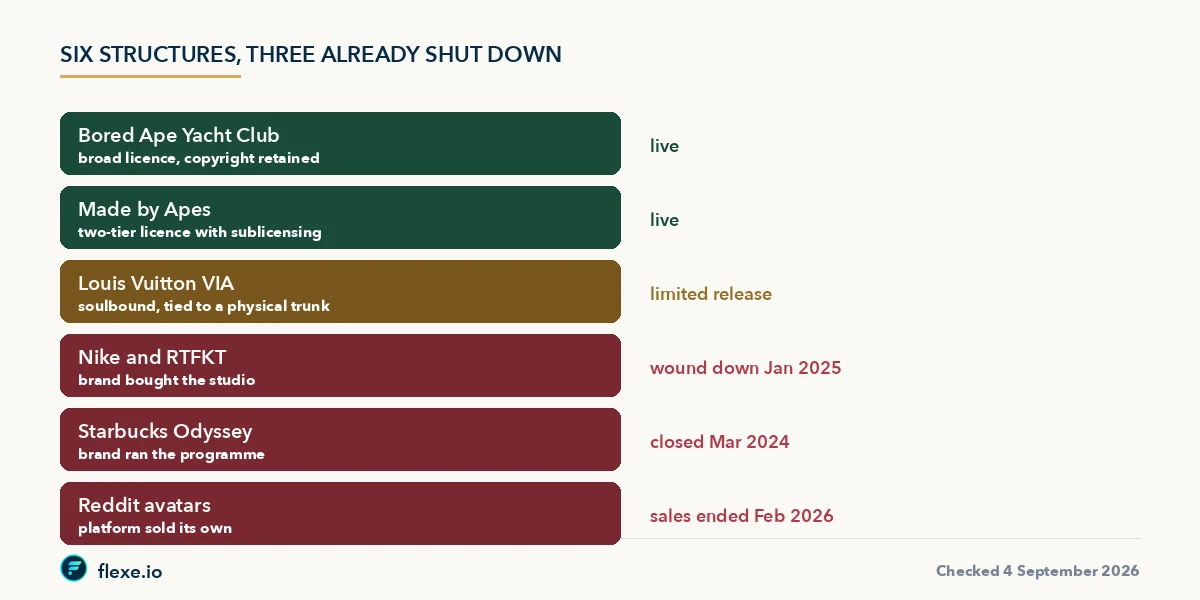
Which licensing structures have actually been used?
| Structure | Worked example | What the holder or partner got | Where it stands |
|---|---|---|---|
| Broad commercial licence, copyright retained | Bored Ape Yacht Club, Yuga Labs | Unlimited worldwide right to use, copy, display and make derivatives | Live, and the reference point every other deal is measured against |
| Two-tier licence with sublicensing | Made by Apes, July 2023 | Primary Licence on the token plus Product Licences for specific goods | Live |
| Soulbound token tied to a physical good | Louis Vuitton VIA Treasure Trunk, June 2023 | Non-transferable token at 39,000 euros, a physical replica trunk, and the right to buy keys to later drops | Ran as a few hundred units, never opened to the public |
| Brand buys the studio outright | Nike and RTFKT, acquired 2021 | Full ownership of the team and the IP | Wound down in January 2025, followed by a collector lawsuit in April 2025 |
| Brand runs the programme itself | Starbucks Odyssey | Loyalty artwork issued and controlled by the brand | Closed in March 2024 |
| Platform sells its own avatars | Reddit Collectible Avatars | Artist-made avatars sold by the platform, artists paid a share | Sales ended in February 2026 |
The pattern in the right-hand column is the useful part. The structures that survived are the ones where the brand gave away usage rights but kept the copyright and carried no operating cost. The ones that closed are the ones where the brand ran a programme: an owned studio, a loyalty scheme, a marketplace. Licensing scales because it costs nothing to maintain. Programmes do not.
Why did the acquisitions fail while the licences held?
Nike bought RTFKT in 2021 at the peak of the category and closed it in January 2025, with a collector lawsuit following in April. The licence structures signed in the same period are still standing. The difference is not the quality of the art or the size of the buyer. It is that an acquisition creates a permanent line in someone’s budget, and a licence does not.
A licence has no headcount, no roadmap and no quarterly review. When interest fades, it simply sits there and costs nothing. A studio has salaries, a product pipeline and an executive who has to defend it every year against categories that convert better. That asymmetry decided which of these programmes were alive in 2026, and it will decide the next round too.
What should a brand check before signing?
| Question | Why it decides the deal |
|---|---|
| Who owns the copyright, and is it registered? | Yuga stated in court filings that it holds no copyright registrations for the Ape images. A licence granted by a party whose own rights are unregistered is worth less than it reads |
| Is the token transferable? | Louis Vuitton made VIA soulbound, which removes speculation and secondary trading but also removes any resale value your buyer might have assumed |
| Does the licence survive a sale of the token? | Rights that follow the token create a permanent obligation on the issuer; rights that stop at transfer create a support problem instead |
| Is there a physical good attached? | A physical component converts a collectible into a product with customs, warranty and returns, and that is a different business with different costs |
| Who pays when the programme ends? | Three of the six programmes above were shut down. Ask what happens to holder rights on wind-down before you launch, not after |
| Can holders sublicense? | Made by Apes exists because holders built products and needed a formal route. Without one, every holder business becomes an enforcement question |
Does licensing still make sense in 2026?
For brands with existing intellectual property and no appetite to operate anything, yes, and the case is stronger than it was in 2021 because the failure modes are now documented rather than theoretical. The deals that persist are narrow: define the artwork, define the permitted uses, keep the copyright, attach no operating commitment.
We should be honest about our own position here. We do not sell NFT licensing, and for most brands asking about it the answer is that a licence is not a marketing channel. It is a legal structure that lets an audience build things with your artwork. If nobody is currently asking to build anything with it, a licence will not create that demand, and the six examples above show what happens when a brand mistakes one for the other.
What NFT brand licensing costs to run
A licence is cheap to hold and not free to administer, and the budget line most brands forget is approvals. Someone has to read what licensees produce, answer whether a use falls inside the grant, and keep a record of what was allowed. Decide before signing whether approval is required in advance or whether the grant is permissive with a right to object afterwards, because the two produce very different workloads for the same document.
Define the term, the territory, the permitted media and the approval route in the document rather than in an announcement post. A grant that says commercial use without limit is a decision never to say no again. If the artwork will appear on physical goods, state who carries product liability and who handles recalls, since the party printing the goods is rarely the party whose name ends up attached to them.
Payment structures split into flat fees and running royalties, and the choice decides how much reporting you need. A flat fee ends the relationship at signature. A royalty obliges you to collect statements, check them, chase the ones that stop arriving and decide what an underpayment triggers, so agree the reporting period, the audit right, the currency and the late payment remedy, and say what happens when a licensee pays in a token whose price moves before it clears.
Enforcement is the part that gets skipped. Keep a register of grants with dates and scope, because the first time a use looks wrong you will need to know whether it was licensed. Yuga’s position on registrations shows why this matters: a licensor whose own rights are unregistered has a weaker hand when it has to act, and the licensee inherits that weakness rather than escaping it.
When a licensee goes outside the grant, the first step is a dated written notice describing the specific use, not a public complaint. Give a cure period and say what happens if it lapses. Handle it quietly where possible, because the value of an NFT brand licensing programme rests on other parties believing the terms are enforced consistently rather than by mood.
Checking a licensee before signing
Run the same checks on the counterparty that you would on a manufacturer. Ask who the contracting entity is, where it is registered, who signs, and what happens on a change of control, because a licence signed by a pseudonymous holder is difficult to enforce and equally difficult to terminate. Ask what else they hold licences for, since artwork appearing beside categories you would refuse creates an association no clause undoes.
Ask to see the product plan before the grant rather than after. A licensee who cannot describe what they intend to make is asking for an option rather than a licence, and options should be priced and time-limited. If they intend to raise money against the licence, state in the document whether the grant may be assigned, because a right that moves with a sale is a different asset from one that ends with the licensee.
Running approvals without stalling launches
Approvals fail on turnaround rather than judgement. Name one reviewer and one deputy, publish the working days you need, and define what a submission has to contain before the clock starts. Most disputes come from partial submissions answered informally and then treated as approved, so keep the decision in writing with a date, even when the answer is yes and the conversation happened in a chat.
Decide which categories never need review and say so. A permissive list for low-risk uses keeps the queue short enough that the submissions which do matter, anything involving children, health, gambling or financial claims, get read properly. When a submission is refused, say which term it falls outside rather than giving an opinion about the product, because the term is what a lawyer can act on later.
Records the licence depends on
Keep the artwork files, the licence versions and the approval history in one place that survives staff changes. Brands lose the ability to enforce because nobody can produce the signed version or prove what the artwork looked like when the grant was made. Store a dated copy of the images, the metadata and the marketing page as it stood, and keep the register of who holds what alongside them.
Agree who hosts the artwork and who pays for it. Collections relying on a single hosting arrangement lose their images when someone stops paying, and a licence to use artwork nobody can retrieve is worth very little. State the storage arrangement in the document and name the party responsible for keeping it reachable.
Plan for the handover too. Licensing programmes outlive the people who negotiated them, and the common failure is an agency change or a departure that takes the approval history with it. Write down who the licensees are, what each grant permits, which submissions were refused and why, and keep that summary current, so the person inheriting the programme can answer a licensee without reopening every question from the start.
Licensing often starts as a collab; our breakdown of NFT influencer collaborations shows how the biggest ones were structured.
Frequently Asked Questions
Do NFT holders own the copyright to their artwork?
Almost never. The standard arrangement grants a commercial use licence while the issuer keeps the underlying copyright, and Bored Ape Yacht Club is the clearest example: holders can build businesses from their Ape, and Yuga Labs retains the copyright. Read the licence document rather than the marketing page, because the two often describe different things.
What is a soulbound NFT and why would a brand use one?
A soulbound token cannot be transferred after purchase. Louis Vuitton used the format for its VIA Treasure Trunks at 39,000 euros each, tied to a physical replica. The trade-off is deliberate: it removes flipping and secondary speculation, and it also removes the resale value buyers of expensive collectibles usually expect, so it suits access and status rather than investment.
Why did big brands close their NFT programmes?
Because a programme carries operating cost and a licence does not. Nike wound down RTFKT in January 2025 after acquiring it in 2021, Starbucks closed Odyssey in March 2024, and Reddit ended avatar sales in February 2026. In each case the brand was running something with staff and a roadmap. The pure licensing structures signed in the same period are still in place.
Can NFT holders start businesses using the artwork?
Under a broad licence, yes, and they have: restaurants, drinks, comics and music labels have all been built on Bored Ape rights. Yuga formalised the route in July 2023 with Made by Apes, which separates the Primary Licence on the token from Product Licences covering specific goods. Projects without such a route end up handling every holder business as an enforcement question.
What should be in the wind-down clause?
What happens to holder rights when the programme stops. Three of the six structures above were shut down and a fourth never opened to the public, so this is the clause most likely to be tested. Set out whether licences survive, who hosts the artwork afterwards, and what obligations transfer if the collection changes hands, and do it before launch rather than during the shutdown.
Where this fits a wider NFT programme
Licensing is one piece of a launch rather than a plan on its own. For the marketing side, our NFT launch strategies guide covers the sequence, working with NFT consultants covers who to bring in, and metaverse marketing covers where brand activity actually reaches people in 2026.