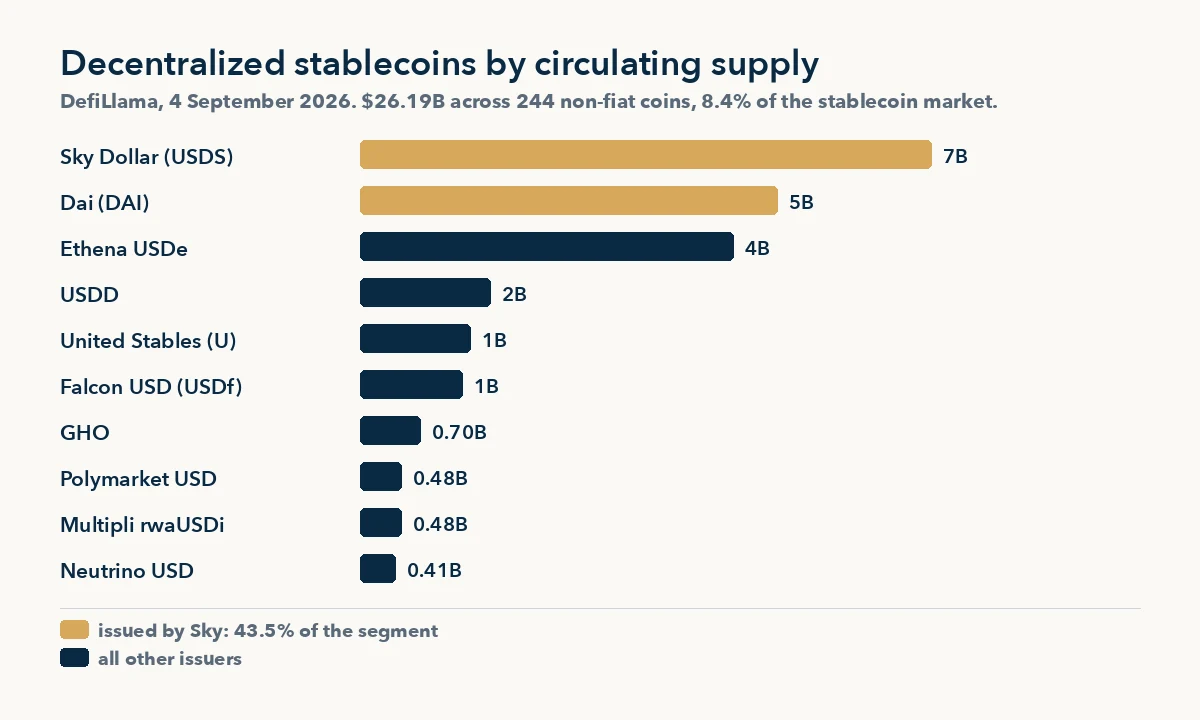
A decentralized stablecoin is a dollar-pegged token backed by crypto collateral, hedged positions or an algorithm instead of fiat reserves held by a company. The largest in 2026 are Sky Dollar (USDS, $6.59 billion supply), Dai ($4.81 billion), Ethena USDe ($4.31 billion), USDD ($1.51 billion) and United Stables ($1.27 billion). The figures are circulating supply from DefiLlama’s stablecoin tracker, checked on 4 September 2026, across 244 non-fiat coins worth $26.19 billion, which is 8.4% of a $311.10 billion stablecoin market.
What are decentralized stablecoins
They are stablecoins whose peg does not rest on a bank account. The tracker groups them by mechanism. Crypto-collateralised coins are minted against volatile assets locked in a vault, and positions that fall below a set ratio are liquidated. Hedged coins hold assets and offset them with short positions. Algorithmic coins manage supply by rules rather than by backing.
The segment is small and concentrated. The ten largest coins hold 83% of non-fiat supply, and one issuer, Sky, accounts for 43.5% of it through two separate tokens. Reserve-backed coins hold the rest of the stablecoin market, and the gap has widened rather than narrowed over the past several years.
Every decentralized stablecoin in the 2026 top ten, ranked by supply
Each entry gives circulating supply, share of non-fiat supply and the mechanism as the tracker classifies it. Share is measured against the $26.19 billion segment rather than the whole market.
1. Sky Dollar (USDS, crypto collateral)
USDS is the larger of the two coins Sky issues and leads the segment by a wide margin. Its backing sits in Sky’s lending vaults, which hold $5.45 billion of collateral, 70.5% of the entire collateralised debt category across 231 protocols.
- Supply: $6.59B
- Share: 25.2% of non-fiat supply
- Best for: holders who want the deepest decentralised dollar and accept governance by one large protocol
- Watch out: counted together with Dai, one issuer holds 43.5% of the segment
2. Dai (DAI, crypto collateral)
Dai is Sky’s older token and still second. Most lists present it as a separate choice from USDS, but both draw on the same issuer and the same vault system, so treating them as two exposures overstates how spread out the segment really is.
- Supply: $4.81B
- Share: 18.3%
- Best for: pools and integrations built around the older ticker
- Watch out: same issuer as USDS, $11.40 billion combined
3. Ethena USDe (hedged collateral)
USDe holds assets and offsets them with short positions, so its peg depends on derivatives markets staying liquid rather than on a liquidation engine. Trackers still place it with crypto-collateralised coins. The venues those hedges depend on are ranked in our comparison of perpetual DEX venues by pool capital.
- Supply: $4.31B
- Share: 16.5%
- Best for: holders who understand and accept derivatives-based backing
- Watch out: a risk profile that the phrase over-collateralised stablecoin does not describe
4. USDD (crypto collateral, Tron)
USDD comes from the Tron ecosystem and opens the second tier of the table, well below the three leaders. It is the only coin in the top ten tied to one chain’s ecosystem rather than to a named protocol.
- Supply: $1.51B
- Share: 5.7%
- Best for: users already active on Tron
- Watch out: find out who sets its parameters before treating it as collateral
5. United Stables (U, crypto collateral)
United Stables is one of three coins in the top ten that did not exist in this form two years ago. It is independent of the large issuers and absent from coverage that still opens with Dai and LUSD.
- Supply: $1.27B
- Share: 4.9%
- Best for: exposure outside the Sky and Ethena systems
- Watch out: a short history that has not been tested in a fast market
6. Falcon USD (USDf, crypto collateral)
Falcon USD is another recent entrant and already sits ahead of long-listed names such as GHO and crvUSD.
- Supply: $1.18B
- Share: 4.5%
- Issuer: Falcon
- Watch out: read the collateral page before sizing a position
7. GHO (crypto collateral, Aave)
GHO is issued by Aave and lives inside its lending markets, which makes it the most familiar name in the second half of the table and the easiest to reach for anyone already borrowing there.
- Supply: $0.70B
- Share: 2.7%
- Best for: users already working inside Aave
- Watch out: supply is not pool depth, so test the exit at your size
8. Polymarket USD (pUSD, crypto collateral)
pUSD is issued by Polymarket. It shows one source of recent growth in the segment: applications issuing a dollar for their own users rather than for general circulation.
- Supply: $0.48B
- Share: 1.8%
- Best for: Polymarket users
- Watch out: liquidity outside the app may be thin
9. Multipli rwaUSDi (crypto collateral)
Multipli’s rwaUSDi ties with pUSD on supply and is the third coin in the top ten that did not exist in this form two years ago.
- Supply: $0.48B
- Share: 1.8%
- Issuer: Multipli
- Watch out: the tracker’s mechanism label is a summary, so read what the collateral actually is
10. Neutrino USD (USDN, algorithmic)
USDN is the only algorithmic coin left in the top ten, in a category that was mostly algorithmic five years ago. Every other entry is backed by collateral of some kind.
- Supply: $0.41B
- Share: 1.6%
- Issuer: Waves ecosystem
- Watch out: the peg relies on supply rules rather than on collateral
Just outside the table, crvUSD is eleventh at $0.29 billion, backed by $0.15 billion of collateral in Curve’s vaults, about one twenty-second of the leader. LUSD does not reach the top ten: Liquity V1, which issues it, holds $0.18 billion of collateral. Both appear in almost every published list, which names them for design rather than size.
| Stablecoin | Supply | Share of non-fiat supply | Mechanism | Issuer |
|---|---|---|---|---|
| Sky Dollar (USDS) | $6.59B | 25.2% | Crypto collateral | Sky |
| Dai (DAI) | $4.81B | 18.3% | Crypto collateral | Sky |
| Ethena USDe | $4.31B | 16.5% | Hedged collateral | Ethena |
| USDD | $1.51B | 5.7% | Crypto collateral | Tron ecosystem |
| United Stables (U) | $1.27B | 4.9% | Crypto collateral | Independent |
| Falcon USD (USDf) | $1.18B | 4.5% | Crypto collateral | Falcon |
| GHO | $0.70B | 2.7% | Crypto collateral | Aave |
| Polymarket USD (pUSD) | $0.48B | 1.8% | Crypto collateral | Polymarket |
| Multipli rwaUSDi | $0.48B | 1.8% | Crypto collateral | Multipli |
| Neutrino USD (USDN) | $0.41B | 1.6% | Algorithmic | Waves ecosystem |
If you run a project here, not just research one: A decentralised stablecoin needs to be tracked before it can be trusted, and the tracker applications ask for data most teams have not prepared. We handle those applications end to end. CoinGecko fast-track listing.
How these stablecoins work
Every coin in this segment answers one question differently: what keeps the token worth a dollar when the assets behind it fall in price?
- Crypto collateral: users lock volatile assets in a vault and mint the coin against them. If the value falls below the required ratio, the position is liquidated. Sky, GHO and most of the table work this way.
- Hedged collateral: the issuer holds assets and offsets them with short positions. The peg depends on derivatives venues staying liquid. Ethena USDe is the example.
- Algorithmic: supply is managed by rules rather than backing. Neutrino USD is the only one left in the top ten.
- Governance: debt ceilings, collateral ratios, fees, accepted assets and the oracle that prices them are set by someone, from a timelocked vote to a multisig. Immutable designs such as LUSD remove governance entirely, and with it any chance of a rescue.
Any yield on these coins also comes from somewhere, and the source is the risk. Borrowers paying interest, a treasury holding bills and funding on short positions are different businesses with different failure modes.
Decentralized vs centralized stablecoins: which to use
Centralized stablecoins are backed by fiat reserves held by an issuer, and they dominate: the non-fiat segment is 8.4% of the market, and Tether alone holds 58.9% of the whole. Decentralised coins replace the issuer’s bank account with collateral you can read on chain, which moves the risk from counterparty trust to liquidation mechanics and governance.
- Backing: reserve-backed coins hold fiat and short-term assets off chain; decentralised coins hold crypto collateral or hedges that anyone can inspect
- Concentration: the fiat side is led by Tether at 58.9%; the non-fiat side is more concentrated than it looks, with one issuer at 43.5% through two tickers
- Failure mode: a reserve coin fails through its custodian or regulator; a collateralised coin fails through a fast market, an oracle or a governance decision
- Depth: exit liquidity for most non-fiat coins runs through larger stablecoins, so their risk becomes yours as well
Use a centralized coin when you need the deepest liquidity and accept trusting a named issuer. Use a decentralised one when on-chain transparency of the backing matters more than depth, and size the position to the pool you would actually exit through. The reserve-backed side is ranked in our comparison of the biggest stablecoins by supply, and tokenised funds, a growing third option, in the RWA platform ranking.
Risks and safety checks
Supply is adoption, not safety. It says nothing about how a coin behaved in the last sharp drawdown, how quickly collateral is liquidated, who can change the parameters, or whether the peg has held under redemption pressure. Several coins on this list have never been tested in a fast market.
Read the collateral, not the label
Open the protocol’s own collateral page and read the composition, not the headline ratio. Crypto collateral covers vaults holding a single large-cap asset and vaults holding a long list of tokens that would be hard to sell in a falling market. Sky’s vaults hold $5.45 billion, and a position that size cannot be unwound the way a small one can.
Find out who can change parameters
Find the document that says who moves the levers and how fast. A governance forum with a timelock and a published vote history is a different proposition from a multisig that can change a ratio overnight. A coin with no governance cannot be rescued either, so decide which failure you would rather live with.
Test redemption before you need it
Work out the path to the asset you actually want, whether a direct redemption, a liquidity pool or a route through a larger stablecoin, and run a small amount through it. Note the fee, the slippage and the time each leg took. Several coins in this table sit near $0.48 billion of supply, and supply is not depth.
Watch for an early depeg
A peg rarely breaks without warning on chain. Redemptions queue, the discount on the deepest pool widens and stays wide, the collateral ratio drifts down, and governance posts appear about emergency parameters. Set an alert on the pool price rather than on an aggregated quote, and decide in advance what you will do at each level of discount.
Count issuers, not tickers
Two of the ten largest come from one issuer and together hold 43.5% of non-fiat supply, and every list shows them as separate lines. An exposure limit written per ticker will quietly be twice the size you intended. Check where a coin is accepted as collateral as well, because a fall in its price forces liquidations in protocols with no connection to the issuer.
Market trends in 2026
- New issuers are taking share. United Stables, Falcon USD and Multipli’s rwaUSDi are all above $0.47 billion and did not exist in this form two years ago.
- Algorithmic designs have almost gone. Neutrino USD at $0.41 billion is the only one in the top ten, in a category that was mostly algorithmic five years ago.
- Concentration is higher than it looks. Sky’s two tokens hold $11.40 billion, and its vaults hold 70.5% of the collateralised debt category.
- The segment is still a twelfth of the market. At 8.4%, fifteen years of work on decentralised money trails reserve-backed issuers and, increasingly, tokenised funds.
Hedged collateral is the other shift. At 16.5% of non-fiat supply, Ethena’s design has made a third mechanism a large part of a segment that used to be described as over-collateralised vaults plus a few algorithmic experiments.
How this ranking was built
We took every coin in DefiLlama’s stablecoin tracker on 4 September 2026 whose peg mechanism is not fiat reserves, which gives 244 coins totalling $26.19 billion, and ranked them by circulating supply. The mechanism column repeats the tracker’s own classification. Where a coin is issued by a protocol whose collateral is separately tracked, we checked that figure too.
Yield, peg stability history and governance structure are not scored. They decide whether a coin is worth holding and none of them reduces to one comparable number. Supply answers the narrower question of how much of each coin the market has actually taken.
Frequently Asked Questions
What is a decentralized stablecoin?
It is a stablecoin whose peg rests on crypto collateral, hedged positions or an algorithm rather than on fiat reserves held by a company. DefiLlama tracked 244 such coins on 4 September 2026 with $26.19 billion of combined supply, which is 8.4% of the $311.10 billion stablecoin market.
What is the largest stablecoin not backed by fiat in 2026?
Sky Dollar (USDS) at $6.59 billion on 4 September 2026, followed by Dai at $4.81 billion and Ethena USDe at $4.31 billion. Sky issues the first two, so a single issuer accounts for $11.40 billion, or 43.5% of all non-fiat stablecoin supply.
Is Ethena USDe really decentralized?
It is debatable. Trackers classify it with crypto-collateralised coins, and at $4.31 billion it is third by supply. It works differently: it holds assets and offsets them with short positions, so the peg depends on derivatives liquidity rather than on liquidations. That is 16.5% of the segment carrying an unlike risk profile.
Why is LUSD not in the top ten?
Because it is small by supply. Liquity V1, which issues it, holds $0.18 billion of collateral, roughly a thirtieth of the leader. Rankings name LUSD for being immutable and governance-free, which is a property of its design rather than a measure of adoption, and the two claims are often presented together.
Are algorithmic stablecoins still around?
Barely. One algorithmic coin reaches the top ten, Neutrino USD at $0.41 billion, or 1.6% of non-fiat supply. Every other entry is backed by collateral of some kind. A category that was mostly algorithmic five years ago is now almost entirely collateralised.
Related reading
For where these coins are borrowed against and lent out, see our ranking of crypto lending platforms by value supplied.