NFT launch strategies in 2026 rest on 6 decisions: the mint model, the price, the supply, the allowlist, the launch-day sequence, and the 30 days after the mint. Most launches fail at the seams between those decisions rather than inside any one of them, because each is planned separately and nobody owns the handover. Figures below were checked on 20 September 2026.
What an NFT launch is, stage by stage
A launch has five stages, and each answers a different question. The allowlist asks who deserves guaranteed access. The presale asks what committed buyers will pay. The public mint asks what the open market will pay. The reveal asks whether the work justifies the purchase. Week one asks whether holders stay.
Treating these as one event is the most common structural mistake. A collection that spends its whole budget on mint day has nothing left for the reveal, which is when most collections lose the audience they just bought. Five rules carry the outcome:
- The allowlist is a filter, not a reward. Sizing it to sell out guarantees flippers.
- Selling out fast is not success. The price was too low or the list too wide.
- The reveal is the second launch. Plan one event and you lose the audience twice.
- Week one after mint decides the floor more than mint day does.
- Every stage needs a named owner. Launches fail at handovers, not at stages.
| Stage | Purpose | Fails when | Measured by |
|---|---|---|---|
| Allowlist | Filter for genuine interest | Sized to guarantee a sellout | Share of spots claimed by real participants |
| Presale | Reward commitment, set a floor | Priced the same as public | Presale-to-public conversion |
| Public mint | Price discovery | Sells out in minutes | Time to sell out, distinct wallets |
| Reveal | Justify the purchase | Treated as a formality | Listings in the 24 hours after |
| Week one | Convert buyers into holders | Team goes quiet | Holders still holding at day seven |
NFT launch strategies by mint model
Six mint models cover almost every collection. The model decides who may buy, what they pay, and who captures the spread between mint price and first-day floor. Gas is not the deciding cost: the Etherscan gas tracker read 0.068 gwei average on 20 September 2026.
1. Free mint
Buyers pay gas only and the project earns from secondary royalties. It fills a holder base fast with people who risked nothing, so day-one listing rates are the highest here.
- Buyer pays: gas only, cents at current prices.
- Best for: artists and brands with an audience already.
- Watch out: bots run many wallets without a per-address cap.
- Metric to watch: minters still holding at day seven.
2. Fixed price mint
One price for everyone, published in advance. Easy to explain, hard to price: too low hands the spread to resellers, too high leaves supply on the contract.
- Buyer pays: the published mint price plus gas.
- Best for: a known audience and a reference price.
- Watch out: a sellout in minutes means the price was low.
- Metric to watch: gap between mint price and the 24-hour floor.
3. Dutch auction
The price starts high and steps down on a published schedule until supply clears. It finds the clearing price without guesswork and removes the gas war, since being first buys nothing while the price is falling.
- Buyer pays: the price at the step they accept.
- Best for: real demand of unknown size.
- Watch out: a start price far above demand reads as greed.
- Metric to watch: the step at which half the supply cleared.
4. Allowlist mint
Only published addresses may mint, usually before the public stage. It is the only model that lets a project choose its first holders, so sizing beats pricing here.
- Buyer pays: a presale price, normally below public.
- Best for: communities built over weeks.
- Watch out: a list as wide as supply turns access into a free option.
- Metric to watch: ratio of allowlist mints to public mints.
5. Raffle mint
Entrants compete for a fixed number of spots and a public draw decides. It allocates scarce access by chance, so it suits demand that runs past supply.
- Buyer pays: an entry action, then the mint price if drawn.
- Best for: oversubscribed drops.
- Watch out: long odds handled badly, covered in our NFT raffle strategies guide.
- Metric to watch: share of drawn entrants who mint.
6. Open edition
Supply is whatever mints inside a fixed window, usually 24 or 48 hours. It replaces the sellout question with a distribution question, since supply is unknown until the window closes.
- Buyer pays: a low fixed price set on volume.
- Best for: artists testing demand, brands wanting reach.
- Watch out: no scarcity means no floor narrative.
- Metric to watch: distinct minters, not units.
| Mint model | Buyer pays | Who it suits | Main risk |
|---|---|---|---|
| Free mint | Gas only | Existing audience | Highest listing rate |
| Fixed price | Published price | Known audience size | Mispricing either way |
| Dutch auction | Price at accepted step | Unknown demand size | Start price too high |
| Allowlist | Presale price | Community built early | List wider than supply |
| Raffle | Entry action, then price | Oversubscribed drops | Losers leaving |
| Open edition | Low price, timed | Reach over floor price | No scarcity, no floor |
Pricing and supply decisions
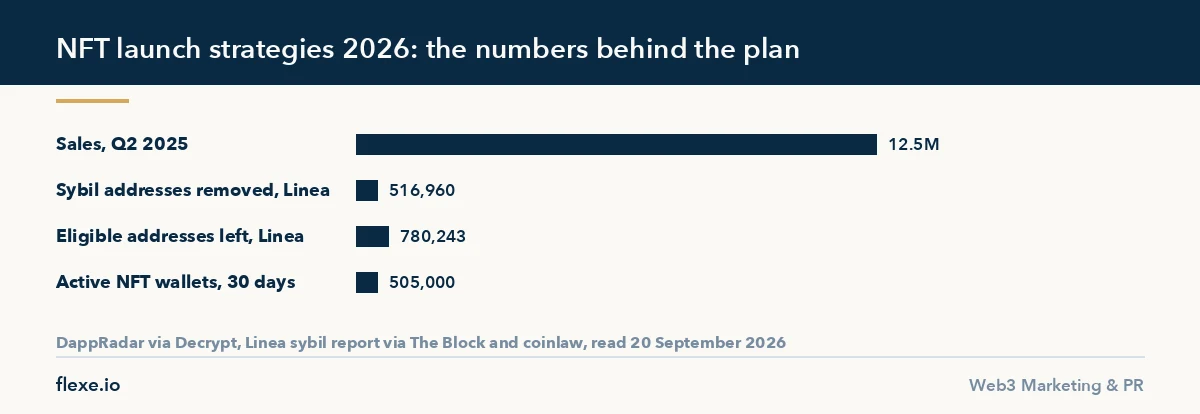
Price against the market that exists now. Average NFT sale prices fell from roughly $321 in January 2025 to $54 by October, and active wallets trading on a 30-day basis stood near 505,000 in the first quarter of 2026, per CoinLaw market data. DappRadar counted 12.5 million sales in the second quarter of 2025, a 78% rise on the quarter before, while volume fell 45% to $823 million, as Decrypt reported. More buyers, smaller tickets.
A collection that sells out in minutes has discovered that its price was below what the market would bear. The difference between mint price and first-day floor is value that went to flippers rather than to the project. A fast sellout also fills the holder base with buyers optimizing for resale, who behave differently from people who bought to keep.
Track distinct wallets rather than units sold: a thousand units across nine hundred wallets is a different collection from one across two hundred. Slower mints with distinct wallets produce more durable communities than instant sellouts. Set supply at the number of holders you can keep talking to.
Allowlist design and sybil defence
Size the allowlist below the supply you intend to sell. A list that covers the whole collection converts guaranteed access into a free option, and the people who take free options sell on day one. A useful check: if every allowlist holder minted and listed at once, what would the floor be. If that number is uncomfortable, the list is too wide.
The filter should cost something. Time in the community, a completed action, or a held position all work; a form submission does not. The same logic governs incentive design generally, which our guide to task campaign design covers in more detail.
Farmed wallets are why the filter has to bite. When Linea screened its token distribution with Nansen, 516,960 of 1,297,203 eligible addresses were removed as sybil, leaving 780,243, The Block reported. That is roughly 40% of a list built by a well-resourced team, and a social-task allowlist will not be cleaner. Cap mints per address, require an action with a time cost, check for wallets funded in identical amounts from one source, and publish the rules before entries open.
What makes a raffle work
Publish the odds before entry opens. A raffle with 10,000 entrants for 200 spots is a two percent chance, and stating that up front converts 9,800 disappointed people into 9,800 who knew the terms. Give losers something: a consolation position or priority in a later phase costs nothing and keeps your most motivated audience from leaving. Draw publicly, since on-chain randomness costs a little gas and removes the accusation that winners were picked in advance.
What makes a giveaway work, and what it cannot do
A giveaway buys attention, and attention is the only thing it reliably buys. Judged on participant count it always succeeds; judged on retention 30 days later it usually does not, because low entry cost selects for people farming many giveaways at once. Run one to widen the funnel before an allowlist opens, then let the allowlist filter. Running a giveaway as the allowlist produces holders who mint and list on the same day.
Safety rules matter more than mechanics. Never ask for a seed phrase or a wallet signature to enter, announce winners only through the official channel, and say that you never message first. Giveaways are the most impersonated format in crypto, and a scam in your name during a launch costs more than the campaign was worth.
| Raffle | Giveaway | |
|---|---|---|
| Solves | Allocating scarce spots fairly | Reach beyond the existing audience |
| Entry should cost | A completed action, not a click | A follow or a share, deliberately cheap |
| Typical failure | Odds so long that losers leave angry | Everyone claims, nobody stays |
| Measure by | Share of entrants who mint | Share of participants present 30 days later |
Timeline: 8 weeks before mint to 30 days after
Eight weeks is the shortest workable window for an allowlist built on actions.
Weeks 8 to 7: decisions and owners
Fix the mint model, supply, price band and chain, and give every stage a named owner with a date. Answer the allowlist floor check while changing the plan is free.
Weeks 6 to 5: audience before allowlist
Widen the funnel before the filter exists, which is where a giveaway or a creator campaign belongs. The vetting standard is engagement relative to audience size and whether it is genuine. A screened network average sits near 1.7 percent, and accounts far above it usually show reciprocal activity. See influencer channels and NFT artists and ambassadors cover selection.
Weeks 4 to 3: allowlist open
Publish the rules, the size of the list, and the odds if a raffle decides it. Entries run against a filter with a time cost, and sybil screening runs alongside.
Weeks 2 to 1: mechanics rehearsed
Test the contract on a public testnet with real wallets, not only your own. Publish the exact mint time in one timezone, the per-wallet cap and the official links, then repeat them daily. Impersonation peaks here, so the mint-day channel should be the one people already check.
Mint week: presale, public, reveal
Presale first, public stage second, reveal as a separate event with its own creative. The 24 hours after a reveal produce the listing wave that sets the floor for weeks, and a reveal without context produces more listings than one that explains the traits. Delayed reveals build tension and suspicion, so if the delay is long, say why.
Days 1 to 30: the part that decides the floor
Week one converts buyers into holders or does not, and the deciding factor is whether the team keeps showing up. Schedule something for every day of it before mint day. Consistency matters more than news, and a silent channel reads as abandonment. Our guide to where crypto communities live covers which platform suits post-launch activity.
Launch-day checklist
Verified the day before, not on the hour:
- Contract verified on the explorer, mint function and per-wallet cap readable.
- Allowlist uploaded and spot-checked against the screened file.
- Mint price, start time and timezone in one place every channel links.
- Gas assumption re-checked on the morning of the mint.
- Official links pinned, with a note that the team never messages first.
- One named person watching for impersonation all window.
- A written answer ready if the mint does not clear.
- Reveal creative finished and scheduled before the mint.
What to do if the mint does not sell out
An unsold mint is a pricing result, not a verdict on the collection, and the worst response is silence followed by a quiet extension. Pick one of four answers in advance. Close supply at the number minted and publish the new total, which makes the collection smaller and the holders whole. Extend the window at the same price with a stated end time, which works only while wallets still arrive. Reopen as a timed open edition. Or refund and relaunch with a different model.
Four failure modes recur across the nft launch strategies that end this way. Sizing the allowlist to guarantee a sellout, which fills the base with flippers. Pricing to sell out rather than to discover, which hands the spread to resellers. Treating the reveal as a formality, which wastes attention already paid for. And going quiet in week one. All four are decided before launch day.
For the promotional mechanics of a drop see our NFT drop marketing guide, and for wider strategy the NFT marketing guide. To have the mechanics run for you, see quest and airdrop campaigns or send the brief on Telegram at https://t.me/flexe_io_agency. Nothing here is financial advice.
Frequently asked questions
Which mint model should a first collection use?
A fixed price mint behind a narrow allowlist is the safest first model, because it has one variable to get wrong instead of several. Dutch auctions suit teams that cannot size demand, open editions suit artists who want reach, free mints retain worst.
How long should an NFT launch campaign run before mint?
Eight weeks is a workable minimum, because an allowlist has to be built through actions rather than forms and those actions take weeks. Campaigns compressed into days can only use filters that take days to satisfy, and those filter nobody.
Should the presale be priced below the public mint?
Usually yes, since the presale rewards commitment made before the outcome was known. The size of the discount matters less than the fact that it exists, because a presale priced identically to the public mint gives no reason to join early.
How do you keep bots off an NFT allowlist?
Cap mints per address, require an action with a real time cost, and screen for wallets funded in identical amounts from one source. Linea removed 516,960 of 1,297,203 addresses as sybil, so assume a social-task allowlist carries at least as much farming.
Is a delayed reveal better than an instant one?
A delay creates a second moment of attention, which is worth having if you planned something for it. Delaying without a plan moves the listing wave later and invites speculation. Announce the reveal time when the mint opens and hold to it.
Which nft launch strategies work without a big budget?
A narrow allowlist, a low fixed price and a reveal planned as its own event cost time rather than money. Gas on Ethereum averaged 0.068 gwei on 20 September 2026, so the mint is cheap; the cost is the filtering before it.