The main NFT raffle strategies are a fixed-ticket raffle (1,000 entries for 100 NFTs gives each entry a 10% chance), a Dutch-auction raffle (on Art Blocks settlement minters every buyer pays the final price), an allowlist or whitelist raffle (Premint reports 70,664,392 registrations across 40,540 projects), a free-to-enter social raffle (Alphabot draws winners with JavaScript’s Math.random method) and an on-chain verifiable random raffle (Chainlink VRF returns up to 500 random values per request on Ethereum). Every platform figure below was checked on 19 September 2026 against official docs and product pages.
Few drops use just one format. A typical 2026 collection runs a social or allowlist raffle to decide who gets access, then sells through a fixed price or a Dutch auction, and moves the draw on-chain only when prizes are valuable.
The 5 NFT raffle strategies for 2026
The first two formats set the price; the other three decide access and how winners are picked.
1. Fixed-ticket raffle
A fixed-ticket raffle sets the number of entries and the number of prizes before it opens. Hand out or sell 1,000 tickets for 100 NFTs and every ticket has a 10% chance, which collectors can work out in their heads.
Best for: small collections and teams that want a predictable, easy to explain mint.
How it works: cap the ticket count, set a price or a free entry rule, close the window, draw winners and publish the list with wallet addresses so anyone can check it.
Watch out: paid tickets can look like a lottery in some jurisdictions, so take legal advice before you charge for entries. A capped ticket supply also rewards whoever controls the most wallets if you do not limit entries per person.
2. Dutch-auction raffle
A Dutch-auction raffle starts the price high and lowers it on a schedule until demand meets supply, with a raffle deciding who may bid or who gets a discount tier. The cleanest version is the settlement model in the Art Blocks minter guide: all collectors pay the same final price, the price at which the last token sold, and anyone who paid more receives the difference back. Art Blocks offers exponential curves, a constant percentage drop per unit of time, and linear curves, a constant absolute drop, and suggests a 5 minute half-life for quick drops or 20 minutes for gradual price discovery.
Best for: high-demand drops where a fixed price would be set too low and flipped within hours.
How it works: raffle winners get access to the auction window, the price falls on its published curve from a start price to a resting price, and settlement refunds the gap after the last sale.
Watch out: without settlement, early buyers pay more than late buyers and say so loudly. With settlement the final price can end far below what the team hoped, and you must accept it.
3. Allowlist or whitelist raffle
The allowlist raffle is still the default for most collections. Entrants register a wallet, meet the entry rules, and a draw decides who may mint, usually at a fixed price and before the public sale. Premint, one of the main tools for this, lets creators gate entry by X follows, Discord roles, token ownership or wallet balance, and says it has handled 70,664,392 registrations for 40,540 projects with 5,935,523 collector wallets connected since 2021.
Best for: collections with an existing community that want to reward early members before a public sale.
How it works: open registration, verify requirements, draw winners, then load their wallets into a Merkle allowlist that the mint contract reads.
Watch out: follow and role requirements are cheap to fake at scale, so an open allowlist raffle with a huge entry count can be mostly farm wallets. Check wallets again just before the draw.
4. Free-to-enter social raffle
A social raffle asks for actions instead of money: follow an account, repost, join a Discord server, connect a wallet. It is the widest top of funnel you can build, with mechanics close to those of crypto quest platforms. Alphabot is typical of the category. The Alphabot documentation on rolling and finalization states that winners are picked with JavaScript’s Math.random method, that raffles with an NFT requirement run one final check of every entry before the draw, and that multiplier tokens add extra entries to the picking array for each token a wallet holds.
Best for: pre-launch awareness and partner collabs, where another community receives a block of your spots to raffle to its own members.
How it works: set tasks on X and Discord, run the raffle for a fixed window, recheck requirements, draw, then export winner wallets for the mint contract.
Watch out: social tasks attract raffle hunters who never mint. A big entry count is not a big buyer count, so add a holding or balance rule if you need people with funds ready.
5. On-chain verifiable random raffle
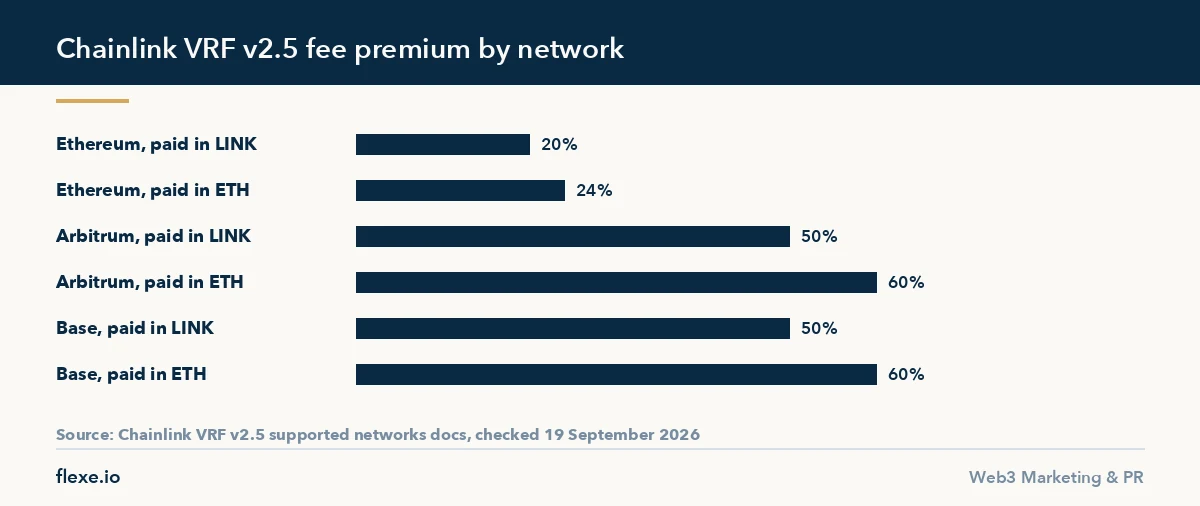
An on-chain raffle moves the draw into a smart contract and takes the random number from an oracle that publishes a proof. With Chainlink VRF the proof is published and verified on-chain before your contract can use the value. According to the Chainlink VRF v2.5 network parameters, an Ethereum mainnet request needs at least 3 block confirmations, can return up to 500 random values and allows a callback gas limit of 2,500,000. The fee premium on Ethereum is 24% when paid in ETH and 20% in LINK, against 60% and 50% on Arbitrum and Base.
Best for: paid raffles, high-value prizes and any drop where you expect people to claim the draw was rigged.
How it works: collect entries on-chain or commit a hash of the entry snapshot, request randomness, and let the contract map each random value to a winning entry that anyone can recompute.
Watch out: you pay gas plus the oracle premium on every request, and the contract still needs a review. Verifiable randomness does nothing for you if the entry list itself is full of sybil wallets.
How the five formats compare:
| Raffle type | Entry cost | Fairness | Bot risk |
|---|---|---|---|
| Fixed-ticket raffle | Free or a fixed ticket price | Clear odds, draw is only as fair as the operator | High without per-person limits |
| Dutch-auction raffle | Auction price, refunded down to final price with settlement | Everyone pays the same price with settlement | Medium, bots gain little from speed |
| Allowlist raffle | Free, gated by holdings or social rules | Depends on the tool’s draw and your filters | High if gates are follows and roles only |
| Free-to-enter social raffle | Free, paid in time and attention | Off-chain draw, not independently verifiable | Very high, the main target of farmers |
| On-chain VRF raffle | Gas plus oracle premium | Verifiable by anyone on-chain | Draw is safe, entry list still needs filtering |
Raffle tools and platforms
Off-chain tools collect entries and draw winners; on-chain tools handle only the draw or the sale.
Premint
Premint is built around allowlists. It lists wallet rechecks and duplicate token detection as bot protection, plus winner notifications, Discord role assignment and API exports. Entrants sign a message rather than a transaction, so Premint gets no power to move funds, which matters because fake raffle pages asking for approvals are a common drainer tactic.
Alphabot
Alphabot is geared toward social raffles and collabs between communities. The final recheck of NFT requirements can take several minutes on large raffles, an auto-finalize option notifies winners as soon as the draw completes, and teams can export entrants’ Discord, wallet and X details for partners or a contract.
Chainlink VRF
Chainlink VRF is the usual choice when the draw must be provable. It offers two billing methods. With a subscription, several consumer contracts share one balance and costs are deducted after each request is fulfilled, with lower gas overhead. With direct funding, the contract pays in native tokens or LINK at request time and costs are estimated up front, with higher gas overhead but no subscription account.
Art Blocks minters
Art Blocks is a useful reference for sale mechanics even if you do not launch there. Besides the Dutch auction with settlement, it documents a ranked auction where the highest bidders win, every winner pays the lowest winning bid and losing bids are refunded, a fixed price minter that sells first come first served, and an allowlist minter that builds a Merkle root from an uploaded CSV. We also tried to review Atlas3, but its site refused our request on the check date, so it is left out rather than described from memory.
Bots and sybil protection for NFT raffles
Raffles reward wallets, not people, so every free raffle attracts farmers who script entries, buy aged X accounts and rotate wallets. You cannot stop all of them, but you can make each fake entry cost more than the expected prize. These are the layers that work best together:
- Holding or balance rules: require a minimum wallet balance or a specific NFT, so each fake wallet needs capital, not just a signature.
- A final recheck before the draw: both Premint and Alphabot recheck wallets, which catches entrants who moved the same NFT between wallets.
- A humanity score: Human Passport docs describe it as a sybil resistance protocol where users collect Stamps from KYC, biometrics, web3 activity, web of trust and web2 activity into a score. The core Stamps and Passport Embed offerings are free.
- Account quality rules on X and Discord: minimum account age, a verified email or phone, and a role earned by real activity rather than a click.
- A published winner list with a short challenge window, so your community can flag obvious clusters of linked wallets before mint day.
There is an honest cost to all of this. Every filter also removes some real fans, especially newcomers with empty wallets and new accounts, and humanity scores favor people who are already active on-chain. Tight filters give you fewer, better entrants; loose filters give you a big number that looks good in a thread and converts poorly at mint.
One practical test: compare the entry count with your real community. In our 2026 community campaigns, growth was steady rather than explosive, for example Atleta Network grew from 130,000 to 141,000 members and Fourmeme from 35,000 to 47,000. A raffle that suddenly draws far more entrants than your server and channel have members should be treated as a bot signal until the wallets prove otherwise.
Raffle vs fixed-price drop vs Dutch auction
A raffle is an allocation method, while a fixed price and a Dutch auction are pricing methods, so the real choice is how you split access and price.
| Model | Who gets the NFT | Price set by | Main risk |
|---|---|---|---|
| Raffle, then fixed price | Random winners among eligible entrants | The team, before the sale | Farm wallets win spots and flip |
| Fixed-price drop | First come first served | The team, before the sale | Gas wars and bots that mint fastest |
| Dutch auction with settlement | Whoever buys before supply runs out | The market, final price for all | Final price below expectations |
| Ranked auction | Highest bidders | The lowest winning bid | Collectors must commit capital early |
Raffles solve the fairness problem of fixed-price drops by replacing speed with luck, but they do not discover a price. Auctions discover the price but favor collectors with the most capital. That is why many teams combine an allowlist raffle for community members with a Dutch auction or a fixed price public phase. Our guide to NFT launch strategies and mint formats walks through those combinations stage by stage.
How to run a raffle that sells the mint
The raffle is the easy part. The hard part is having enough real people who want the collection when it opens, so grow the community first, then run partner raffles with communities holding similar NFTs, then open your own allowlist raffle with holding rules.
Creators speed up the first two steps. Our base covers 11,859 crypto KOLs on X and 11,695 crypto and finance YouTubers, all with 5,000+ followers, and our crypto influencer marketing for NFT launches uses them to put a raffle in front of collectors rather than farmers. Community management with us starts at $2,000, and a focused single-channel campaign starts at $4,000.
The inconvenient part: a raffle cannot fix weak demand. Across 150 of our campaigns the median net ROI was 2.8x within 90 days, but the range ran from 1.4x to 7.0x, and 12 percent of campaigns failed to return their spend. If the allowlist fills with raffle hunters, the mint will show it. When you want help building the community first, start with our community management service for NFT projects.
Related reading: NFT drop marketing guide, NFT marketing guide for collections and crypto airdrop task campaigns.
Frequently Asked Questions
What are the best NFT raffle strategies in 2026?
The strongest raffle setups in 2026 pair an allowlist raffle for community members with a Dutch auction or fixed price mint, and use a social raffle for reach before launch. Move the draw on-chain with verifiable randomness when prizes are valuable. Most successful drops combine two formats rather than relying on one.
Are NFT raffles legal?
It depends mainly on whether entrants pay. Free-to-enter raffles based on social tasks are usually treated differently from paid ticket raffles, which can fall under lottery or gambling rules in many jurisdictions. Take legal advice before charging for entries, publish clear rules and odds, and keep a free entry route if your lawyer recommends one.
How do I stop bots from winning my NFT raffle?
Layer entry rules that cost money or time to fake, then recheck wallets right before the draw. Holding or balance requirements, X and Discord account checks, a humanity score such as Human Passport and a published winner list each remove a share of farm wallets. No single filter stops a determined farmer.
Is Premint or Alphabot better for an NFT raffle?
Premint fits a classic allowlist with wallet rechecks, duplicate token detection and Discord role assignment, while Alphabot suits task-based social raffles and collabs between communities. Neither draw is verifiable on-chain, and Alphabot documents that it uses JavaScript Math.random. For paid or high-value prizes, run the final draw with Chainlink VRF instead.
How much does it cost to run an NFT raffle?
The tools are the small line item: Human Passport core Stamps are free, and Chainlink VRF on Ethereum charges gas plus a premium of 20% in LINK or 24% in ETH. The bigger cost is attracting real entrants. With us, community management starts at $2,000 and a focused single-channel campaign at $4,000.