Crypto B2B marketing, which means selling infrastructure to crypto companies, is B2B software marketing with one difference that changes everything: your buyer can read your usage on chain. A node provider, oracle, custody platform or analytics vendor cannot claim adoption that the buyer cannot verify, and cannot hide adoption that has stalled. That single fact removes most of the vocabulary normal B2B marketing runs on.
It also removes the excuse. In a market where integrations, transaction counts and contract calls are public, the honest move is to publish them first, because the prospect will look anyway and finding the number themselves is worse than being handed it.
Who is actually buying in crypto B2B marketing
| Role | What they need to see | What they ignore |
|---|---|---|
| Engineering lead | Documentation, latency, uptime history, a working sandbox | Brand messaging |
| Founder or head of growth | Who else integrated, and whether those projects are alive | Feature lists |
| Compliance or legal | Jurisdiction, data handling, incident history | Marketing claims about security |
| Finance | Pricing model and what happens at scale | Contact-us gating |
The fourth row is where most crypto B2B loses deals quietly. Hiding pricing behind a form filters out the engineer evaluating options on a Friday afternoon, who is usually the person who decides which two vendors get shortlisted.
Documentation is the crypto B2B marketing campaign
For a technical buyer, docs are not support material, they are the product demo. A vendor whose documentation answers the question faster than a sales call gets shortlisted by people who never spoke to anyone. That makes documentation quality a marketing metric rather than an engineering chore, and it is the single highest-yield asset in this category.
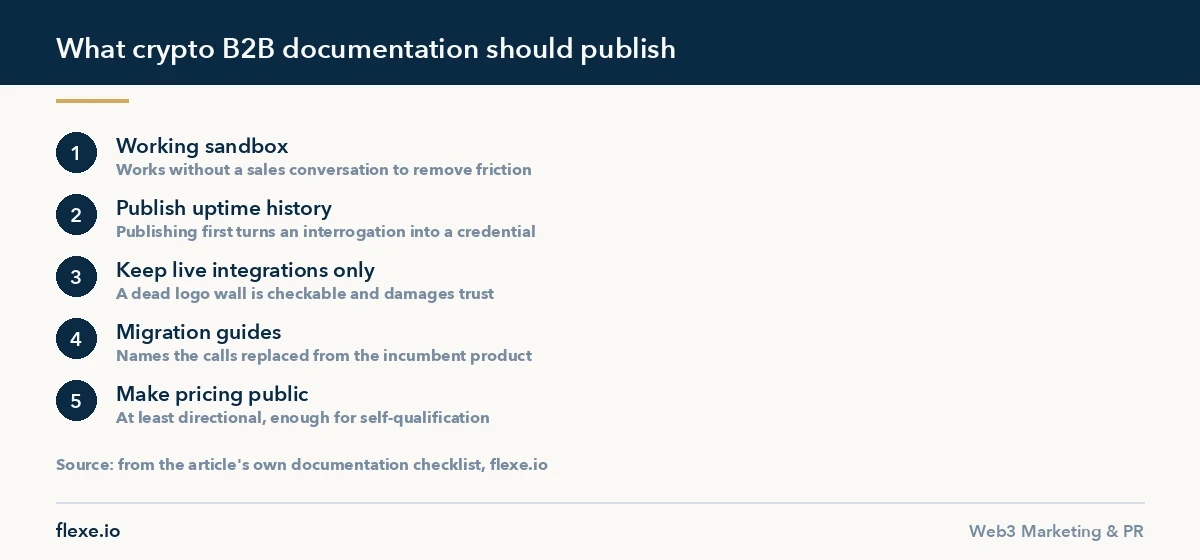
- A sandbox that works without a sales conversation. Gating the trial removes the evaluator most likely to advocate for you.
- Uptime and incident history, published. Every serious buyer asks; publishing first converts an interrogation into a credential.
- Named integrations that are still live. A logo wall of dead projects is checkable and actively damaging.
- Migration guides from the incumbent. The buyer is usually replacing something, and the switching cost is the real objection.
- Pricing that is at least directionally public. Not necessarily a full rate card, but enough to self-qualify.
Why case studies matter more here than anywhere
Because they are verifiable. A named client with an on-chain integration is a claim the prospect can check in a minute, which makes it worth far more than an anonymised success story. The corollary is that permission to name clients is a commercial asset worth negotiating for at contract time rather than asking for later.
The channels that reach these buyers are narrow: developer communities, the documentation of adjacent tools, conference conversations and direct relationships. Broad crypto promotion reaches token holders, who are not the buyer. Where public visibility does matter is credibility rather than reach: how we build credibility for infrastructure vendors.
Mapping the buying committee before the campaign
Before writing anything, list the people who have to say yes and what each of them can veto. The table above names the roles, and the campaign question is which of them you currently reach and which you do not. Most infrastructure vendors market exclusively to the engineer and then lose deals in a security review they never prepared for, which is a content gap rather than a sales failure.
Security and compliance reviews arrive as a questionnaire, and answering one well is a marketing asset. Keep a maintained document covering key management, data handling, jurisdiction, subprocessors and incident history, and send it before it is requested. A vendor who produces it in an hour looks like a company that has done this before, and that impression does most of the work.
Incident history is the section everyone is tempted to omit. Publish it anyway, with what happened, what the impact was, how long it lasted and what changed afterwards. Buyers assume every provider has had outages, so an empty page reads as concealment rather than as reliability, and the specific detail is what a technical reviewer uses to judge whether your operations are serious.
Procurement and legal add weeks that nobody schedules for. Ask early which review stages exist on their side, whether a vendor security assessment is required, how long each stage usually takes, and who signs. The answer changes the marketing calendar, because a buyer who needs a quarter of internal process should be reached a quarter earlier than your own planning suggests.
Identify who inside the buyer will be your advocate and write for them specifically. The engineer who shortlisted you has to justify the choice internally, often in a document you will never see. Give them the comparison, the migration plan and the cost model in a form that can be pasted into that document, and the deal moves without you being in the room.
Write for the reviewer who is comparing you against an incumbent they already trust. Inertia is the real competitor in infrastructure, and the honest version of your pitch names what the incumbent does well before explaining the specific case where it does not. A comparison pretending the other product is bad gets discounted by exactly the person you need on your side.
What the sales cycle needs from marketing
The evaluation kit is the defined set of things a buyer needs in order to choose you, and most vendors assemble it improvisationally per deal. It includes a sandbox that works without a call, a migration guide from the incumbent, a reference customer who has agreed in advance to take calls, and a written cost model at the volumes this buyer will actually run.
Judge the sandbox by whether a stranger can produce a result in it unaided. Give it to someone who has never seen the product, watch without helping, and fix whatever made them stop. The failure is rarely the code, and it is usually a missing key, an unexplained default or an error message naming an internal service the user has never heard of.
Reference customers should be recruited before they are needed. Ask at the point where the customer is happiest, agree how often you can call on them, and keep a short list rather than one overworked name. A reference who has been asked four times this quarter gives a flat answer, which is worse for the deal than having no reference at all.
Write the cost model out at several volumes instead of quoting a rate. The buyer’s real question is what this costs when their product works, and a price that looks reasonable at test volume and punishing at production volume is discovered late and remembered permanently. Publishing the shape of the curve, even without exact figures, does most of what a full rate card would do.
Keep a migration guide per incumbent rather than one generic page. Switching cost is the real objection on this page, and a guide naming the specific calls being replaced and the differences in behaviour answers it concretely. It is also the page that ranks for searches made by people who have already decided to leave someone, which is the highest-intent traffic in this category.
Version and date the technical pages the way engineering versions the product. A documentation page describing behaviour that changed two releases ago costs more trust than a missing page would, because the buyer now doubts everything else on the site. Tie the documentation review to the release process so that nobody has to remember it as a separate task.
Running a pilot with written success criteria
A pilot without written criteria becomes an indefinite free tier. Agree what is being tested, at what volume, over what period, and what result leads to a paid contract. Put it in a short document signed by whoever controls the budget, because the engineer running the pilot usually is not that person and an enthusiastic technical result does not convert itself into a purchase.
Instrument the pilot so that both sides see the same numbers. Agree the measurement method up front, share a view rather than a monthly summary, and raise problems while they are still fixable. Most pilots that quietly expire did so because something broke early and nobody told the vendor until the decision had already been made somewhere else.
Contracts, pricing and naming rights
Negotiate the right to name the client at contract time, as this page argues, and be specific about what it covers: the logo, a case study, a quote from a named person, or a joint announcement. Each requires different approvals inside their company, and asking for all of them later means starting a fresh review with people who have no reason to prioritise it.
Agree the case study process alongside the right. Name who reviews the draft, how long they have, and what happens if the reviewer leaves the company. Studies die in approval queues more often than they are refused, and a named owner with a deadline in the contract is what prevents a finished piece sitting unpublished for a quarter.
Keep the logo wall honest by scheduling a check of it. Integrations end, projects die, and a wall full of dead names is checkable and damaging, as this page notes. Someone should verify every claim on that page at a regular interval and remove what no longer holds, which is a short task that nobody owns until it embarrasses the company.
Plan for the named client who leaves. Remove the logo before they ask, tell the case study’s reviewer it is coming down, and keep the relationship intact, since departures in this market are often about a funding change rather than about you. A vendor who handles the exit gracefully gets recommended by people who no longer pay them.
Service levels belong in the marketing conversation because buyers compare them directly. Decide what you commit to, what the remedy is, and whether the published figure matches what operations can actually hold. A commitment written by marketing and discovered by engineering at the first incident costs more than the deals it won, and it is quoted back to you at renewal.
Crypto B2B marketing measurement that holds up
Measure accounts rather than leads. A single buying committee produces several sign-ups from the same domain over weeks, and counting them separately makes the pipeline look broader than it is. Group activity by company, and the picture changes from a list of contacts into a small number of evaluations at different stages, which is what the sales conversation is actually about.
Documentation analytics are the closest thing to intent data in this category. Which pages an account reads, whether they reached the migration guide, how many people from that domain appeared, and whether anyone opened the sandbox tell you more than any form. Set that up early, since treating documentation as unmeasured engineering output wastes the signal the highest-yield asset generates.
Expect most of the evaluation to happen without contact. The engineer reads, tries the sandbox, compares two vendors and decides, and the first conversation is often a formality. That means the goal of measurement is not attribution to a touchpoint but knowing which accounts are active, so an outbound message can arrive during the evaluation rather than months after it closed.
Agree with sales what counts as a qualified account before reporting on any of it. Without that definition the pipeline conversation becomes an argument about numbers rather than about accounts, and marketing ends up optimising for a figure nobody downstream believes. The definition should name what the buyer did, such as opening the sandbox or reading the migration guide, rather than how they arrived.
Tracking the buyer who never contacts you
Ask the question in the onboarding form rather than reconstructing it from analytics: what were you replacing, and what made you look now. The answers name the competitor, the trigger event and the page that mattered, which is enough to decide where the next quarter of effort goes. Keep the answers raw rather than aggregated, since the phrasing is the useful part.
Review lost deals on the same schedule as won ones. In this category the common losses are a missing feature, a price that broke at scale, a compliance requirement you could not meet, and a competitor with a closer integration to something they already run. Each has a different fix and only one of them belongs to marketing, which is why the review needs the other teams present.
Renewals deserve the same attention as acquisition and rarely get it. Usage that flattens months before the renewal date is the signal, and it is visible in data you already have. Someone should be watching it and starting the conversation while there is still time to fix the cause, rather than discovering the decision in a notice email.
Cut the activity that reaches token holders rather than buyers. Broad crypto promotion produces numbers that look healthy on a report and never appear in a pipeline, and the budget it consumes is the budget the documentation and the migration guides need. The test is simple: can you name one account in the pipeline that arrived through it.
Infrastructure networks sell to operators as much as to traders, and our guide to DePIN marketing shows how that audience is reached.
Frequently Asked Questions
How is crypto B2B marketing different?
The buyer can verify your adoption on chain. Integration counts, transaction volumes and contract calls are public, so claims that cannot be checked are discounted and stalled growth cannot be hidden.
Should crypto infrastructure publish pricing?
At least directionally. Gating price behind a form filters out the engineer evaluating options independently, who is usually the person deciding which vendors reach the shortlist.
What is the highest-yield marketing asset?
Documentation, followed by a sandbox that works without a sales conversation. For a technical buyer the docs are the demo, and vendors who answer faster than a sales call get shortlisted by people who never make contact.
Do case studies work in crypto B2B?
Better than elsewhere, because they are verifiable. A named client with a live on-chain integration can be checked in a minute, which makes naming rights worth negotiating at contract time.