Both hand out tokens to strangers in the hope some of them stay. The difference is what the stranger has to do first, and that single difference determines almost everything about who arrives and how long they remain.
An airdrop rewards a state: holding something, having used something, being on a list. A quest campaign rewards an action performed now. Retention follows from that, and so does the cost of being wrong.
What each mechanism actually selects for
| Airdrop | Quest campaign | |
|---|---|---|
| Reward trigger | A state you snapshot | A task completed now |
| Who it attracts | Whoever already qualified | Whoever is willing to act |
| Farming pressure | Extreme once criteria are known | Manageable if tasks cost something |
| Control over criteria | Total, until you announce them | Total throughout |
| Cost profile | One large distribution | Spread across the campaign |
| Typical outcome | Immediate sell pressure | Slower arrival, better retention |
| What it teaches users | Qualify and claim | Use the product |
| Main risk | Rewarding people who never return | Completions that mean nothing |
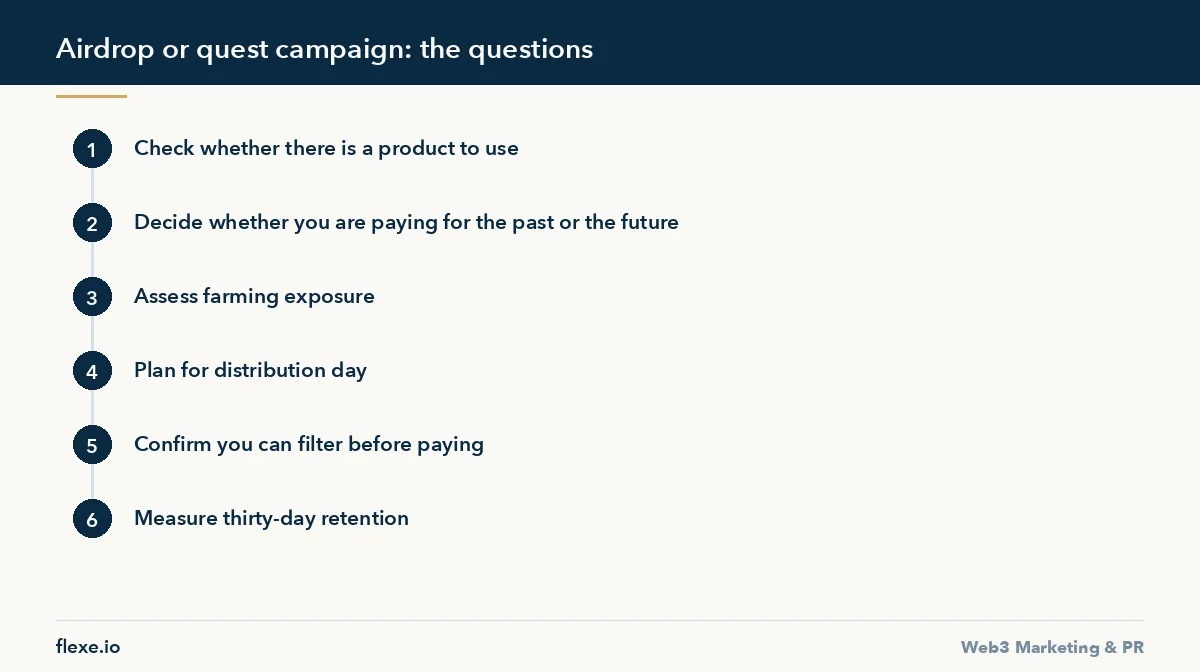
1. Is there a product to use yet?
A quest campaign needs something to do. If the product is live, tasks can require a real action and the campaign doubles as onboarding: the reward is paid for behaviour you actually want repeated.
If nothing is live, the only available tasks are social, and social tasks cost seconds and are trivially automated. In that situation a quest campaign is an airdrop with extra steps, and the extra steps do not filter anyone.
2. Are you rewarding the past or shaping the future?
An airdrop is a payment for something already done, and it is the right instrument when you genuinely want to thank early users, compensate testers, or distribute to a set of holders you can define.
It is the wrong instrument when the goal is to create behaviour, because it pays after the fact and teaches nothing. If you want deposits held or swaps made, pay for deposits held and swaps made.
3. How much farming can you absorb?
The moment airdrop criteria become known or guessable, they are farmed at scale by operators running thousands of addresses, and the distribution ends up concentrated in exactly the wallets least likely to hold.
Quests can be defended, because you control the task. Requiring an on-chain transaction, a holding period or a minimum wallet age removes most automation, since the strategy depends on completing and exiting immediately. The design that survives is in how to run a quest campaign without buying bots.
4. What happens to the token on distribution day?
An airdrop delivers a large supply into many hands at one moment, and a predictable share of it is sold immediately. If the pool is thin, that sale is the price chart for the following week.
A quest campaign spreads distribution across the campaign and usually across smaller amounts, so the same total budget arrives without a single cliff. Where an airdrop is unavoidable, depth has to be funded in advance, and the mechanics are in how to add liquidity to a pool the first time.
5. Can you filter afterwards?
Both mechanisms need Sybil filtering, and both need the rules published before anyone participates. Retroactive disqualification is the fastest way to turn a distribution into a public dispute, whatever the evidence.
The practical question is whether you receive the raw address list and can exclude before paying. If a platform cannot do that, the campaign cannot be corrected once it starts.
6. What will you measure?
Claim rate and completion count are both available immediately and describe nothing. The number that matters is how many recipient addresses are still active thirty days later.
Measured that way the comparison usually resolves cleanly, and in our own task campaigns retention tracked task difficulty and on-chain requirements far more closely than it tracked reward size. Harder tasks and smaller rewards consistently left more real users behind.
Which to choose
If the product is live, run quests. They cost less per retained user, they can be defended against automation, they distribute without a cliff, and the reward is paid for behaviour you want repeated.
Use an airdrop when you owe something to a defined group, when a governance distribution has to be broad by design, or when a snapshot has already happened and the commitment is made. In those cases publish the criteria, fund the depth first, and expect the sell pressure rather than being surprised by it.
What neither does is create a community. Participants arrive for a reward and are not in conversation with anyone, and turning some of them into a community is separate work, covered on our crypto community management page.