The top NFT influencer collaborations to study in 2026 are Adidas x Bored Ape Yacht Club, gmoney and PUNKS Comic (29,620 NFTs sold for about $22 million), Snoop Dogg x Gala Music (at least $44.3 million of Stash Boxes in five days), Pudgy Penguins x Walmart (over 1 million toys sold in the first year), Steve Aoki x Antoni Tudisco ($4.25 million on Nifty Gateway) and Nike x RTFKT (acquired on 13 December 2021). Every figure below was checked on 19 September 2026 against the original announcement or a trade publication that reported it at the time.
Search lists for 2025 keep recycling the same names because the biggest creator and brand deals in NFTs happened between 2021 and 2023, and the ones that came later mostly copied their structure. They still show what was sold, what holders got and what a smaller budget can repeat. We ranked the list by two things: how much of the result was publicly disclosed, and how much a mid-sized project can copy.
9 notable NFT collabs between creators and brands
The first five entries have disclosed numbers you can check. The last four are included for their structure rather than their sales, so we describe them without figures.
1. Adidas x Bored Ape Yacht Club (2021)
Adidas Originals built its first NFT drop, Into the Metaverse, with three partners from inside the NFT scene: the Bored Ape Yacht Club, the PUNKS Comic team and gmoney, an NFT collector and influencer with a large following on X. According to Modern Retail’s interview with the Adidas digital director, the brand sold 29,620 NFTs at 0.2 ETH each in December 2021, about $22 million in total. Holders were promised limited physical apparel the following year and game content in The Sandbox.
What it was: a global sportswear brand borrowing credibility from an NFT collector and two native projects instead of hiring a mainstream celebrity.
Result: about $22 million in primary sales priced in ETH, with the NFT working as a pass to physical and digital perks.
Lesson for a project: one respected collector who already holds the partner collection can carry more weight with NFT buyers than a much bigger name from outside crypto.
2. Snoop Dogg x Gala Music (2022)
Snoop Dogg released his album B.O.D.R. (Bacc On Death Row) as NFT “Stash Boxes” on the Gala Music store in February 2022. Music Business Worldwide reported a cap of 25,000 boxes at $5,000 each, each holding one of 17 songs, and sales of at least $44.3 million in five days. Collectors who completed the full album qualified for an exclusive concert and a pre-party with Snoop.
What it was: an artist using his own audience to sell a music release through a Web3 platform partner.
Result: the largest disclosed revenue on this list, earned in under a week.
Lesson for a project: a collect-the-set mechanic with a real-world top prize gives holders a reason to buy more than once, and it works best when the creator’s fan base is already large before the mint.
3. Pudgy Penguins x Walmart (2023)
Pudgy Penguins took its NFT characters into physical retail. The Pudgy Penguins press release on its Target launch states that Pudgy Toys debuted in 2,000 Walmart stores in September 2023, grew to 3,100 Walmart locations, and sold over 1 million units for $10 million in retail sales in the first year. Each toy carries a QR code into Pudgy World, a game on zkSync.
What it was: an NFT brand acting as the licensor, with a mass retailer as the distribution partner.
Result: an NFT character line selling at toy-aisle scale, followed by a second national retailer, Target.
Lesson for a project: characters that work without a wallet reach buyers who will never mint, and the QR code gives you a path back on chain.
4. Steve Aoki x Antoni Tudisco (2021)
DJ Steve Aoki paired with digital artist Antoni Tudisco for Dream Catcher, a drop of animated artworks with Aoki soundscapes. CoinDesk reported that the collection launched on Nifty Gateway on 7 March 2021 and brought in $4.25 million, with one piece selling for $888,888. He followed in April 2021 with a sci-fi comic series, Neon Future.
What it was: a musician with a mainstream audience teaming up with a respected visual artist, so each side covered the other’s gap.
Result: a seven-figure celebrity drop, which opened the door to a series rather than a single release.
Lesson for a project: pair a creator who brings the audience with an artist who brings the craft, and plan the second drop before the first one ends.
5. Nike x RTFKT (2021)
RTFKT was a digital sneaker and collectibles studio founded in 2020 by Benoit Pagotto, Chris Le and Steven Vasilev. The Nike announcement of the RTFKT acquisition is dated 13 December 2021 and says the terms were not disclosed. Nike later wound the studio down after a change of chief executive, and reports since then say it was sold to an undisclosed buyer.
What it was: the deepest form of collaboration, where the brand bought the creator studio outright.
Result: years of co-branded digital and physical sneakers, then a shutdown that left holders with fewer of the promised perks.
Lesson for a project: holder benefits that depend on one corporate partner can end when that partner changes priorities, so write down what survives if the deal stops.
6. Gary Vaynerchuk x VeeFriends (2021)
Gary Vaynerchuk drew the VeeFriends characters himself and turned the collection into access: holding a token served as a ticket to VeeCon, his conference where the only way in was an NFT, along with in-person time and gifts for some token types.
What it was: a creator-led collection where the influencer is the brand.
Result: a recurring event that gave holders a reason to keep the token after the mint.
Lesson for a project: utility the creator can deliver personally is more believable than a roadmap of partnerships that do not exist yet.
7. Hello Sunshine x World of Women (2022)
Reese Witherspoon’s media company Hello Sunshine signed a storytelling partnership with World of Women, a collection made by women artists. The plan covered developing the characters into films and TV series, plus live events that teach women about NFTs. Witherspoon already used a World of Women NFT as her profile picture.
What it was: a celebrity-owned studio licensing NFT characters for entertainment.
Result: mainstream press coverage and a credible story about who the collection was for.
Lesson for a project: a public, unpaid show of ownership before a deal makes the later partnership look earned, not bought.
8. Paris Hilton x Blake Kathryn (2021)
Paris Hilton, an active NFT collector before she launched anything, released Planet Paris with digital designer Blake Kathryn on Nifty Gateway. Fixed-price editions sat alongside a single edition sent to auction.
What it was: a celebrity lending her personal brand to an established digital artist.
Result: a sold-out drop and a long-running public role for Hilton as an NFT advocate.
Lesson for a project: mixing fixed-price editions with a single auction piece gives both casual fans and big collectors a way in.
9. Tiffany x CryptoPunks (2022)
Tiffany and Co. sold NFTiff passes only to CryptoPunk holders. Each pass could be redeemed for a custom gold pendant with gemstones, modelled on the buyer’s own Punk. The passes sold out within minutes.
What it was: a brand collaborating with a collection’s holders directly, without a single influencer in the middle.
Result: fast sell-out, strong press, and a physical object tied to each holder’s identity.
Lesson for a project: a gated offer for another collection’s holders turns that community into your launch channel.
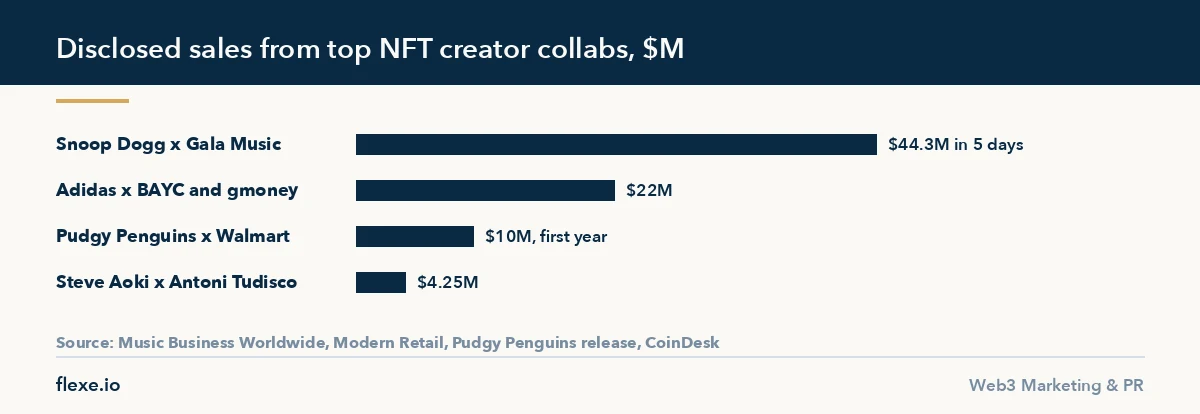
What makes an NFT influencer collaboration work
The same pattern repeats. The creator was already inside the scene (gmoney held Apes, Hilton collected, Witherspoon wore a World of Women avatar), the NFT did something after the mint (apparel, concerts, a conference ticket, a pendant), and the price and supply were stated plainly.
Most projects cannot sign Snoop Dogg, so the practical version is a group of mid-sized creators who already collect in your category, and vetting decides the result. We check audience geography, bot share, recent engagement, how past paid launches traded, and whether the creator’s public wallet holds what they claim. Our guide on how to vet a crypto KOL before paying lists the full checklist.
Flexe has run more than 800 campaigns since 2018. Our base holds 11,859 crypto KOLs on X and 11,695 crypto and finance YouTubers, all with 5,000 or more followers. The honest part: most of that base is wrong for any single NFT mint. The accounts we put in front of a collection usually come from our active X roster of 85 verified accounts, which reaches 8.7M followers at 1.74% engagement, and even then only the creators who collect art or gaming NFTs make the shortlist.
Community work matters as much as the creator post. In 2026 our community campaigns took Fourmeme from 35,000 to 47,000 members, Atleta Network from 130,000 to 141,000 and Tothemoon from 40,000 to 45,000. The creator brings people to the door; the community team keeps them until mint day. If you want both sides handled together, our crypto influencer marketing service covers creator selection, briefs, posting and reporting.
How to structure NFT influencer collaborations: fees, revenue share, disclosure
There are four common deal shapes. Most real agreements combine two of them, for example a modest flat fee plus an allocation that vests after mint.
| Structure | How the creator is paid | Works best when | Watch out for |
|---|---|---|---|
| Flat fee per post or package | Cash or stablecoins before posting | You need reach on fixed dates | No link between pay and results |
| Mint allocation | Free NFTs from the collection | The creator genuinely collects | Instant selling after reveal; must be disclosed |
| Revenue share | A cut of primary sales via a tracked link or code | The creator’s audience buys directly | Attribution disputes, wallet tracking gaps |
| Licensing or co-creation | Royalties on joint products | The creator is a brand in their own right | Long contracts that outlive the hype |
Flat fees pay the creator whether the mint fills or not. Revenue share lines up incentives, but only if you can track sales per creator, which on chain means a unique mint link, a referral code or an allowlist per creator. Allocations are the most NFT-native option. Add a lock period so the creator is not selling into buyers they just sent you. Co-creation, the Aoki and Hilton model, is covered in our note on NFT brand licensing deals.
On budget, a focused single-channel campaign with us starts at $4,000, and full-stack launches that combine creators, PR, paid acquisition and community run $50K to $500K over three to six months. Creator rates vary widely by audience quality, not follower count, so read how to price a KOL campaign before you accept the first quote.
Whatever the shape, put these clauses in writing:
- A disclosure requirement for every post, with the exact wording and placement.
- A ban on price predictions, floor talk and “guaranteed” returns.
- Content approval before posting, with a fixed turnaround time.
- Lock or vesting terms on any free NFTs or allocations.
- What happens to holder perks if either side exits the deal.
Risks: disclosure rules, hype and perks that expire
The biggest legal risk is an undisclosed paid post. The FTC endorsement guides FAQ says a material connection between an endorser and a brand must be disclosed, and that covers payment and free products. It accepts plain wording such as “#ad” or “#sponsored” at the start of a post, rejects disclosures hidden in a bio, in comments or behind a “more” link, and asks for one in every post. Platform branded-content tools are not enough on their own: the responsibility sits with the influencer and the brand. Brands are expected to train and monitor creators, even when an agency runs the campaign. The guides were last revised in 2023.
The FAQ does not name NFTs or tokens. In our reading, a free NFT or a mint allocation is both a payment and a free product, so it needs the same disclosure as cash. Rules outside the US differ, so have counsel review the post template too.
The second risk is perks that expire. RTFKT holders learned that a corporate partner can change strategy, so promise only what your team can deliver alone. The third risk is a creator scandal attaching itself to your collection.
Finally, set expectations honestly. Across 150 of our campaigns the median net ROI was 2.8x within 90 days, with a range of 1.4x to 7.0x, and 12 percent of campaigns failed to return their spend. Creators fill mints; they cannot save art nobody wants.
Related reading: our NFT influencer marketing guide, the step-by-step NFT marketing guide for new collections and our comparison of the best crypto KOL agencies.
If you would rather hire the work out, we checked nine NFT marketing agencies on what each one publishes about itself.
Frequently Asked Questions
What are the most successful NFT collabs with influencers?
The most successful disclosed ones are Snoop Dogg x Gala Music, Adidas x Bored Ape Yacht Club and gmoney, Pudgy Penguins x Walmart and Steve Aoki x Antoni Tudisco. Snoop sold at least $44.3 million of Stash Boxes in five days, and Adidas sold 29,620 NFTs for about $22 million.
How much do NFT influencer collaborations cost?
Costs range from a few thousand dollars to six figures, depending on creator quality and scope. A focused single-channel campaign with us starts at $4,000, and full-stack launches run $50K to $500K over three to six months. Many deals add a mint allocation or revenue share on top of a flat fee.
Do NFT influencers have to disclose paid promotion?
Yes, under the FTC endorsement guides any payment or free product is a material connection that must be disclosed. The disclosure should sit at the start of each post, in plain words such as #ad, and not only in a bio or comment. Treat free NFTs and allocations the same way as cash.
Is revenue share better than a flat fee for an NFT creator deal?
Revenue share is better when you can track each creator’s sales, and a flat fee is better when you need guaranteed posts on fixed dates. Tracking needs a unique mint link, code or allowlist per creator. Many teams combine a smaller fee with a share or a vesting allocation.
Do NFT influencer collaborations still work in 2026?
They still work when the creator already collects in your category and the NFT gives holders something after the mint. They fail when the offer is hype alone. Across 150 of our campaigns, the median net ROI was 2.8x within 90 days, and 12 percent failed to return their spend.