There is no published rate card for crypto influencer marketing. The same account will quote two projects very different numbers in the same week, and both quotes are real. What decides whether a price is reasonable is not a benchmark table but the relationship between what you are buying and what it is expected to produce.
This is how to build a defensible number and how to read a quote you have been given.
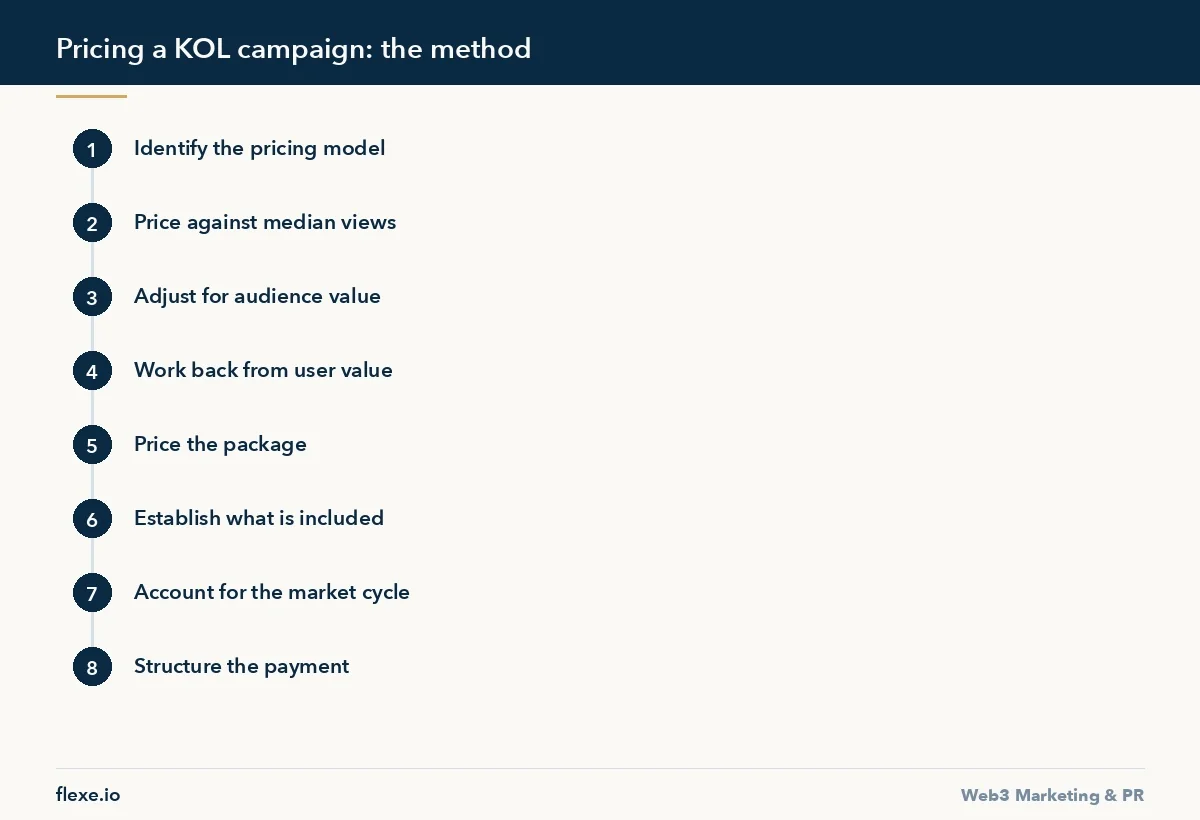
1. Know which pricing model you are being quoted
Four models are common, and they distribute risk very differently.
- Flat fee per post. The default. All performance risk sits with you.
- Rate per thousand views. Ties cost to delivered reach, but reach is the thing easiest to inflate.
- Performance-based. Payment tied to clicks, sign-ups or wallets. Fairest in principle and refused by most established accounts.
- Tokens or a share of allocation. Aligns incentives and creates a holder with an interest in the price, which cuts in both directions.
Mixed models are usually the workable compromise: a reduced flat fee plus a performance component, which tests whether the creator believes their own numbers.
2. Price against median views, not followers
Convert every quote into a cost per thousand actual views, using the median of their recent posts rather than the follower count or their best post. This makes accounts of wildly different sizes directly comparable.
Do the same calculation using only their previous sponsored posts. That second number is closer to what you will actually get, and the gap between the two is often large enough to change the decision. The method for pulling those medians is in how to vet a crypto KOL.
3. Adjust for what the audience is worth to you
A thousand views from an audience that trades on the chain you launched on is worth several times a thousand views from a general crypto audience. Cost per thousand views is only comparable within a similar audience profile.
Regional accounts are frequently the best value in this calculation, because they are priced against their follower count while delivering a concentrated audience nobody else is reaching.
4. Work backwards from what a user is worth
Take the value of one acquired user in whatever terms matter to you, then estimate the conversion rate from view to that user, conservatively. That gives a ceiling for what any post can be worth.
Most projects have never done this calculation, which is why quotes get accepted or rejected on whether they feel expensive. A number derived this way is also the strongest position in a negotiation, because it is arguable rather than arbitrary.
5. Price the package, not the post
A single post is the weakest unit to buy. Repeated exposure from the same trusted account outperforms one post from a larger one, and creators discount multi-post arrangements because they value predictable work.
Ask what a three-post arrangement over six weeks costs against three separate bookings. The difference is usually substantial and the campaign is better regardless.
6. Establish what is actually included
A quote for a post may or may not include a pinned period, a link in the bio, replies to questions underneath, a repost from a second account, or permission to reuse the content in your own advertising. Each is negotiable and each is frequently assumed by one side and not the other.
Content reuse rights are the most valuable and the most often forgotten. A creator video you can run as an advertisement is worth considerably more than the post itself.
7. Expect a market premium and price it in
Quotes rise in strong markets and fall in weak ones, sometimes by a multiple. The same campaign is a different transaction depending on when it runs.
Booking during quiet periods buys more attention per unit of budget, and creators are more willing to agree to performance components when their inbound demand is lower.
8. Pay in a structure that protects both sides
Part before publication and part after the agreed period has elapsed is standard and reasonable. It protects against a post deleted the day after payment, and it gives the creator confidence that the second half will arrive.
Put the deliverable, the dates, the minimum time live and the payment split in writing. Disputes in this market are almost always about something that was never stated rather than something that was breached.
Why published rate lists mislead
Figures quoted publicly as the going rate for a tier of account are collected from a small sample, they age quickly, and they ignore audience quality entirely. Two accounts with identical follower counts can differ by an order of magnitude in what they deliver.
Build the number from your own conversion economics and the account’s own median performance. That produces a price you can defend, and a decision that survives whatever the market rate does next quarter.
What to measure once the campaign runs is in how to measure whether a KOL campaign worked. Screened accounts, negotiated rates and managed campaigns are on our crypto influencer marketing page.