As the ICO landscape evolves in 2026, finding the right ICO promotion agency is essential for ensuring a successful token launch. The ICO market is competitive, and published market-size projections for it vary so widely that none is worth planning against. A professional agency can help your project stand out by driving awareness, building credibility, and attracting investors. At Flexe.io, we specialize in delivering tailored promotion strategies to maximize your ICO’s success. Contact us via Telegram to discuss how we can support your campaign.
What Is an ICO Promotion Agency?
An ICO promotion agency is a specialized marketing partner that handles the promotion and advertising of your initial coin offering. From creating compelling content to executing data-driven campaigns, these agencies ensure your project reaches the right audience and achieves its funding goals.
Why You Need an ICO Promotion Agency
- Professional Expertise: Agencies bring extensive experience in blockchain marketing, ensuring campaigns are tailored to the crypto audience.
- Time and Cost Efficiency: Outsourcing promotion lets your team focus on core project development while experts handle marketing.
- Maximized Reach: Agencies use proven strategies to target global audiences, ensuring maximum visibility for your ICO.
Services Provided by ICO Promotion Agencies
1. Targeted Advertising
Agencies leverage platforms like Web3 Ads and Google Ads to deliver precision-targeted campaigns that reach blockchain-savvy investors.
2. Influencer Marketing
Collaborating with crypto influencers builds trust and amplifies reach. Flexe.io connects you with a network of 5,000+ influencers for impactful campaigns.
3. Content Marketing
High-quality content, such as blog posts, whitepapers, and explainer videos, educates potential investors about your project.
4. Community Building
An active and engaged community is essential for ICO success. Agencies offer services like community management to foster trust and loyalty on platforms like Telegram and Discord.
5. Press Release Distribution
Professional agencies distribute press releases to top crypto media outlets, ensuring wide coverage of your project’s updates and milestones.
6. Regional Campaigns
For ICOs targeting global investors, regional campaigns ensure your message resonates with local audiences. Regional PR services can help bridge cultural and linguistic gaps.
How to Choose the Best ICO Promotion Agency
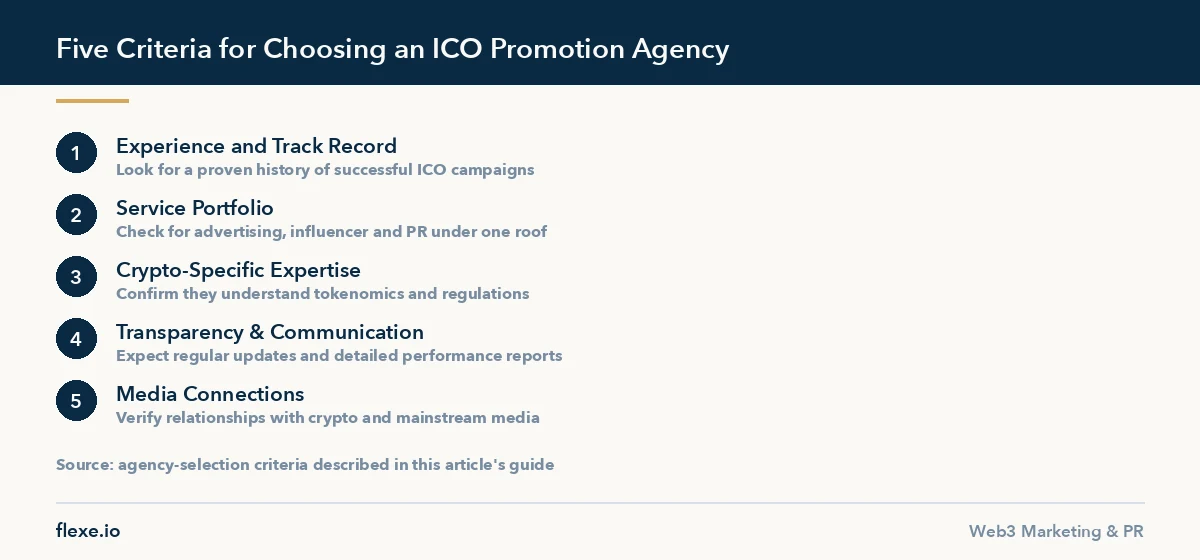
1. Experience and Track Record
Look for agencies with a proven history of successful ICO campaigns. A track record of helping projects achieve their fundraising goals is a key indicator of expertise.
2. Service Portfolio
Ensure the agency offers comprehensive services, from targeted advertising to influencer marketing and PR. This allows for a cohesive and multi-channel promotional strategy.
3. Crypto-Specific Expertise
Agencies specializing in blockchain marketing understand the nuances of the industry, including tokenomics, regulations, and the expectations of crypto investors.
4. Transparency and Communication
Top agencies provide regular updates and detailed reports on campaign performance, ensuring alignment with your goals.
5. Media Connections
Strong relationships with crypto and mainstream media outlets enable agencies to secure high-quality coverage for your ICO.
Red Flags to Avoid
- Lack of Crypto Experience: Avoid agencies that don’t specialize in blockchain or ICO marketing.
- Unrealistic Promises: Be wary of guarantees like “instant success” or “viral campaigns.”
- Poor Communication: Agencies that fail to provide clear timelines and deliverables can harm your campaign.
Trends in ICO Promotion for 2026
1. AI-Powered Campaigns
AI tools are transforming ICO promotion by enabling hyper-targeted ads and predictive analytics.
2. Metaverse and AR Integration
As the metaverse grows, promotional campaigns are incorporating augmented reality (AR) to create immersive investor experiences.
3. Decentralized Advertising Platforms
Blockchain-based ad platforms are gaining traction, offering transparency and better targeting for ICO promotions.
Why Flexe.io Is Your Ideal ICO Promotion Agency
With experience since 2018 and a portfolio of 800+ successful blockchain campaigns, Flexe.io is a trusted partner for ICO promotion. From Web3 Ads to influencer marketing, we offer a comprehensive suite of services to ensure your project’s success.
Contact Flexe.io or reach out via Telegram to elevate your ICO promotion strategy in 2026.
Choosing an ICO or Token Launch Agency
The launch-agency market is where inexperienced projects lose the most money, because everything is sold as a package and almost nothing is measurable until it is too late.
- Ask what they will not do. An agency that promises listings, coverage, community and price support is reselling all four and controlling none.
- Ask for a project that failed. Everyone has one. The answer tells you whether you are talking to operators or to salespeople.
- Separate guaranteed from best-effort. Listings and exchange relationships are either contracted or they are hope. Get the distinction in writing.
- Refuse percentage-of-raise pricing. It rewards the raise, not what happens after it, and the agency disappears at exactly the point you need them.
When the brief itself is unsettled, working backwards from the problem produces a better plan than starting from a menu of services.
Briefing an ICO promotion agency properly
The quality of the work an ICO promotion agency returns is set largely by the brief it receives. Write down what the token does, who is supposed to buy it and why, the markets you are excluding, the dates that cannot move, and the claims your counsel will not allow anyone to make. An agency working without those constraints will guess at them, and the guesses arrive as published copy you then have to retract.
Have the assets ready before the campaign starts. A landing page that converts, documents in the languages you are targeting, a channel with someone answering in working hours, and screenshots of a product that exists do more for conversion than additional spend. Traffic bought against an unfinished destination is paid for twice, because the audience that bounces is harder to reach the second time and usually more expensive.
Name one person on your side who can approve creative within a day. Campaign work dies in review queues, and an agency waiting four days for sign-off on a post will either miss the moment or start publishing without you. Set the review turnaround in the same document as the deliverable dates, and decide in advance who approves when that person is travelling or asleep.
What the scope of work should list
Insist that every deliverable is countable and dated. A line reading press coverage means nothing; a line naming the number of placements, the type of outlet, whether the piece is labelled as sponsored, and the week it runs can be checked. The same applies to community work, where a number of moderated hours and a response time are verifiable and a promise of engagement is not.
Separate what the agency controls from what it can only influence. Ad delivery, content production and moderation coverage are controllable. Editorial pickup, listing decisions and organic sentiment are not, and any scope that prices them as deliverables is selling you an outcome somebody else decides. Write the distinction into the document so the review conversation later is about performance rather than about interpretation.
Settle ownership of the assets at signature. Ad accounts, pixels, creative files, channel administration, media contacts made on your behalf and the analytics property should be yours, with the agency holding access rather than title. Agencies that keep the accounts make leaving expensive, and the moment you notice is the moment you are least able to afford a rebuild from nothing.
Pricing, payment terms and exit clauses
Beyond refusing percentage-of-raise pricing, get the money split into the parts it actually covers: fees for the work itself, pass-through media spend, any tooling billed on, and a performance component where one exists. Media budget invoiced without platform receipts is the easiest place for margin to hide, so ask for platform-level reporting alongside the invoice from the first month rather than requesting it once the numbers start looking odd.
Agree a notice period short enough to be usable. A long lock-in with no performance break means an underperforming campaign runs to term because leaving costs more than staying. Pair the notice with a handover clause listing what returns to you and by when, so the end of the relationship is a process instead of an argument conducted while a sale is live.
Keep an amount back until the reporting is delivered. Final reports have a way of evaporating once the last invoice clears, and the report is what you need to plan the next quarter. A modest retention released on delivery of the campaign data and the account handover costs the agency nothing if they intended to deliver it anyway.
Reporting you should receive weekly
A weekly report should show spend against plan, what shipped, what did not and why, and performance by channel measured on the same definitions every week. Changing definitions between reports is the single most reliable sign that somebody is presenting rather than reporting. Ask for the raw exports alongside the summary, because the summary is an interpretation and the export is the evidence.
Insist on shared analytics access rather than screenshots. Tagged links from every channel the agency runs, arriving in your own property, let you compare sources on your terms and settle disputes without a meeting. Check a live link yourself in the first week to confirm the tagging is present and correct, because tags added retroactively cannot repair a month of unattributed traffic.
Read the reports for the questions they avoid. Impressions rising while registrations sit still, a channel that is always described qualitatively, or a metric that appears once and never returns are all worth asking about directly. The answer you want is a hypothesis and a change, not a longer report with the same numbers arranged differently.
Running the relationship day to day
Hold one short call a week with a fixed agenda: what was learned, what changes next, what is blocked on your side. Most campaign damage comes from slow decisions rather than bad ones, and a standing slot removes the delay of scheduling. Keep the decisions in writing after the call so the next dispute is settled by a document rather than by two recollections.
Give the agency access to the parts of the business they are selling. Someone who has never spoken to the developers will write copy that reads like a template, because a template is all they have been given. Thirty minutes with a founder early produces material an outsider could not have written, and that difference is visible in everything published afterwards.
Checking references before you sign
Ask for two clients whose campaigns ended at least half a year ago and contact them yourself rather than reading a quotation on a slide. The useful questions are about behaviour rather than results: what happened when something went wrong, whether the team that pitched is the team that did the work, and how the relationship ended. Anyone can supply a reference from a campaign that is still running and still being paid for.
Inspect the work itself while you are there. Read posts the agency wrote for other projects and judge whether the copy is distinguishable between clients, because a house template applied to every token is what you will receive as well. Look at the communities they built and whether anyone still speaks in them now that the campaign budget has stopped arriving.
Decide early what happens to the community after the raise. Most plans stop at the sale, and the weeks immediately afterwards are where the work is actually lost, so agree who moderates, who publishes and against what budget once the campaign formally closes. An agency with no answer for that period is quoting for the easier half of the job and leaving you the rest.
When a campaign underdelivers
Fix the destination before increasing the spend. When traffic arrives and nothing converts, the page, the offer or the audience definition is wrong, and buying more of the same traffic multiplies the cost of the same mistake. Ask for one change at a time with a stated expectation, because simultaneous changes leave you unable to say afterwards which one worked.
If the agency cannot explain a result, treat that as the finding. Campaigns fail for ordinary reasons: the audience was wrong, the message was wrong, the timing collided with something larger, or the product was not ready. A partner who names the reason and proposes a change is worth keeping through a bad month. A partner who produces a longer deck is answering a different question than the one you asked.
Frequently Asked Questions
How do you choose an ICO or token launch agency?
Ask what they will not do. An agency promising listings, coverage, community and price support is reselling all four and controlling none. Then ask for a project that failed and what they changed.
What should a token launch agency cost?
Refuse percentage-of-raise pricing: it rewards the raise rather than what happens after, and the agency disappears at exactly the point you need them. Flat retainers with a performance component align both sides more honestly.
Are exchange listings guaranteed by agencies?
Almost never, whatever the pitch implies. Listings are either contracted with the exchange or they are hope. Get the distinction in writing before signing anything.
What does ICO marketing look like now?
The format survived under other names: IDO, launchpad sale, points programmes converting to a token. The marketing problem is unchanged and the regulatory exposure is higher, so sell the mechanism rather than the upside.
When do most token sales fail?
In the three weeks after the raise, when marketing stops and unlocks begin. Any plan that ends at the raise is only half a plan.
Do you need geo-blocking for a token sale?
Yes, and before promotion rather than after. Excluding restricted markets once a campaign is running is a compliance problem that cannot be unwound.