A crypto project rebrand is a name change that has to carry years of search presence across to the new name, and it works through five levers: a per-URL redirect map, a permanent bridge page, tracker and exchange updates filed one by one, renamed rather than new social accounts, and an announcement that states the reason. It costs more in search presence than in design fees, and the part that gets underfunded is the redirect map.
Everything a project has accumulated sits on the old name: forum threads, tracker pages, exchange listings, press coverage, community history and the search results that answer questions about it. A rebrand that changes the site and forgets the rest strands all of it.
What is a rebrand for a crypto project?
The asymmetry is worth stating plainly. The new name has no search presence at all on day one, while the old name has whatever the project spent years building. For a period measured in months, people looking for you will still be typing the old word. A rebrand is therefore less a design exercise than a migration, and the table below shows what breaks and what can be recovered.
| Asset | What happens | Recoverable? |
|---|---|---|
| Own website pages | Rankings drop until redirects are processed | Yes, with clean 301s on every URL |
| Tracker and listing pages | Show the old name until each is updated individually | Yes, but it is manual and slow, one application per platform |
| Exchange listings | Ticker changes require exchange cooperation and are not simultaneous | Partly; expect a window where names disagree |
| Forum threads and community history | Cannot be renamed, and they rank on the old name | No, and this is why the old name keeps working for you |
| Press coverage and citations | Permanently reference the old name | No, which is an argument for keeping a bridge page |
The fourth and fifth rows are the ones that catch teams out. A Bitcointalk thread with 100 pages of history ranks on the old project name and will keep ranking on it, because that is the name in the text. Deleting or abandoning it destroys accumulated search presence that the new name will take a year to rebuild.
Crypto project rebrand: the key tactics
The redirect map is the whole project, and the other tactics exist to keep the old name working for you while the new one catches up.
1. Map every URL individually
A blanket redirect to the new homepage loses the ranking of every page it collapses, which is the most common and most expensive error. Each old address needs its own clean 301 to its exact counterpart. The quieter version of the same mistake is sending a deep article to its section index because the mapping was tedious, which spreads the error across a hundred URLs where no single instance looks serious enough to fix.
- Best for: own website pages, the one asset that is fully recoverable
- Metric to watch: old pages landing on their counterpart through a single permanent redirect
- Watch out: chains of two or three hops load more slowly and lose part of what the original page earned
- Budget: the mapping time, which is the part teams underfund
2. Keep a permanent bridge page
“X is now Y” answers the question people and answer engines are actually asking, and it should rank on both names. Press coverage and citations permanently reference the old name, which is the argument for keeping this page as a fixture rather than a temporary notice. State on it that the contract address has not changed, if it has not, and publish the official addresses and accounts in one place.
- Best for: searchers still typing the old name and anyone checking whether a migration is real
- Watch out: a name change is the moment impersonators publish a fake migration and ask people to move funds
3. Update trackers one by one
CoinMarketCap, CoinGecko and every second-tier tracker each need their own request, and they are not fast. Tracker and listing pages show the old name until each is updated individually, one application per platform. Reviewers want the change to be visible and explained on the live site before they act, and the process mirrors the one described in our guide on getting listed on CoinGecko and CoinMarketCap.
- Best for: tracker and listing pages
- Metric to watch: trackers still showing the old name, which will lag the announcement by weeks
4. Rename social accounts, never replace them
Do not delete the old social accounts. Rename them rather than starting new ones, so followers and history transfer, then confirm the old handle is now held by you: handles released by a rename are claimed within minutes by people who understand exactly what they are worth. Pin a post on each renamed account explaining the change, because a follower who sees an unfamiliar name in a feed reports it as a compromise before reading anything.
5. Tell exchanges and partners before the public
Exchange ticker changes require exchange cooperation and are not simultaneous, so expect a window where names disagree. Tell exchanges, listing contacts, custodians and partners before the public announcement, with the date and the exact wording you intend to use. Each has a review queue, a ticket system, a legal step and a release calendar, and none of it starts until they are told. An exchange that learns about a rebrand from social media is an exchange whose ticker change lands weeks later than it needed to.
6. Announce a reason, not an unveiling
Crypto communities read rebrands as either growth or as distance from something, and silence about which one it is guarantees the second interpretation. State what prompted the change, what stays the same, and specifically what happens to holdings, because that is the question underneath all the others. Whatever explanation exists in the first hours becomes the narrative, and a rebrand announced without a reason invites the community to supply one. Once the new name is live, the seven steps to build a crypto brand on social media apply from day one: one home platform, claimed handles and a pinned links page.
7. Keep the old domain and email alive
Never let the old domain expire. A lapsed registration hands your accumulated history to whoever buys it next, and what gets published there afterwards is attached to years of citations you cannot edit. Renew it for several years at once and keep the redirects live indefinitely. Keep the old email domain receiving mail for at least a year too: support addresses, exchange correspondence, invoices and account recovery all point at the old name, and bounced mail tends to surface during a listing process.
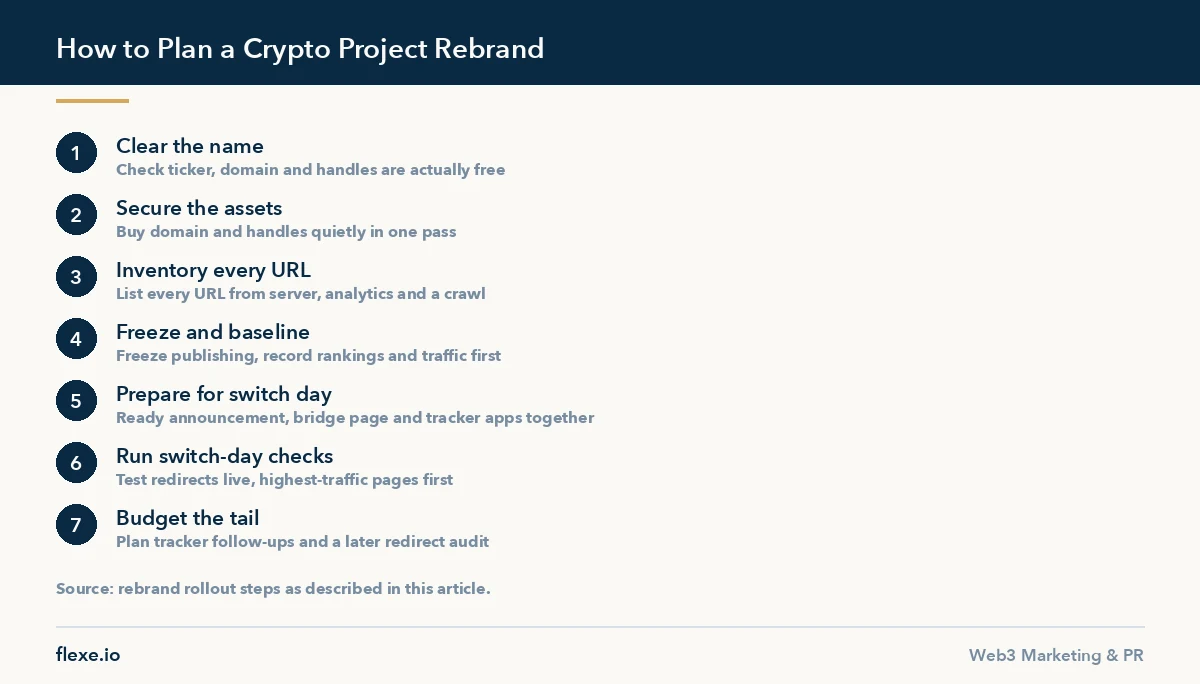
How to plan it step by step
The redirect map and the announcement are one project: how we plan a rebrand rollout. In order, the work runs like this.
1. Clear the name first
Check that the word is not already in use as a ticker, that the domain and the handles on every platform you use can actually be obtained, and that searching for it does not return an established project in an adjacent category. A name chosen in a meeting and cleared afterwards is how a rebrand ships with a handle that has a number appended to it.
2. Secure the assets quietly, in one pass
Registrations are public, and a project with an audience has people who monitor exactly that kind of record. Buying the domain in one week and the handles over the following month announces the change through the paperwork and hands a window to anyone who wants to register a lookalike ahead of you.
3. Inventory every URL
Export from the server, from analytics, from the search console and from a crawl of the live site, including pages nothing links to any more. Reconcile the lists into a single sheet with the old address in one column and its replacement in the next. Pages missing from that sheet are the ones that return errors for a year while nobody notices.
4. Freeze publication and take a baseline
Freeze publication for the fortnight around the change, because a post published two days before the switch will be the page still broken in month three. Anything urgent goes out on the old structure and joins the map explicitly. Before the switch, record rankings on the old name, traffic by page, referring domains and the queries the site was found on, and store the exports rather than screenshots.
5. Prepare everything for the same day
Prepare the announcement, the bridge page, the tracker applications and the partner notices together, so they all go out inside the same day. An application arriving before the site says anything, or a site changing with no statement anywhere, both read as unverifiable and get queued behind everything else.
6. Run the switch-day checks
Test redirects against the live site rather than staging, using a sample of the highest-traffic pages, the deepest pages, the ones with inbound links and a few nobody remembers. Then work through the rest of the list in the same session.
- Update canonical tags, internal links, image paths and sitemaps; submit the new sitemap and keep the old one reachable until replacements are processed.
- Verify what fails silently: email sending and authentication records, the certificate on the new domain including the prefixed variant, any API endpoint or webhook, and app store metadata.
- Search for imposter accounts and tokens on the day, file reports immediately, and publish the official list on a page.
- Confirm each renamed handle and pin the explanation post.
For the search side of the switch, our crypto SEO guide covers how sitemaps and internal links are handled on project sites.
7. Budget the tail
Announcement day is not the end. Tracker follow-ups, second-tier directories, press corrections, partner pages that still carry the old logo, and a redirect audit a month later are all real work with a real cost. Teams that plan only up to the announcement leave the last quarter of the job undone, and that quarter is where most of the lost search presence actually sits.
Mistakes to avoid
- A blanket redirect to the homepage. It loses the ranking of every page it collapses.
- Temporary redirects or chains. A page redirected temporarily, through a chain, or into a category page explains most traffic drops.
- Deleting old forum threads or social accounts. They rank on the old name and keep working for you.
- Scrubbing the old name from your own pages. Those mentions connect the two names for anyone searching, including the systems that answer questions.
- Reversing the rebrand. A second change splits the thin presence on the new name, restarts every tracker application and tells the market the team is not settled.
How to measure results
Search presence on the new name builds over months, not weeks, and the recovery curve depends almost entirely on redirect quality. The practical planning assumption is that the old name will keep bringing traffic for at least two quarters, that trackers will lag the announcement by weeks, and that forum threads and press archives will reference the old name permanently. Expect the old name to keep outranking the new one for a long time. Without the baseline taken before the switch, the question of whether the new name is recovering has no answer.
If traffic falls further than expected, start with the map rather than with theories. Sort the old pages by the traffic they carried and check that each lands on its counterpart through a single permanent redirect; the usual faults are repairable in an afternoon once found. If a tracker stalls, reply with material it can verify: the announcement on the old domain, the redirect from the old site, consistent naming across your accounts and the ticker as it now appears at the exchanges. When the ticker change lags at some venues, keep one page listing which venues show which name, updated as each lands, so support has one link instead of a dozen improvised answers.
If the room reads the change as distancing from something, the answer is specificity rather than volume. Name what prompted it, state what is unchanged, say exactly what happens to holdings, and answer follow-up questions in the same thread. A second announcement written to correct the first reads as damage control and gets treated accordingly.
Frequently Asked Questions
What is the biggest risk in a crypto project rebrand?
Losing accumulated search presence. Everything built under the old name, including forum threads, tracker pages and press coverage, ranks on that name, and a crypto project rebrand without a per-URL redirect map strands it. A blanket redirect to the new homepage is the most common and most expensive version of this error.
Should old forum threads be deleted after a rebrand?
No. Threads with long histories rank on the old project name and will keep doing so, which is useful because people keep searching for the old word. Abandoning or deleting them destroys search presence that the new name will take a long time to rebuild.
How long before the new name ranks after a rebrand?
Months rather than weeks, and the curve depends mainly on redirect quality. Plan for the old name to keep bringing traffic for at least two quarters, for trackers to lag the announcement by weeks, and for press archives to reference the old name permanently.
What should a crypto rebrand announcement say?
The reason for the change, what stays the same, and exactly what happens to holdings. A rebrand announced without a reason invites the community to supply one, and the assumed reason is rarely flattering. State whether the contract address has changed and link to the official accounts.
What should the bridge page say about the contract address?
It should state plainly that the contract address has not changed, if it has not. A name change is the moment impersonators publish a fake migration and ask people to move funds, so a factual sentence about addresses protects holders better than a warning about scams.