Centralised exchange listings are decided by a committee that reads a form. The form is short, the committee is busy, and most applications are rejected because they answer questions the exchange did not ask while leaving the ones it did ask incomplete.
What follows is the sequence that gets an application read on its merits, and the honest picture of what an exchange is actually assessing when it reads one.
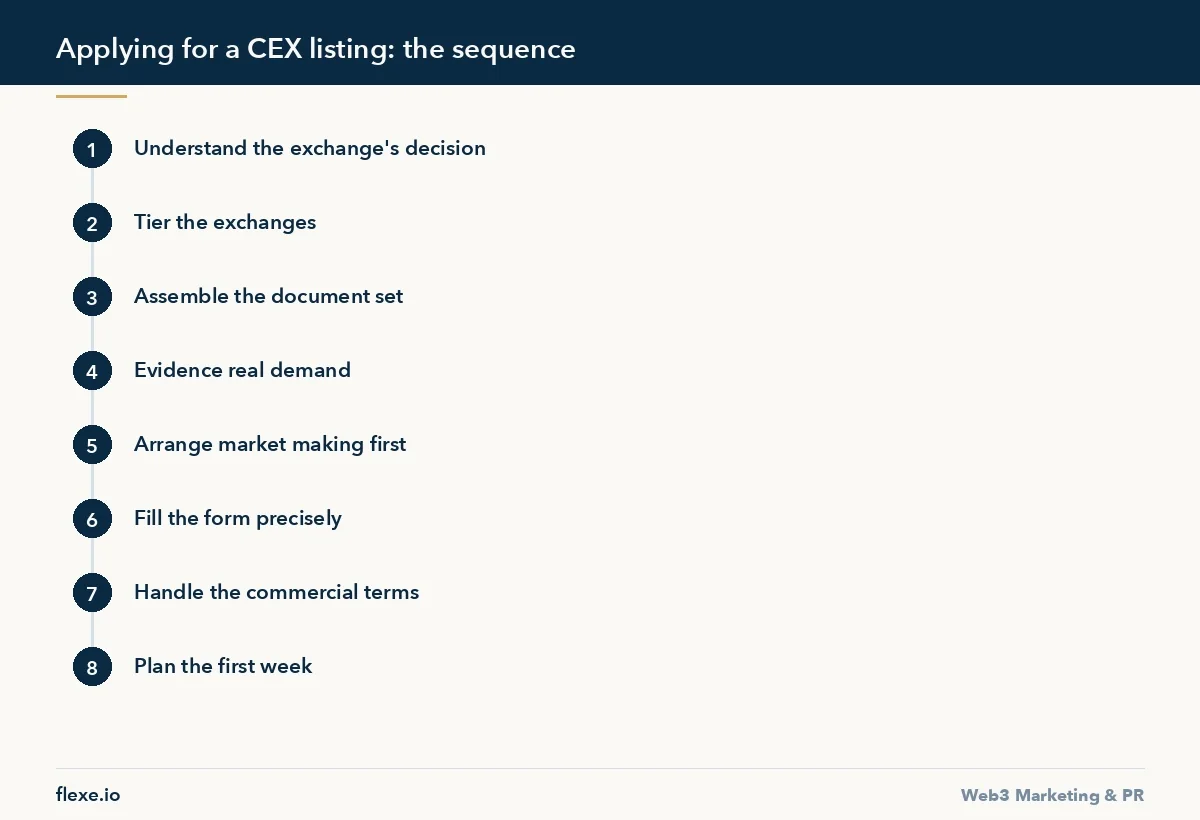
1. Understand what the exchange is buying
An exchange earns from trading fees. A listing costs it integration engineering, custody support, market surveillance and regulatory exposure. It says yes when it believes the pair will trade enough to be worth those costs, and no when it does not.
Everything in the application is read against that question. Community size, partnerships and roadmap matter only as evidence about future volume. Framing the pitch as a story about the project rather than a case about liquidity is the most common structural mistake.
2. Sort the exchanges into tiers before applying anywhere
The major venues reject nearly everything and rarely explain why. Mid-tier exchanges with real regional volume are reachable for a project with demonstrable traction. Small venues will list almost anything, and a listing there proves nothing to the next exchange.
Apply in order and use the earlier listings as evidence for the later ones. Applying to the largest venue first, being rejected, and applying again months later with the same materials is a slower path than building the record that makes the answer different.
3. Assemble the document set before you open the form
Nearly every exchange asks for the same core package, and having it ready is the difference between one submission and six weeks of email.
- Token contract address on each chain, with verified source code on the explorer
- Full supply table: total, circulating, locked, with unlock dates and the addresses holding each tranche
- Audit report from a recognised firm, with the commit hash and the resolution status of every high-severity finding
- Legal opinion on the token’s classification in the jurisdictions the exchange serves
- Company registration, beneficial ownership and the identity documents of the founders
- Existing venues and their current volume, plus on-chain liquidity depth
- A named technical contact who can respond within hours during integration
The supply table is where applications most often fall apart, because the numbers on the project’s own site, on the trackers, and in the contract disagree. Reconcile them first. The procedure for the tracker side is in how to get listed on CoinGecko and CoinMarketCap.
4. Build the evidence of demand
The strongest application arrives with a trading record. On-chain volume in a deep pool, a listing on a smaller venue that trades genuinely, and holder growth that did not arrive in a single week are all readable and hard to fake.
Exchanges check this themselves rather than taking your word for it, and they know exactly what manufactured volume looks like. Inflated numbers are not a neutral risk: being caught fabricating traction ends the conversation permanently and is remembered across venues.
5. Arrange market making before, not after
Most exchanges require a market maker as a condition of listing, and some ask which firm you have engaged in the application itself. A pair that lists with a wide spread and no depth is an embarrassment to the venue and a bad first impression for the token.
Agree the terms early: which pairs, what spread commitment, what uptime, and who supplies the inventory. Doing this in the week before launch produces the worst terms available.
6. Fill the form precisely
Answer what is asked, in the field where it is asked, with a number where a number is possible. Reviewers work through many applications and one that requires reconstruction gets set aside rather than researched.
Two details matter more than they look: give a working contact who reads their email, and use the same project name, ticker and contract address everywhere. Inconsistency between the form, the website and the explorer reads as either carelessness or something worse.
7. Prepare for the commercial conversation honestly
Listing terms vary enormously by venue and are almost never published. They can include a fee, a deposit of tokens for user campaigns, a marketing commitment, or nothing at all. Any figure quoted publicly as the going rate should be treated as one data point, not a price list.
Ask what is included and get it in writing: which pairs, what launch support, what happens if volume falls below a threshold, and whether the token can be delisted and under what conditions. Delisting clauses are standard and worth reading before signing.
8. Plan the first week, not the announcement
The listing itself generates a short burst of attention. What determines whether the pair keeps trading is the week that follows: depth on both sides, something for new holders to do, and a reason for the exchange’s users to come back.
Exchanges track this closely and it feeds directly into whether the next venue says yes. A listing that dies in four days is worse than no listing, because it is now part of your record.
The announcement and media side of a listing week, including which outlets cover listings and how far in advance they need materials, is covered on our crypto PR page.