Bitmedia is a crypto display and native advertising network whose defining feature is its entry point: campaigns start from around 20 dollars a day, against 500 to 2,500 dollars at most alternatives. That makes it the network where a small budget buys days of learning rather than a single unreadable burst. This review covers what the low threshold actually gets you, where the network is weak, and when to move up to something else.
Key Takeaways
- The 20 dollar daily entry is the reason to use Bitmedia. It buys iteration, which is what small campaigns actually need.
- Targeting is geographic, device-based and by crypto interest. There is no wallet-level signal.
- It suits volume and global retail audiences rather than precision.
- Low entry attracts inexperienced advertisers, so inventory quality varies more than on higher-minimum networks.
- Move to a wallet-targeting network once you have a defined on-chain conversion event.
What is Bitmedia and who is it for?
Bitmedia is an advertising network for cryptocurrency and blockchain projects, running display and native formats across crypto publisher inventory. It is sold on CPM and cost-per-day, and its client list includes major exchanges alongside a long tail of smaller projects.
The audience it fits is a project with a modest budget and an unproven creative. At roughly 20 dollars a day, a 600 dollar month buys thirty days of data across several variants. The same 600 dollars on a network with a 500 dollar minimum buys one short burst and one answer.
Why does the entry point matter more than it sounds?
Because the largest variable in crypto display is creative, not network. Placement performance across two creatives on the same network routinely differs by more than performance of one creative across two networks.
A campaign that can only afford one test learns nothing about that variable. A campaign that can run four creatives for a week each learns which message works before spending real money, and Bitmedia is priced so that this is possible.
This is also why treating the low minimum as a quality signal is a mistake. It is a pricing decision, not a statement about inventory.
What is Bitmedia weak at?
Precision. Targeting runs on geography, device and crypto interest category, which describes an audience rather than identifying one. A campaign that needs holders of a specific asset, or wallets that have interacted with a particular protocol, is not describable in these terms.
The second weakness follows from the first strength. A low barrier means more inexperienced advertisers in the ecosystem, which affects the ad environment your creative appears in. This is a real trade-off rather than a fatal one, and it is worth checking placements rather than assuming.
Third, it will not deliver premium tier-one publisher placement at scale. That is what Coinzilla carries, at ten times the minimum. Our Coinzilla review covers where that trade lands.
How does it compare?
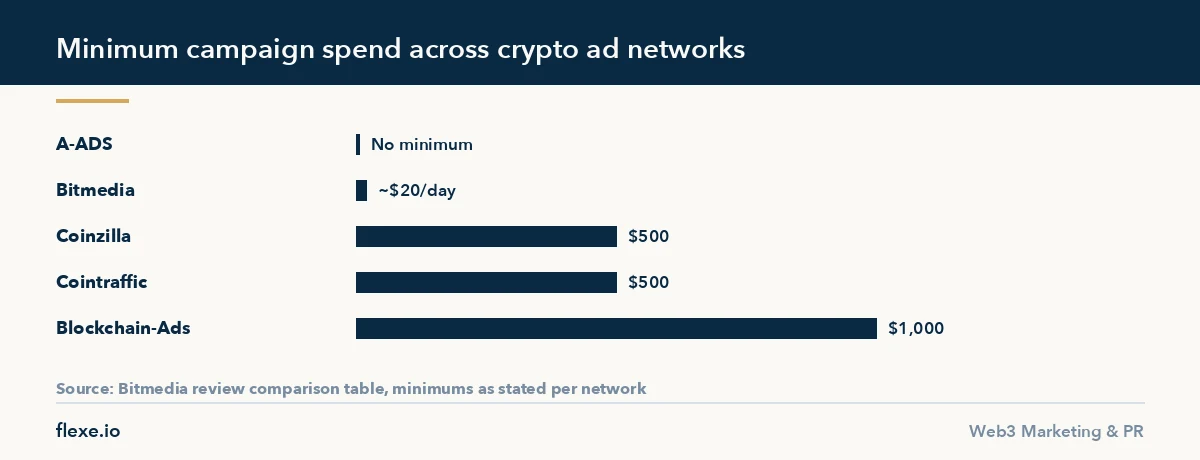
| Network | Minimum | Targeting | Trade-off |
|---|---|---|---|
| Bitmedia | ~$20/day | Geo, device, crypto interests | Cheap iteration, variable inventory |
| Coinzilla | $500 | Publisher category, geography | Premium inventory, less room to test |
| Cointraffic | $500 | Publisher, geography | Strong EU coverage, same test constraint |
| A-ADS | No minimum | Minimal | Lowest barrier, least control |
| Blockchain-Ads | $1,000 | Wallet behaviour, 37+ chains | Precision, needs a defined conversion |
When should you move off Bitmedia?
When you can name the conversion event. A project that can say what a successful visitor does on chain has the input that wallet-targeting networks need, and at that point the extra minimum buys efficiency rather than just reach.
Until then, the precision is wasted. Buying a 1,000 dollar wallet-targeted campaign without a defined conversion produces the same untargeted result as the cheaper option, at five times the price.
The sequence that works: prove the creative cheaply, define the conversion, then buy precision.
Plan the test before funding it
Write the variants down before any money moves. Each one should differ in a single element, whether that is the headline, the image or the offer, and each needs a minimum run length agreed in advance. A campaign edited every morning on whatever the impressions did overnight produces a great deal of motion and no conclusion.
Decide the stopping rule at the same time. Name the result that means a variant is finished and the result that means it keeps running, and write it somewhere the person watching the campaign will see it. Judgement applied in the moment tends to favour whichever creative the team liked before the test started.
The entry point is only useful if the days buy separate answers. Running several variants at once on the same total budget, on a network priced for iteration, still answers nothing if each variant changes more than one thing at a time and the results have to be untangled afterwards.
Spend the budget so it lasts
Set the daily amount so that the month reaches its end. The argument for this network is days of learning, and a campaign that burns its budget in the opening week has converted that advantage back into the single unreadable burst that a higher minimum would have forced on the same money anyway.
Hold part of the budget back for the variant that works. Finding a creative that performs and having nothing left to run behind it is a common ending, and the spend that proved it worked has no value on its own. The test is an expense; the scale-up afterwards is the reason for it.
Because the network sells on impressions and by cost per day, the same daily figure buys different amounts of exposure depending on format and audience. Compare what a day of spend actually delivered in each setup rather than assuming the daily number means the same thing across all of them.
Track clicks on a page you control
Tag every creative with its own parameters and read the traffic in your own analytics rather than only in the network’s reporting. The two will disagree. The gap between an impression counted at delivery and a visit counted when a page finishes loading is normal, and it is not on its own evidence of anything.
Decide which action you are counting before the campaign starts, even if it is only a page view further into the site. Display traffic judged on clicks alone flatters whichever creative attracted curiosity, and curiosity is the cheapest thing available to buy anywhere on the internet.
Keep the landing page fixed while the creatives change. Changing both at once leaves a result that cannot be attributed to either of them, which is the most common way a small test budget gets spent in full without producing a single decision anybody can act on afterwards.
Check the placements your ads run on
Inventory quality varies here, so look at where impressions actually went instead of assuming. Ask for a placement breakdown, read it while the campaign is still live rather than afterwards, and exclude anything delivering volume without a single visit that behaves like a person who meant to arrive.
Look at the site itself, not only its name in a report. A placement below the fold on a page nobody scrolls will deliver impressions at an attractive rate indefinitely, and the attractive rate is exactly why it survives a report reviewed at speed by somebody checking totals.
Keep the exclusions in a document that outlives the campaign. The same placements reappear on the next campaign and on other networks, and rebuilding the list from memory every time is how a team pays for the same lesson twice in the same quarter.
What this Bitmedia review cannot tell you
The network is a delivery mechanism and most of the outcome sits outside it. A Bitmedia review can describe the entry point, the targeting available and the trade being made. It cannot tell you whether the offer is worth clicking, or whether the page behind the click answers the question the creative raised.
Geography is the other variable it cannot settle for you. An audience described by country and crypto interest performs very differently depending on which countries the product can actually serve, and a campaign running everywhere is usually paying for attention in places it has no way to convert into anything.
Terms change as well. What a network charges, which formats it sells and what targeting it exposes are set by the network and revised without notice, so confirm the current position directly before planning a budget around anything that was written about it earlier.
Mistakes that waste a small budget
Judging a variant on one day is the first, because a day of delivery on a modest daily spend is a sample of whoever happened to be online. The decision belongs at the end of the agreed run length, not on the morning the numbers first look disappointing to somebody watching them.
The second is comparing results against a network with a different minimum without matching the conditions. A short burst at a higher entry point and a month of iteration answer different questions, and treating them as a like-for-like test produces a conclusion about the network that is really a conclusion about the budget.
The third is running traffic to a page that asks the visitor for nothing specific. Traffic arriving somewhere with no defined next step produces a click count and nothing to learn from, whatever the network was, and it is the cheapest of all these mistakes to fix before launch.
Build the creative set before launch
Have every variant finished, sized and approved before the campaign opens. Producing creatives while the campaign runs means the earliest variants get the most delivery for no reason other than being ready first, and the comparison at the end quietly reflects the production schedule rather than the messages.
Write the variants so that each one makes a different claim rather than the same claim with a different picture. Two creatives that say the same thing in different fonts will produce two similar results and one wasted week, which is the outcome a small budget can least afford.
Check how each creative reads at the size it will actually be served. A message that needs three lines to land is not a display message, and the version that survives on a small placement is usually the one with a single claim and a legible name attached to it.
Know what a finished test looks like
A test is finished when the decision would not change with another week of the same delivery. That is a judgement, and writing down the reasoning at the moment you make it is what allows the next campaign to start from a position rather than from the same blank page again.
Record the losing variants and why they lost, not just the winner. The pattern across several campaigns is worth more than any single result, and most teams keep only the winning creative, which leaves them re-testing the same failed angle a quarter later with a different image on it.
Then take the decision to the next question rather than repeating the test. Once the message is settled, the open variables are the audience and the landing page, and running the settled creative against those is where a small budget stops buying information it already has.
Agree who runs the campaign daily
Name one person responsible for the campaign and give that person the access they need before launch rather than during it. Shared credentials passed around a team produce changes nobody can account for, and a test that was edited by two people on the same afternoon has no result worth reading at the end of its run.
Set a fixed review slot rather than watching continuously. A short weekly pass comparing what the network reported against what your own analytics recorded, with the exclusions and the variant notes updated in the same sitting, catches drift early and costs less attention than a dashboard somebody refreshes between other tasks all day.
Reconcile the spend against your own records before paying anything, and keep the campaign notes where the next person can find them. Teams change, agencies change, and the second campaign usually starts by rediscovering what the first one already established, which is an expense nobody budgets for and everybody pays at least once.
To see how Bitmedia fits next to other crypto ad networks, read our crypto advertising guide.
Frequently asked questions
What is the minimum budget for Bitmedia?
Around 20 dollars a day, which is the lowest meaningful entry point among established crypto ad networks and the main reason to choose it.
Does Bitmedia have wallet targeting?
No. Targeting is geographic, device-based and by crypto interest category. Wallet-behaviour targeting requires a network built on on-chain data.
Is Bitmedia good for an exchange?
For awareness and creative testing, yes. For first-time-deposit campaigns where each acquisition needs attributing, a wallet-targeting network will outperform it regardless of budget.
Bitmedia or Coinzilla?
Bitmedia if the budget needs to stretch across many days and several creatives. Coinzilla if the priority is premium publisher inventory and the budget can absorb a meaningful test at a 500 dollar minimum.
Where to go next
For the full network comparison, see our guide to crypto ad networks. For campaign records on restricted platforms, see our paid advertising case studies.
Working out which network fits a specific campaign? Send the brief on Telegram at https://t.me/flexe_io_agency and we will come back with a recommendation and a test structure within 24 hours.
Nothing here is financial advice. Network terms are as published by the networks and change; verify before committing budget.
If you would rather have this run for you, see our paid acquisition service.