Coinzilla is a crypto display and native advertising network running more than a billion monthly impressions across 650 or more publisher sites, sold on CPM and CPC from a 500 dollar minimum. It is the volume option among crypto-native networks, strongest on European publisher inventory, and it buys brand awareness rather than measurable acquisition. This review covers what it does well, where it does not fit, and what to run instead when it does not.
Key Takeaways
- Coinzilla is an awareness network. Judged on wallet conversions it will underperform anything with on-chain targeting.
- Publisher category and geography are the targeting levers. There is no wallet-behaviour targeting.
- European publisher coverage is its structural advantage over most alternatives.
- The 500 dollar minimum makes it accessible, and a 500 dollar test will not tell you much.
- Creative approval is faster than mainstream platforms because the network is built for the category.
What is Coinzilla and how does it work?
Coinzilla is an advertising network specialised in cryptocurrency and blockchain, placing display and native units across publisher sites in the category. Its reported scale is over one billion monthly impressions across 650 or more publishers, which puts it among the largest crypto-native networks by inventory.
The model is conventional: you buy impressions or clicks, choose publisher categories and geographies, and the network handles placement. That conventionality is the point. Mainstream networks restrict or ban the category, so a network built for it removes the approval problem that consumes most of the effort elsewhere.
What is Coinzilla good at?
Brand awareness at volume on publications the audience already reads. If the objective is that a name becomes familiar across crypto media before a launch, this is the instrument, and the inventory size means the reach is genuinely there.
The second strength is European publisher coverage, which is stronger than most alternatives. Projects targeting European markets specifically will find inventory here that other networks do not carry.
The third is speed of approval. Compared with getting a crypto campaign through Google or Meta, where the work is largely compliance, a crypto-native network starts running in a fraction of the time.
Where does Coinzilla not fit?
Anywhere the objective is a measurable on-chain action. Targeting is by publisher category and geography, not by wallet behaviour, so a campaign optimising for first-time deposits or wallet connections is working without the signal that would make it efficient.
For that objective, networks built on wallet data are the correct tool. Blockchain-Ads targets on wallet behaviour across 37 or more chains from a 1,000 dollar minimum, and the difference in outcome is not marginal.
The second poor fit is a genuinely small budget. The 500 dollar minimum is accessible, but a display campaign at that level produces a sample too small to learn from. If the budget is a few hundred dollars, a network with a lower entry point such as Bitmedia at around 20 dollars a day gives more days of data for the same money.
How does it compare to the alternatives?
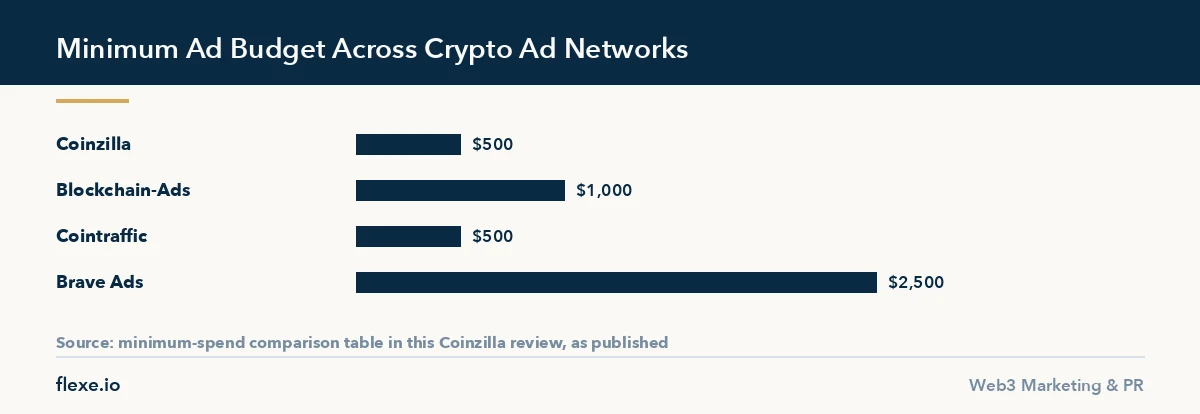
| Network | Minimum | Targeting | Best for |
|---|---|---|---|
| Coinzilla | $500 | Publisher category, geography | Brand awareness, European inventory |
| Bitmedia | ~$20/day | Geo, device, crypto interests | Flexible entry, volume, global retail |
| Cointraffic | $500 | Publisher, geography | NFT and DeFi launches, EU market |
| Brave Ads | $2,500 | Consent-based, in-browser | Privacy-conscious audiences |
| A-ADS | No minimum | Minimal | Anonymous placement, testing |
| Blockchain-Ads | $1,000 | On-chain wallet behaviour, 37+ chains | Deposits, exchange acquisition |
Read the minimum column as a proxy for what each network expects you to know before arriving. The higher-minimum networks assume you have a conversion event defined; the lower-minimum ones do not.
How should you test it?
Set the objective before the budget. If the answer to what success looks like is a number of impressions, Coinzilla is appropriate and the test can be short. If the answer involves wallets or deposits, the test will fail for reasons that have nothing to do with the network.
Run at least two creative variants and at least two publisher categories, because the variance between placements in this category is larger than the variance between networks. Judging a network on one creative in one category is the most common way a good network gets written off.
Measure on a defined window and hold to it. Display attribution is imprecise, and extending the window until the numbers look acceptable is how a campaign report stops meaning anything.
Set the budget across enough days
The 500 dollar minimum is an entry point, not a test budget. A display campaign learns from the number of days it runs and the number of placements it touches, so the useful question is how long the money keeps the campaign live, not how many impressions it can buy in a single burst at the start.
Split the budget rather than spending it evenly. Give the first portion to discovery across several publisher categories, then move what remains onto the categories that produced attention at the lowest cost. A flat spend across everything for the whole period produces an average that describes none of the placements you actually bought.
Decide the stopping rule in advance. Write down the figure at which you would extend the campaign and the figure at which you would stop it before any data arrives at all. Campaigns that simply run until the budget is gone rarely produce a decision, because the person reading the report has already spent the money either way.
Plan the calendar as well as the money. Running an awareness campaign into a week when nothing else is happening wastes the familiarity it builds, and running it while the team cannot answer inbound questions wastes the interest it creates. The buy is worth considerably more when something is waiting at the other end of it.
Building creative for publisher inventory
Display units are seen at a glance beside editorial content, so a banner that has to be read loses. Lead with the name and one claim, keep the wording short enough to take in while scrolling, make the same message work across every size the network serves, and check that it still reads when the unit is small, because you do not choose which slot a given publisher renders.
Run at least two variants, as the test structure requires, and make them genuinely different rather than two colours of the same idea. Variance between placements in this category is larger than variance between networks, and two near-identical creatives will never tell you whether a weak result came from the message or from the inventory it ran on.
Keep the creative consistent with the destination. A banner promising one thing and a page opening with another loses the visitor it just paid for, and on a buy sold by impressions that loss is invisible in the campaign report, which will happily show delivery against a page nobody stayed on.
Keep a record of which creative ran where and for how long. Reports change shape between exports, and reconstructing which version was live during a good week is unreliable after the fact. A short log written as you go is what makes the second campaign better informed than the first one was.
Where the landing page decides everything
Awareness traffic arrives cold, without intent, from someone who was reading an article a second earlier. The page it lands on has to answer what the product is and who it is for before anything else, because a visitor who did not go looking for you is not going to hunt through a site for that answer.
Instrument the page before the campaign starts rather than afterwards. A destination that cannot distinguish this traffic from anything else turns the whole test into an argument about attribution, and display attribution is imprecise enough without that handicap. Tag the links, keep a separate parameter per creative, and confirm the tracking fires before the first impression is served.
Measure what a cold visitor can plausibly do. Time on the page, a scroll, a click into the documentation or a subscription are all reachable from an awareness impression. A wallet connection usually is not, and judging the network by one is precisely the mistake described above in the section on where it does not fit.
Reading placement reports without fooling yourself
Placement reports look precise and hide a great deal. A category that spent most of the budget is not necessarily the category that worked, it is the category with the most inventory available. Normalise by spend before comparing anything, and look at the spread across publishers inside a category rather than at the category average.
Watch for placements that deliver volume with no engagement at all. Every display network carries inventory that renders impressions nobody looks at, and the useful response is to exclude the placement and rerun rather than to judge the network on a blended number that quietly includes it alongside everything else.
Hold the measurement window you set. Extending it until the result improves is how a report stops carrying information, and it is more tempting here than elsewhere because awareness effects genuinely do arrive late, which makes the excuse sound reasonable every single time somebody offers it.
Agree who reads the report before it exists. A campaign whose numbers are only ever seen by the person who bought it will always be reported as a partial success, and the discipline of showing the same figures to somebody with no stake in the answer is what keeps the stopping rule honest.
What this Coinzilla review cannot measure
A comparison of networks works from what those networks publish about themselves. It cannot tell you how your specific creative performs against your specific audience on a particular publisher in a particular month, and that variance is the largest term in the equation. Use the comparison to shorten the list of networks worth testing, not as a prediction of your result.
Reported figures also move. Impression volumes, publisher counts, targeting options and minimums are stated by the networks themselves and change without announcement, so confirm the current terms directly before committing budget rather than planning against a number read in any comparison, including this one.
The thing a comparison does settle is fit. Whether targeting runs on publisher category or on wallet behaviour is a structural property of a network and will not change during your campaign, and matching that property to your objective removes most of the ways a test fails for reasons the network was never able to control.
Questions to ask before the first campaign
Before the first campaign, ask the questions whose answers would change how you run it: which publisher categories carry the geography you want, how placements are reported back to you, whether a specific site can be excluded, and what the approval process needs from the creative and from the landing page behind it.
Ask about billing and pacing as well. Whether the buy is priced on CPM or CPC changes what you are optimising and what a weak creative costs you, and knowing how quickly the budget is allowed to spend prevents a test designed to run for a fortnight from finishing in two days and teaching you nothing.
Put the answers into the brief you send. The faster a network can see the objective, the geography, the budget and the measurement window, the more useful its first response is, and a network that recommends against itself for your objective has told you something valuable at no cost to you at all.
Running it alongside another network
Running a second network in parallel is the fastest way to learn what the first one contributes, but only if the two are not judged on the same metric when they were built for different ones. An awareness buy and a wallet-behaviour buy will not produce comparable cost per conversion, and forcing the comparison usually kills the one doing the slower job.
Stagger them instead, or measure each against the objective it was chosen for, and keep the landing pages separate so the traffic can be told apart afterwards. The comparison worth having at the end is not which network won, it is which objectives each one can be relied on to serve and at what cost.
Give each network its own creative set as well. Inventory differs, and a unit built for one environment can look out of place in another, which produces a difference in results that then gets attributed to the network rather than to the artwork it was asked to carry.
For a side by side view of Coinzilla and the other crypto ad networks, see the crypto ads guide.
Frequently asked questions
What is the minimum budget for Coinzilla?
Around 500 dollars, sold on CPM and CPC. That threshold is accessible, though a campaign at exactly that level produces a sample too small to draw conclusions from.
Does Coinzilla support wallet targeting?
No. Targeting is by publisher category and geography. For wallet-behaviour targeting the relevant networks are the ones built on on-chain data, such as Blockchain-Ads across 37 or more chains.
Is Coinzilla better than Bitmedia?
They answer different questions. Coinzilla carries larger premium inventory and suits awareness at volume; Bitmedia has a far lower entry point and suits flexible or mid-size campaigns where the budget needs to stretch across more days.
How quickly does a Coinzilla campaign get approved?
Considerably faster than mainstream platforms, because the network is built for the category rather than tolerating it. Approval effort is where most of a crypto campaign budget goes on Google or Meta, and it largely disappears here.
Where to go next
For the full network comparison, see our guide to crypto ad networks. For campaign records including paid work on restricted platforms, see our paid advertising case studies.
Choosing between networks for a specific campaign? Send the brief on Telegram at https://t.me/flexe_io_agency and we will come back with a network recommendation and a realistic test structure within 24 hours.
Nothing here is financial advice. Network figures are as published by the networks themselves and change; verify current terms before committing budget.
If you would rather have this run for you, see banner display campaigns.