A stablecoin pool exists to make a trade land at the price the trader expected. Everything else about it is secondary, and most of the mistakes made setting one up on a newer exchange come from optimising for something other than that.
The steps below are in the order they have to happen. The last one is the one people skip and later regret.
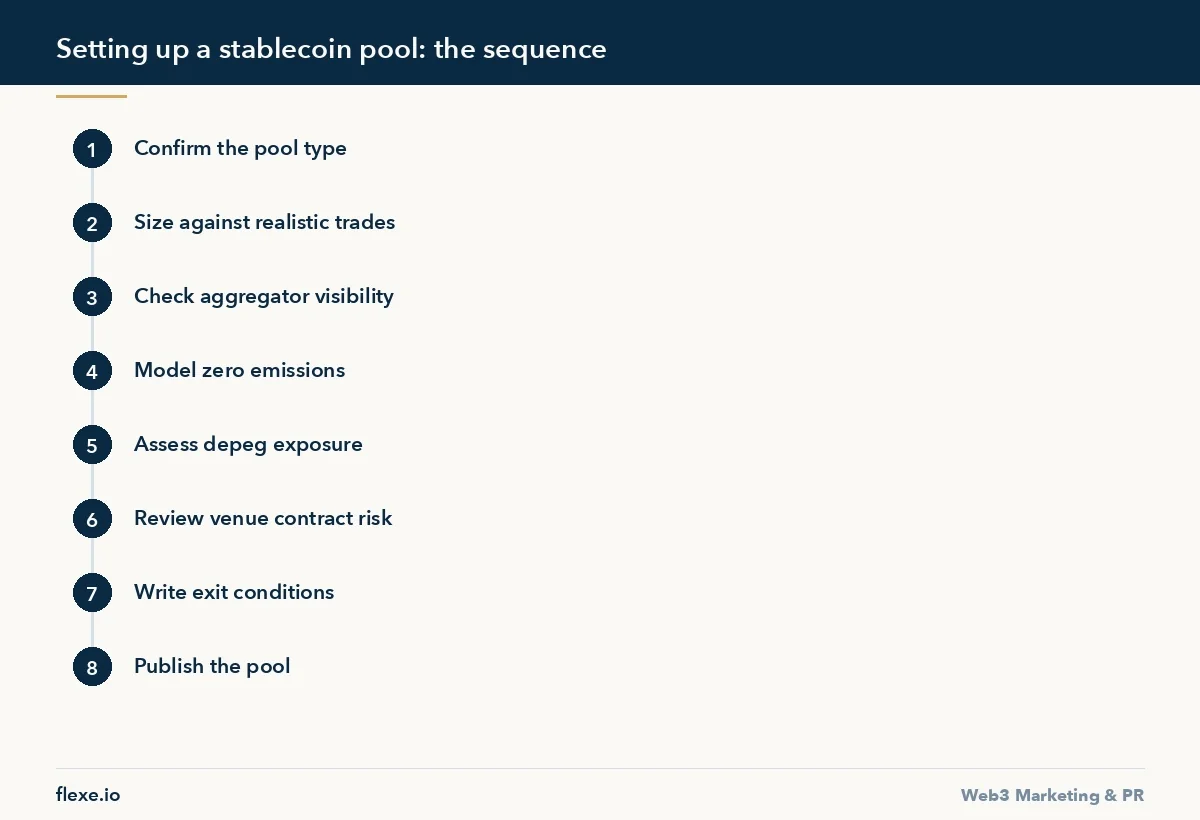
1. Confirm the pool type before depositing anything
Pools built for assets that trade at the same value use a different pricing curve from general-purpose pools. The stable curve concentrates depth around parity, which is exactly where stablecoin trades happen, and it is the entire reason slippage stays low at a given size.
Newer exchanges do not always default to it, and some offer only the general curve. Depositing a stablecoin pair into a general pool means accepting several times the price impact for the same capital. Check which curve the exchange is using before the first deposit, not after.
2. Size against the trade you want to serve
Depth is meaningless as an absolute number. The useful question is what the largest trade you want to absorb costs the trader in price impact. Decide that figure first, then work backwards to the capital required.
Serving retail-sized swaps takes a fraction of what serving treasury-sized ones does. Projects routinely fund a pool for the second while only ever seeing the first, which locks capital that produces nothing.
3. Check whether the aggregators can see it
On an established exchange, indexing is automatic. On an emerging one it frequently is not, and an unindexed pool receives only the trades that arrive through the exchange’s own interface. That is a small fraction of total flow.
Before committing capital, check whether the aggregators that route on that chain already list other pools from the same exchange. If they do not, you are funding depth that the market cannot reach, and the pool will look inexplicably quiet.
4. Model what happens when the incentives stop
Emerging exchanges attract liquidity with emissions. Those emissions decay, and the liquidity that arrived for them leaves when they do. This is not a failure of the exchange, it is the design working as intended.
What matters is whether your pool still makes sense at the fee revenue alone, with emissions set to zero. If it does not, you are not providing liquidity, you are farming a subsidy, and you should size and time the position accordingly rather than treating it as infrastructure.
5. Understand what depeg does to your position
A stable pool assumes both assets hold parity. When one does not, the curve does what it was built to do and converts the position almost entirely into the weaker asset. The mechanism is working correctly and the outcome is still bad.
This is the case for caring about which stablecoins are in the pair rather than which pair pays best. Pairing against an asset whose backing you cannot inspect means accepting a risk that no yield figure discloses.
6. Watch the exchange’s contract risk, not just the pool’s
On a newer venue the pool contract is usually a fork of established code, which is reassuring, but the surrounding infrastructure often is not. Router upgrades, admin keys on the factory and unaudited peripheral contracts have all produced losses on pools whose own code was sound.
Check what the exchange can change without notice and who can change it. If a single key can upgrade the router your capital routes through, that is the real risk profile regardless of the pool’s audit status.
7. Write down the exit conditions first
Decide in advance what would make you withdraw: an emissions cut below a stated level, a depeg beyond a stated threshold, an unannounced contract change, volume falling below the point where fees cover the risk.
Positions on emerging venues are usually exited late, after the reason to leave has already cost something. Written conditions turn that into a decision made in advance rather than under pressure.
8. Tell people the pool exists
Depth that nobody knows about attracts no volume, and volume is what pays for the position. Publish where the pool is, which router reaches it and what size it comfortably handles.
For a token launch, this is the step that connects liquidity work to demand. How we run that distribution across explorers and crypto media is on our crypto traffic acquisition page, and the mechanics of getting listed and indexed in the first place are in our guide to listing a token on a DEX.
What deeper liquidity cannot fix
- A stablecoin losing parity. Depth changes how fast the position converts, not whether it does.
- Missing aggregator indexing. Unreachable depth earns nothing however large it is.
- Emission decay. Yield that came from subsidy leaves with the subsidy.
- Contract risk at the venue level. A sound pool inside unsound infrastructure carries the infrastructure’s risk.