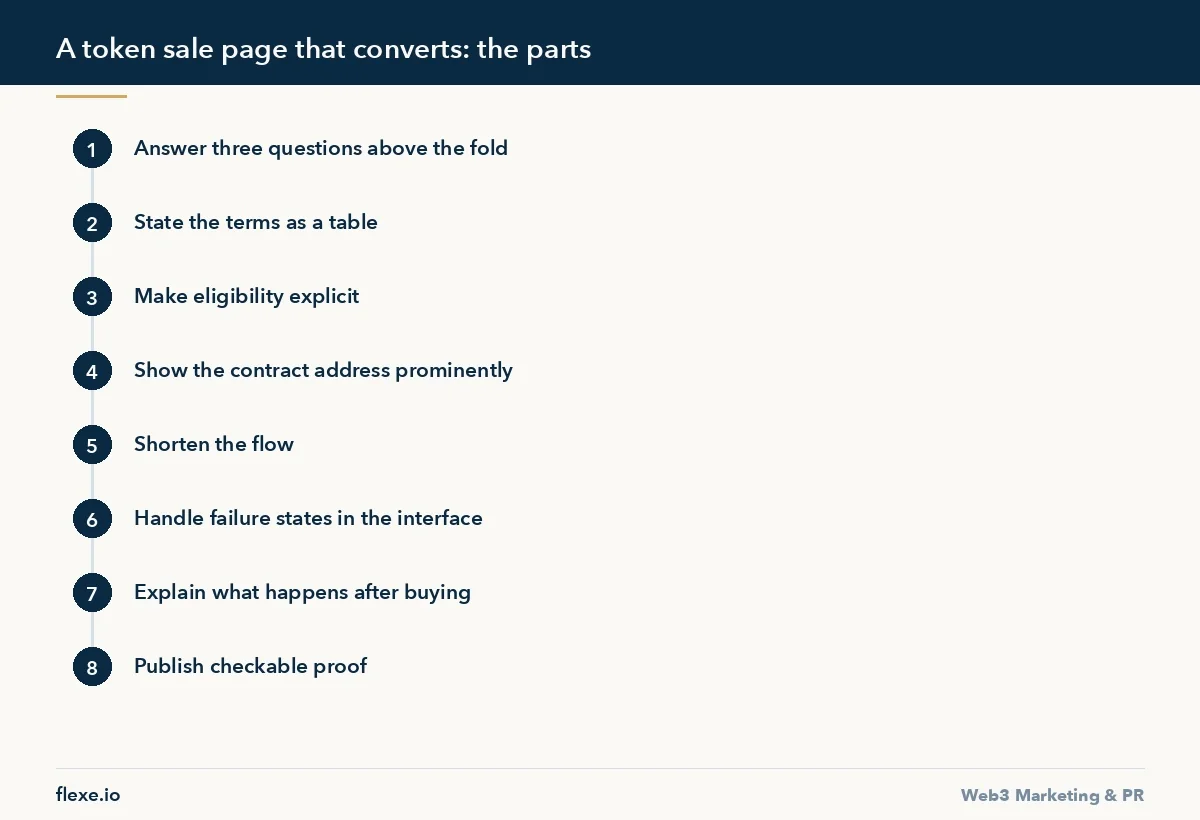
Here is how to build a token sale page: state what is sold, at what price and until when above the fold, put the full terms in one table, make eligibility and the contract address explicit before the wallet connects, cut the flow to connect, amount, approve and confirm, and tell buyers what happens after they pay. The page has one job: turn a visitor who arrived from a tweet into someone who has connected a wallet and committed funds, inside a session that lasts a couple of minutes.
Almost every failing sale page fails for the same reason, which is that it was written to impress rather than to be acted on. Below is the structure that works, in the order a visitor actually needs it.
What you need before you start
- Final terms: raise target, tokens offered, price, accepted currencies and chains, contribution limits, vesting on the sale allocation, and exact opening and closing times with a timezone.
- A verified sale contract: the address, the explorer link and, if it exists, the audit report.
- Eligibility rules: excluded jurisdictions, whether identity verification or a whitelist applies, how long verification takes and which documents it needs.
- Refund conditions: a missed minimum raise, contributions from exchange accounts and transactions arriving after the close.
- A legal review slot: a cycle agreed with counsel before the page is built, not in its last days.
How to build a token sale page step by step
1. Answer the first three questions above the fold
What is being sold, at what price, and until when. Those three facts decide whether the visitor keeps reading, and on most sale pages at least one of them requires scrolling to find. Put them in text, not in a graphic. Keep the mission statement, the vision and the founder quote below this. They are not what someone who followed a sale link came for.
- Check: all three facts are visible on a phone without scrolling.
- Format: text, not an image.
2. State the terms as a table
One block containing: total raise target, tokens offered, price per token, accepted currencies and chains, minimum and maximum contribution, vesting applied to purchased tokens, and the exact opening and closing times with a timezone. Vesting on the sale allocation is the term buyers most often discover after committing, and burying it does more damage to a project than any discount ever recovers.
- Check: vesting sits in the same block as the price.
- Also include: the refund conditions decided before the sale.
3. Make eligibility explicit before the wallet connects
If the sale excludes certain jurisdictions, requires identity verification, or is limited to a whitelist, say so at the top. A visitor who connects a wallet, completes a form and is then rejected on nationality is a support ticket and a public complaint. Where verification is required, state how long it takes and what documents are needed. People plan around a known wait and abandon an unknown one.
- Check: the eligibility statement appears where it is read, not in a footer.
- State: the verification wait and the documents.
4. Show the contract address prominently
The sale contract address belongs on the page in copyable text, linked to the explorer, and repeated in the community channels. Token sales are the highest-value moment for address-substitution scams, and a visitor who cannot find the official address on the official site will find one somewhere else. If the sale contract is audited, link the report rather than displaying a badge. If it is not audited, say so. The verification procedure is in how to verify a token contract.
- Check: the address is text a buyer can copy, not an image.
- Audit: a link to the report, or a plain statement that there is none.
5. Reduce the flow to as few steps as the sale allows
Connect wallet, choose amount, approve, confirm. Every additional screen loses people, and the ones added most often are avoidable: a newsletter capture before the sale form, a referral code field nobody has, a terms modal that must be scrolled to the bottom on mobile. Keep the full terms on a linked page and make acceptance one checkbox next to a link that opens properly on a phone.
- Remove: newsletter captures, unused referral fields and blocking modals.
- Check: the terms link opens on a phone.
6. Handle the failure states in the interface
Wrong network, insufficient gas, rejected approval, contribution below minimum, sale closed while the page was open. Each needs a message that says what happened and what to do next, in the interface rather than in a browser console. The wrong-network case is worth building properly, with a button that switches the network. It is the most common failure and the easiest to fix.
| Failure state | What the interface should do |
|---|---|
| Wrong network | Explain it and offer a button that switches the network |
| Insufficient gas | Say what is missing and what to do next |
| Rejected approval | Say the approval was not signed and how to retry |
| Contribution below minimum | Show the minimum next to the amount field |
| Sale closed while the page was open | Change the visible state and stop the flow |
| Contribution from an exchange account | Warn at the amount step that funds must come from a wallet the buyer controls |
7. Tell people what happens after they buy
When do tokens arrive, where do they arrive, and what should the buyer do in the meantime. A confirmation screen that says nothing beyond success generates the largest volume of support messages a sale receives. Give a claim date, a link to check the contribution on chain, and a single channel where updates will be posted. Then post there on schedule, including when the news is a delay.
- Check: the confirmation screen shows a claim date, an on-chain link and one update channel.
- Rule: post delays in that channel on schedule.
8. Publish proof, not adjectives
Named team members with reachable profiles, the audit report, the legal entity, the previous funding if any, and the product in whatever state it exists. Each is checkable, which is what makes it worth including.
Backer logos without a public confirmation, exchange logos for listings not yet agreed, and press mentions that link to paid placements all reduce trust in the buyers who check, and those are the buyers who contribute the most.
9. Test the token sale page before launch
Run the whole flow on a test network first, then run it once with real funds at the minimum contribution before the sale opens. The rehearsal that finds problems is the one done on a phone, on a mid-range connection, with a wallet that has never touched the site, because that is the state most buyers arrive in. Test across the wallets your buyers actually use, including the in-app browsers, and on at least one older phone. Check that the amount field accepts a pasted number and that the confirmation screen appears without a manual refresh.
Load is the other rehearsal. A page that goes down in the first minutes loses the contributions it was built for, so test the page and the node endpoint under the traffic you are inviting, and have a fallback endpoint configured in advance rather than discovered while the sale is open.
Running the page on sale day
Somebody should be watching the page, the chain and the community channel at the same time, with the authority to change the page without asking. The most common sale-day failure is a known problem that took hours to fix because the only person who could fix it was asleep in another timezone and nobody had agreed who else could act.
Keep a visible state on the page itself: not started, open, paused, closed, sold out. Buyers who arrive from a link posted hours earlier should learn the current state from the page rather than from a failed transaction, and that state should be set in one place that every other element reads. Watch the support channel for the same question repeating. A question asked once is a user; the same question asked all morning is a page problem, and the fix is usually one sentence added to the interface.
Instrument each step separately: page view, connect clicked, wallet connected, amount entered, approval signed, contribution confirmed. Without those, a sale that underperforms tells you only that it underperformed. Watch the drop between connected and confirmed most closely. A page can look healthy on visits and lose almost everyone at approval, which is nearly always a wrong-network, gas or minimum-contribution problem that the interface never explained.
Have the link, the contract address and the opening time ready as a single message that community members and creators can copy without editing it. Publish the address on the official site first and watch for accounts reposting it with a single character changed, because that substitution works best during the first busy hour.
Refunds, stuck transactions and delays
Decide the refund conditions before the sale opens and put them in the terms block: what happens if a minimum raise is not reached, what happens to a contribution sent from an exchange account, and what happens to a transaction that arrives after the closing time. Contributions from a custodial account generate the worst support threads, because tokens cannot be delivered to an address the buyer does not control.
For stuck or failed transactions, publish one route: a channel or address where the buyer sends the transaction hash, and a stated time within which somebody replies. Buyers who cannot find that route post the hash publicly, which is exactly where the address-substitution accounts are waiting for them.
When the sale is paused or moved, change the state on the page first, then post the same wording in the community channel with a reason and a new date if you have one. If a date moves more than once, stop publishing a countdown and publish a status line instead. Keep a dated record of changes to the terms on the site, because buyers who committed under earlier terms will compare.
Copy that survives a legal review
Write the page assuming counsel will read every sentence and remove anything that promises a return. Describe what the token does, what the funds are for and what the buyer receives, and keep projections, comparisons against listed prices and language about future value off the page entirely. Agree the review cycle before the page is built: a sale page that goes through legal in the last days ships with paragraphs bolted into the wrong places.
Answer the questions buyers ask in every sale on the page itself: whether the price is fixed or moves during the sale, whether allocation is first come, what happens if the raise fills while a transaction is pending, and whether these tokens are the same asset that will trade later.
What sends traffic away from a token sale page
These are the mistakes that cost contributions most often:
- Countdown timers that reset, which get screenshotted as evidence of manipulation.
- A raise total that only ever moves up in round numbers.
- Social proof counters that cannot be reconciled with the community’s visible activity.
- Vesting on the sale allocation buried below the fold or left out of the terms.
- A confirmation screen that says nothing beyond success.
The first three are read as manipulation by exactly the audience most likely to buy. The page also cannot fix a sale nobody knows about. Getting qualified traffic to it in the window the sale is open is a separate problem, covered on our crypto traffic acquisition page, and the community side in how to build a Telegram group from zero.
How long it takes and what it costs
The page itself works inside a visitor session of a couple of minutes, so price, deadline and address have to be found at once. If you are working out how to build a token sale page on a budget, the preparation costs are mostly time: sending counsel an outline early costs a day and saves the rebuild, and a leak between connected and confirmed is fixable in an afternoon once the number is visible.
The expensive failures are the unplanned ones. A page that goes down in the first minutes loses the contributions it was built for, a known problem can take hours to fix when nobody else was authorised to act, and the support route has to stay open for weeks after the close because questions about distribution arrive then rather than during the sale.
What the page becomes afterwards
The sale page does not get deleted when the sale closes. It becomes the reference anyone checks later: the final terms, the contract address, the distribution date and the record of what was promised. Turn the flow into a claim or status page as soon as the sale ends, with the same address, a link to check the contribution on chain, and the next date. Publish who answers support and how long a reply takes, and post delays on the same page instead of waiting for the room to ask what happened.
If you are selling nodes rather than tokens, our guide to node sale marketing explains how the buyer questions change.
Frequently Asked Questions
What has to be visible above the fold on a token sale page?
What is being sold, the price, and the deadline, written as text rather than inside a graphic. Those three facts decide whether a visitor continues reading, and on most sale pages at least one of them requires scrolling to find. Mission statements and founder quotes belong below them.
Should vesting on sale tokens be disclosed on the page?
Yes, in the terms block next to the price. Vesting on the sale allocation is the condition buyers most often discover after committing, and the reputational cost of burying it exceeds anything a discount recovers. State it plainly with the other terms before the wallet connects.
Why do sale pages lose buyers mid-flow?
Added steps and unhandled errors. Newsletter captures, referral fields and blocking modals each cost conversions, and wrong-network, gas or minimum-contribution failures with no message in the interface end the session. The drop between wallet connected and contribution confirmed shows where the page leaks.
How should a sale page display the contract address?
In copyable text, linked to the block explorer, and repeated in the community channels from one approved message. A buyer who cannot find the official address on the official site will find an unofficial one elsewhere, and token sales are the highest-value moment for address-substitution scams.
Do countdown timers and raise counters help a token sale?
Only if they are real. Timers that reset and totals that move only in round numbers are read as manipulation by the informed buyers who tend to contribute the most. If a sale date moves more than once, replace the countdown with a plain status line.