The crypto agency or freelancers comparison is usually framed as price against quality, which is the wrong axis. What actually separates the two is inventory and coverage: an agency owns relationships and lists that take years to build, and a freelancer owns their own time. Whichever you are short of decides the answer.
Crypto agency or freelancers: where the line actually falls
| Freelancer | Agency | |
|---|---|---|
| Best at | One channel, executed well | Several channels coordinated to a date |
| Inventory | Whatever they can reach personally | Screened outlet and creator lists |
| Availability | One person, one timezone | Cover across hours and absences |
| Ramp-up | Days | Weeks, including onboarding |
| Accountability | Personal and direct | Contractual, with a named lead |
| Single point of failure | Yes. Illness or a better offer ends it | No, though quality varies by who is assigned |
| Overhead you pay for | Almost none | Coordination, vetting, reporting |
| Worst outcome | Work stops without warning | You pay for coordination you did not need |
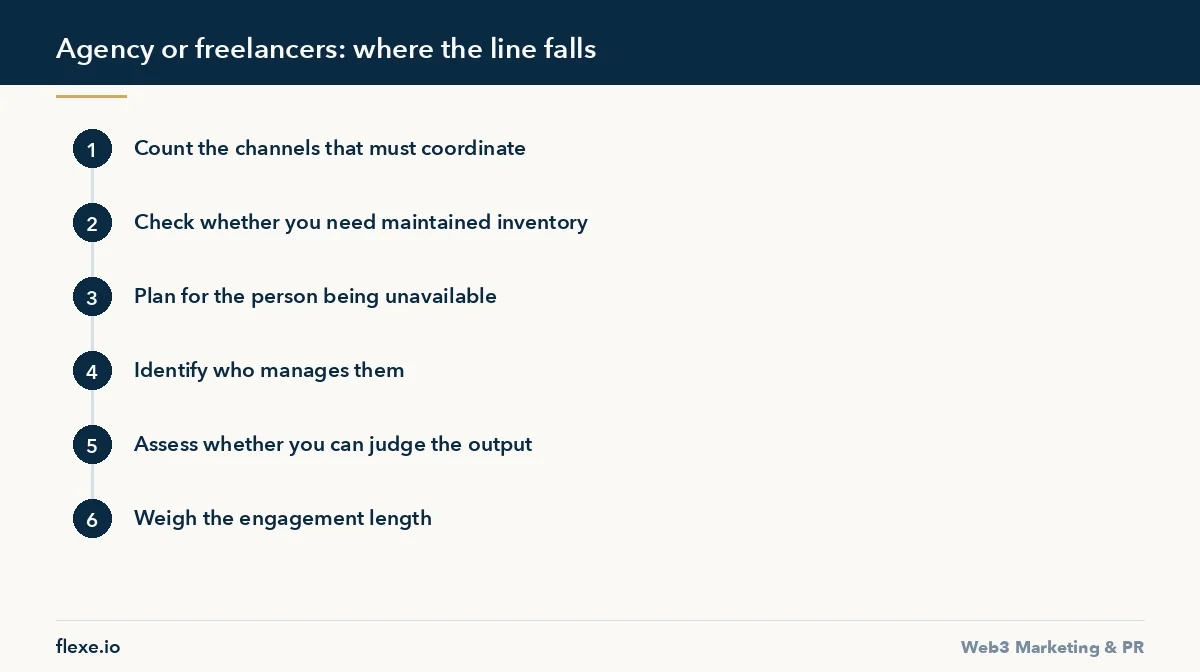
1. How many channels have to move together?
One channel is a freelancer’s natural unit. A strong community manager, a good designer or a writer who understands the space will beat an agency on that single task, and cost less.
The moment a listing hour needs coverage, creator posts, a community that is staffed and paid traffic all landing in the same window, the work is coordination. Four freelancers with no one sequencing them is the arrangement that fails most often, because each does their part correctly at the wrong time.
2. Do you need inventory you cannot reach yourself?
This is the strongest argument for an agency and the one least often stated. Screened creator rosters, outlet lists with verified link status and traffic, and negotiated rates exist because someone maintained them over years and re-checks them as they decay.
A freelancer can reach the people they personally know, which is often excellent and always narrower. If the requirement is placements across dozens of outlets or creators, that is an inventory problem rather than an execution problem.
3. What happens when the one person is unavailable?
A freelancer is a single point of failure by definition. That is acceptable for work with no deadline and unacceptable for a launch window or a community that must be moderated overnight.
Community work is where this bites hardest. Attacks are timed for the hours nobody is watching, and one person cannot cover a room around the clock, whatever they promise. The staffing pattern is in how to moderate a crypto Discord.
4. Who is going to manage them?
Freelancers are cheaper partly because you supply the management. Someone on your side has to write the briefs, chase deliverables, check the work and hold the schedule. That is real hours from someone senior enough to make decisions.
If nobody on the team has those hours, the saving is nominal. The work either drifts or the founder absorbs it, which is the most expensive labour in the company.
5. Can you tell good work from bad in this channel?
Hiring a freelancer means judging their output yourself. In channels where quality is legible, such as design or writing, that is straightforward. In channels where it is not, it is a real risk.
Creator selection and media placement are the clearest cases. A creator roster looks impressive until you check medians, paid-versus-organic performance and reply quality, and a placement report looks impressive until you check whether the pages are indexed and whether the links are followed. Those checks are in how to vet a crypto KOL and how to tell if a placement passes a followed link.
If you would rather have this run for you, see the full service list.
6. How long is the engagement?
Agency onboarding costs weeks that are wasted on a two-week job. For a defined short task with a clear deliverable, a freelancer starts immediately and the ramp-up never has to be paid for.
Over a longer engagement the ramp-up amortises and the inventory and coverage advantages compound, which is why the crossover point is duration and breadth rather than budget.
Contracts for a crypto agency or freelancers
Whichever side you hire, the agreement should name the deliverables, the dates, the person doing the work and the notice period on both sides. Engagements go wrong most often on the last of those: work stops, a month is already paid, and nothing in writing says what is owed or what has to be handed back.
Define the deliverable as something checkable rather than as an activity. Posts published rather than content support, placements live with their URLs rather than press work, moderator hours covered rather than community management. An agreement written in activities cannot be failed, which means it also cannot be enforced when it should be.
Payment in tokens is common and worth settling before anyone starts. A rate set in tokens moves against the work, vesting on the supplier side changes their incentives, and an invoice denominated in a volatile asset creates an argument about which price applied. Pricing the work in fiat and paying in whatever both sides prefer keeps that argument separate from delivery.
Accounts and access you should own
Register the ad accounts, the analytics property, the domains, the email and the social profiles under company control and add the people working on them as users. The common version is the opposite, and it ends with a project asking a former contractor for access to its own history at the worst possible moment.
Keep a record of who holds what, review it whenever anyone joins or leaves, and remove access on the day an engagement ends rather than at the end of the month. Shared passwords should not exist at all, and anything touching funds or publishing rights deserves a separate check of its own.
Ask before signing what happens to the material at the end: the raw files, the data, the drafts and the contacts. An agency that keeps its outlet relationships is not doing anything unusual, but you should know that going in rather than discovering it in the middle of a handover you are already paying for.
What a rate actually includes
Compare offers on what is delivered rather than on the monthly figure. A retainer usually includes coordination, reporting and the cost of maintaining the lists the work places into; a freelance rate usually includes none of those, and the management hours land on your side. The cheaper arrangement is often the more expensive one once those hours are counted.
Ask what is not included before signing: media budget, creator fees, design assets, translation, tools, rush work. The items left out of a proposal are the ones that arrive as separate invoices later, and the second invoice is where most of the disagreement in this market actually happens.
For anything bought on your behalf, ask how it is billed. Whether creator fees and placement costs pass through at cost or with a margin is a reasonable question with a reasonable answer either way, and the version that causes trouble is the one nobody thought to ask about.
Running a paid trial task
Before a long engagement, buy one small piece of real work at the normal rate: a single article, a week of moderation, one creator placement, or a campaign run to a defined budget. Unpaid tests attract the people with nothing better to do, and they tell you nothing about how somebody works when the work actually matters.
Grade the trial on the things that repeat. Whether the brief was followed, whether questions arrived before the deadline rather than after it, whether the work needed rewriting, and how the report was written. The quality of a single output matters less than whether that process would survive being run every week for a year.
Give the same brief to a freelancer and to an agency if you are genuinely undecided. The difference in what comes back, and in how much of your own time each consumed getting there, answers the question better than any comparison of rate cards.
Briefs that produce usable work
A usable brief says who the audience is, what the piece has to accomplish, which facts are fixed, what must not be claimed, who approves it and by when. Most disappointing contract work traces back to a brief that was a sentence in a chat window, and the rewrite costs more than the original did.
Include examples of work you consider right and work you consider wrong, with a line on why. Preferences that everyone on your side treats as obvious are invisible to somebody who joined last week, and they surface only as revisions on the second draft.
Name one approver. Feedback assembled from several people with different opinions produces a second draft worse than the first, and the supplier learns that the real requirements appear only after delivery. Collect internal comments, resolve them internally, then send one set of changes.
Reporting you should insist on
Ask for the underlying records rather than the summary: the URLs of what was published, the dates, the spend by line, and exports from the accounts rather than screenshots of them. A report that cannot be checked is a statement of effort, and in channels where quality is hard to judge that is all you will be given.
Set the reporting cadence in the agreement along with the format, so producing it is part of the work rather than a favour. Reports that arrive because somebody asked arrive shaped by the question, and the months when nobody asked are the ones worth reading afterwards.
Check a sample yourself every month. Open the placements and see whether the pages are indexed and the links are followed, read the community scroll rather than the engagement number, and put one campaign’s reported numbers next to your own analytics. Those checks take an hour and they change what the next report looks like.
Hiring for the roles you keep
The functions that stay close to the team, such as community, content and design, are hired for judgement rather than for volume, because they make small decisions in public every day without asking first. Test that during the trial: give a brief with a gap in it and see whether the question comes back before the work does.
Those roles also need product knowledge that takes weeks to build, which is why turnover in them costs more than the rate difference between candidates. Write down what each person learned, keep the pinned answers and internal notes current, and the next hire starts from something instead of from the beginning.
When to end an engagement
The signals are consistent: deadlines that move without being flagged, reports that arrive later and thinner, questions answered with reassurance rather than detail, and the named lead being replaced quietly. Any one of them is normal in a busy month. Arriving together, they mean the account has been deprioritised, and waiting rarely reverses that.
Raise it once, in writing, with specifics and a date by which things should look different. Vague dissatisfaction produces a call and a promise; a written note listing what was missed produces either a fix or a clear answer that it will not be fixed, and both of those are useful.
When ending it, write the handover into the last invoice: access removed, files delivered, work in progress documented, contacts introduced where that was agreed. Handovers scheduled after the final payment do not happen, and the cost lands on whoever picks the work up next.
Where the comparison usually goes wrong
Two mistakes account for most of the bad outcomes. The first is buying coordination you do not need, paying for a team to run a single channel that one person on your side could own outright. The second is buying execution with no coordination at all, several contractors working in the same launch window and nobody holding the calendar they share.
Both are visible before anything is signed, from the questions above: how many channels, whose inventory, whose hours, and how long the work runs. Those answers rarely change once an engagement starts, which is why the decision is worth the afternoon it takes rather than the quarter it takes to undo.
Running both without paying twice
When an agency and freelancers work on the same project, the overlap is usually the calendar. Decide who owns the schedule, hold one weekly call where both are present, and keep a single document of what lands when. Parallel plans reproduce the failure described above, where each side does its part correctly at the wrong time.
Draw the boundary by function and write it down: who publishes, who approves, who talks to creators, who operates the ad account. Two parties holding the same responsibility is worse than one party holding too much, because the gap only becomes visible once something has already been missed.
Review the split every quarter against what actually happened. Roles that were right at launch, when several channels had to move to one date, are often wrong six months later, when the work is steady and one person could carry it without help.
Crypto agency or freelancers: the arrangement most projects should use
Both, split by function rather than by price. Keep the roles that need product knowledge and daily presence close to the team, hired directly: community management, content, design. Buy in the roles that depend on maintained inventory and coverage: media placement, creator campaigns, ad account operation.
The version that goes wrong is hiring an agency for the work your own people should own, or hiring four freelancers for work that needed one person sequencing it. Both are visible in advance from the questions above.
Our own position on who we suit and who we do not, along with the published benchmarks behind it, is on our crypto marketing agency page.