Crypto FUD management is the practice of answering doubt in a crypto community before the room writes its own explanation, and it works through five levers: an acknowledgement inside the first hour, a clear split between legitimate concerns and manufactured attacks, one named spokesperson who can publish without approval, moderator coverage across every shift, and a permanent public answer for each resolved incident.
The method comes from our work with 60-plus communities on Telegram, Discord and X. The pattern that turns a complaint into an exodus is always the same: an uncomfortable question goes unanswered while easy ones get replies, and the room concludes the channel is a marketing surface rather than a support one. The second most common failure is speed in the wrong direction. A polished statement six hours late loses to a short honest post in the first thirty minutes, because by hour six the community has already written its own explanation and is defending it.
What is FUD, and what does not count as FUD?
Not every critical message is FUD. The distinction matters because the responses are opposite. A legitimate concern answered defensively becomes a crisis. Manufactured FUD answered at length gives it oxygen and a longer life than it earned.
| Type | How to tell | Response |
|---|---|---|
| Legitimate concern | Specific, checkable, raised by someone with history in the community | Answer directly and publicly, with the detail, even when the answer is unflattering |
| Honest misunderstanding | Specific but based on a wrong premise | Correct the premise once, link the source, move on |
| Competitive attack | Arrives in coordinated bursts from accounts with no history | Answer the underlying question once for real members, ignore the accounts |
| Paid campaign | Same phrasing across many accounts, timed to an event | Do not engage; document and let the community see the pattern |
| Price complaint | Sentiment tracks the chart rather than any event | Not FUD and not answerable; do not pretend it is a communications issue |
Crypto FUD management: the key tactics
1. Acknowledge within the first hour
The first hour is when members form their explanation and start repeating it, so speed beats polish and an incomplete answer given early beats a complete one given late. “We have seen this, we are checking, update in two hours” is a complete first response. Say what you do not know: an admitted gap is repairable, while a confident wrong statement is not.
- Best for: every incident, including the ones where the facts are not yet known
- Metric to watch: time from the first message to the first acknowledgement
- Rule: give a time for the next update and keep it
- Watch out: missing a promised update costs more than the original problem
2. Sort the question before you answer it
Use the table above before anyone writes a reply. Real concerns get a direct public answer, even when it is unflattering; an attack gets one answer for real members while the accounts are ignored; a paid campaign gets no engagement, only documentation the community can see.
- Best for: waves that mix long-standing members with brand new accounts
- Signal of an attack: coordinated bursts from accounts with no history
- Signal of a paid campaign: the same phrasing across many accounts, timed to an event
- Watch out: answering manufactured FUD at length gives it oxygen
3. Answer where the question was asked, then mirror it
If the complaint started in the Telegram group, the reply belongs in the Telegram group first, pinned, with the same text repeated on X and in the Discord announcement channel within minutes. A blog post instead reads as avoidance. Moderators need the text pasted into their handover note so that four people are not writing four slightly different versions.
- Best for: projects active on more than one platform
- Metric to watch: whether one identical text appears in every channel
- Watch out: answering in private messages hides the reply from everyone who saw the question
- Also avoid: a pinned statement that is never updated, which leaves a stale promise at the top of the channel for days
4. Give one named person the right to speak
Approval chains cost response time, so agree the boundary in advance. A named spokesperson should be free to acknowledge, confirm what is already public, promise a time for the next update, and correct a factual error. Anything touching funds, contracts, law or a partner’s business waits for the founder or counsel, and that is the only category that waits. Write both lists down, because arguing about the boundary during an incident costs more than any wording mistake.
- Best for: teams where every public word currently goes through the founder
- Metric to watch: how long it takes before anyone is cleared to post
- Outside the remit: a leaked document or a partner named in a complaint
- Watch out: a rota that lives in one manager’s head
5. Moderate scams and abuse, never criticism
Removing critical messages in a channel whose members already suspect a problem confirms the suspicion faster than any accusation could. Never delete the question: deletion converts a complaint into evidence of a cover-up, and screenshots outlive the post. The moderation line sits at scams and abuse, not at criticism.
- Best for: channels under pressure, where every removal is noticed
- Metric to watch: critical messages removed without a scam or abuse reason
- Moderators may: acknowledge, point at the pinned answer and remove scams
- Moderators may not: speculate about causes, timelines or anything involving money
6. Keep a permanent answer for every resolved incident
Old incidents come back, usually before a listing or a vote, and usually as a screenshot with the date cropped out. The cheapest defence is one page or one pinned message per resolved incident, written once, dated, and never quietly edited. Moderators then reply with a link rather than a fresh improvisation, and the room sees consistency instead of a new position each time.
- Best for: projects heading into a listing, a vote or a new round of attention
- Metric to watch: repeat questions answered with a link rather than a new explanation
- Close with: a post stating what happened, what changed, where the permanent answer lives and who to ask next
- Watch out: threads that simply stop, which leave the last unanswered message standing as the summary
7. Build credit in calm periods
The preparation that pays is unglamorous: a named person who can speak without approval, a stated update cadence, and a channel history where hard questions have been answered before. A community that has watched a project answer uncomfortable questions in calm periods extends credit in bad ones. A community whose channel contains only announcements has nothing to extend. When the first hour matters more than the statement: how we handle crisis communications.
How to plan crypto FUD management step by step
The first hour only works if somebody owns it before the post appears.
1. Write the on-call rota
Name one person per shift who can publish without asking and a second who can be woken, and write both into a rota the wider team can read. When the rota lives in one manager’s head, the first thirty minutes go on working out who is allowed to speak, and that is the half hour that decides the rest.
2. Set up detection
Nothing in the first hour works if you hear about the post six hours late. Somebody has to watch the mentions, the reply tabs, the quote posts and the groups where your token gets discussed while nobody from the team is an admin. Set alerts on the project name, the ticker and the founder’s handle, and treat a member forwarding you a screenshot as the detection method of last resort.
3. Prepare one incident document
Speed comes from having the material ready rather than from typing faster. Keep the deployed contract addresses, the audit links, the treasury wallets and the last three public statements in one document the on-call person can open. Most of the first hour goes on finding a link that already exists.
4. Write a response bank for every shift
A complaint posted at three in the morning local time is still hour one for everyone reading it. Give the shift approved wording anyone can post unedited: the acknowledgement, the holding line while something is being checked, the pointer to an existing public answer, and the refusal to comment on a partner’s business. The person awake at four in the morning then chooses between sentences rather than inventing one, and the tone stays the same across shifts.
5. Write the escalation ladder as names and numbers
On a Sunday night a moderator holding a claim about a contract exploit needs to know who to call second when the first person does not answer, and the ladder has to end with somebody who is always reachable. A rota that resolves to an unmonitored inbox is the same as having no rota at all.
6. Brief volunteer moderators on their limits
Volunteers can acknowledge, point at the pinned answer and remove scams. They do not speculate about causes, timelines or money. Say this when they are recruited rather than after the first mistake.
7. Standardise the shift handover and the log
The handover carries the open threads, not the mood. Each entry names the question, where it was asked, what was answered, what was promised and by when, and who is still waiting. Keep a log from the first minute too: timestamps, screenshots and what you published when. A promised update that falls between two shifts proves that a public commitment is not tracked anywhere.
8. Check what bought coverage includes
If coverage is bought rather than staffed, the contract has to say how fast an acknowledgement goes out overnight, who holds publishing rights, which decisions escalate and to whom, and what happens on a weekend. Pay for the window rather than for hours logged, and ask for the incident log as a deliverable. An arrangement that covers content production but leaves the night unmanned is the one most projects sign without reading.
When the accusation turns out true
Some of what arrives as FUD is correct. The response then is not a rebuttal but a sequence: confirm the part that is true in plain words, say what has already been done, say what is not yet decided, and give the date of the next update. Partial admissions read worse than full ones, because the community immediately tests the boundary and finds the rest anyway.
Where members lost money, separate the apology from the remedy. A remedy announced before the numbers are known becomes a second incident when it changes, so publish the process and the date instead: who collects claims, what evidence is needed, and when the decision lands. Say plainly if there will be no compensation. An honest no ends a thread, while a vague maybe keeps it running for weeks.
A question from a publication is answered once, in writing, by the spokesperson, and the same text goes into the community channel the moment it is sent. With a partner named in a complaint, agree one version with them and publish on your own channel rather than waiting for a joint statement, which arrives on the schedule of the slowest legal team involved. For the full sequence, see our guide on how to handle a crypto crisis.
Mistakes to avoid
- Silence. Leaving the hard question unanswered while easy ones get replies.
- Arguing with individual accounts. It turns a broadcast into a fight the community watches.
- Legal language. To a crypto audience it reads as a confession.
- Enthusiasm instead of an answer. Responding to a hard question with an announcement about something else entirely.
- Deleting criticism. It confirms the suspicion faster than any accusation could.
- Private replies. The member who received one usually posts a screenshot anyway, without the surrounding context.
Most of these come down to where the moderation line sits and who is allowed to speak. Our notes on crypto community moderation cover the day-to-day rules that keep a channel from drifting into them.
How to measure results
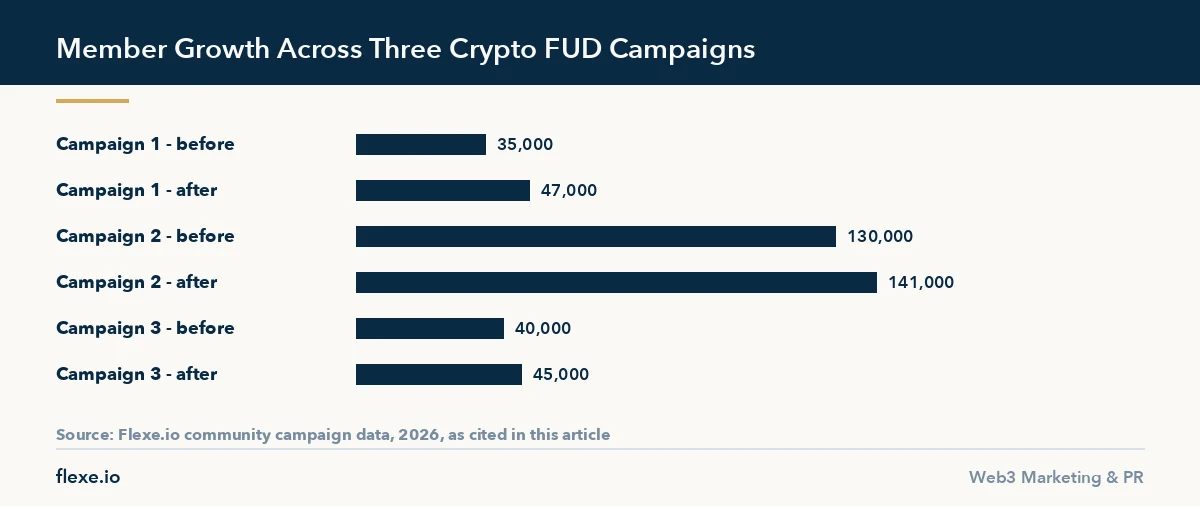
The measurable version of community credit is retention. In three community campaigns run in 2026, member counts moved from 35,000 to 47,000, from 130,000 to 141,000 and from 40,000 to 45,000, and the figure that predicted whether the room held together under pressure was the one at day 30, not the peak.
Two or three days after an incident ends, read the log with the team and answer four questions:
- When did the first message appear?
- When did the first acknowledgement go out?
- Which promised updates were kept?
- What could the moderators not answer without escalation?
The output is a change to the response bank or to the rota, not a document. Reviews that produce neither are why the same incident takes the same shape next quarter. Then watch the channel for a week rather than the chart. The incident is over when new members stop finding the thread and asking what happened, not when the team stops talking about it.
A delisting is one of the harder rumors to answer, and our token delisting guide sets out the messaging order to follow.
Frequently Asked Questions
Should a crypto project respond to every piece of FUD?
No. Legitimate concerns and honest misunderstandings deserve a direct public answer, even when the answer is unflattering. Coordinated attacks and paid campaigns should be answered once for the benefit of real members, not engaged account by account. Price complaints that track the chart rather than any event are not FUD and are not a communications issue.
How fast should a project respond to FUD?
Within the first hour, even if the response is only an acknowledgement with a promised update time. Whatever is true in the first hour becomes the community narrative, so an incomplete early answer beats a complete late one. A short honest post in the first thirty minutes beats a polished statement six hours later.
Should moderators delete critical messages?
No. Deleting criticism converts a complaint into evidence of a cover-up, and screenshots outlive the deleted post. Moderate scams and abuse, leave criticism standing and answer it. Removing critical messages in a channel whose members already suspect a problem confirms the suspicion faster than any accusation could.
What is the biggest mistake in crypto crisis communication?
Silence, followed by legal language. Both read as confirmation to a crypto audience. A short plain statement admitting what is not yet known outperforms a polished statement issued hours later, and giving a time for the next update, then keeping it, matters more than the wording of the first post.
What should a project do if the FUD turns out to be true?
Confirm the true part in plain words, say what has already been done, say what is not yet decided, and give the date of the next update. Partial admissions read worse than full ones. If members lost money, publish the claims process and decision date rather than a remedy announced before the numbers are known.