How much does crypto PR cost in 2026? A single press release costs $149 on a general newswire, $500 to $2,499 for 8 to 20 crypto outlets, and $6,499 to $14,997 for the largest crypto bundles; agency work starts at $4,000 for a focused single-channel campaign, and a full-stack launch runs $50,000 to $500,000 over three to six months. The wire figures come from the published price pages of Chainwire, Web3 News Wire, Bitcoin PR Buzz and EIN Presswire, checked on 19 September 2026, and the agency figures are Flexe.io rates after 800+ campaigns since 2018.
What the wire money buys is reach and a same-day timestamp across a set of outlets. What it does not automatically buy is a followed link or editorial review at every outlet on the list, and those two are what most buyers assume they are paying for.
How much does crypto PR cost in 2026: price by item
Wire packages are the only part of this market with open rate cards, so they anchor the table.
| Item | Price | What you get | Source |
|---|---|---|---|
| General newswire release | $149 for one release, $999 for 15 | Newswire syndication with country and industry targeting, not crypto-specific | EIN Presswire |
| Crypto wire, entry package | $500 to $1,399 | 8 to 10 crypto news sites | Web3 News Wire, Chainwire |
| Crypto wire, mid package | $1,000 to $2,499 | 20 crypto news sites | Web3 News Wire, Chainwire |
| Crypto wire, large package | $6,499 to $14,997 | 75+ to 478 outlets, mostly mainstream syndication | Chainwire, Bitcoin PR Buzz |
| Single placement at a mid-tier crypto outlet | Typically a few hundred dollars | One article on one site, often labelled sponsored | Flexe.io inventory |
| Focused single-channel campaign | From $4,000 | One channel run end to end, for example earned and paid placements | Flexe.io |
| Community management | From $2,000 | Telegram and Discord moderation and content | Flexe.io |
| Full-stack launch | $50,000 to $500,000 over three to six months | PR, KOLs, community and paid media under one plan | Flexe.io |
Two things stand out. First, the gap between the cheapest and the most expensive wire is almost a hundred times, but the per-outlet price barely moves: Web3 News Wire charges $500 for 10 sites and $3,000 for 30+, and Bitcoin PR Buzz charges $997 for 127 outlets and $14,997 for 478. Second, the large bundles grow mostly by adding mainstream syndication. In the Bitcoin PR Buzz list only 13 of the 127 outlets in the entry package are crypto sites, and 59 of the 478 in the top one.
What does a crypto press release package actually contain?
Wire pricing is one of the few public prices in this market, which makes it the right place to start. The packages differ by how many sites receive the same text, not by how much attention each one gives it.
| Package | Price | Distribution | What is identical across all of them |
|---|---|---|---|
| Lite | $1,399 | 8 crypto outlets | Same-day publication, homepage placement at partner outlets, editorial suggestions rather than editing, up to two images and one embedded video |
| Standard | $2,499 | 20 crypto outlets | |
| Premium | $6,499 | 75+ crypto outlets plus mainstream articles | |
| Gold | $10,799 | 100+ crypto outlets, mainstream, trading terminals |
Report a wire buy as one distribution with a number of pickups, not as seventy-five placements. The copies share an anchor, a target and a publication minute, and search engines treat them accordingly.
If you run a project here, not just research one: If you are deciding what a placement budget should buy, we will put together a publication shortlist with domain authority, turnaround and what each outlet realistically does for a project at your stage. crypto PR packages.
What drives the price of crypto PR
Three things move a quote more than anything else: whether the outlet passes a followed link, how its authority score was measured and how old the traffic figure is.
Followed links and editorial review
Top outlets rarely give a followed link, because they have watched what that costs. Cointelegraph’s US organic search traffic went from an estimated 5,173,160 visits in July 2025 to 25 by May 2026, a collapse concentrated in October and November 2025. The leading explanation is a /crypto-betting/ subfolder that ranked for gambling queries in several countries; the entire iGaming directory was removed between 7 and 12 October 2025 and those URLs now return errors. Google has not confirmed any action.
Over the same window The Block fell about 15%, CoinDesk about 59% and Decrypt about 71%, and all three kept ranking. An outlet that has seen a peer lose nearly all of its search visibility over a paid subsection will not put its domain behind an advertiser’s link for the price of a press release slot.
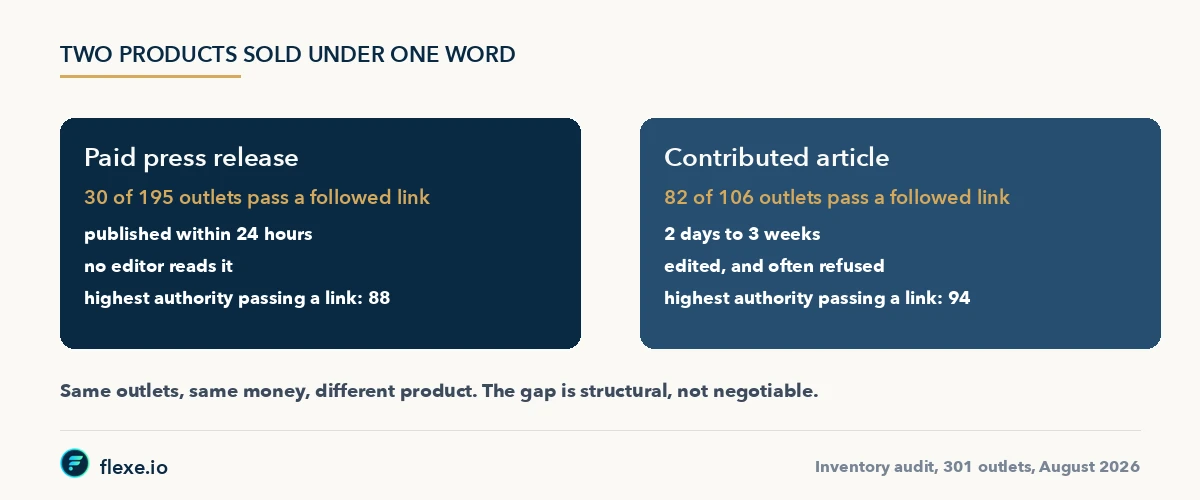
This shows up in our own inventory. We checked every outlet we can buy from: 30 of 195 that accept a paid release pass a followed link, against 82 of 106 that accept a contributed article. The full breakdown is in our study of followed links across 301 outlets. A contributed article goes through an editor and exists in a single copy; that is why it costs more per placement.
Domain authority is not the same as value
Sellers price by authority score, and our measurements say that is a weak guide. We re-measured the link profiles of 106 crypto media domains in September 2026. Eighteen of them, roughly one in six, carry a domain authority of 50 or higher while their Trust Flow sits below 25. Twenty-seven have a Citation Flow at least double their Trust Flow, meaning plenty of incoming links from sources that are not themselves trusted.
One outlet in the set shows a domain authority of 72 with a Trust Flow of 15 and just 36 referring domains. Another sits at authority 59 while its topical profile reads Recreation and Pets rather than anything financial. Buying by authority score alone means paying for a number that describes the wrong thing.
Stale traffic figures
The largest errors in this market are not inflation, they are staleness. We have been on the wrong side of this ourselves. Our own page on Bitcointalk promotion carried a monthly traffic figure of roughly 703,000 for months, taken from a supplier sheet. Re-measuring it against Similarweb in August 2026 gave about 212,000, on a trend falling around 10% a year. We corrected the page and dated the note.
Packages vs retainers: which should you choose?
A package is a fixed distribution at a fixed price: you supply the text, the wire publishes it, and you receive a list of URLs. A retainer or campaign fee pays for the work around the placements: strategy, writing a release an editor would publish, pitching journalists, preparing quotes and data, and reporting.
- Choose a package when the news is already written, the date is fixed and you need a same-day timestamp across crypto media.
- Choose a campaign when you need coverage an editor chooses to run, followed links or interviews, which no wire can promise.
- Choose a full-stack launch when PR has to line up with KOLs, community and listings, which at Flexe.io runs $50,000 to $500,000 over three to six months.
- Start small with a focused single-channel campaign from $4,000 if you are testing whether PR moves your metrics at all.
Reading an agency quote
A PR agency quote should separate third-party costs, such as wire fees and paid placements, from the agency’s own fee for strategy, writing and outreach. Ask for both lines, ask which placements are guaranteed and which depend on an editor’s decision,. A quote that bundles everything into one number makes it impossible to see what you are paying for.
Red flags: what you should not pay for
Avoid paying for guaranteed placements in outlets that state they do not accept paid editorial content, for readership figures the supplier cannot source and for bulk distribution to sites with no readers. Watch for these signs in any offer:
- Coverage on famous outlets through unnamed partners, which is often labelled sponsored or removed later.
- A headline outlet count with no named list of live URLs.
- Traffic figures with no date and no tool named.
- The word “permanent” applied to a link, with no example of a live page from the last 30 days.
- One price for everything, with wire fees and agency time mixed together.
Half of what matters can be checked before payment, and half cannot.
| Question | Answerable before payment? | How, or why not |
|---|---|---|
| Will the link be followed? | Yes | Ask for a live example from the last 30 days in your exact format and read the raw HTML for rel, canonical and robots |
| Which sites are in the package? | Yes | The named list of live URLs is part of the deliverable, so it belongs in the report either way |
| How old is the traffic figure? | Yes | Ask for the date and the tool. A number with no date has not been re-checked |
| Is the outlet’s link profile actually about crypto? | Yes | The topical profile of an outlet’s backlinks is often not the subject of its articles |
| How many people will read this specific piece? | No | Wires state plainly that they cannot track views on third-party sites; publishers do not share their analytics |
| What is the outlet’s real traffic? | No | Similarweb, Semrush and Ahrefs are models. Their disagreement with a publisher’s own analytics is known in direction, not in size |
| Will the link still be there in a year? | No | “Permanent” is a word on a landing page. Rel, robots and the page itself can change without notice |
| Will an editor review the text? | No | Some outlets run a real editorial pass and some publish as received. Package wording rarely separates the two, so ask which outlets on the list edit |
How to budget a crypto PR campaign
The real answer to how much does crypto PR cost depends on the outcome, so start the budget there rather than from a package list. A launch that needs to be visible on the day, a funding announcement that should reach investors, a listing that needs traders to know about it and an authority campaign that should earn links are different jobs, and each one points to a different mix of wire distribution, organic placements and outreach.
For announcements, the wire is usually the largest line and the easiest to size. Pick the smallest package that covers the outlets your audience actually reads, and put the difference into one or two placements where an editor chooses to cover the story. For authority, spend on a small number of organic placements in outlets that pass a followed link and have real readers, and check both before paying.
Keep a share of the budget for the work around placements: writing, quotes and data, fast answers to journalist questions and follow-up after publication. Spread the rest across the cycle: the wire carries the news on the day, analysis lands in the following weeks, and results coverage needs budget left for later. Plan the reporting before spending: every placement with its URL, date, link status and indexing a few weeks later.
How these prices were checked
Wire prices were read from each service’s own public price page on 19 September 2026: Chainwire, Web3 News Wire, Bitcoin PR Buzz and EIN Presswire. We recorded current prices, not struck-through list prices or limited-time offers. Chainwire was first read on 4 September 2026 and had not changed. Link figures come from our own inventory and the September 2026 re-measurement of 106 crypto media domains.
Agency figures are Flexe.io starting rates. We do not quote other agencies’ fees because few publish them and unpublished quotes cannot be checked. If you ask how much does crypto PR cost for your own launch, the honest answer is a named outlet list with prices and a check date, not a range.
Frequently Asked Questions
How much does a crypto press release cost?
Between $149 and $14,997 on published price lists checked on 19 September 2026. EIN Presswire starts at $149 for one general release, Web3 News Wire charges $500 for 10 crypto sites, Chainwire charges $1,399 for 8 crypto outlets and $10,799 for 100+, and Bitcoin PR Buzz tops out at $14,997 for 478 outlets. Most publishers do not publish their own rates, so any single-outlet quote needs a check date.
How much does a crypto PR agency charge?
At Flexe.io a focused single-channel campaign starts at $4,000, community management starts at $2,000, and a full-stack launch costs $50,000 to $500,000 over three to six months. Those fees cover strategy, writing, outreach and reporting. Wire fees and paid placements are third-party costs, so ask any agency to show them on a separate line from its own fee.
Is a press release or a contributed article better for links?
A contributed article, by a wide margin. In our inventory 82 of 106 outlets that accept contributed articles pass a followed link, against 30 of 195 that accept a paid release. The trade-off is time and control: a release publishes within a day and is rarely refused, while a contributed piece takes days to weeks and editors turn work down.
Does a release on a top-tier outlet help SEO?
Rarely, and buying one for that reason is a category error. The press release section of a large outlet is disclosed advertising, and the highest domain authority we recorded among outlets passing a followed link on a release is 88. You are buying a logo, a URL you can cite, and a same-day timestamp. Treat any link value as zero and you will not be disappointed.
Why is the same outlet quoted at different prices?
Most often because one of the quotes is older than the other. Rates move with an outlet’s own traffic and with demand around launch season, so a figure carried forward from last year is not a bargain, it is a stale number. Ask what a quote is based on, which tool produced it and when the underlying figures were last checked.
Buying placements rather than auditing them
If you would rather hand the channel over, our crypto PR service covers outlet selection, drafting and reporting against the checks above. For the link data behind this page see the followed-link study, and for the same problem on the influencer side, crypto KOL pricing covers why published rates there are asking prices too.