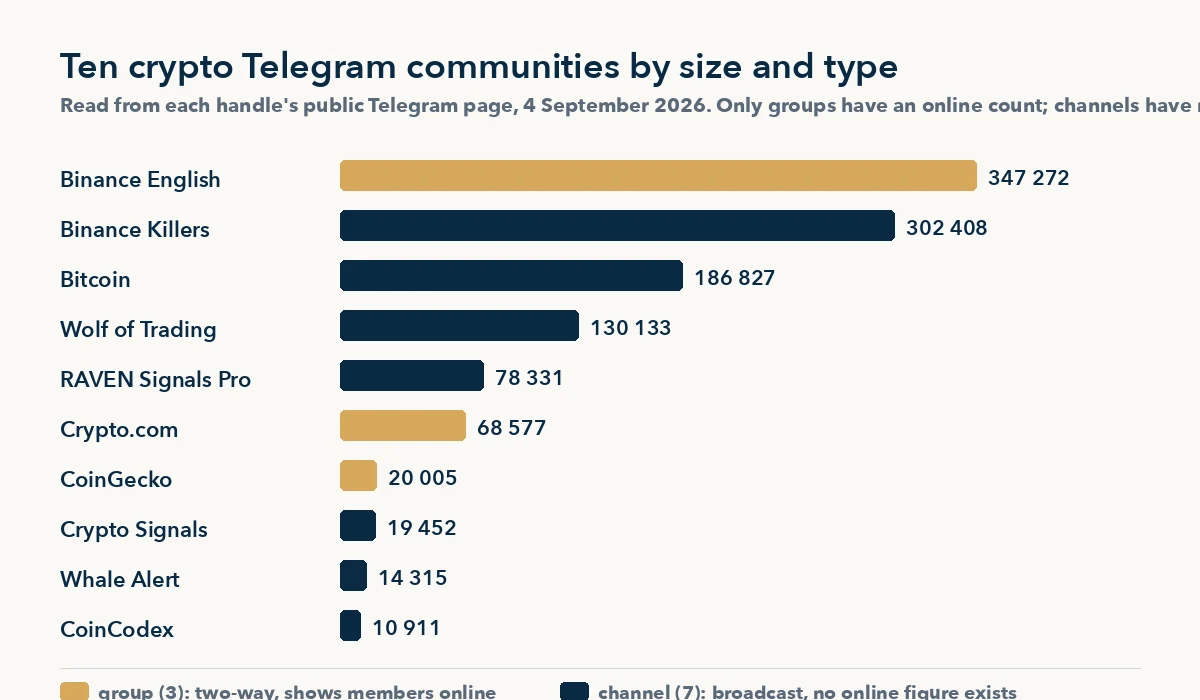
Ten crypto communities that appear on published Telegram lists span 10 911 to 347 272 members, a 32-fold spread that the lists themselves never show. Every figure below was read from Telegram’s own public page for each handle on 4 September 2026. Anyone planning where a token, a DEX or a launchpad should show up needs that spread, because a roster ordered by reputation hides the fact that its top and bottom entries are different businesses.
| Community | Handle | Size | Members online | Type |
|---|---|---|---|---|
| Binance English | BinanceExchange | 347 272 | 9 638 | Group |
| Binance Killers | binancekillers | 302 408 | none by design | Channel |
| Bitcoin | Bitcoin | 186 827 | none by design | Channel |
| Wolf of Trading | WolfOfTrading | 130 133 | none by design | Channel |
| RAVEN Signals Pro | ravensignalspro | 78 331 | none by design | Channel |
| Crypto.com | CryptoComOfficial | 68 577 | 2 353 | Group |
| CoinGecko | coingecko | 20 005 | 882 | Group |
| Crypto Signals | cryptosignals | 19 452 | none by design | Channel |
| Whale Alert | whale_alert | 14 315 | none by design | Channel |
| CoinCodex | CoinCodex | 10 911 | none by design | Channel |
A working link proves nothing
Open t.me/anything in a browser and Telegram answers with HTTP 200 whether or not a community exists behind that handle. We confirmed this with a deliberately invented handle: the page loads, the status is 200, and there is simply no community block on it. So “the link works” is not evidence, and neither is a screenshot of a join button.
The signal is the small grey line under the name on that page. Telegram renders it only when a real public community sits behind the handle, and it carries either a subscriber count or a member count. No line means no public community at that address, whatever the list that sent you there says. When we tried to resolve one name from a published roster to a working handle, we could not find one that returned that line, which is a result about our search rather than proof the community is fictional.
If you run a project here, not just research one: If you are building the group rather than reading about it, the hard part is the first two thousand real members. We place projects in channels like these and run the seeding without the bot traffic that gets a group flagged. paid placements in Telegram channels.
Subscribers and members are different products
Telegram separates channels from groups, and the difference decides what you can expect. A channel broadcasts: only admins post, the audience reads, and Telegram publishes a subscriber count and nothing else. A group is two-way, and its page shows both members and how many are online at that moment. The online figure is not a number Telegram hides from channels, it is a number channels do not have: presence is a property of a group membership, and a broadcast subscriber list has no equivalent. So for seven of the ten rows above there is nothing to withhold.
Seven of the ten above are channels. That matters for anyone planning reach: a channel gives impressions and no conversation, so it behaves like a media buy, while a group behaves like a forum you have to earn a place in. Binance English at 347 272 and Binance Killers at 302 408 look interchangeable in a ranked list and are not: one is a conversation, the other is a broadcast.
The online count is the number nobody publishes
Groups expose a second figure that no roster we have seen reproduces: how many members are online. Divided by total members it gives a liveness ratio you can compute yourself in seconds. It exists only for the three groups in the table, which is itself the point: for a broadcast channel there is no public way to tell a live audience from a dormant one.
- CoinGecko: 882 online of 20 005, which is 4,4%.
- Crypto.com: 2 353 of 68 577, which is 3,4%.
- Binance English: 9 638 of 347 272, which is 2,8%.
- What it means: the smallest group here is the most awake, and the largest is the least. Read once, the ratio is a snapshot and moves with time of day. Read three times across a week it separates a community from an audience.
Which community fits which need
- Reaching an audience that can answer back. A group, not a channel. CoinGecko and Crypto.com are the two here that allow replies and publish a live online count, which is the only public signal of whether anyone is actually present.
- Narrow, high-intent audiences. Whale Alert at 14 315 is the smallest entry here and the most specific. For a DEX or an aggregator, a feed followed by people who watch large transfers is worth more per member than a general channel twenty times its size.
- Signal channels are a separate market. Binance Killers, Wolf of Trading, RAVEN Signals Pro and Crypto Signals all sell access tiers, which means their members are already paying for attention elsewhere. Our guide to Telegram signal groups covers how that market is structured.
- Official project channels. Take the handle from the project’s own website, never from a roster. Impersonation clusters around rosters, and a launchpad or aggregator sending users to a copied handle carries the reputational cost, not the roster.
- Building your own instead. At these ratios, a 20 000-member group with 4% online outperforms a 300 000-member channel nobody reads. Our notes on building a Telegram group and on choosing between Telegram and Discord cover the trade-off.
What this list leaves out and why
We did not rank these by quality, because quality in a community is not observable from outside it. We did not check message volume, moderation, or how much of the membership arrived through paid promotion, and none of those are readable from a public page. We also excluded private and invite-only communities entirely: they show nothing to verify, which makes them impossible to compare and easy to misrepresent.
The uncomfortable part is that this page will age like every other roster. Handles get renamed, communities get abandoned, counts move. That is exactly why the ten-second check above matters more than the table: run it yourself on the day you need the answer. The broader landscape sits in our guide to crypto Telegram groups, and the DeFi corner of it in running a DeFi strategies group.
Frequently Asked Questions
How do I find crypto communities on Telegram without relying on a list?
Start from projects and tools you already use and follow the Telegram link on their own website. That path cannot be hijacked by a roster. Telegram’s in-app search works too, but it ranks by name match rather than by size or activity, so the handle page is still the only place the real figures appear.
Does a Telegram link returning an error mean the community is fake?
You will rarely see an error. Telegram answers almost any handle with a normal page and status 200, including handles nobody has ever registered. The thing that distinguishes a real public community is the grey line showing subscribers or members. Its absence means there is nothing public at that address right now, which is the single check worth automating if you track communities at any scale.
What is the difference between a Telegram channel and a group?
A channel is one-way: admins broadcast, everyone else reads, and Telegram shows only a subscriber count. A group is two-way and shows members plus how many are online. Seven of the ten communities in the table are channels, so a plan that assumes two-way engagement loses most of the list before budget is discussed.
Is a bigger crypto Telegram community better?
Not for most purposes. In the table the online ratio falls as size rises: CoinGecko shows 4,4% of members online, Crypto.com 3,4%, Binance English 2,8%. Large numbers buy reach, not attention. For a narrow objective such as reaching people who watch large transfers, the smallest entry on the list is the most useful one.
How often should I re-check a community before trusting it?
Before you act on it, and at least once more a week later. A single reading catches an empty handle but not a community that has been abandoned or renamed. Two readings a week apart show whether membership is moving at all, which is the difference between a live audience and an archived one.
Related reading
Telegram’s own documentation on channels and supergroups explains why the two report different figures.