Crypto journalists receive more pitches than any other beat of comparable size, and the overwhelming majority are identical: a token nobody has heard of, a partnership with another token nobody has heard of, and a quote from a chief executive saying the industry is at an inflection point.
Getting covered organically is not about persistence. It is about having something that is actually news and sending it to someone whose job is to write about that specific thing.
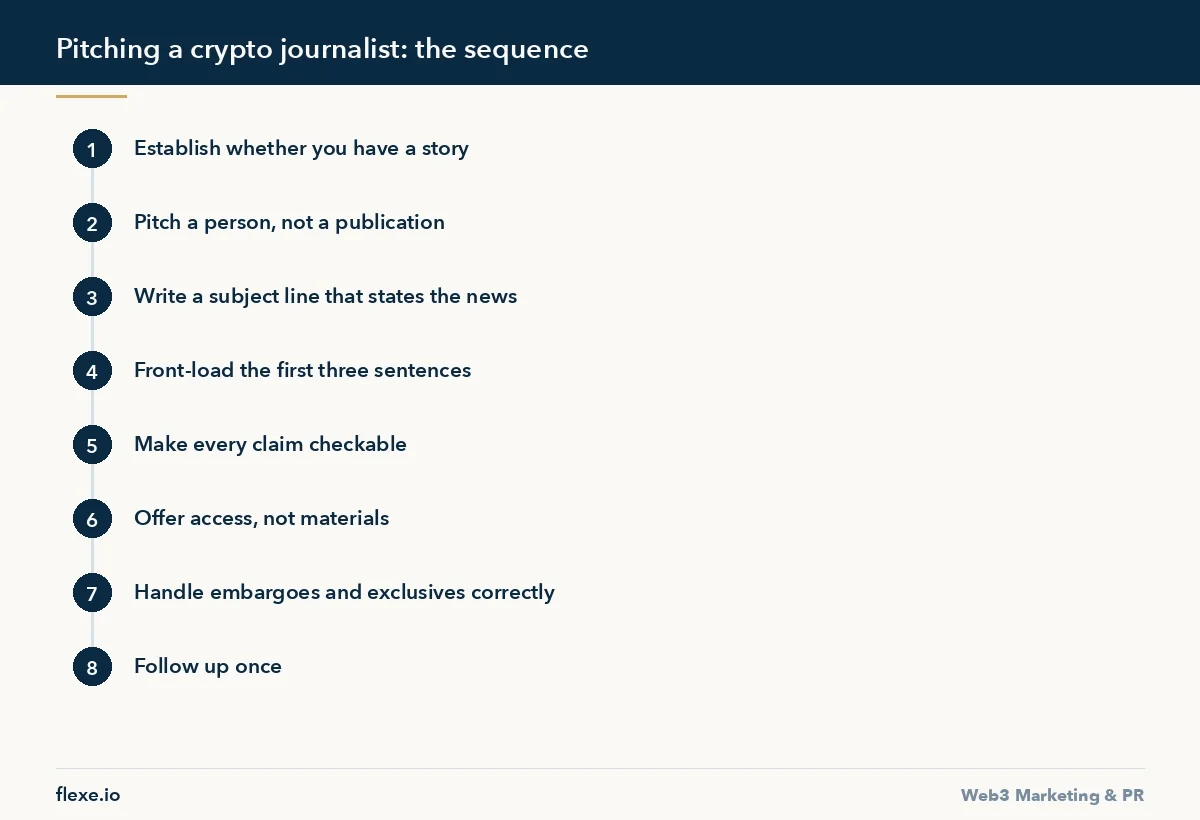
1. Establish whether you have a story
A story is something a reader would want to know even if they had never heard of your project. Funding with named investors, a security incident and its handling, original data nobody else has, a regulatory development you are directly affected by, or a product doing something that did not previously exist.
A new website, a rebrand, an advisor joining, a partnership without a product consequence and a roadmap update are not stories. They can be announced, but announcement is a different activity, covered in how to write a crypto press release.
2. Pitch a person, not a publication
Find the specific journalist who has written about your subject in the last few months. Read three of their pieces. Their beat, their angle and what they find interesting are all visible, and a pitch that matches them is a different object from one sent to a general inbox.
Sending the same message to forty journalists at once produces a response rate close to zero and puts your domain on the list they filter. One well-targeted pitch is worth more than the whole list.
3. Write a subject line that is the story
The subject line decides whether the message is opened, and it should state the news rather than tease it. Specific and plain beats clever every time, and the words “exclusive” and “revolutionary” both reduce open rates among people who receive these all day.
If the subject line cannot contain the news, that is usually evidence the news is not there yet.
4. Put everything essential in the first three sentences
What happened, why it matters, and what makes it verifiable. A journalist decides in seconds, and anything below the fold of the preview pane is read only if those three sentences worked.
Then stop. A pitch is not a press release and it is not a document. Six sentences is a good length, and attachments are frequently what sends a message to spam.
5. Make the claim checkable
Every number needs a source the journalist can open. On-chain figures with a link to the explorer, an audit report, a filing, a named investor who will confirm. Reporters have been burned by crypto claims and will not print a figure they cannot verify.
Providing the verification path unprompted is the single largest difference between pitches that convert and pitches that get a polite reply asking for it, which most projects never answer well.
6. Offer access rather than materials
What a journalist frequently wants is a person who will answer questions on the record, including uncomfortable ones. Offering a founder for twenty minutes is more valuable than any press kit.
If you offer it, be available. A reporter working to a deadline who cannot reach you writes the piece without you, or does not write it.
7. Respect the mechanics of embargoes and exclusives
An exclusive means one outlet gets it first, and it is the strongest incentive you can offer a tier-one publication. An embargo means everyone publishes at an agreed time. Confusing the two, or breaking either, ends the relationship immediately and the industry is small.
Agree the terms explicitly and in writing. Assuming an embargo without stating one is how announcements leak early and how projects acquire a reputation among reporters.
8. Follow up once, then stop
One follow-up after three or four working days, on the same thread, adding something new rather than repeating the pitch. If there is no response after that, the answer is no.
Keep the contact. A journalist who ignored one pitch may well take the next one if it is better, and the relationship is built across pitches rather than within one.
Building the list before you need it
The worst time to find the right reporter is the week you have news. Keep a running file of journalists who cover your category, with the pieces of theirs you have read, what they appear to care about, and anything you noticed about how they work. Twenty entries you understand are worth more than a purchased database of thousands of addresses.
Add to it whenever you read something relevant, not only when you are pitching. Note the freelancers as well as the staff writers, because a freelancer with a beat sells stories into several outlets and is often easier to reach than anybody on a masthead. Record where each person moves when they change jobs, since the beat usually travels with them.
Keep the file honest about status: who replied, who ignored you, who asked for something you never sent. Pitching a reporter who is still waiting on an answer from your last exchange is how a contact turns into a filter rule, and the file is also the only thing stopping two people on the same team from writing to them in the same week.
Record the practical details as well: which outlets the person writes for, what they have said publicly about how they prefer to be contacted, the days when their inbox is obviously overloaded, and whether they have ever asked to be taken off a list. Those notes cost seconds to write and prevent the errors that get a sender filtered permanently, which is the one outcome no future story recovers from.
How to pitch a crypto journalist you know
A relationship changes the format, not the standard. The pitch gets shorter, the preamble disappears and the subject line can assume some context, but the news still has to be news and the numbers still have to be checkable. Reporters who have covered you before are quicker to look and equally quick to notice when the bar has dropped.
Use the relationship for things a cold pitch cannot do: asking whether something is worth writing up before you build an announcement around it, offering a look at data early, flagging that a claim circulating in the category does not hold. Being useful when you have nothing to sell is what makes the next genuine story get read at all.
Do not spend it on favours. Asking somebody to cover a non-story because you get along converts a working contact into a person who screens your messages, and in an industry this small the cost is rarely limited to that one outlet. The relationship survives on the assumption that you only write when there is something there.
Preparing the material behind the pitch
Before sending anything, assemble what a reporter will ask for and put it somewhere you can send it within minutes: the verification links, the numbers with their sources, high-resolution images, correctly spelled names and titles, and a short factual background on the project. The pitch itself stays short. The material sits behind it, ready rather than promised.
Agree internally what can be said on the record and what is off limits, and make sure whoever gives the interview knows the difference before it starts. A founder who improvises a figure under friendly questioning creates a correction cycle that costs more attention than the original story ever earned, and the correction is what gets quoted afterwards.
Have the boring answers ready, because those are the ones that get asked: who funded this, where the team is based, what the token does, what happens to holders if the plan changes, what went wrong the last time. A project that hesitates on these reads as a project with something it is managing rather than explaining.
Handling the reply you did not want
Most replies are no, and some are worse than no: a request for information you cannot provide, or a question about something the project would rather not discuss. Answer anyway, promptly and without defensiveness. The reporter is deciding whether you are a source worth keeping, and that decision outlives whatever story prompted the exchange.
If the answer is that the story is not for them, ask what would be, in one sentence, and then leave it there. If they point you at a colleague, use the suggestion and say who sent you. If they say the timing is wrong, write the reason into your file and come back when the reason has changed rather than when the week is over.
If they intend to write something critical, engaging is almost always better than declining to comment. Provide the facts you can support, correct anything wrong before publication rather than after, and accept that the piece runs either way. A story written without you is a story written from whoever else was willing to talk about you.
Getting the interview right
Confirm the basics in writing beforehand: who is speaking, for how long, what the piece is about, whether it is recorded, and what counts as on the record. Then prepare the person for the questions they do not want, because those are the questions that decide how the finished piece reads, not the ones about the roadmap.
Keep answers short enough to quote. A reporter working to a deadline takes the sentence that says something, and a founder who talks for several minutes without producing one gives them nothing usable and little reason to call again. Saying you do not know, and offering to find out by a stated time, is a perfectly good answer that reporters respect.
Send the follow-up material the same day, before the reporter has finished writing. Anything arriving after the piece is filed exists only for the next one, and a promise made during an interview and delivered late is remembered more clearly than most of what was actually said in the conversation.
Corrections and the second draft
When something published is wrong, decide first whether it is wrong in a way that matters. Chasing a small imprecision spends credibility you will want for a real error, and a reputation for complaining about everything means nobody reads the message on the day a serious mistake needs fixing quickly.
If it does matter, write to the reporter rather than to an editor, quote the exact line, state the correct fact and provide the source that settles it. Ask for a correction rather than for the piece to be removed. Demands to take something down are refused, and then repeated publicly by everybody who notices the demand was made.
Keep the exchange private and unemotional even when the error was careless. The same person will be covering your category next quarter, and how you behaved when you were the wronged party is part of what they remember about working with you and about whether your next message deserves a reply.
Pitching during an incident
During a security incident or a public failure the inbound questions arrive before you are ready, and every hour of silence gets filled by somebody else. Decide early who speaks, publish what is confirmed, and say plainly what is not yet known rather than waiting for a complete account that will not exist for days.
Do not launch anything into that window. A product announcement sent while an incident is live reads as an attempt to bury it, and reporters will say exactly that in the piece. Hold the news, tell anyone expecting it why it is being held, and come back once the story has resolved and the timeline can be described.
When it does resolve, the follow-up is genuinely worth pitching: what happened and what changed so that it cannot happen the same way again. Projects that handle the bad week openly are the ones reporters call during the next one, and that access is worth more than any coverage bought in a calm quarter.
Measuring whether any of this worked
Counting published pieces is the wrong measure. Look instead at which outlets covered you, whether the coverage described what the project actually does, whether the numbers you supplied appeared intact, and whether anybody who matters to the business read it. One accurate piece in a publication your buyers read beats a page of syndicated repeats.
Track the second-order effects, because that is where media work pays: inbound from partners, questions in the community quoting the article, other reporters picking up the same detail, and the piece surfacing when somebody searches the project by name. These arrive over months rather than on the day of publication, so review them on that timescale.
Review the pitches that failed as carefully as the ones that landed. If a style of subject line never gets opened, change it. If reporters keep asking for verification you did not include, include it next time. The record of what did not work is what makes the following quarter of coverage cheaper to earn than this one was.
What paid placement does and does not replace
Paid distribution puts a release in front of an audience reliably and on a schedule. It does not produce a reporter choosing to write about you, which is a different signal to readers and to the systems that summarise the web.
Projects that build a genuine media relationship early tend to get covered during the moments that matter most, including the bad ones, and that is when it is worth the most.
Outlet selection, distribution and crisis support are on our crypto PR page, and the crisis procedure itself in how to handle a crypto PR crisis in 48 hours.