The NFT brand ambassadors, artists and studios most worth following in 2026 are led by Beeple, whose Everydays sold for $69,346,250 at Christie’s, Gary Vaynerchuk, who hand-drew the 268 characters behind VeeFriends, Luca Netz, whose Pudgy Toys reached 3,100 Walmart stores, Yuga Labs, which took over CryptoPunks and Meebits from Larva Labs, and RTFKT, which Nike acquired in December 2021. Every fact below was checked on 19 September 2026 against an auction record, a press release or the person’s own public profile.
We split the list into people who represent NFT projects in public, artists whose work sets the visual taste of the market, and studios that turned collections into brands. We left out follower counts and any number we could not source today.
NFT brand ambassadors and influencers to follow
NFT brand ambassadors, as used here, are people who publicly stand behind an NFT project: a founder who fronts it, a celebrity with a formal role, or a collector whose buys move attention.
1. Gary Vaynerchuk (VeeFriends creator)
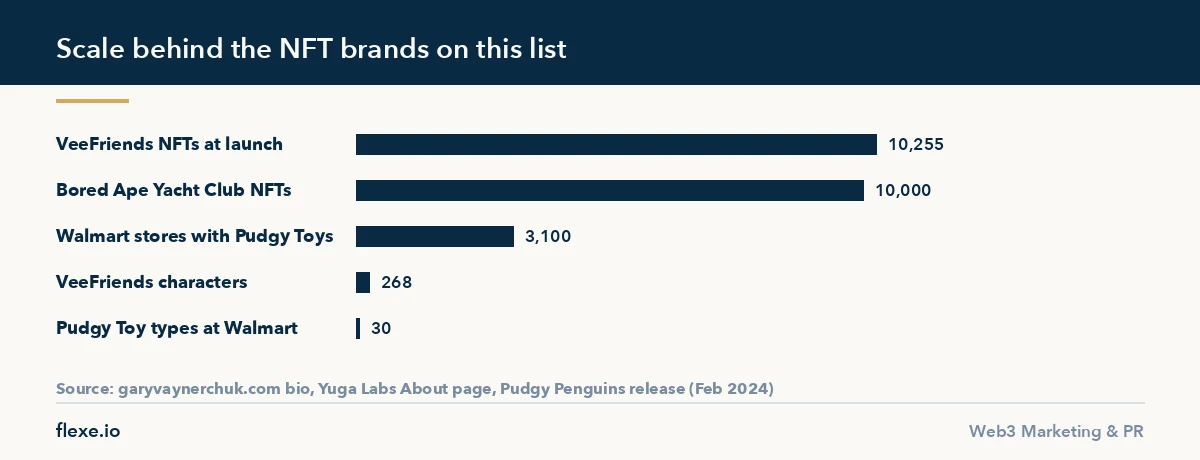
Gary Vaynerchuk is the clearest case of a founder who is also the brand’s main ambassador. According to his own biography page, VeeFriends launched on 11 May 2021 with 10,255 NFTs of 268 unique characters that he drew by hand, and each Series 1 token worked as admission to VeeCon in 2022, 2023 and 2024.
Known for: tying an NFT to a real-world pass, then extending the characters into physical products.
Where to follow: garyvaynerchuk.com and veefriends.com, with his social accounts linked from both.
Why it matters for brands: utility that people can use in person, such as event access, gives an ambassador something concrete to talk about besides floor price.
2. Pharrell Williams (Doodles chief brand officer)
Pharrell Williams took a formal executive role at Doodles as chief brand officer and board member, announced to holders at an NFT.NYC event, and the role came with an NFT-inspired album project with Columbia Records.
Known for: music and fashion, and a board-level role at an NFT brand rather than a one-off endorsement.
Where to follow: the official Doodles channels, where his work for the brand is announced.
Why it matters for brands: a title and a product (the album) give an ambassador a reason to keep showing up, which one sponsored tweet never does.
3. Luca Netz (Pudgy Penguins and Igloo Inc. CEO)
Luca Netz is the CEO of Pudgy Penguins and of its parent company Igloo Inc., which also backs the Abstract consumer blockchain. He is the public face of the brand’s move into retail: a Pudgy Penguins release from February 2024 put Pudgy Toys in 3,100 US Walmart stores, with 30 toys priced from $2.99 to $11.97.
Known for: taking an NFT collection to mass retail and building a chain around the brand.
Where to follow: the official Pudgy Penguins and Igloo channels.
Why it matters for brands: he shows that an NFT ambassador can speak to toy buyers who never open a wallet, which widens who the brand can reach.
4. punk6529 (collector, 6529)
punk6529 is a pseudonymous collector whose handle anchors the 6529 site. Its core collection, The Memes, is a set of large edition CC0 NFTs meant to spread a message about decentralization and to be remixed freely.
Known for: a decentralization-first view of digital ownership and a public domain approach to NFT art.
Where to follow: @punk6529 on X and 6529.io.
Why it matters for brands: collectors trust him on principles, so a brand that wants his attention needs an argument, not a budget.
5. Snoop Dogg (collector, as Cozomo de’ Medici)
Snoop Dogg tweeted that he is the collector behind the Cozomo de’ Medici account, a wallet known for CryptoPunks, Meebits and Art Blocks pieces. The lesson for brands: a famous name attached to a famous wallet still needs checking before a campaign is built on it.
Known for: music first, and a high-profile collector persona that pulled mainstream press into NFT art.
Where to follow: @CozomoMedici and Snoop Dogg’s own verified accounts.
Why it matters for brands: a celebrity collector brings press coverage, but the identity and the holdings behind the persona should be confirmed on-chain first.
The chart below shows the scale behind the brands in this section and the studios further down, using only figures we could link.
NFT artists to watch in 2026
Artists are not ambassadors in the contract sense, but they set what the market thinks good NFT work looks like.
1. Beeple (digital artist)
Beeple made the sale that brought NFTs to mainstream news. The Christie’s lot page for EVERYDAYS: THE FIRST 5000 DAYS records a price realised of USD 69,346,250 in an online sale that closed on 11 March 2021. The piece is a collage of images he made daily over many years.
Known for: the Everydays series of images made day after day.
Where to follow: @beeple on X, beeple_crap on Instagram and beeple-crap.com.
Why it matters for brands: a single auction result still shapes how outsiders value digital art, so his name opens doors with traditional media that crypto-native artists cannot.
2. XCOPY (crypto artist)
XCOPY is a pseudonymous crypto artist. The official site lists works such as Last Selfie, Max Pain, Right Click and Save-as Guy and The Doomed, and states “No rights reserved” in its footer, with a section for Creative Commons works.
Known for: works about crypto culture and a public domain stance on parts of the catalog.
Where to follow: xcopy.art.
Why it matters for brands: open licensing means fans can remix the work, a model brands can study before they decide how much of their own IP to release.
3. Tyler Hobbs (generative artist)
Tyler Hobbs writes custom algorithms and works with plotters and paint. His bio names Fidenza, released on Art Blocks, as his best known project, and QQL, a collaboration with Dandelion Mane, as an experiment in how people and algorithms create together.
Known for: Fidenza and physical plotter works shown in galleries.
Where to follow: @tylerxhobbs on X and Instagram, and tylerxhobbs.com.
Why it matters for brands: generative art lets a collection give every holder a unique piece, a format some brands now use for loyalty drops.
4. FEWOCiOUS (painter and digital artist)
FEWOCiOUS, who signs as Victor, makes autobiographical work. His site presents collections as chapters of his life, including Hello, I’m Victor FEWOCiOUS and This Is my Life.
Known for: personal, autobiographical collections framed as chapters of a life.
Where to follow: fewocious.com.
Why it matters for brands: a strong personal story travels well beyond crypto circles, which suits fashion and lifestyle collaborations.
5. Refik Anadol (media artist)
Refik Anadol turns large datasets into visual art and room-sized installations. His bio describes him as a pioneer in the aesthetics of data and machine intelligence, and he co-founded Dataland, presented on his site as a museum of AI arts in Los Angeles.
Known for: AI-driven installations on buildings and in museums.
Where to follow: refikanadol.com.
Why it matters for brands: he connects NFT collectors, museums and large tech sponsors, a mix few other artists can offer.
NFT studios to follow
Studios show what happens to an NFT brand after the mint: acquisitions, licensing, retail, new chains and sometimes closure.
1. Yuga Labs (Bored Ape Yacht Club)
Yuga Labs started with Bored Ape Yacht Club, which its About page says launched in April 2021 with 10,000 NFTs as a membership pass to a digital club, followed by the Otherside metaverse and the ApeChain network in 2024. In March 2022, Larva Labs announced that Yuga had acquired the IP of CryptoPunks and Meebits, and that Yuga’s first step would be granting commercial rights to holders.
Known for: Bored Apes, Mutant Apes, Otherside and the 2022 purchase of the CryptoPunks and Meebits IP.
Where to follow: yuga.com and the official BAYC channels.
Why it matters for brands: giving holders commercial rights turned collectors into licensees, a model any brand should understand before it drafts NFT terms.
2. RTFKT (Nike’s former NFT studio)
RTFKT is history now, but it is the most useful case on this list. Nike announced it had acquired RTFKT on 13 December 2021, describing a brand founded in 2020 by three co-founders that used game engines, NFTs, blockchain authentication and augmented reality to make digital collectibles. RTFKT later announced it was winding down, with one final MNLTH drop and a web archive of its work.
Known for: virtual sneakers, digital collectibles and one of the best known brand acquisitions in NFTs.
Where to follow: rtfkt.com, now an archive.
Why it matters for brands: even a studio owned by a global brand can close when strategy changes, so holders need a clear plan for what they keep.
3. Doodles (NFT entertainment brand)
Doodles grew from a PFP collection into a media and entertainment brand. Its choice of a music star as chief brand officer, plus a record label project, is a clear example of a studio treating its characters like a pop culture franchise.
Known for: character art, music projects and a celebrity executive.
Where to follow: doodles.app and the official Doodles accounts.
Why it matters for brands: it shows how an NFT brand can put an ambassador inside the company, not just on a media plan.
4. Pudgy Penguins and Igloo Inc.
Pudgy Penguins is the strongest current case of NFT IP in physical retail. The same Walmart release says holders who submitted their penguins for licensing through OverpassIP receive royalties when their characters appear in the toy line. Parent company Igloo Inc. also contributes to Abstract, a consumer-focused blockchain.
Known for: toys, holder royalties and a brand-led blockchain.
Where to follow: pudgypenguins.com and the Igloo and Abstract channels.
Why it matters for brands: paying holders when their NFT is used gives the community a direct reason to promote the brand.
5. Art Blocks (generative art platform)
Art Blocks hosts generative art where, in its own words, each work is created the moment it is collected: the artist writes the algorithm, the algorithm makes the piece, and every output is unique. Fidenza by Tyler Hobbs was released there.
Known for: curated long-form generative collections.
Where to follow: artblocks.io.
Why it matters for brands: it is the reference venue if a brand wants to commission algorithmic art that feels credible to serious collectors.
How brands pick an NFT ambassador
Most brands choose NFT brand ambassadors for fame and end with regret. A better order is to start with the audience you need, then find the person that audience already listens to. For NFT launches, that is usually a collector or creator with a smaller but active following, not the biggest name available. Our guide on how to vet an NFT ambassador covers the hiring side in detail; the checks below are the short version.
- Confirm identity and holdings on-chain. The Cozomo de’ Medici case shows why a claim in a tweet is not proof.
- Read the last few months of posts, not the bio. Look for real replies from collectors, not only emoji threads.
- Check past paid work. If every post is a promotion, the audience has learned to scroll past.
- Ask what the person will do beyond posting, such as hosting a space, joining a drop or holding the asset.
- Write down disclosure rules and what happens if the project or the person runs into trouble.
This is where our own data helps. Our KOL base holds 11,859 crypto KOLs on X and 11,695 crypto and finance YouTubers, all with 5,000 or more followers, and our active X roster is 85 verified accounts with 8.7M combined reach and 1.74% engagement. We filter that base by audience and past performance, using the same method as our checklist on how to vet a KOL before you pay. A focused single-channel campaign starts at $4,000.
Vetting lowers risk, it does not remove it. Across 150 of our campaigns the median net ROI was 2.8x within 90 days, but the range ran from 1.4x to 7.0x and 12 percent failed. No ambassador can rescue a mint that opens into a falling market. If you want a team to shortlist and manage NFT creators for you, our crypto influencer marketing service handles vetting, contracts and reporting.
Related reading: NFT influencer marketing guide, NFT branding guide and NFT brand licensing explained.
Agencies that run these programmes are compared in our list of NFT marketing agencies, checked on their own sites.
Frequently Asked Questions
What is an NFT brand ambassador?
An NFT brand ambassador is a person who publicly represents an NFT project or brand, usually a founder, a collector or a celebrity with a formal role. Examples include Gary Vaynerchuk for VeeFriends and Pharrell Williams as chief brand officer at Doodles. The role goes beyond one paid post and usually includes ongoing content, events or product work.
Who are the top NFT influencers to follow in 2026?
Good starting points are Gary Vaynerchuk, Pharrell Williams, Luca Netz, punk6529 and Snoop Dogg’s collector persona, Cozomo de’ Medici. They cover founder-led brands, celebrity roles, retail expansion and collector culture. Follow their official channels and check any identity claim on-chain before you treat an account as the real person.
Which NFT studios are worth following?
Yuga Labs, Pudgy Penguins with Igloo Inc., Doodles and Art Blocks are the most useful studios to follow, and RTFKT is worth studying as a closed case. Together they show acquisitions, holder licensing, mass retail, generative art and what happens when a corporate owner changes strategy.
How much does it cost to hire an NFT ambassador?
Cost depends on the person and the scope, from a few posts to a formal role with equity. At Flexe, a focused single-channel influencer campaign starts at $4,000, and full-stack launches run from $50K to $500K over three to six months. Celebrity roles like a chief brand officer are negotiated privately and are rarely disclosed.
How do you check if an NFT influencer is real?
You check an NFT influencer by matching their public claims to on-chain data and to their own official profiles. Confirm the wallet they say they hold, read months of posts for genuine replies, review past paid work and ask for audience data. A famous name alone is not proof, as the doubts around some collector personas show.