A crypto meme page is a distribution asset that happens to be funny, and it works when five levers are set in order: a clear purpose, a daily format you can repeat, replying more than posting, the views to followers ratio, and a route that carries reach to the project. Most projects treat it the other way round, spend three months chasing jokes, and end up with an account that posts into an empty room. The order of work matters more than the humour.
What is a crypto meme page
It is a social account, usually on X, that posts humour about a crypto category or a single project in order to reach people who do not follow the project yet, keep existing holders engaged between announcements, or become an advertising surface that can later be sold or rented. The value is that it does not read as marketing.
The hard part is keeping it useful to the project without turning it into a second official channel.
How to build a crypto meme page: the key tactics
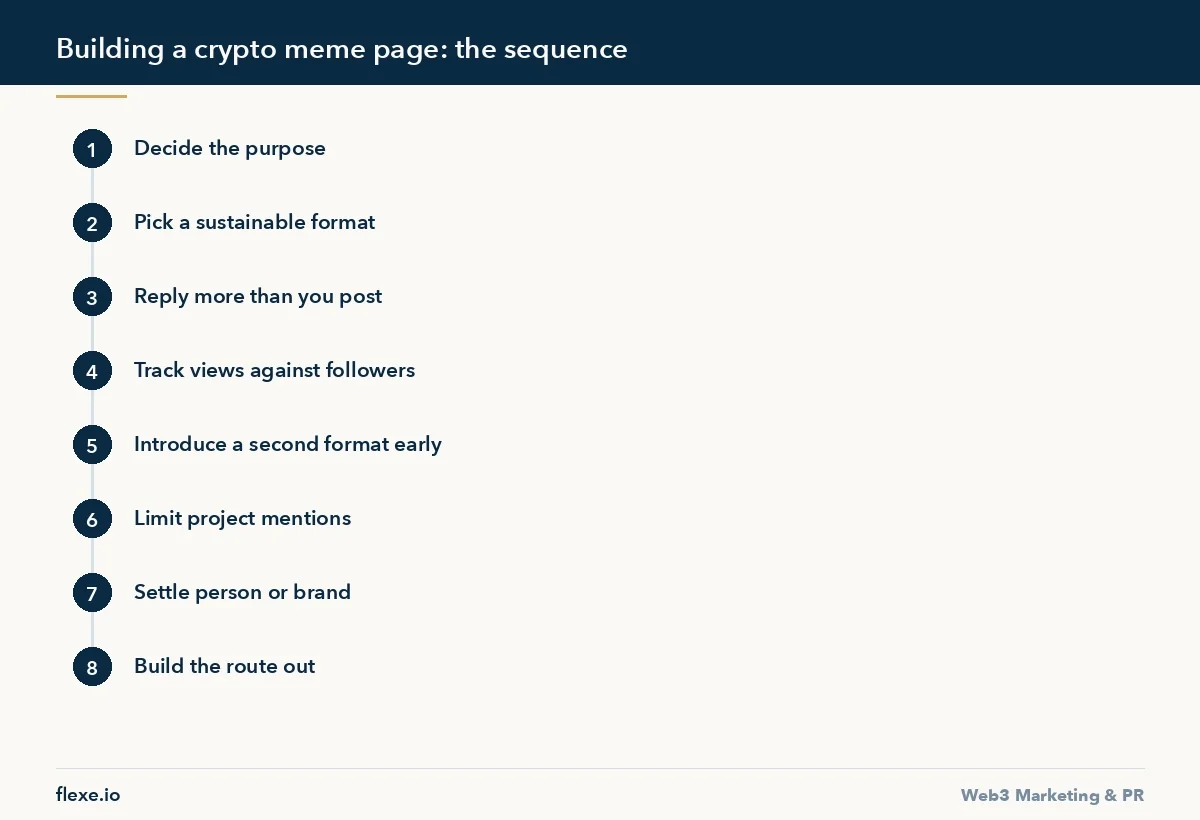
Eight moves, in order. Skipping one breaks the next.
1. Decide what the account is for before the first post
There are only three useful answers: reach, retention or resale. These require different accounts and produce different content. Reach accounts post about the category and rarely mention the project. Retention accounts post about the project and rarely reach anyone new. Trying to do both from one handle is the most common reason an account plateaus at a few thousand followers and stays there.
- Best for: Every project, before a handle is registered
- Watch out: Mixing reach and retention on one handle
2. Pick the format you can sustain daily
Frequency beats quality in the first ninety days, because the platform needs signal before it will distribute anything. Pick a format you can produce in under ten minutes and repeat it: a recurring caption structure, a running joke with a fixed setup, a chart with a punchline, a reaction template. Accounts that start with elaborate original art post four times and stop. Accounts that start with a repeatable template post four hundred times and get somewhere. Choose the format on the basis of what you can still do on a bad Tuesday.
- Best for: The first ninety days
- Budget: Under ten minutes of production per post
- Metric to watch: Posting streak, not likes
- Watch out: Original art that nobody can repeat daily
3. Reply more than you post in month one
A new account has no distribution. The fastest route to some is replying inside the comment sections of accounts that already have it. A good reply on a large post reaches more people than a good post on a small account, and it costs the same effort. Pick fifteen to twenty accounts in the category, be early on their posts, and be worth reading. It is unglamorous and it is the whole early game.
- Best for: Month one, when the account has no reach of its own
- Budget: Time only, fifteen to twenty target accounts
4. Watch the metric that actually predicts survival
Follower count tells you nothing about whether an account works. The number that does is the ratio of views to followers on an ordinary post, measured on a day with no news. An account whose typical post reaches a large multiple of its follower count is being distributed beyond its audience and will keep growing. An account whose posts reach a fraction of its followers is being throttled, and adding followers will not fix it. Across the accounts we vet for campaigns, this ratio separates working accounts from decorative ones more reliably than any other single figure.
- Healthy sign: Views a large multiple of followers
- Warning sign: Views a fraction of followers
5. Expect the reach collapse and plan for it
Every meme account hits a point where the format stops working. The audience has seen the joke, the platform has stopped rewarding it, and engagement falls without any obvious cause. This is normal and survivable, but only if the account has more than one format in rotation before it happens. Introduce the second format while the first is still working. An account that changes direction from a position of strength keeps its audience. One that changes after the collapse looks desperate and loses them.
- Best for: Any account past its first working format
- Metric to watch: A falling ratio on quiet days with no change in effort
6. Keep the project at arm’s length
The moment the account becomes an announcement feed, reach drops and does not come back, because the audience followed a voice and got a newsletter. A workable ratio is one project mention for every ten posts that stand on their own. When something genuinely matters, the account has the credibility to say so and be heard. Spend that credibility twice a month and it is gone.
- Rule: One project mention per ten standalone posts
- Watch out: Spending the mention on routine announcements
7. Decide early whether it is a person or a brand
Anonymous character accounts travel further and are harder to hand over. Branded accounts travel less and survive staff changes. Both work. What does not work is starting as a person and converting to a brand later, because the audience followed the person.
If the account is run by someone who might leave, document the voice while they are still there: the recurring bits, the things it never says, the accounts it talks to. Most meme pages die on handover, not on content.
8. Connect it to something before you need it
An account with reach and nowhere to send people converts nothing. Establish the route early: a pinned post that explains what the project is, a link that survives a redesign, a community room that a newcomer can enter without being lost. If you are still choosing that room, our comparison of where crypto communities live covers which platform suits which purpose. How we vet accounts before putting budget behind them, including the engagement checks that catch bought followings, is documented on our crypto influencer marketing page.
- Best for: Before the first post that lands
- Metric to watch: Arrivals at the destination you set, week by week
How to plan it step by step
The plan decides whether the account survives its first operator and its first bad week.
1. Pick a handle you can keep
Check the handle on every platform you might want later and register the others now. Avoid a name that reads as the official account unless it is one, because the first incident brings support questions the operator should not answer in public. Keep the avatar and display name stable, since recognition in a crowded feed is visual and is the cheapest advantage a small account has. If a redesign is unavoidable, change one element at a time; an account that looks different overnight reads as compromised or resold.
2. Set the account up so it survives
Register it on an address the company controls rather than a personal inbox, and put recovery on a shared authenticator rather than one phone. The ownership question otherwise surfaces at the worst moment: a suspension appeal, or the week the founder of the account leaves. Record the handle, the email, the recovery codes and the payment method wherever the rest of the project’s credentials live.
Keep a copy of the content. Export posts or keep source files in shared storage. Losing the archive costs more than losing the handle, since a following can be rebuilt faster than a year of material can be written again.
3. Agree how the operator is paid
If you are hiring an operator rather than running it in-house, pay for time and output rather than for results the platform controls. A monthly rate against a defined posting rhythm and reply volume is enforceable. A rate per unit of reach pushes the operator toward engagement bait that damages the account. Put ownership of the handle in the agreement in writing, with what happens to it if the arrangement ends. Agree which short list of topics always needs a check first; approval on everything removes the speed that is the account’s only real advantage over official channels.
4. Build a production week that holds
Batch the making and spread the posting. An hour spent producing a week of material against a fixed template beats a daily scramble, and it keeps the account alive through travel and busy weeks. Keep a handful of evergreen posts in reserve for days when nothing is happening, or when reacting to the news of the day would be a mistake. Leave room for the timely posts, because those are the ones that travel. Operators who fill the schedule completely have nothing left to say on the day the category is actually talking.
5. Work the first hour after a post lands
Reach arrives within the first hour or it does not arrive, so be present for it. Reply to early comments, because the conversation under a post is a second surface with its own distribution. Do not add the project link in those first replies. It turns the post into an advertisement, and the effect shows up on whatever you publish next. Note what the post was, when it went out and what it answered; repeatable causes of reach are the whole asset.
6. Work with other accounts carefully
Reciprocal posting between accounts of similar size is the cheapest growth available and the easiest to overdo. Constant mutual amplification reads as paid. Space it out, and keep it to accounts whose material you would have shared anyway. When paying an account for a post, ask for the view figures from its last set of ordinary posts rather than its best ones, and read the replies for whether real people are responding.
| Account purpose | What it posts about | Project mentions | Who it reaches |
|---|---|---|---|
| Reach | The category | Rare | People who do not follow the project yet |
| Retention | The project | Frequent | Existing holders between announcements |
| Advertising surface | Whatever keeps the audience | Sold or rented later | Buyers of placements |
| Reach and retention mixed | Both | Unclear | Stalls at a few thousand followers |
Mistakes to avoid
Most are decisions nobody wrote down.
- Crossing lines nobody agreed. Price predictions, comparisons that name another project’s team, anything reading as advice about buying, and jokes aimed at people rather than at the category are the recurring sources of trouble. The account carries the project’s name whether or not the handle says so.
- Deleting badly. A post that has to come down should come down quickly and without a second post explaining it, unless what was said was actually harmful, in which case the correction matters more than the lost reach. Screenshots outlive deletions, so the check happens before publishing.
- Fighting a restriction. Stop posting until the state is clear, because continuing through a restriction tends to extend it. File the appeal once through the platform‘s own process and keep the reference number. Repeated appeals, and new accounts created to complain about the old one, make it worse.
- Joking through a downturn. Keep posting about the category and stop anything that sounds like reassurance about price. Agree in advance who decides when the account goes quiet, because a hack, an exploit at a neighbouring project or a real disaster requires the schedule to stop within minutes.
- One handle as the whole distribution. Have a second handle that posts occasionally, a community room or a mailing list before anything goes wrong. Projects learn what one handle was worth only on the morning it stops working.
Letting the account decay in public is the last one. Accounts end when the format is exhausted, the operator leaves or the project moves on. Decide between a quiet stop and a handover, because a page posting twice a month is a worse signal than one that stopped deliberately. Move the audience first with a pinned post, overlap operators on a handover, and remember a buyer inherits everything published under the handle.
How to measure results
Record the numbers weekly by hand rather than opening the dashboard when it feels good. Views per post on ordinary days, replies from accounts that are not yours, and arrivals at whatever destination you set are enough to work with. The trap is treating the best post of the month as the baseline, which makes every following week read as a decline and pushes the operator toward whatever produced the spike.
Compare like with like. A post that landed during a market-wide event tells you about the event. Judge the format on quiet days, which is also where the views to followers ratio is meaningful, because news days distribute almost everything regardless of whether it was any good.
Be honest about what the account cannot do:
- It cannot rescue a product nobody wants. Attention accelerates whatever is already true.
- It cannot produce predictable reach. Distribution varies by an order of magnitude between posts and no operator controls it.
- It cannot substitute for a community. A following is an audience, not a room where people talk to each other, which is why the route to community management matters.
- It cannot be bought credibly. Purchased accounts arrive with the previous audience, and it is usually the wrong one.
Agencies that run this work for projects are compared in our list of meme coin marketing agencies.
Frequently Asked Questions
How often should a crypto meme page post?
Daily, in a format that takes under ten minutes to produce. In the first ninety days frequency matters more than production quality, because the platform needs signal before it will distribute anything. Batch a week of material against a fixed template and leave room for timely posts.
What metric shows whether a meme account is working?
The ratio of views to followers on an ordinary post on a day with no news. A large multiple means the account is distributed beyond its audience and will keep growing. A fraction means it is throttled, and adding followers will not fix that.
How often should the account mention the project?
Around one mention for every ten posts that stand on their own. An account that reads as an announcement feed loses reach and does not recover it, because the audience followed a voice and got a newsletter. Rare mentions keep the credibility to be heard when it matters.
Is buying an established meme account a shortcut?
Rarely. A purchased account arrives with the previous audience, which is usually the wrong one, and the voice that built it typically leaves with the seller. The buyer also inherits everything published under the handle.
Should a meme account be anonymous or branded?
Both work, but decide on day one. Anonymous character accounts travel further and are harder to hand over. Branded accounts travel less and survive staff changes. What fails is starting as a person and converting to a brand later, because the audience followed the person.