A YouTube crypto placement buys consideration time rather than reach, and it is the only creator format where the asset keeps working after the invoice is paid. That single property changes how it should be bought, measured and compared against Telegram or X. This YouTube crypto marketing guide covers formats, what to check before booking, and why judging a YouTube campaign at one week always makes it look like a failure.
Key Takeaways
- YouTube is the slowest creator format to report and the longest to keep working. Views accumulate for months after payment.
- Subscriber count is the least useful number. Compare recent views against subscribers instead.
- A dedicated video and a 60-second integration are different products with different failure modes.
- Comment quality tells you more about an audience than any metric the channel will send you.
- Disclosure is a regulatory requirement in most markets, and undisclosed promotion damages the project more than the channel.
What does YouTube crypto marketing actually buy?
Attention measured in minutes rather than impressions. A viewer who watches eight minutes of an explanation has engaged more deeply than any impression count can represent, which is why YouTube converts differently from formats that buy a glance.
The second property is duration. A Telegram post is effectively finished within hours; a YouTube video keeps surfacing in search and recommendations for months. Across creator formats this is the only one where the asset appreciates rather than expires, and it is the reason the reporting window has to be different.
Which format: dedicated video or integration?
| Dedicated video | Integration | |
|---|---|---|
| Length | Whole video about the project | 30 to 90 seconds inside other content |
| Best for | Products needing explanation | Awareness and repetition |
| Risk | Reads as an advert and underperforms the channel average | Skipped entirely |
| Reuse | Usable as an asset on your own channels | Not reusable |
A dedicated video is worth it when the product genuinely needs explaining, which most DeFi mechanics do. For a token launch where the message is a date and a name, an integration inside content the audience already came for usually performs better.
How do you evaluate a channel before booking?
Compare recent views against subscriber count. A channel with 400,000 subscribers averaging 6,000 views on recent uploads is trading on history, and the subscriber figure is the number that will appear in the proposal.
Then read the comments on the last five videos. Comment quality is the hardest signal to fake and the most informative: an audience asking substantive questions is a different asset from one posting emoji. Whether a channel has run crypto promotions before also matters, because an audience that has watched three token promotions in a month discounts the fourth.
The screening standard is the same as for any creator: engagement proportionate to audience size, and genuine rather than reciprocal. Our active X roster averages 1.74 percent engagement across its 85 accounts, and figures far above that across large rosters usually indicate no screening at all.
Why does a one-week report look bad?
Because most of the value has not arrived yet. A Telegram placement delivers essentially all of its effect within 24 hours, so a report at day seven captures the whole campaign. A YouTube video at day seven has delivered a fraction of the views it will eventually accumulate.
Comparing the two at the same moment will always favour Telegram and will always be the wrong comparison. Set the YouTube reporting window at 30 and 90 days, agree it before the campaign, and expect the first number to look unimpressive.
What does a YouTube crypto marketing campaign look like in practice?
For an exchange client, BitYard, the campaign ran as a single video placement rather than a multi-channel package. Single placements are the right shape when the objective is to test whether a channel and audience fit before committing to a series, and they are the wrong shape when the objective is frequency.
For creator packages structured by audience tier, our influencer case studies cover how tiering works and why buying only the largest account produces a good report and a quiet campaign.
Briefing a channel properly
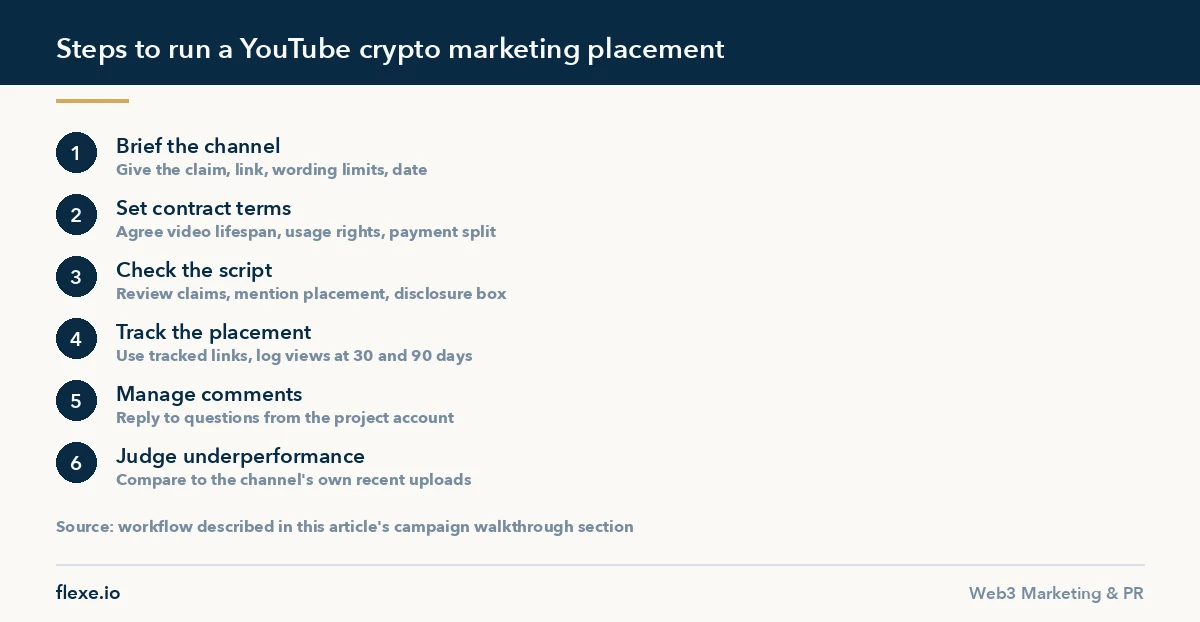
The brief a channel needs differs from the one a Telegram admin needs, because someone has to write a script from it. Send the single claim the video should carry, a working link so the creator can film the product rather than describe it, the wording you cannot have said, and the date window. Everything past that is the creator’s job and the reason the audience listens at all.
Send the assets with the brief rather than after it. Logo files, a short product walkthrough the creator can record over, the correct spelling of every name, and the tracked link. Channels script in batches, and a brief that arrives complete gets scheduled into the next batch while one missing an asset waits for the batch after that.
Ask for the script or the talking points before filming, not after. A correction to a line in a document costs nothing; the same correction once the video is cut means a reshoot, and most channels will refuse. Read the draft for factual accuracy and for anything that reads as a price forecast, then return it quickly, because a channel holding a slot for your approval will give that slot to someone else.
YouTube crypto marketing contracts and payment
Write down what happens to the video after publication. A YouTube crypto marketing placement is bought partly for its life after the invoice, so the agreement should state how long the video stays public, that it will not be made private or unlisted, that the description link stays in place, and who to contact when any of that changes. A video quietly delisted six weeks later removes most of what you paid for.
Settle usage rights at the same time. If you commissioned a dedicated video, agree in writing whether you may reupload it on your own channels, cut clips from it, embed it on your site, or run it as an advert, since this is the one creator format that can become your own asset. Agree the payment split too, with part held until the video is live and the description and pinned comment match the brief.
What to check in the script
Check where the mention sits. An integration placed after the point where most viewers have left is technically delivered and practically worthless, so agree the position in the video and not only its length, then confirm it in the published cut. For a dedicated video, check that the product is shown working rather than narrated over stock footage.
Check the claims again in the published version. Channels edit after approval, and a figure that was correct in the script sometimes arrives rounded up on screen. Watch the whole thing on the day it goes out, because a correction requested within hours is usually handled with an edited description or a pinned note, while one requested a week later is not.
Check the disclosure. The paid promotion box, a spoken line, or both, depending on the market the audience sits in. Disclosure is a regulatory requirement in most markets and costs the campaign nothing, while an undisclosed placement that surfaces later becomes a problem for the project rather than for the channel.
Tracking a video placement
Give every placement its own tracked link and put it in the description as well as the pinned comment, since the two collect different people. Ask the channel for its own analytics screenshot at the agreed reporting points rather than a view count typed into an email, because retention and traffic sources tell you whether the audience stayed for the part you paid for.
Log the numbers at the moments you agreed rather than continuously. Views at 30 and 90 days, arrivals from the tracked link over the same windows, whatever second measure you chose, and the price paid, all recorded in one row. A handful of placements logged this way turns the next negotiation into a comparison rather than a guess.
Pick the second measure before the video goes out. Views are the number the channel controls; arrivals in your community channel, or sign-ups from the tracked link, are the ones that tell you whether the audience acted. Agreeing it afterwards produces an argument about which number counts.
Handling comments after publication
Comments are where the placement converts or leaks. Put someone from the project under the video for the first days, answering questions from the project account rather than an anonymous one, and have them treat the sceptical questions properly instead of deleting them. The thread stays attached to the video for as long as the video keeps surfacing, which on this format is months.
Do not ask the channel to remove critical comments. The audience notices and the channel resents it, and the question that was deleted reappears somewhere you cannot answer it. A direct reply from the project under a hostile comment is read by everyone who arrives later, and on a video that keeps accumulating views, later is most of the audience.
When a video underperforms
Judge it against the channel’s own recent uploads rather than against the proposal. A placement that lands near the channel’s normal view count did what it could, and the problem is in the selection or the message. A placement far below that channel’s own average usually means the video went out without the usual title and thumbnail treatment, which is worth raising before anything else.
If the numbers are low at the first checkpoint, wait for the second before acting. Views accumulate through search and recommendations for months, and the first report is expected to look unimpressive. Cancel the rest of a series only if retention, rather than the view count, shows the audience left before the mention arrived.
If the channel stops answering after payment, escalate once in writing with the agreed deliverables listed, then stop. Chasing costs more than the placement, and the useful output is a note in your own records. The same note prevents the next person in the project booking that channel again on the strength of its subscriber figure.
Mistakes that cost the campaign
Booking on subscriber count is the most expensive habit. The proposal leads with it, and a channel with 400,000 subscribers averaging 6,000 views on recent uploads is trading on history. Divide recent views by subscribers before any conversation about price, and treat that result as the opening number rather than the one in the deck.
Buying a dedicated video for a message that is a name and a date wastes the format. With nothing to explain, a whole video about a token reads as an advert and underperforms the channel average, which then gets recorded as the channel’s failure rather than a format error.
Booking a channel that has run several token promotions in the same month wastes the placement, because the audience has already discounted the format before your video starts. Read the last month of uploads before booking rather than the subscriber graph, and ask what else is scheduled in the weeks around your slot.
Reporting the campaign at seven days ends good campaigns early. The comparison against Telegram at that moment always favours Telegram and is always the wrong comparison, and a project that cancels the remaining placements on the strength of it pays for the slowest part of the format without collecting the part that arrives later.
Planning the second placement
Treat a single video as a test rather than a campaign, which is the shape the BitYard placement took before anything larger was committed. What a first placement buys, beyond its own views, is a read on whether this audience asks the questions your product answers. Keep the comment threads, because they are the material for the next brief.
If the read is good, book the same channel again rather than a larger one. Repetition on a channel an audience trusts does more than a single appearance on a bigger one, and the second video can assume what the first explained. Space them far enough apart that the audience is not watching the same promotion twice in a fortnight.
Sequence the rest of the plan around the slow reporting window. A YouTube placement booked at the same time as a Telegram push will be judged next to it, so either separate them or agree the reporting windows separately at the start. The decision that matters is made when the plan is written, not when the first report lands.
Keep the record between campaigns as well. Recent views against subscribers at the time of booking, the price, the retention shape, and what the comments asked: a file like that turns the third booking into a decision rather than a negotiation, and it survives the person who ran the first two.
Frequently asked questions
How much of a YouTube campaign lands in the first week?
A minority of it. Videos continue accumulating views through search and recommendations for months, which is why the reporting window should be 30 and 90 days rather than seven.
Is subscriber count worth anything?
Only as a denominator. The useful figure is recent views divided by subscribers, which exposes channels whose audience stopped watching some time ago.
Dedicated video or integration for a token launch?
Integration, in most cases. A launch message is a name and a date, which does not need a whole video, and a dedicated video about a token with nothing to explain tends to read as an advert.
Does a placement need to be disclosed?
Yes. Disclosure is a regulatory requirement in most markets, and undisclosed promotion that is later discovered damages the project more than the channel, since the project is the party with something to sell.
Where to go next
For how YouTube compares against Telegram and X as a placement unit, see crypto influencer channels compared. For the current service, see YouTube crypto influencers.
Planning a YouTube campaign? Send the brief on Telegram at https://t.me/flexe_io_agency and we will come back with a vetted channel shortlist and verification scores within 24 hours.
Nothing here is financial advice.