Checked on 7 September 2026. 106 crypto mini apps and bots inside Telegram, every link opened and confirmed live on that date. Ranked by monthly active users with the 30 day change beside each one, because an app that had two million users last year and eighty thousand now is not the product you are being sold.
Counts come from the user numbers Telegram itself reports. Nothing is ranked by total installs or all time downloads, which is the number every promoted list uses and the only one that never goes down.
What the numbers say about the four segments
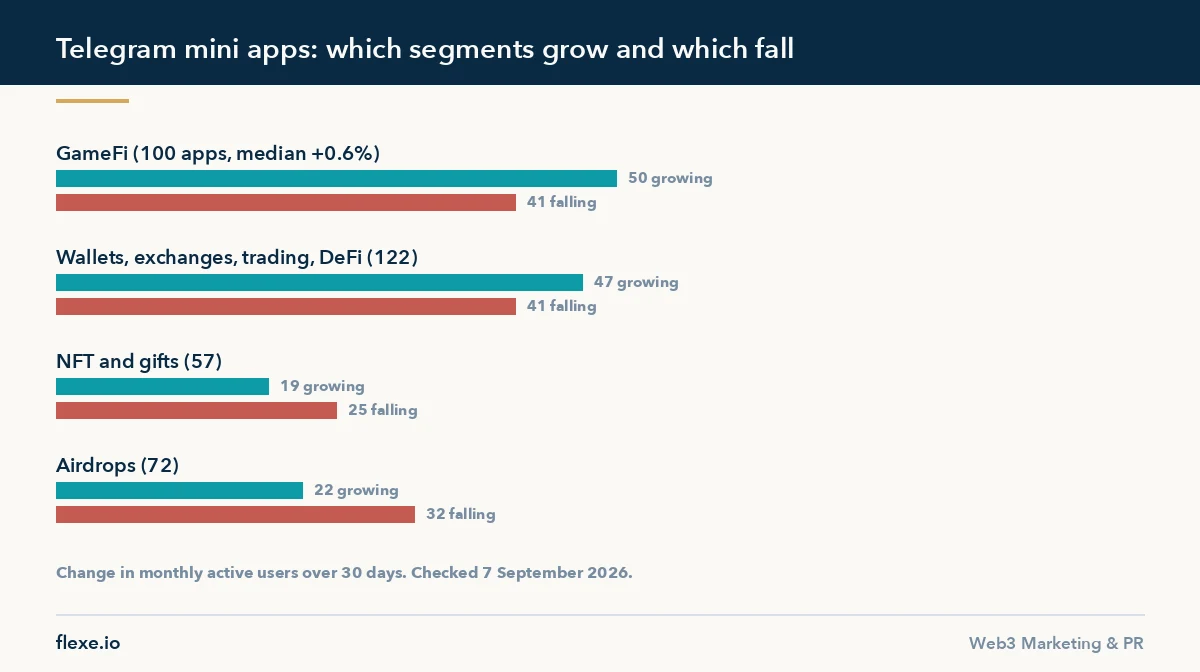
The common view is that Telegram tap to earn games are dead and the useful tools are what survived. We measured it, and over the last thirty days that is not what the data shows.
| Segment | Apps | Growing | Falling | Median 30d |
|---|---|---|---|---|
| GameFi | 100 | 50 | 41 | +0.6% |
| Wallets, exchanges, trading, DeFi | 122 | 47 | 41 | 0% |
| NFT and gifts | 57 | 19 | 25 | 0% |
| Airdrops | 72 | 22 | 32 | 0% |
GameFi is the only segment with a positive median and more apps growing than shrinking. The ones in trouble are airdrops and NFT gifts, where roughly three fall for every two that grow. What died is a specific cohort, not the category: Major is down 63% over thirty days, ClawQuest down 51%, PrizeBox down 36%, while the current wave adds users at a rate the 2024 winners no longer reach. VIRUS BOT is up 394%, PixelTap 341%, TikTak 300%, Wen Lambo 196%.
For campaign planning that matters more than the segment label. Placement in a name that peaked eighteen months ago costs the same as placement in something still compounding, and the public follower count will not tell you which is which.
If you run a project here, not just research one: If you are shipping a mini app, distribution inside Telegram is the whole game. We buy that placement: ads inside the app ecosystem and the channels that drive installs. Telegram mini app ads.
All 106 verified crypto mini apps by monthly users
One table, ranked by monthly active users, with category and thirty day change. Fifty are wallets and payment apps, twenty two are trading terminals and market data tools, sixteen handle swaps, fifteen cover staking and yield, three are prediction markets.
| # | Mini app | Category | Monthly users | 30d change |
|---|---|---|---|---|
| 1 | Crypto Bot | Wallet | 1.4M | -6.2% |
| 2 | xRocket | Wallet | 512.3K | +7.8% |
| 3 | AlfaBit | Wallet | 308.4K | +6.4% |
| 4 | Pump.fun VolumeBot | Trading | 266.7K | no data |
| 5 | Pump.fun Booster Bot | Trading | 178.6K | +37% |
| 6 | Antarctic Wallet | Wallet | 172.7K | +20% |
| 7 | Canlı Borsa Botu | Trading | 152.3K | +23% |
| 8 | Tonnel Relayer Bot | DeFi | 138.7K | -8.2% |
| 9 | Lucidai | Trading | 125.6K | 0% |
| 10 | METATRONICS | Trading | 101.7K | +57% |
| 11 | TickBit | Trading | 96.3K | -28% |
| 12 | DC Next Bot | Wallet | 88.2K | -1.5% |
| 13 | Tonkeeper wallet nft gifts bonus market | Wallet | 86.5K | 0% |
| 14 | FactualAI | Trading | 86K | 0% |
| 15 | Altyn Wallet Bot | Wallet | 79.7K | +3.4% |
| 16 | Veri Terminali | Trading | 75.8K | +15% |
| 17 | Zarub | Wallet | 73.7K | -1.9% |
| 18 | VIBE | Prediction | 73.6K | 0% |
| 19 | xprediction | Prediction | 71.4K | 0% |
| 20 | Rick | Trading | 71.2K | +15% |
| 21 | Getgems: Buy and Sell Gifts | Exchange | 70.9K | -12% |
| 22 | iMe Wallet | Wallet | 69.9K | +0.5% |
| 23 | ValoraX AI | Wallet | 68.8K | 0% |
| 24 | Tinlake | Wallet | 62.4K | -33% |
| 25 | QuantumGround AI | DeFi | 60.7K | 0% |
| 26 | Sentra Claus | Trading | 52.6K | 0% |
| 27 | Bitget Wallet Lite | Wallet | 42.2K | +19% |
| 28 | W Wallet | Wallet | 41.1K | 0% |
| 29 | CT Pool | DeFi | 40.9K | +6.2% |
| 30 | Apes Club | DeFi | 40.6K | -53% |
| 31 | XPocket | Wallet | 38.8K | +63% |
| 32 | Bitget-Buy Crypto&Bitcoin | Exchange | 38.3K | +28% |
| 33 | Pi NetWork | Wallet | 37.8K | 0% |
| 34 | Spell Wallet | Wallet | 35.7K | -2.9% |
| 35 | Bitlock Wallet | Wallet | 34.6K | -1.6% |
| 36 | Tonkeeper | Wallet | 34.2K | +0.6% |
| 37 | Karta – Crypto card & wallet | Wallet | 33.5K | +10% |
| 38 | Pulse Market | Exchange | 33.1K | 0% |
| 39 | Prosto Exchange | Wallet | 32.8K | +120% |
| 40 | Vertus | Wallet | 32.5K | +102% |
| 41 | Cwallet | Wallet | 32.4K | +4.1% |
| 42 | Via Wallet Stars | Wallet | 32K | 0% |
| 43 | Yohi | Trading | 31.2K | +15% |
| 44 | DuckChain | DeFi | 30.5K | -4.8% |
| 45 | Mpay | Wallet | 29.4K | +12% |
| 46 | Rapira | Wallet | 28.9K | +6.9% |
| 47 | XDAO | Wallet | 27.3K | -70% |
| 48 | Vecno | DeFi | 25.5K | 0% |
| 49 | UXUY Wallet | Wallet | 25K | +6.5% |
| 50 | Pirate Network | DeFi | 23.8K | -58% |
| 51 | iCryptoCheck | Wallet | 23.6K | no data |
| 52 | Bnb Forge | DeFi | 22.4K | +51% |
| 53 | TONxDAO | DeFi | 22.4K | -51% |
| 54 | pgon | Wallet | 22K | -30% |
| 55 | GOATS | DeFi | 21.9K | +8.6% |
| 56 | FKwallet | Wallet | 21.6K | +6.5% |
| 57 | To’lovchi | Wallet | 21.1K | +8.0% |
| 58 | HelperStars & Premium | Exchange | 20.7K | +4.0% |
| 59 | Gift Satellite Bot | Trading | 20.6K | +3.3% |
| 60 | Upscale | Trading | 19.1K | +4.9% |
| 61 | Cwallet Bot | Wallet | 18.8K | +11% |
| 62 | Blum Trading Bot | Wallet | 18.6K | -5.3% |
| 63 | Bybit City | Exchange | 18.2K | no data |
| 64 | Slide.fun | Trading | 18.1K | -52% |
| 65 | Athletix | Prediction | 17.8K | +51% |
| 66 | OKX Wallet | Wallet | 17.3K | +9.8% |
| 67 | LiteBits Faucet | Wallet | 16.6K | +32% |
| 68 | Citro Wallet | Wallet | 16.4K | -29% |
| 69 | Lovely Legends | Exchange | 16.3K | +18% |
| 70 | Plata Pay | Wallet | 15.4K | 0% |
| 71 | XRPOP | DeFi | 15.3K | 0% |
| 72 | ByDex.net – Visa bank / USDT / BTC / RUB | Wallet | 14.5K | +17% |
| 73 | MaxSwap Crypto Wallet | Wallet | 14.3K | +1.3% |
| 74 | My Pintopay | Wallet | 13.7K | -24% |
| 75 | CinCin Exchange | Wallet | 13.6K | -8.4% |
| 76 | StarStake | DeFi | 13.6K | -78% |
| 77 | Capybobo | DeFi | 13.4K | -5.7% |
| 78 | Mosca | Exchange | 13.3K | -10% |
| 79 | RollerCoaster | Trading | 13.2K | 0% |
| 80 | TonTrader | Trading | 13.2K | no data |
| 81 | ZAVOD | Wallet | 13K | -30% |
| 82 | Drops Bot | Wallet | 12.9K | -7.6% |
| 83 | Gifting | Exchange | 12.9K | +24% |
| 84 | My Wallet App | Wallet | 12.7K | +15% |
| 85 | Ex24.pro Currency Exchange Official | Exchange | 12.6K | +11% |
| 86 | NC Wallet | Wallet | 12.5K | no data |
| 87 | SwapWallet | Wallet | 12.5K | -24% |
| 88 | ” TOKEN ᴘʀɪᴄᴇ | Exchange | 12.2K | no data |
| 89 | xKuCoin | Exchange | 12.1K | -2.9% |
| 90 | Coin Bot | Exchange | 12K | -15% |
| 91 | EXFM FINANCE | Exchange | 11.9K | no data |
| 92 | CoinTrendzBot | Trading | 11.6K | +5.1% |
| 93 | Keko Memepad | DeFi | 11.6K | 0% |
| 94 | Crypto Office | Wallet | 11.5K | -3.3% |
| 95 | @SOLTRENDING Official | Trading | 11.4K | -76% |
| 96 | Cornix Trading Bot | Trading | 11.2K | +1.0% |
| 97 | Sigma Σ | Wallet | 11.1K | -14% |
| 98 | Whiskra Trade Bot | Trading | 11.1K | 0% |
| 99 | Fast Ton Trade Bot | Exchange | 10.6K | 0% |
| 100 | BIT App | Exchange | 10.5K | +0.8% |
| 101 | Crypto880 | Trading | 10.2K | 0% |
| 102 | LamboSwapi Trading Bot | Wallet | 10.1K | no data |
| 103 | Vault Miner | DeFi | 6.5K | -41% |
| 104 | Walletium | Wallet | 3.3K | -6.7% |
| 105 | MyStars.tg Up to 40% cheaper | Exchange | 2.8K | +52% |
| 106 | vfxAlert_Bot | Trading | 646 | +2.2% |
What monthly users do and do not tell you
Monthly active users is the only figure Telegram shows publicly for a mini app, which is why every ranking uses it. It counts accounts that opened the app at least once in the period. It does not show how long they stayed, whether they came back the next day or whether they connected a wallet, so two apps with the same monthly figure can have completely different audiences.
The 30 day change beside each app matters more than its position. A large app losing users every month is spending its audience, while a smaller app that keeps growing without a token event is usually the healthier place to reach people. Sudden jumps tend to follow airdrop announcements or task campaigns, and they reverse once the reward is paid.
The change also needs context. A drop after a seasonal event is normal for games, while a steady decline over several months in a wallet or exchange app usually means users found a better alternative.
Bots are the other distortion. Tap to earn and task apps attract automated accounts because rewards are paid per action, and the public counter does not separate them from people. An app with a very large user count and very little activity in its own channel or chat is worth a closer look before you pay to appear in it.
Retention inside the app is invisible from outside as well. An app can keep a stable monthly figure while replacing most of its users through new campaigns, and that churn is exactly what a promotion buyer pays for without seeing it. The only way to estimate it from outside is to watch the app’s own channel over several weeks and compare its activity with the user count.
Geography is missing too. Telegram does not publish where an app’s users are, and many of the largest apps draw most of their audience from a small group of countries. If your product is not available in those regions, a large user count is not a large audience for you, so ask the app for a country breakdown before buying.
For a project deciding where to spend, the useful comparison is not users but cost per real action: a wallet connection, a deposit or a completed quest that you can verify on your side. Ask the app for past campaign results measured that way, and run a small test before committing a full budget.
How projects buy exposure inside mini apps
Most large mini apps sell promotion in a few standard ways. Task placements pay users a reward for completing an action, such as joining a channel or following an account. Banner and feed placements show a project inside the app without a reward. Some apps also run partnership campaigns, where a project’s quest becomes a featured event for a set period.
Task placements produce the biggest numbers and the weakest audience. People complete tasks for the reward, and many leave the channel or unfollow the account once it is paid. They are useful when a project needs a visible community quickly, for example before a listing, and poor when the goal is users who stay.
Unrewarded placements deliver fewer actions but more intent, because the people who click chose to. They are harder to buy at scale and are usually priced per view or per period. Partnership campaigns sit in between, and their value depends on how closely the host app’s audience matches the project.
Referral mechanics are a separate category. Some apps let a project add a referral reward on top of the task, so that users who invite friends earn more. This multiplies reach and multiplies bots at the same rate, because automated accounts invite each other, so cap referral rewards and verify each invited account before paying out.
Whatever the format, agree the tracking before the campaign starts. Give every placement its own link or referral code, decide which action counts, and compare retention a week later rather than only on the day. Apps that cannot provide per-placement data leave you paying for a total you cannot audit.
Pricing models you will be quoted
Mini apps price promotion per completed task, per thousand views or as a flat fee for a featured slot over a period. Per task pricing looks efficient because you pay only for actions, but the action is often the cheapest one available, such as joining a channel. Per view pricing suits unrewarded banners, where the question is how many of those views come from people rather than automated accounts. Flat fees are the hardest to compare, so ask for the views and actions the same slot delivered in its last few campaigns before accepting one.
What to ask before signing
Ask for the audience split by country and device, the share of users active in the last seven days rather than the month, the results of recent campaigns in the same segment and how the app filters automated accounts. Ask as well whether your placement will run next to direct competitors and whether rewards are paid by the app or by you. An app that answers these in writing is usually a safer buy than a larger one that sends only a media kit.
Mistakes to avoid when choosing a mini app
The most common mistake is buying the largest app by monthly users without checking its trend. An app that peaked during a token event and has been shrinking since can still show a large number while delivering a fraction of the audience it once had.
The next is mixing up segments. A gaming audience that taps for rewards behaves differently from wallet or exchange users, and a DeFi project advertising in a tap game often pays for impressions that never convert. The segment breakdown at the top of this page exists for exactly that reason.
Skipping a direct check is just as costly. Open the app, complete a task yourself and look at what a user actually sees, including how your placement would appear next to competitors. Read the app’s own channel for recent activity and for complaints about unpaid rewards, which usually come before a collapse in users.
Trusting screenshots is another. Dashboards shared in sales conversations can be edited or taken on an unusually good day, so ask to see the app’s analytics live during a call, or for exports covering several weeks.
Finally, avoid long commitments with a single app. Mini app audiences move quickly, and a monthly test across several apps from different segments gives better data than a quarter booked with one.
How to run a campaign inside a mini app
Start with a small test in two apps from different segments, with the same offer and the same tracking. Run it long enough to see what happens after the reward is paid, usually a week, and compare the share of users who are still active or still in your channel.
Write the brief as if the app’s users know nothing about the project. Mini app placements are seen for seconds, so the task or banner needs one clear action and one reason to take it. Links to a long announcement or a whitepaper lose most people at the first step.
Keep the creative consistent across apps during a test. If the banner, the task wording and the landing screen all change at once, you cannot tell whether the app or the message made the difference.
Plan the follow up before the test starts. Users who complete a task are easiest to reach again in the first days, so prepare the next step, such as a second quest or a short onboarding message, rather than leaving them in a quiet channel.
Reading the results
Compare each placement on the same numbers: the cost per verified action, the share of those users still active a week later and the share who did something you did not pay for, such as opening your own app or joining a second channel. The last figure is the clearest sign of real interest, because nobody was rewarded for it. A placement that is cheap on the first number and weak on the others bought you a count, not an audience.
When to stop
Stop a placement when retention a week after the reward stays well below what your other channels deliver, when the app cannot provide per-placement data, or when complaints about unpaid rewards appear in its channel. Pause rather than cancel when results are mixed: mini app audiences shift quickly, and a format that underperformed during one airdrop season can work in the next.
Scale only what held up. Move budget into the app and format that produced users who stayed, keep the tracking unchanged so the numbers stay comparable, and repeat the check each month, because positions on this list change as quickly as the apps themselves.
How this was checked
Every entry was opened on its public Telegram page on 7 September 2026 and confirmed on Telegram to resolve to a live bot or mini app. All 106 passed. Twenty one carry a different name inside Telegram than the directory shows, and the Telegram name is what is printed here, because that is what you see when you open the link.
Monthly users and the thirty day change are read from the figures Telegram publishes, surfaced through the FindMini TMA sensor and its bots sensor. Where an app shows no data it launched too recently for a thirty day comparison. Gambling and lottery entries were removed, as were records the directory had broken.
This is part of ongoing research based on 150+ crypto marketing campaigns. Our company Flexe.io has worked since 2018 with over 800 clients, including Telegram mini app advertising and Telegram KOL placement. The companion directory of 332 crypto Telegram channels and chats ranks channels by median views rather than subscribers.
Frequently asked questions
How many crypto mini apps are there on Telegram?
The Crypto and Web3 directory lists 397 mini apps. After removing gambling entries and records where the link was broken, 106 utility apps were confirmed live on 7 September 2026. They break down into fifty wallets, twenty two trading terminals, sixteen swap tools, fifteen staking apps and three prediction markets.
Are Telegram tap to earn games dead in 2026?
No, and the data says the opposite of the common view. Over thirty days fifty of one hundred GameFi apps grew and forty one shrank, a median of plus 0.6 percent, better than wallets and trading tools at flat zero. What collapsed is the 2024 cohort: Major fell 63 percent and ClawQuest 51 percent.
Which segment is losing users fastest?
Airdrop apps are worst, with thirty two of seventy two shrinking against twenty two growing. NFT gift apps follow at twenty five falling against nineteen growing. Both are in worse shape than GameFi and worse than utility apps, which reverses what most Telegram marketing advice assumes about airdrops for user acquisition.
What is the largest crypto mini app on Telegram?
Crypto Bot, a combined wallet and exchange, at 1.4 million monthly users, though down 6.2 percent over thirty days. Second is xRocket at 512 thousand and up 7.8 percent, third AlfaBit at 308 thousand and up 6.4 percent. The top three carry most of the audience and the tail below fifty thousand is thin.
How were the numbers verified?
Every entry was opened on its public Telegram page on 7 September 2026 and confirmed to resolve to a live bot. All 106 passed, none dead. Counts come from figures Telegram itself publishes, not installs or all time downloads, the number promoted lists prefer because it never goes down. Twenty one apps carry a different name inside Telegram.