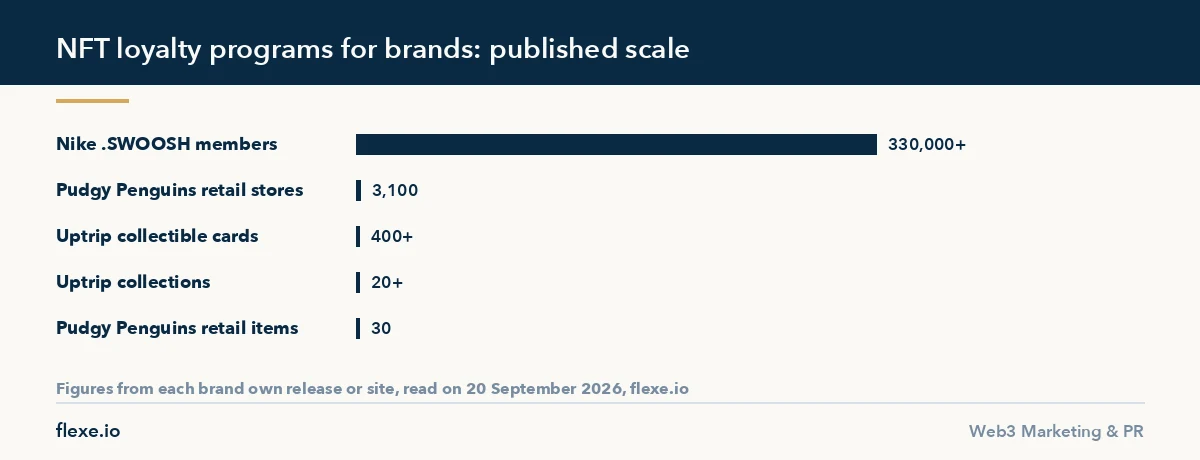
NFT loyalty programs for brands are membership schemes where the proof of membership is an NFT the customer owns, and the reward is access, status or a physical product rather than cash. Five programs checked on 20 September 2026 show the range: Nike .SWOOSH (330,000+ members, boxes at $19.82), Pudgy Penguins (toys in 3,100 Walmart stores with a code inside), Lufthansa Uptrip (400+ cards, up to EUR 3,000 of rewards per user), Reddit Collectible Avatars (shop closed 11 November 2025) and Starbucks Odyssey (beta closed 31 March 2024).
What an NFT loyalty program is
It is a loyalty system built on a blockchain, where rewards are tokens, NFTs, or on-chain points that users own and can often use across experiences, unlike closed traditional points. The record sits in the customer’s wallet, not only in the brand’s database, so it survives an account closure.
On-chain rewards are transparent, portable, composable, and programmable, which can deepen engagement and turn customers into a community with a real stake in the brand. The case against: two of the five programs above were closed by the brands that ran them. Web3 loyalty replaces points with tokens or NFTs users truly own, but ownership alone retains nobody. Five properties separate a programme that holds from a subsidy:
- The reward is access, not value. Points redeemable for money attract farmers. Points that open something unavailable at any price attract members.
- Status is visible. A tier nobody else can see does not change behaviour. On-chain badges work because they are public.
- Earning requires doing the thing you want repeated. Programmes that reward logging in produce logins and nothing else.
- The economics survive the exit. If usage goes to zero when rewards stop, you built a subsidy, not a programme.
- Compliance and clear value come before speculative upside. A reward priced as an investment is a different product with a different regulator.
NFT loyalty programs for brands: five programs checked in September 2026
1. Nike .SWOOSH (sportswear, live)
Nike built .SWOOSH as a members platform for virtual creations, not a points scheme. Its first collection, Our Force 1, came in two digital boxes, Classic Remix and New Wave, each at $19.82 USD, the year the Air Force 1 launched. Nike’s release put the community at more than 330,000 members, with early access on 8 May and general access on 10 May. Source: Nike newsroom.
- What members got: a virtual Air Force 1, a downloadable 3D file, and a claim on the physical products Nike said would follow.
- Entry price: $19.82 per box.
- Best for: brands whose customers already create and share.
- Watch out: a paid entry ticket filters out the casual customers a loyalty scheme exists to keep.
2. Pudgy Penguins (toys and retail, live)
Pudgy Penguins reverses the model: the toy is the entry point and the digital reward comes free with it. Pudgy Toys reached 2,000 Walmart stores in September 2023 and expanded to 3,100 U.S. Walmart stores in February 2024 with 30 exclusive items, 5 collectible figurines and 25 Lil Pudgys mystery igloos, priced from $2.99 to $11.97. Source: Pudgy Penguins press release.
- What members got: a QR code on every box that opens traits, outfits, accessories and backgrounds in Pudgy World, plus a rare trait for whoever finds a golden ticket.
- Entry price: $2.99 to $11.97 at a supermarket till.
- Best for: consumer brands with shelf space, where the code on the box is the cheapest wallet onboarding available.
- Watch out: the digital layer still has to survive without the retail push.
3. Lufthansa Uptrip (airline, live)
Uptrip bolts NFT rewards onto an existing scheme rather than replacing it. Passengers of Lufthansa Group carriers, including Austrian Airlines, Brussels Airlines, Swiss, Eurowings and ITA Airways, scan a boarding pass after each flight and pick two cards. There are 400+ cards covering cities, aircraft types and flight conditions, and 20+ collections such as Lufthansa Fan and Travel the World. Cards are minted on Polygon, powered by Miles & More. Source: Uptrip.
- What members got: completed collections redeemed for 2,000 award miles, wifi on continental and intercontinental flights, business lounge vouchers and Frequent Traveller or Senator status, up to EUR 3,000 per user.
- Entry price: free, earned by flying.
- Best for: brands with an existing tier scheme and a repeat transaction.
- Watch out: the miles do the retaining here, and the card layer has to justify its own cost.
4. Reddit Collectible Avatars (social platform, wound down)
Reddit ran the widest consumer NFT programme by wallet count, then closed the shop. Artists designed limited-edition avatars based on Snoo and earned 80 percent of primary sales and 50 percent of resale royalties. Reddit closed the Avatar Shop on 11 November 2025 and set 1 January 2026 as the Vault export deadline. Falling sales volumes were the stated backdrop. Source: Crypto Briefing.
- What members got: an avatar and a wallet they did not have to set up; avatars still work, but profile Collection Display and on-platform transfers are gone.
- Creators now get: 100 percent of secondary sale fees.
- Worth copying: onboarding with no seed phrase, no gas, no crypto vocabulary.
- Honest read: reach was never the problem. Repeat purchase was.
5. Starbucks Odyssey (coffee retail, closed)
Odyssey layered NFT stamps on top of Starbucks Rewards. Members played coffee-themed games and completed journeys to earn or buy stamps, which gave access to benefits and events. Starbucks closed the beta on 31 March 2024 and the Discord on 19 March 2024, saying the programme had to end to prepare for what comes next. Stamps stayed on Nifty Gateway. The warning came earlier: the First Store Collection, at $100 per token in April 2023, failed to sell out. Source: The Block.
| Programme | Mechanic | What members actually got | Status on 20 September 2026 |
|---|---|---|---|
| Nike .SWOOSH | Paid digital collection, 330,000+ members | Virtual AF1, 3D file, claim on physical drops | Live |
| Pudgy Penguins | Retail toy with a QR code, 3,100 Walmart stores | In-game traits, outfits, backgrounds, golden ticket | Live |
| Lufthansa Uptrip | Card collecting on flights, 400+ cards | 2,000 award miles, lounge and wifi vouchers, status | Live |
| Reddit Collectible Avatars | Free and paid avatars, artist royalties | Platform avatar, resale market | Shop closed 11 November 2025 |
| Starbucks Odyssey | Stamps earned through journeys and games | Event access, tradable stamps on Nifty Gateway | Beta closed 31 March 2024 |
How the mechanics work: tiers, chains, staking and referrals
Designing one is four decisions in order. Name the behaviour you want repeated. Choose the mechanic that matches that behaviour rather than the fashionable one. Assume the reward will be farmed and price it accordingly, because poor tokenomics attract mercenary users. Keep it compliant and genuinely useful, because the programme has to pay back in retention and community, not only acquisition.
Variable tiers people can see
Variable tiers change the kind of reward with the level, not just the discount size. Uptrip is the working pattern: one card is worth little, a completed collection converts into miles, a lounge voucher or Frequent Traveller status, and the top of the ladder reaches EUR 3,000. Tiers hold attention because the next rung is visible and countable, and an on-chain tier is public.
Points across several chains
Multi-chain points suit brands whose fans hold assets in more than one place. Both Uptrip and Reddit chose Polygon for the same reason: low fees and a wallet flow a non-crypto customer can finish. A multi-chain balance is normally kept off-chain and settled on-chain at claim, so the customer never thinks about the network. Every extra chain is another indexer, contract set and support queue, so add one only when a measurable share of the audience is already there.
Staking a membership NFT for rewards
Staking in a brand programme means locking the membership NFT for a period in exchange for points, a higher tier or first access to a drop. It is a commitment device, not a yield product, and that difference matters to a regulator. Reward the lock with access nobody can buy and staking reads as a loyalty tier. Reward it with a token price and it reads as an investment contract.
Referral mechanics
Referral works best when the referred person gets the better half. On-chain referral is easy to verify, because the claim transaction records who introduced whom, and that is also why it gets farmed. Cap the payout per wallet, pay on a completed purchase rather than a signup, and treat any wallet cluster funded from one source as one participant. Quest platforms handle most of this, and we compared the main ones in our guide to crypto quest platforms.
| Mechanic | What it does | Best for |
|---|---|---|
| NFT membership pass | Opens perks and gated access, transferable | Communities where membership itself is the product |
| Token rewards for engagement | Pays out for measurable actions | Programmes with a clear behaviour to reinforce |
| On-chain points | Carry across experiences and partners | Brands blending Web3 with an existing loyalty scheme |
| Variable tiers | Changes the kind of reward, not only its size | Schemes with a long customer lifetime, such as travel |
| Staking a membership NFT | Locks the pass for access or a higher tier | Programmes that need commitment, not traffic |
| Referral claims | Records who introduced whom, on-chain | Growth phases with a hard cap per wallet |
Web3 loyalty versus traditional points
Traditional points are closed, opaque, and expire, while Web3 rewards are owned, transparent, and often portable. The trade-off is added complexity and the need for careful, compliant token design. The five programmes above suggest a middle answer: the ones still running sit on top of an existing scheme or product, and the ones that closed tried to be the scheme.
| Aspect | Traditional | Web3 |
|---|---|---|
| Ownership | Brand-controlled | User-owned |
| Transparency | Opaque | On-chain |
| Portability | Locked in | Often portable |
What it costs to run and who it suits
The contract is the cheap part. The running costs are community, support, artwork and redemption liability. At Flexe.io community management starts at $2,000 a month and a focused single-channel campaign at $4,000; a full-stack launch runs $50K to $500K over three to six months. We have run 800+ campaigns for crypto, Web3 and fintech clients since 2018, and our 2026 community work shows the scale a live programme has to be fed: Fourmeme grew from 35,000 to 47,000 members, Atleta Network from 130,000 to 141,000, Tothemoon from 40,000 to 45,000. Scope and pricing sit on our crypto community management page.
The inconvenient number is ours. Across a first-party benchmark of 150 campaigns the median net ROI was 2.8x within 90 days, with a range of 1.4x to 7.0x and a disclosed failure rate of 12 percent. Roughly one campaign in eight did not return its cost, and a loyalty programme carries more of that risk because it has to be funded after launch too. NFT loyalty programs for brands suit companies with a repeat transaction, an existing membership base and a product worth queueing for. If paid reach is the real gap, paid acquisition is a cheaper test than a loyalty launch.
Risks, compliance and what fails
The failure mode is visible in the closures. Starbucks failed to sell out a $100 collection a year before the beta ended; Reddit closed a shop with enormous distribution because sales volumes fell. In both cases the collectible was asked to carry the programme alone. Tradeable points become a market, and markets attract farmers rather than customers, so non-transferable status usually retains better even though it looks less exciting on a roadmap.
On compliance, a regulator asks whether a buyer could reasonably expect profit from the efforts of others. Non-transferable status, discounts and utility access rarely carry that expectation. Tradeable stamps sold at a fixed price, staking that pays a yield, and marketing that mentions resale value do. Four practical checks belong on the same list:
- Exit plan in writing. Say at launch what happens to the assets if the programme closes. Starbucks moved stamps to Nifty Gateway and Reddit kept avatars usable.
- Custody. A custodial wallet gets ordinary customers through the door, but you then own the keys and the liability.
- Consumer law before securities law. Expiry, pricing and refunds on a paid membership follow ordinary prepaid product rules.
- Documentation. Terms, reward schedules and token mechanics in plain language settle more disputes than they cost, the work we do on whitepapers and documentation.
Related reading: crypto quest platforms compared, how to choose the direction before the channel, and community management pricing and scope. To talk it through, message us on Telegram at https://t.me/flexe_io_agency.
Related reading
Loyalty is one way to keep users; crypto grant programs show how ecosystems fund builders instead. Projects preparing a token sale can compare what four crypto launchpads actually publish. Exchanges looking for formats beyond points can borrow from trading platform marketing that answers real doubts, and teams buying reach will find 14 blockchain ad networks with minimum budgets.
Frequently Asked Questions
What are NFT loyalty programs for brands?
They are membership schemes where proof of membership is an NFT the customer owns, and the reward is access, status or physical goods rather than cash. Lufthansa Uptrip trades completed card collections for rewards worth up to EUR 3,000 per user, and Pudgy Penguins puts a code for in-game traits inside toys sold in 3,100 Walmart stores.
Do Web3 loyalty programmes actually retain users?
Most retain users exactly as long as the rewards last, which is the opposite of loyalty. The ones that hold reward access rather than value, because points redeemable for money attract farmers. Of the five checked on 20 September 2026, the three still running are attached to an existing product or tier scheme.
Which brands have run NFT loyalty programs?
Nike with .SWOOSH, past 330,000 members, selling Our Force 1 boxes at $19.82; Pudgy Penguins with 30 toy items in 3,100 Walmart stores; Lufthansa with Uptrip, 400+ cards on Polygon; Reddit with Collectible Avatars, shop closed 11 November 2025; and Starbucks with Odyssey, beta closed 31 March 2024.
How much does an NFT loyalty program cost to run?
Budget for people, not contracts. Community management at Flexe.io starts at $2,000 a month and a focused single-channel campaign at $4,000, while a full-stack launch runs $50K to $500K over three to six months. Add redemption liability, artwork and support to that.
Are NFT loyalty rewards securities?
Usually not, when the reward is access rather than value. Non-transferable status, discounts and utility access rarely carry the profit expectation regulators look for. The risk sits with points that are tradeable, redeemable for money, or marketed as an investment. Design and jurisdiction decide it, so take legal review before launch rather than after.
Should loyalty points work across several chains?
Only when a measurable share of your audience already holds assets on the second chain. Uptrip and Reddit Collectible Avatars both settled on Polygon alone, for low fees and a wallet flow ordinary customers can finish. Each extra chain adds an indexer, a contract set and a support queue.