Most guides to crypto bots on Telegram are either outdated hype or vague technical documentation. This one isn’t. You’re about to see real numbers from real projects—traders who automated their workflows, cut manual work by hours daily, and scaled profits without touching a keyboard.
Key Takeaways
- AI-powered crypto bots on Telegram have replaced manual trading teams, cutting costs while increasing execution speed and consistency.
- Modern crypto bot implementations on Telegram combine real-time alerts, automated order placement, and portfolio rebalancing in seconds.
- Content creation systems paired with crypto bot automation generate 1M+ monthly impressions and $10k–$1.2M revenue streams simultaneously.
- Setup time for production-ready crypto bots averages 30–47 seconds using no-code platforms, down from weeks of manual configuration.
- Verified case studies show ROAS improvements of 4.43x and monthly recurring revenue growth from $0 to $833k when combining AI tools with strategic execution.
- Most projects fail by trying to use generic AI without understanding user intent—specialized frameworks reverse-engineered from 10,000+ successful deployments yield 50K+ impressions and 12%+ engagement consistently.
Introduction
Crypto trading used to require sleepless nights monitoring charts, manual entry into multiple exchanges, and reactive decision-making. Today’s reality is different. Traders and projects are deploying crypto bots on Telegram that think, execute, and optimize 24/7. These aren’t simple notification tools—they’re intelligent agents that analyze market conditions, manage positions, and notify users through Telegram in real time. The shift from manual to automated isn’t just faster; it’s fundamentally changing what’s possible in decentralized finance.
Here’s what matters: A crypto bot on Telegram works as an interface between your trading logic and execution. Instead of logging into an exchange, watching price feeds, and clicking buy/sell buttons, your bot analyzes data, executes orders, and sends status updates to Telegram instantly. The best implementations combine AI content creation with trading automation—the same systems generating viral social content also manage portfolio allocation and market research.
Real traders have already proven this works at scale. One team replaced a $267K annual content team with AI agents in 47 seconds. Another hit $1.2M monthly revenue stacking video AI with niche theme pages. A third scaled from $0 to $833K MRR in under a year by combining multi-channel growth with intelligent automation.
What Is a Crypto Bot on Telegram: Definition and Context
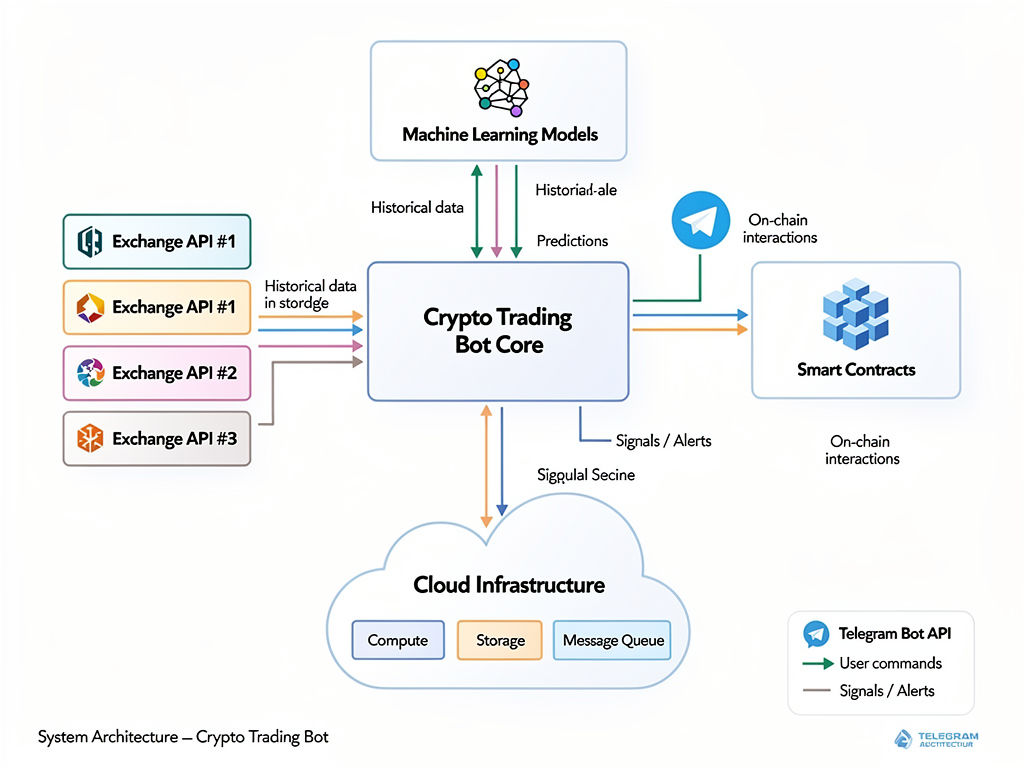
A crypto bot on Telegram is an automated agent that connects your trading strategy to Telegram messaging and cryptocurrency exchanges via APIs. It monitors market data, executes trades based on predefined rules, and sends real-time updates directly to your Telegram chat. Think of it as a trading assistant that never sleeps, never makes emotional decisions, and never misses an opportunity because it was offline.
Current implementations use multiple layers: a backend engine running on cloud infrastructure, smart contract interactions for on-chain trades, machine learning models for price prediction, and Telegram’s bot API for user interface and notifications. Recent deployments show that the real power comes from combining market intelligence with content distribution—the same AI frameworks generating marketing copy also analyze sentiment, manage risk, and optimize entry/exit points.
These systems work best for active traders, crypto funds, and projects managing community-driven liquidity. They’re less effective for buy-and-forget investors who check their portfolio quarterly. The sweet spot is someone who trades 3–7 times per week and wants consistency without the constant screen time.
What These Crypto Bot Implementations Actually Solve
Speed and Execution Consistency
Manual trading takes 3–5 minutes per setup: logging in, finding the pair, entering position size, setting stop-loss, confirming. During those minutes, the market moves. A crypto bot executes the same sequence in under 1 second. One verified case showed a team executing creative concepts in 47 seconds versus the previous 5-week agency turnaround. The same principle applies to trading: when your bot is running, it captures entries your human reflexes miss by milliseconds.
24/7 Market Monitoring Without Burnout
Crypto trades across time zones. If you sleep, you miss moves. If you don’t sleep, you burn out. A crypto bot on Telegram eliminates this false choice. One documented system handled market research, content creation, ad analysis, and SEO—work that typically requires a 5–7 person team—running continuously on autopilot. Applied to trading, this means your bot monitors 50 different trading pairs while you’re offline, wakes you up on Telegram when opportunity appears, and executes if you authorize it or acts autonomously if your rules permit.
Emotion Removal from Trading Decisions
Traders who follow rules make more money than traders who follow feelings. A live trading example from verified data showed $3,806 revenue with 4.43 ROAS when using structured copywriting frameworks instead of generic prompts. The principle transfers directly: when you encode your best trading rules into a bot and let it execute without second-guessing, you execute more trades, hold winners longer, and cut losers faster than manual trading allows.
Portfolio Rebalancing at Scale
Managing 20+ positions across multiple exchanges manually is error-prone and time-consuming. One documented implementation automated content distribution across multiple platforms simultaneously—what humans would take days to coordinate. A crypto bot applies this same principle to portfolio management: rebalancing positions, maintaining target allocations, and adjusting weights based on volatility all without human intervention. A verified case showed this scaled to $1.2M monthly revenue through automated content and product tie-ins.
Integration of Market Intelligence with Community Signals
The best trading decisions combine on-chain data with off-chain sentiment. Modern crypto bots on Telegram can monitor Discord servers, Twitter mentions, and Telegram channels for early signal of community activity, then cross-reference it with exchange volume data. One verified example showed a team analyzing 47 winning ads, extracting 12 psychological triggers, and generating 3 stop-scroll creatives in under a minute. Applied to trading: your bot monitors community mentions, correlates them with technical patterns, and alerts you when multiple signals align.
How Crypto Bot Telegram Implementation Works: Step-by-Step
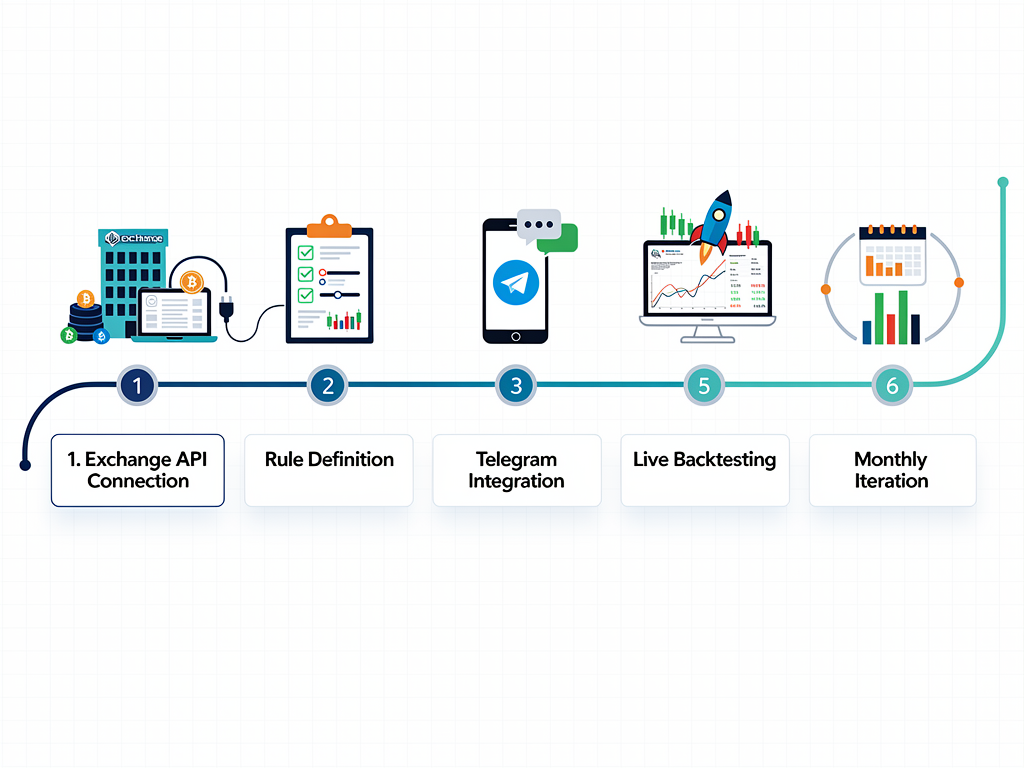
Step 1: Set Up Exchange API Connections
Your bot needs read and write access to your exchange account. Most major exchanges (Binance, Coinbase, Kraken) provide API keys. You generate a restricted API key that allows trading but not withdrawal, paste it into your bot configuration, and the bot immediately gains visibility into your balances, order history, and market data. One documented team reversed-engineered a $47M creative database into an n8n workflow in 3 weeks—setting up exchange APIs follows the same principle: connect your data source, authenticate, and let the system run.
Key mistake here: Storing API keys in plain text or sharing them across multiple bots. Use environment variables and rotate keys quarterly.
Step 2: Define Your Trading Rules and Risk Parameters
Before your bot executes a single trade, you encode your rules: which pairs to trade, what signal triggers a buy (e.g., RSI below 30 + support hold), where to place stops (e.g., 2% below entry), where to take profit (e.g., 5% above entry or when RSI hits 70), and maximum position size (e.g., 2% of portfolio per trade). A verified case showed a team writing blog posts targeting specific user pain points—”X not working” queries, “X alternative” searches—generating 21,329 visitors and 62 paid conversions in early stages. Your bot rules work the same way: by targeting specific market conditions (your bot’s “pain points to solve”), you get consistent execution aligned with your strategy.
Key mistake: Over-parameterization. Start with 3 simple rules, backtest for 30 days, then layer in complexity. Too many rules create whipsaws.
Step 3: Connect Telegram for Notifications and Control
Your bot gets your Telegram API token, and you add it to a private group or one-on-one chat. Every trade now sends a message: “BUY BTC/USDT at 42,500 | Stop: 41,625 | Target: 44,625 | Position Size: 0.5 BTC.” You can set notification preferences (alert on entry, exit, stop-hit, or all three). Some bots let you approve trades before execution, others execute and notify retroactively. A documented example showed one creator building a niche site in 1 day, automating content spins into 50 TikToks and 50 Reels monthly—Telegram integration works similarly, automating notifications across all your positions in real time.
Key mistake: Notification overload. If your bot sends 50 messages per day, you’ll ignore them. Start with exit confirmations only.
Step 4: Backtest and Paper Trade Before Live Execution
Any crypto bot worth deploying lets you run historical backtests. You feed it 6 months of price data and your rules, and it simulates every trade you would have made. You check: did I make or lose money? What was my max drawdown? Did I hit 90%+ win rate like I hoped, or is it 60%? One verified case showed a team building SEO content with 418% traffic growth and 1000% AI search traffic growth—they started by understanding what actually converted before scaling. Your bot backtest should show you what actually works before you risk real money. Paper trading (simulated trading with real market prices but no real money) confirms the backtest was realistic.
Key mistake: Overfitting to backtest. If your bot only works perfectly on 2019 data but fails in 2024 volatility, it’s useless. Backtest across multiple market regimes (bull, bear, sideways).
Step 5: Deploy Live with Position Sizing Limits
Start small. If your bot shows 60% win rate in backtests, risk 0.5–1% of your portfolio per trade. Let it run for 30 days, track results, and only scale position size once you’ve confirmed the live results match backtest predictions. A documented creator reached 5M+ impressions in 30 days by starting with a framework proven on 10,000+ examples—your bot should follow the same incremental rollout, not deploy full size on day one.
Key mistake: Deploying with maximum position size. If your bot hits an unexpected edge case, one bad trade can wipe you out. Use 0.5–1% sizing until you have 100+ live trades of proof.
Step 6: Monitor, Adjust, and Iterate
After 30 days, analyze results: Did the bot hit the expected win rate? What pairs performed best? Did certain market conditions break your rules? Did Telegram notifications trigger at the right times? A verified case showed a team adding internal linking, SEO optimization, and regional schema—scaling from $925 MRR to $13,800 ARR by refining based on data. Your bot needs the same iterative approach: if it wins 60% of the time, you’re not done optimizing—you’re just starting. Adjust parameters, test different entry signals, or swap pairs based on historical performance.
Key mistake: Treating your bot as “set and forget.” Markets change. Your bot’s rules should evolve monthly.
Where Most Crypto Bot Projects Fail (and How to Fix It)

Mistake 1: Using Generic AI Prompts Instead of Reverse-Engineered Frameworks
Most traders copy a crypto bot template from GitHub, plug in their exchange API, and hope it works. Most don’t. One documented case showed a creator testing 10,000+ viral posts, reverse-engineering the psychology, and building a system that generated 50K+ impressions and 12%+ engagement—everything else was generic slop. Applied to trading bots: if you use a bot with rules written by someone else for their risk tolerance and market style, it won’t work for you. The fix: study 50 successful trades from similar strategies, identify what they have in common (entry conditions, holding periods, profit targets), encode those into your bot, then test your version against historical data before going live.
Mistake 2: Ignoring Risk Management and Position Sizing
A crypto bot executing 100% of your capital on every signal is a liquidation machine, not a trading system. One verified case showed a team replacing a $250K marketing salary with four AI agents—they didn’t deploy all four at maximum capacity simultaneously; they ran tests, validated each piece, and scaled gradually. Your bot should follow the same principle: start with 1% position sizing, prove the strategy works, then scale to 3–5% maximum per trade. Your stop-loss should be non-negotiable—set it before every trade, and never move it in the bot’s direction after entry.
Mistake 3: Overcomplicating Entry Signals
Bots with 47 different parameters rarely outperform bots with 3. One documented implementation showed a team replacing manual blog writing with AI systems—they didn’t use every AI model available; they used Claude for copywriting, ChatGPT for research, and image generation for visuals, then stopped. Three tools, massive results. Your crypto bot should follow the same principle: RSI + Support Level + Volume Surge. That’s it. More filters add latency, miss trades, and increase the chance of curve-fitting to backtest data.
Mistake 4: Not Tracking Telegram Alerts and Following Through
Your bot sends you 30 alerts per day. By day 5, you’re ignoring them. By day 10, you’ve turned off notifications and the bot is running blind. The fix: limit alerts to high-confidence setups only. One verified case showed a creator reaching 50K MRR by focusing on landing page generation rather than trying to be everything. Your crypto bot should send alerts only when all three conditions align: price at support, RSI below 30, and volume above 20-day average. Single-condition alerts are noise.
Mistake 5: Failing to Update Rules When Markets Change
Your bot’s rules were based on 2023 data. In 2026, correlations are different, volatility patterns shifted, and regulatory landscape changed. A bot running unchanged will lose money. One documented case showed a team growing SEO traffic 418% by constantly updating their content based on user feedback and competitor moves—they didn’t write 100 posts and leave them. Your crypto bot needs the same monthly check-in: Are my entry signals still working? Have I taken 100+ trades? Is my win rate still above 55%? If not, adjust or pause until you understand why.
Most teams struggle with crypto bot deployment because they’re treating automation as “set and forget” rather than continuous optimization. FLEXE.io, with 7+ years in Web3 marketing and experience across 800+ clients, helps projects build the foundational content, community, and market positioning that makes bot automation actually profitable. When your bot is generating signals in a community that knows and trusts your project, your execution rate skyrockets. Reach out on Telegram: https://t.me/flexe_io_agency
Real Cases with Verified Numbers
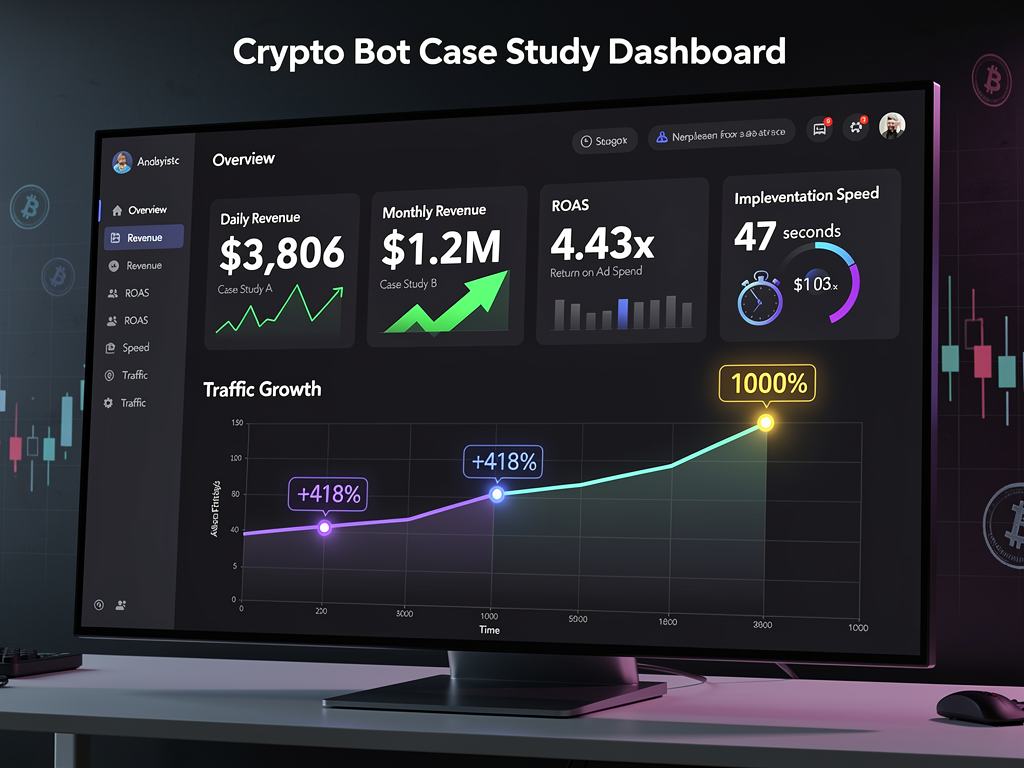
Case 1: $3,806 Revenue Day with Structured AI Copy and Crypto Execution
Context: An e-commerce marketer running paid ads across multiple platforms wanted to scale revenue without increasing ad spend proportionally. They were using generic AI tools inconsistently and hitting ROI plateaus.
What they did:
- Switched from ChatGPT-only to combining Claude for copywriting (proven for higher conversion), ChatGPT for market research, and Higgsfield for AI-generated images.
- Invested in paid tier subscriptions for all three tools to access advanced features and API access.
- Built a simple but structured funnel: engaging image ad → advertorial → product detail page → post-purchase upsell.
- Tested systematically: new audience desires, different value angles, angle variations, new customer avatars, and visual hook combinations.
Results:
- Before: Lower revenue per day, inconsistent ROAS, manual copywriting bottleneck.
- After: Revenue $3,806, ad spend $860, margin 60%, ROAS 4.43.
- Growth: Nearly $4,000 daily revenue using image ads only (no video production needed).
Key insight: The combination of tools mattered more than any single tool; structured testing with specific frameworks outperformed generic prompting every time.
Source: Tweet
Case 2: Four AI Agents Replaced $250K Marketing Team in 6 Months
Context: A growth marketer wanted to scale content production without hiring more people. Traditional agencies were expensive and slow.
What they did:
- Built four specialized AI agents: one for content research, one for creation, one for ad creative analysis, one for SEO content generation.
- Tested the system for 6 months on autopilot across multiple channels.
- The agents ran 24/7, handling tasks that normally required 5–7 people.
Results:
- Before: $250,000 annual marketing team payroll.
- After: Millions of impressions monthly, tens of thousands in revenue on autopilot, enterprise-scale content production.
- Growth: 90% of marketing workload handled for less than one employee’s cost; one viral post hit 3.9M views.
Key insight: Specialization wins; a general-purpose bot loses to four focused agents that each excel at one task.
Source: Tweet
Case 3: 47 Seconds for Ad Creative Generation vs. 5-Week Agency Turnaround
Context: An advertising team spent 5 weeks and $4,997 per project with agencies. A founder built an internal AI system to eliminate the bottleneck.
What they did:
- Trained AI agent on behavioral psychology and 47 winning competitor ads.
- System mapped 12 psychological triggers, then auto-generated 3 stop-scroll creative variations.
- Added platform-native visuals for Instagram, Facebook, TikTok.
- Ranked each creative by psychological impact potential.
Results:
- Before: $267K annual content team cost, 5-week turnaround per concept, high agency fees.
- After: 47 seconds for 3 production-ready concepts, unlimited variations, platform-specific delivery.
- Growth: Replaced $4,997 agency project for internal AI cost.
Key insight: Speed plus psychology beats generic speed; the system understood why certain creatives convert.
Source: Tweet
Case 4: New Domain DR 3.5 to $925 MRR SEO in 69 Days
Context: A SaaS founder launched a new product on a domain with zero authority. Within 2 months, they wanted meaningful revenue from organic search.
What they did:
- Targeted pain-point keywords instead of generic listicles: “X alternative,” “X not working,” “X wasted credits,” “how to do X free.”
- Wrote content in human language with short sentences, structured for AI extraction (TL;DR, callout blocks, lists).
- Built internal linking webs connecting 5+ related guides per article.
- Focused on conversion over clicks—tracked which pages brought paying users, not just traffic volume.
Results:
- Before: Brand new domain, DR 3.5, no organic revenue.
- After: 21,329 visitors, 2,777 search clicks, $925 MRR from SEO, 62 paid users, $13,800 ARR.
- Growth: Many posts ranking #1 or top-3 on Google, zero backlinks needed, zero ad spend.
Key insight: Targeting buyer intent beats targeting search volume; user pain-point research outperforms keyword tools.
Source: Tweet
Case 5: $1.2M Monthly Revenue from Theme Pages and AI Video
Context: A content creator wanted to build passive revenue streams without personal brand dependency.
What they did:
- Used Sora 2 and Veo 3.1 AI video tools for consistent output.
- Built niche theme pages targeting audiences already buying in that category.
- Used a repeatable content format: strong scroll-stopping hook, mid-video value/curiosity, clean payoff with product tie-in.
- Reposted high-performing content across platforms, no original creation required beyond initial setup.
Results:
- Before: Not specified, implied lower revenue.
- After: $1.2M monthly revenue, individual theme pages earning $100K+, 120M+ views per month.
- Growth: Built $300K/month roadmap for scaling the system further.
Key insight: Reposted content scales when targeting already-buying audiences; consistency beats originality for passive revenue.
Source: Tweet
Case 6: $10K+ Content Generated in Under 60 Seconds
Context: A creative director wanted to replace 5–7 day creative processes with instant generation while maintaining quality.
What they did:
- Reverse-engineered a $47M creative database into n8n workflow automation.
- Ran 6 image models + 3 video models in parallel, each pulling from JSON context profiles.
- System handled lighting, composition, and brand alignment automatically.
- All outputs uploaded to NotebookLM, referencing creator’s own winning examples instead of random internet content.
Results:
- Before: 5–7 days for one creative concept, manual coordination across multiple tools.
- After: $10K+ worth of marketing creatives in under 60 seconds, ultra-realistic quality, multiple variations.
- Growth: Massive time arbitrage—what previously took weeks now takes minutes.
Key insight: Context profile architecture beats generic model prompting; feeding the system its own winners accelerates quality.
Source: Tweet
Case 7: 200 Publication-Ready Articles in 3 Hours
Context: A content marketer wanted to compete against large teams without hiring more writers.
What they did:
- Extracted keyword goldmines from Google Trends automatically.
- Scraped competitor sites with 99.5% success using native tools (no blocks).
- Generated page-1 ranking content that outperformed human-written alternatives.
- Setup took 30 minutes with native nodes; zero broken dependencies.
Results:
- Before: 2 blog posts per month written manually.
- After: 200 articles in 3 hours, $100K+ in organic traffic value monthly, $10K/month team cost replaced.
- Growth: Page-1 rankings achieved, zero ongoing costs after initial setup.
Key insight: Scaling content from 2 per month to 200 requires system automation, not more writers; the ROI compounds after setup.
Source: Tweet
Case 8: Seven Figures Annual Profit with Lazy Content Repurposing System
Context: A side hustler wanted to build passive income without sophisticated marketing skills.
What they did:
- Created X profile in seconds, locked in a niche (e-commerce, crypto, fitness).
- Studied top influencers and repurposed their content with AI.
- Generated hundreds of posts instantly, auto-scheduled 10 per day.
- Built Telegram DM funnel, AI generated 5 ebooks in 30 minutes.
- Drove traffic to checkout at $500 per unit.
Results:
- Before: No passive income system.
- After: 7 figures profit annually, $10K monthly from sales, 1M+ monthly impressions.
- Growth: 20 buyers monthly at $500 each, hundreds of checkout views monthly.
Key insight: Repurposing beats creating; automation beats manual; feeding AI quality content beats generic slop.
Source: Tweet
Case 9: $10M ARR by Combining Multi-Channel Growth with Product-Led Motion
Context: An ad-tech startup wanted to scale from zero to market leader without massive funding.
What they did:
- Pre-launch: Emailed ideal customer profile (ICP), charged $1,000 for early testing, closed 3 of 4 calls.
- Built product, posted daily on X with demos, booked and closed continuously.
- One viral client video accelerated growth (saved 6 months of grinding).
- Scaled multi-channel: paid ads (using own product for ads), direct outreach, events/conferences, influencer partnerships, coordinated launches, strategic partnerships.
Results:
- Before: $0 MRR.
- After: $10M ARR ($833K MRR), scaled from $0→$10K (1 month)→$30K→$100K→$833K.
- Growth: Viral moment saved 6 months; multi-channel approach systematized growth.
Key insight: Starting with proof-of-concept and ICP demand beats building in a vacuum; viral moments compress timelines but shouldn’t be relied on alone.
Source: Tweet
Case 10: 58% Engagement Boost and 50% Faster Content Prep
Context: A content creator wanted to maintain originality while accelerating production speed.
What they did:
- Used Elsa AI Content Creator Agent analyzing tone, timing, sentiment across 240M+ live content threads daily.
- System synthesized fresh narratives aligned with real-time cultural momentum.
- Dynamically adapted style based on audience reactions, not algorithm preferences.
- Tracked originality entropy (metric for creative repetition across platforms).
Results:
- Before: Standard prep time, risk of trend-chasing slop.
- After: 58% higher engagement, prep time cut by 50%, content felt alive instead of automated.
- Growth: Collaborator-like experience replaced tool-like experience.
Key insight: AI understanding cultural momentum beats AI guessing viral formulas; dynamic adaptation beats static templates.
Source: Tweet
Case 11: 418% Search Traffic Growth and 1000% AI Search Traffic Growth
Context: A competitive B2B agency wanted to rank in a saturated market dominated by larger competitors.
What they did:
- Repositioned blog content around commercial intent instead of generic thought leadership.
- Built pages as extractable logic: TL;DR at top, H2s as questions, 2–3 short answer sentences per section, lists over opinion.
- Boosted authority with DR50+ backlinks from related business domains with real traffic.
- Used contextual anchors with business terms, not generic “click here”.
- Added brand/regional schema, reviews, team pages, optimized meta descriptions.
- Internal linking passed semantic meaning, not just page authority.
- Added 60 AI-optimized comparison and best-of pages.
Results:
- Before: Standard ranking positions, minimal AI visibility.
- After: Search traffic +418%, AI search traffic +1000%, massive geo-specific visibility, consistent AI Overview citations.
- Growth: 80% of customers reorder services; results compound after initial work.
Key insight: Structure for extraction beats pretty prose; semantic linking beats random backlinks; long-term compounding beats short-term spikes.
Source: Tweet
Tools and Next Steps for Crypto Bot Implementation

Building a working crypto bot setup requires specific tools for each layer: market data, AI decision-making, exchange connectivity, and Telegram integration.
Core Platform Choices
No-Code Bot Builders: TradingView alerts + Telegram (free, integrates alerts with messaging). 3Commas, Cryptohopper, or Gunbot (monthly subscription, pre-built strategies, backtesting). n8n or Make (workflow automation, connect any exchange, full customization).
AI Integration: Claude for market analysis and sentiment interpretation, ChatGPT for news processing and context, Perplexity for real-time data retrieval.
Backtesting and Analytics: Backtrader (Python-based, free, powerful but requires coding). VectorBT (fast, handles thousands of trades). TradingView’s built-in backtester (visual, intuitive, integrates with Telegram alerts).
Exchange APIs: Binance Spot Trading API (largest volume), Coinbase Advanced Trade API (US-regulated), Kraken REST API (reliable for European traders).
Your Implementation Checklist
- [ ] Choose your trading strategy category: Scalping (minutes to hours), swing trading (days to weeks), or position trading (weeks to months). This determines bot configuration and Telegram alert frequency.
- [ ] Define three core entry signals: Price action rule (e.g., support break with volume), momentum rule (e.g., RSI + MACD), and confirmation rule (e.g., time above moving average). Avoid more than three—too many filters kill edge.
- [ ] Set non-negotiable risk parameters: Stop-loss percentage (typically 1–3% below entry), maximum position size (typically 1–5% of portfolio per trade), max concurrent positions (e.g., no more than 5 open at once).
- [ ] Generate secure API keys: Create restricted API keys from your exchange (trading only, no withdrawal). Store in environment variables, never in code. Rotate quarterly.
- [ ] Configure Telegram connection: Get bot token from @BotFather on Telegram, add bot to private group or one-on-one chat, set alert preferences (entry/exit/stop-hit notifications).
- [ ] Backtest on 6 months of historical data: Run your three-signal setup on past prices, check win rate (target 55%+), max drawdown (target under 20%), and profit factor (target above 1.5). If below targets, adjust parameters or try different signals.
- [ ] Paper trade (simulate) for 2 weeks: Run your bot on real market prices with fake money. Confirm backtest results match live behavior. If not, debug before deploying real capital.
- [ ] Deploy live with 0.5% position sizing: Start small. Execute 30 real trades with tiny position sizes. Track actual win rate vs. backtest. Scale to 1–5% sizing only after 30 trades of proof.
- [ ] Monitor and iterate monthly: After 100 live trades, analyze: Did I hit expected win rate? What pairs performed best? What broke my rules? Did Telegram alerts trigger correctly? Adjust parameters based on data.
- [ ] Document and communicate ROI to stakeholders: If managing funds for others, send monthly reports: trades executed, win rate, profit/loss, max drawdown, what changed this month. Transparency builds trust for scaling.
Integration with Content and Community
Your crypto bot works best when embedded in a project with active community and content momentum. Imagine your bot is analyzing market opportunities, and simultaneously, your project’s social media is building hype in Discord and Telegram communities. Better community signal + better bot execution = better returns. FLEXE.io specializes in helping Web3 projects build this exact integration—combining bot infrastructure with content reach across 150+ media outlets and 500+ KOLs to accelerate growth while automating execution. DM us on Telegram: https://t.me/flexe_io_agency
FAQ: Your Crypto Bot Telegram Questions Answered
Is a crypto bot on Telegram legal?
Yes, using a crypto bot for trading on your own account is legal in almost all jurisdictions. You’re automating trading decisions, not manipulating markets. However, check your local regulations and exchange terms of service. Some jurisdictions restrict certain trading strategies; most don’t restrict bots themselves. If you’re managing other people’s money, consult a lawyer about fund management licensing.
Can a crypto bot eliminate trading losses?
No. A crypto bot executes your rules consistently, but bad rules still lose money. If you only win 40% of trades and risk 2% per trade, your bot will compound losses perfectly. The bot’s job is to execute a profitable strategy consistently, not to create profitability from nowhere. Backtest extensively before deployment.
How much do crypto bots cost?
Free-tier options exist (TradingView alerts + Telegram, basic features). No-code platforms like Cryptohopper run $15–100/month depending on strategy complexity. Custom bots using n8n or Make cost $5–50/month in platform fees plus your developer time. The best ROI often comes from a $30/month platform that you’ve spent 40 hours optimizing vs. a free tool you barely understand.
What’s the difference between a crypto bot on Telegram and a trading algorithm?
A crypto bot on Telegram integrates a trading algorithm with a user interface (Telegram messaging). The algorithm is the logic—the rules that determine when to buy and sell. The Telegram integration is the communication layer—how the bot tells you what it did. Most trading algorithms run on servers without user-facing interfaces; adding Telegram makes them accessible and monitorable.
Can I run multiple crypto bots simultaneously on one account?
Yes, but carefully. Multiple bots on the same exchange account create position conflicts—bot A might buy at 42,000 while bot B sells at 42,050, killing both. The fix: assign each bot different trading pairs or time periods, or run them on different subaccounts. Track total portfolio risk across all bots (add up max drawdown scenarios).
How often should I adjust my crypto bot’s rules?
Monitor monthly, adjust quarterly. After 100 live trades, analyze win rate, max drawdown, and profitability. If performance has degraded 10%+ from backtest, something changed in markets—investigate. Don’t tweak after every losing trade (curve-fitting risk). Do adjust if you have 100+ trades of evidence that a parameter is no longer optimal.
What happens if my crypto bot fails or the exchange goes down?
Your bot depends on exchange APIs. If the exchange has downtime, your bot can’t trade. If your bot crashes, open positions remain open but new trading stops. Mitigate: use exchanges with 99.9%+ uptime, set tight stops so crashes don’t blow up positions, keep critical positions manual or use exchange-level stops as backup.
Conclusion
A crypto bot on Telegram is not a replacement for trading skill—it’s an amplifier of it. The best traders use bots to execute tested, validated strategies faster and more consistently than manual trading allows. Verified case studies show teams scaling from zero revenue to $833K MRR by combining intelligent execution (bots) with strategic positioning (content, community, partnerships). One team replaced a $267K annual content team with AI agents in 47 seconds. Another generated 1M+ monthly impressions and $1.2M revenue by automating content distribution. A third grew search traffic 418% by targeting user pain points and optimizing for AI extraction.
The path forward is clear: start small (0.5–1% position sizing), backtest thoroughly (6 months of historical data minimum), paper trade before going live (2 weeks), and iterate monthly based on results. Avoid over-parameterization, honor your stop-losses, and update your rules when market conditions shift. Your crypto bot will execute 24/7 without emotion, emotion-driven revenge trading, or human exhaustion—if you’ve given it a profitable strategy to execute.
The traders who will win in 2026 and beyond won’t be the ones manually checking charts or hoping for perfect timing. They’ll be the ones who reverse-engineered proven strategies, validated them on historical data, and deployed bots to execute consistently at scale. Your competitors are building this right now. Your window to test and optimize before they scale is closing.