An X Space is a live audio room on X, and X Spaces for crypto projects work as the AMA format that replaced the Telegram text AMA. Its value is not the live audience, which is almost always smaller than the host expects. It is the recording, the co-host list and the replay, which keep working for weeks after the room closes.
Judged on live listeners a Space usually looks like a poor use of an hour. Judged on what it produces afterwards, it is one of the cheapest credibility formats available to a project with nothing to announce.
What are X Spaces for crypto projects actually good for?
| Objective | Fit | Why |
|---|---|---|
| Borrowing credibility from co-hosts | Strong | The co-host list is visible before, during and after, and it associates your project with theirs |
| Answering hard questions in public | Strong | Live audio is difficult to fake, which is the point |
| Producing clips for later distribution | Strong | One hour of audio yields weeks of short video |
| Reaching a large new audience | Weak | Live attendance is small and heavily overlaps your existing followers |
| Driving immediate conversions | Weak | There is no clickable surface inside the audio itself |
How do you get attendance?
Through the co-hosts, not the promotion. Every co-host brings a notification to their followers, so the guest list is the distribution plan. A Space with four co-hosts who each have a genuine audience will outperform one with a large promotional budget and a single host, and the difference is not close.
This is where influencer vetting carries over directly. A co-host with a large follower count and no real reach adds a name to the panel and nothing else. across our active X roster of 85 crypto accounts, the average account holds 102,199 followers but delivers 12,615 median views per post at a 1.74% engagement rate, and the same ratio governs who actually shows up to a room.
How should X Spaces for crypto be run?
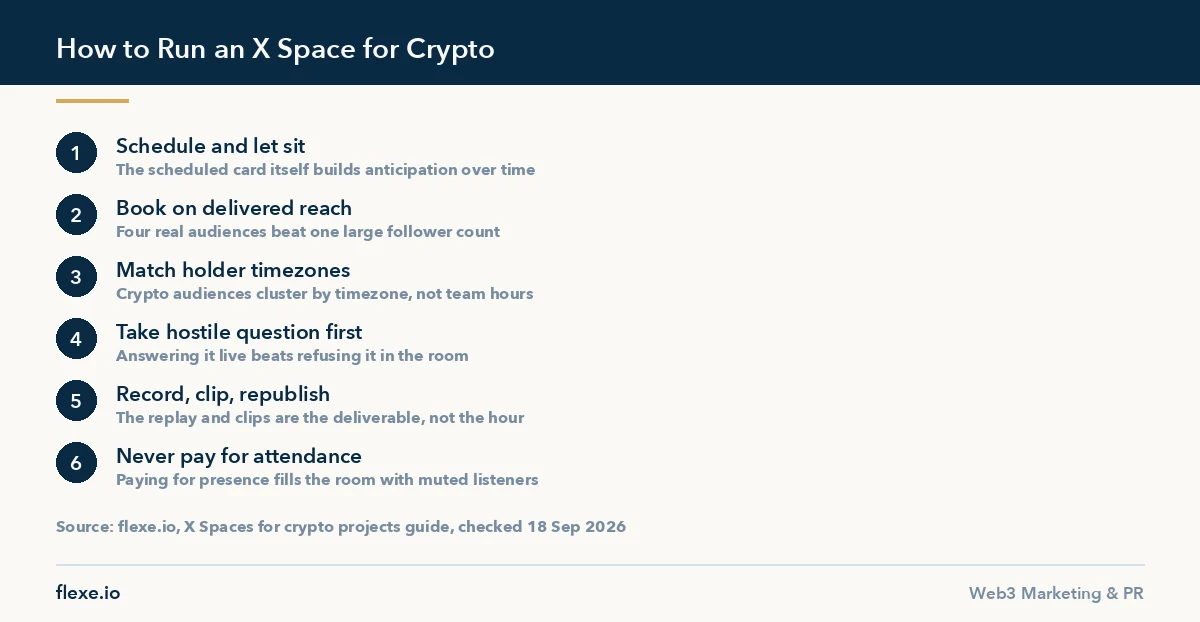
- Schedule it and let it sit. The scheduled card is itself a promotional asset that accumulates reminders.
- Book co-hosts on delivered reach, not follower count. Four genuine audiences beat one large nominal one.
- Run it at a time that matches your holders, not your team. Crypto audiences cluster by timezone as much as any other.
- Take the hostile question first. Refusing it in a live room is more damaging than answering it badly.
- Record, clip and republish. The replay and the clips are the deliverable; the live hour is the raw material.
- Never gate a reward behind attendance. Paying for presence fills the room with people who mute it.
How do you measure it?
Live listener count is the vanity figure. The measurable outputs are replay listens over the following two weeks, the number of clips produced and their individual reach, follower growth on the host account during and after, and mentions of the project by co-hosts and attendees afterwards. A Space that had 200 live listeners and produced six clips that each outperformed a normal post was a good hour.
The honest caution is that none of this attributes cleanly to revenue. Spaces build credibility and supply content; they do not convert directly, and a plan that assumes otherwise will read as a failure regardless of how well it ran.
Because the guest list is the distribution plan: how we book co-hosts.
Booking co-hosts and agreeing the format
Ask each co-host directly, in a message that states the topic, the date with the time written out in their own timezone, and the segment you want them to speak on. A vague invitation to join a Space gets accepted and forgotten. An invitation naming the part of the hour they own gets prepared for. Confirm again the day before, because a co-host who never taps the notification is an empty seat with a name attached to it.
Agree the commercial terms in writing before anything is scheduled. The deliverable is not simply appearing: it is staying for the full hour, posting the scheduled card to their own timeline in advance, resharing the replay afterwards, and answering the questions you agreed to put to them. Without those last two the booking has bought a voice in the room rather than distribution, and distribution was the reason to book anyone at all.
Vet on delivered reach rather than follower count, the same way you would for any paid placement. Ask for recent post view figures rather than reading the profile number, then compare against the pattern across our active roster, where the average account holds 102,199 followers but delivers 12,615 median views per post at a 1.74% engagement rate. An account far below that ratio brings its follower count to the guest list and nobody to the room.
Write the title of the Space so that it reads on its own. The scheduled card circulates without any context attached, so a title naming the subject and the projects appearing gets reminders set by people who have never heard of you, while a title built around a slogan gets nothing at all. The same text becomes the heading on the replay, which is what people find weeks later.
Check the calendar before fixing a slot. A Space scheduled against a large conference session or another project’s own announcement loses co-hosts and listeners at the same time, and moving it after the card has been promoted costs more attention than moving it early would have. Run it at an hour that suits where the holders are rather than where the team happens to sit.
Expect one cancellation. Book a co-host more than the panel needs, because at least one confirmed guest tends to disappear on the day without a message. The replacement should be somebody already briefed rather than whoever is awake, or the room ends up with a panel that cannot answer the questions it was assembled to answer.
What to send a co-host beforehand
A short brief with the running order, the questions you intend to put to them, and anything you would rather was not mentioned. Founders give away roadmap detail in live audio constantly and there is no editing pass afterwards. If a figure cannot be stated publicly yet, say so explicitly in the brief rather than hoping nobody raises it while the recording is running.
Decide in advance who holds the microphone controls. One person should be responsible for promoting requested speakers and removing anyone disruptive, and it should not be the person answering questions. Trying to moderate and speak at once produces the long silences that listeners read as evasion, and those silences are what the clips end up containing.
Running X Spaces for crypto on the day
Start on time and start with the news. The opening minutes hold the largest audience the room will have, and a Space that begins by introducing every co-host in turn spends that window on the least interesting material available. Say what happened, then introduce people as they speak. The introductions cost nothing later and cost a great deal at the start.
Keep a written list of the questions you expect and the answers you are prepared to give, particularly on vesting schedules and on anything an auditor has raised. Reading a prepared answer aloud is perfectly acceptable. Improvising a number in live audio is how a project ends up correcting itself in a thread the following morning, with the original still sitting in the replay.
Watch the request queue rather than the listener count. The people asking to speak are the ones most likely to post about the room afterwards, and letting a few of them up costs nothing. Screen quickly before promoting anyone: an anonymous account created that week and asking for the microphone is usually there to promote something of its own.
Pin a post to the room carrying the link you want people to open. There is no clickable surface inside the audio itself, so the pinned post and the co-hosts’ own timelines are the only routes out of the room. Say the destination aloud once as well, slowly, because a share of the audience is listening without the app in front of them.
Give the room a reason to stay past the opening stretch. A question held back from the queue, a detail saved for later in the hour, or an answer deliberately deferred all work. Announcing everything in the first minutes and then discussing it produces a room that empties while the panel is still talking, which shows up in the replay as an hour nobody finished.
When the room goes wrong
Audio drops, co-hosts disconnect, and hosts occasionally lose the room entirely. Decide in advance who reopens it and under which account, then post that plan in the group chat with the co-hosts so nobody sits waiting for instructions. A Space that dies and restarts within a minute keeps most of its listeners. One that reappears an hour later has effectively ended.
If somebody hostile takes the microphone, let them finish before answering. Cutting a speaker off is the clip that travels, and it travels without your answer attached to it. Assume any thirty seconds of the recording can be published on its own, because the recording belongs to everyone who was in the room and not to the host account.
Do not read a script for the whole hour. Live audio is difficult to fake, which is the entire reason the format carries credibility, and a monologue that could have been published as a post removes the only advantage the medium has. Prepared answers to hard questions are fine. A prepared hour is a recording nobody needed to attend.
Turning one hour into weeks of clips
Record locally as well as relying on the platform replay. Capturing the audio on the host machine leaves you with a clean file if the replay is lost or the account runs into a problem later. Transcribe the recording the same day, while the team still remembers which answers mattered and which ones only sounded good at the time.
Mark clip candidates from the transcript rather than by listening through the hour again. A clip is a question and its answer, complete in well under a minute, which makes sense to somebody who was not in the room. Anything that needs context from earlier in the recording is not a clip, however good the answer was when it was given.
Caption everything. Most of the replay audience watches muted in a feed, and an uncaptioned audio clip is a still image with nothing to read on it. Put the question on screen as text and let the answer play underneath. This is the difference between a clip that performs and one that was technically published.
Space the clips across the following weeks rather than posting the whole set the next day. The recording is inventory, and publishing it in one batch means it competes with itself. Ask each co-host to reshare the clip that features them, which is a far easier request than resharing a promotional post and is accepted much more often.
What to hand the co-hosts afterwards
Send each co-host their own clip, the replay link, a short note saying what was announced, and the date of the next room if one is planned. That package gets posted considerably more often than a bare request to share does. It also makes the next booking easier, because the account has evidence that the last appearance produced something it could use rather than an hour it gave away.
Publish the replay in a thread on the host account with a summary of what was covered and timestamps for the parts worth hearing. That thread is what an investor or a journalist opens weeks later, and it is far more useful to either of them than an hour of unlabelled audio with no indication of where anything sits.
Treat the transcript as source material for other formats. Questions the support channel receives repeatedly are usually answered somewhere in the hour, and those answers can be reused in documentation without rewriting them. A founder explaining something clearly is expensive to produce and cheap to reuse once it exists in text.
Keep a record for each Space: the co-host list, what each one actually posted, replay listens over the following two weeks, and how the clips performed against a normal post. Across several rooms this shows which accounts genuinely bring an audience. A Space with 200 live listeners that produced six clips outperforming a normal post was a good hour, and the log is what proves it.
One edge case worth planning for: if the announcement is under embargo, do not schedule the room before the embargo lifts. The scheduled card carries the title, and a title hinting at the news gives it away to anybody reading the card. Schedule with a neutral title and rename it once the news is public, or schedule late and accept a smaller live room.
Spaces work best as part of a wider account plan, so read our guide to crypto marketing on X and Twitter for the posting and reply routine around them.
Frequently Asked Questions
Are X Spaces still worth doing for crypto projects?
Yes, but for credibility and content rather than reach. The live audience is small; the value sits in the co-host association, the replay and the clips that come out of the recording.
How do you get more listeners to a Space?
Book co-hosts with genuine reach. Every co-host notifies their followers, so the guest list is the distribution plan. Promotion from a single host account rarely matches what four real co-hosts deliver.
Should you pay people to attend a Space?
No. Rewarding attendance fills the room with people who join and mute, which inflates the one number that was already the least meaningful and tells you nothing about interest.
How do you measure an X Space?
Replay listens over the following two weeks, clips produced and their reach, follower growth on the host account, and mentions afterwards. Live listener count is the weakest available signal.