Crypto influencer token picks are tokens an account names in public, and each one rests on one of four arrangements: a disclosed open-market buy, a paid fee, a vested allocation or an allocation with no lock. Telling which one you are looking at is the entire skill, whether you follow picks or pay for them, and it comes down to a handful of levers: the wallet, the disclosure, the vesting cliff, the liquidity behind the token and the account’s own history of past calls.
What Are Crypto Influencer Token Picks?
When an influencer names a token, three things could be happening: they bought it, they were paid, or they were given an allocation before anyone else. New DeFi tokens are the most heavily promoted category in crypto because the launch window is short and the incentive to move fast is enormous. The common arrangements, in ascending order of conflict:
- Bought on the open market and disclosed. The cleanest. The influencer takes the same risk as the audience and the position is verifiable on chain.
- Paid fee, disclosed. Straightforward advertising. Useful for awareness, worth nothing as a signal about the token.
- Allocation with a vesting schedule. Aligns the influencer with medium-term performance. Ask when the cliff falls, because that date predicts when the enthusiasm stops.
- Allocation with no lock. The audience is the exit. This is the arrangement behind most of the picks that collapse within days.
The practical check takes two minutes: look for the wallet, look for the disclosure, and look at what the same account promoted three months ago and what happened to it.
| Arrangement | What it tells you about the token | Risk to the audience | Question to ask |
|---|---|---|---|
| Open-market buy, disclosed | The influencer carries the same risk | Lowest of the four | Which wallet, and when did it buy? |
| Paid fee, disclosed | Nothing; it is advertising | Low if the disclosure is clear | Is the fee stated in the post? |
| Allocation with vesting | Alignment until the cliff | Rises as the cliff approaches | When does the cliff fall? |
| Allocation with no lock | The audience is the exit | Highest; most collapses start here | Why is there no lock at all? |
Crypto Influencer Token Picks: The Checks That Separate Signal From Exit Liquidity
1. Thesis Before Ticker
A pick that explains the mechanism, the competition and what would make it wrong is analysis. A ticker with a rocket is a distribution event.
- Check: does the post say what would prove it wrong?
- Red flag: a ticker, a chart and no reasoning.
2. Liquidity Relative to Audience Size
An account with 200,000 followers naming a token with a thin order book cannot be doing anything other than moving it. The maths does not allow for a genuine recommendation.
- Check: order book depth against follower count.
- Red flag: a large account and a token that trades thinly.
3. Whether They Post the Exit
Accounts that announce when they sell are rare and worth following for that reason alone.
- Check: search the account for past sell announcements.
- Red flag: entries on record, exits never mentioned.
4. Frequency of New Picks
Someone naming a new altcoin every week is running a content schedule, not a portfolio.
- Check: the number of new names per month.
- Red flag: a weekly new pick with no follow-up on the last one.
5. The Wallet, Not the Caption
A published wallet proves what it holds, not what the person holds. Anyone can show one address and trade from another, so treat a disclosed wallet as the floor of a position rather than the whole of it. What is informative is behaviour over time: an address that accumulated before the post and has not moved since is telling you something, and an address funded by the project’s own treasury is telling you something else.
Where no wallet is published, the promotion window itself is readable. Look at which larger holders appeared around the date of the post and whether those positions survived the following weeks.
- Check: when the wallet was funded, and by whom.
- Red flag: a treasury-funded address or no wallet and no answer.
6. The Account Read Backwards
Take the tokens it named over the past year, note the date of each call, and look at where those tokens sit now and whether the account ever mentioned them again. This is slower than reading the current post and it is the only check that produces a usable answer. The accounts worth following are identified by what they got wrong and acknowledged rather than by a run of posts that all appear correct because the failures were quietly removed.
- Check: a dated list of past calls and where each token sits now.
- Red flag: deleted posts about tokens that did not work.
How to Verify a Pick Step by Step
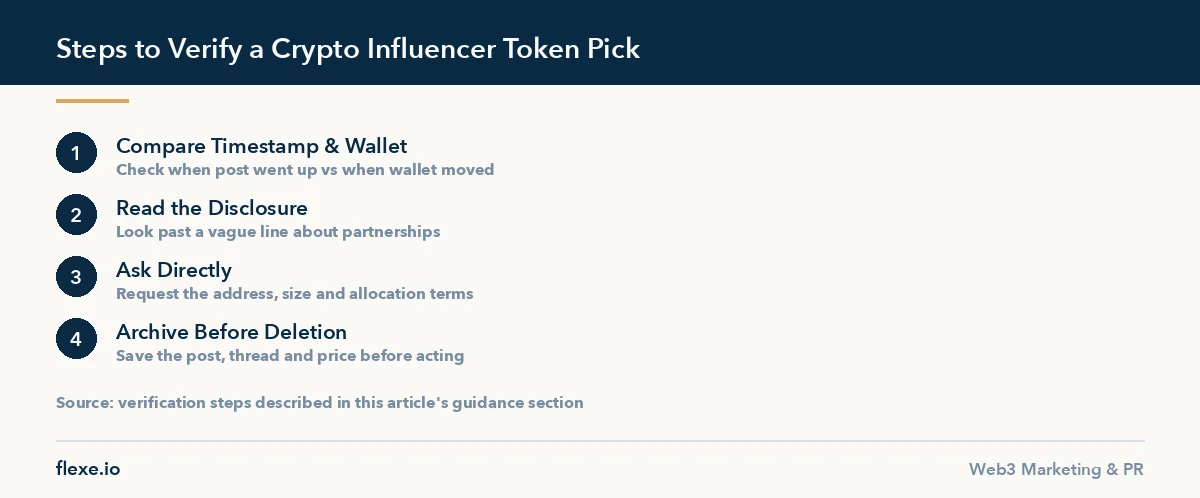
The checks above take two minutes only once you know where to look.
1. Compare the Timestamp With the Wallet
Start with the timestamp: compare when the post went up with when the wallet moved, because a position opened minutes before a public call is a different thing from one held for weeks.
2. Read the Disclosure Itself
Read the disclosure rather than noting the presence of one, since a vague line about partnerships covers a paid mention and an allocation with no lock equally well.
3. Ask Directly
Asking directly is underused. A message requesting the address, the size and the terms of any allocation takes a minute to send, and the reply, including silence, is data. An influencer unwilling to show a position in something they are recommending has answered the question.
4. Archive Before It Is Deleted
Posts about tokens that did not work have a habit of disappearing. Archive the post, the reply thread and the price at the time before you act on it or pay for it, and keep the file somewhere outside the platform. Keep the same record for accounts you decided against, since a pattern only becomes visible across several calls. This is the only way to build the history that the two-minute check depends on, since the evidence of what an account promoted three months ago is routinely gone by then.
If You Are the Project Buying the Pick
The same mechanics read differently from the other side of the table. What produces a durable result rather than a spike:
- Vest the allocation past your own milestones. An influencer who can sell on day two will, and their audience watches the wallet.
- Pay for the thesis, not the mention. Ask for a written rationale you can both stand behind. It costs more and survives scrutiny, which a ticker post does not.
- Match liquidity to audience. Sending a large audience into a thin book creates a candle and a crowd of angry holders. Depth first, promotion second.
- Insist on disclosure. Undisclosed promotion is a legal exposure for you as well as for them. Disclosed picks from credible accounts outperform hidden ones.
Related: crypto KOL marketing covers rates and contracts, brand partnerships covers longer-term arrangements, and token marketing covers the launch itself.
Partner selection is where most of the time goes. We keep the shortlists and the relationships: crypto influencer campaigns, a vetted crypto influencer lists built to brief, and paid consultation if you would rather build the list yourself and have it checked.
Picking the accounts is the part that decides the outcome, and follower counts will not tell you which ones deliver. If you would rather hand that over, our crypto influencer marketing team screens every account for bought engagement before it enters a campaign. For a ranking of the accounts themselves rather than their picks, see our top crypto influencers list.
How to Measure Results After the Post
Decide what you are measuring before the post goes up, because afterwards the numbers arrive already contaminated. For a project, the useful measurements are holders rather than price, the survival of those holders a week later, and whether the audience arriving from that account behaves differently from everyone else. Price during the promotion window tells you about liquidity and very little about the campaign.
Decide who does the measuring too. A report assembled by the account being paid, or by the agency that booked it, will be accurate and incomplete in the same predictable direction. Keep the collection on your side even where the booking is handled elsewhere, and agree at the start which numbers both parties will treat as final.
What to Capture and When
Take a reading immediately before publication, then at fixed intervals afterwards rather than at moments that happen to look interesting. Capture the post metrics, the holder count, the depth of the order book and the volume, and note anything else that happened that day, since a listing, a scheduled token release or a broad market move will otherwise be credited to the post.
Give every account its own tracked link, built before the brief goes out. That is the only clean read available, and it will still be a floor rather than a total, because a meaningful share of the audience searches the name later instead of clicking anything at all. Keep a comparison window of equal length from before the campaign started. Without it every reading looks like a result, and a token that was already gaining holders will make a weak post look effective. It also shows the opposite case, where a post worked and a falling market hid it.
Reading the Price Action Honestly
A candle on the day of a post is the easiest thing to produce and the least informative. What matters is where the token sits once the initial reaction has cleared and whether the holders added during that window are still there. A spike that fully retraces within days delivered attention to people who are now down on the position, which is worse for the project than no post at all.
If the price moved and the holder count barely did, the audience traded rather than joined. That is a fair outcome to buy deliberately and an expensive surprise to buy by accident, and which one you get is decided mostly by the account you chose rather than by what they wrote. Write the reading down while the campaign is still fresh, with the account name, the date, the figures and what you would do differently.
When a Pick Goes Wrong
Assume that at some point one will. The response matters more than the incident, because the audience watching learns what kind of project you are from what you do in the following days rather than from the original post. Write the escalation path down while nothing is happening, including who speaks publicly and who does not.
If the booking came through an agency or a network, tell them the same day and in writing. They hold the relationship and the remaining payments, and they are the ones who can stop a second post from going out while the first is still being argued about.
If the Account Sells Early
Check the vesting terms you wrote before saying anything publicly, because an accusation that turns out to describe a permitted sale is unrecoverable. If the terms were breached, raise it privately first with the dates and the evidence, then decide whether the public version is worth the fight. If the terms allowed it, the failure was in the contract and the lesson belongs to the next one. Either way, stop any further payment attached to that account immediately and say nothing you cannot support with a transaction. The audience can read the chain as well as you can, and a project that describes the situation plainly keeps more credibility than one that goes quiet and hopes the thread dies.
If Your Community Turns on the Post
Sometimes the objection is to the account rather than to the token, and that is worth hearing. Answer in the thread rather than removing it, name the arrangement, and state what the allocation terms are. Communities forgive a disclosed payment far more readily than a discovered one, and the disclosure costs nothing at the point where the argument is already happening.
If the account turns out to have a history you did not check, the honest move is to say so and to explain what has changed in the selection process.
Frequently Asked Questions
Do crypto influencers get paid to promote tokens?
Yes, frequently, and the arrangement matters more than the fact. A disclosed fee is straightforward advertising and says nothing about the token. An allocation with a vesting cliff tells you when the enthusiasm will stop. An allocation with no lock means the audience is the exit, which is the arrangement behind most picks that collapse within days.
How do you tell a genuine altcoin pick from exit liquidity?
Look for a thesis rather than a ticker. Then check whether the token’s liquidity could absorb that audience at all, see whether the account ever posts its exits, and count how often it names something new. A weekly new pick is a content schedule, not a portfolio, and a ticker with a rocket is a distribution event.
How can you check if an influencer holds what they promote?
Look for a published wallet, then compare when it moved with when the post went up. Many accounts publish theirs, but a disclosed wallet is the floor of a position, not the whole of it. Where no wallet is public, on-chain analysis around the promotion window often shows the pattern, and asking directly for the address and terms is underused.
Are crypto influencer token picks worth following?
As a source of ideas to research, sometimes. As a reason to buy, almost never. The accounts worth watching are the ones that publish their reasoning, their position and their exits, and those are a small minority. Read what an account named over the past year and where those tokens sit now before you trust the next call.
When do influencer-promoted tokens usually fall?
Most often around the point where an allocation with no lock, or a newly vested one, becomes sellable. That is why the vesting cliff is the single most useful thing to ask about before following or funding a pick. The date the cliff falls predicts when the enthusiasm stops, and it is usually written in a contract the audience never sees.
Need Help Picking the Right Influencers?
Follower counts are the least useful number on a media kit. If you have a list of candidates and want them checked for real engagement before you pay anyone, send it over.